Home · The Ordane Journal · Rules and mechanics · The 4% Drawdown Rule in Prop Firms, Explained
The 4% Drawdown Rule in Prop Firms, Explained
The 4% drawdown rule in prop firms is a maximum total loss limit: you may lose up to 4% of your initial account balance before the account is breached. On a $25,000 evaluation account, the account closes when total loss reaches $1,000, which leaves a floor at $24,000. Profit targets, payout schedules and platform fees are separate rules.
Ordane accounts operate on simulated capital. No live funds are traded and no deposits are accepted. Payouts depend on simulated performance under Rulebook v1.4; no level of performance is typical or assured.
Ordane sells one product, the Ordane Instant Account: direct access, no evaluation phase and no challenge, on simulated capital. This article is for information only and is not investment, financial, or tax advice.
What is the 4% drawdown rule in prop firms?
The 4% drawdown rule is a maximum total loss condition: it fixes how much simulated capital you may lose before the firm closes the account. The percentage itself is simple; the mechanics behind it are not, because three separate variables decide how much room that 4% actually gives you.
4% of what: account size, balance or equity
The first variable is the calculation base. Some firms measure drawdown from your account balance, the closed-trade figure, while others include floating profit and loss (equity). If the rule is equity-based and a trade moves $800 against you intraday, you can sit dangerously close to the line even if you close at breakeven; if it is balance-based, only realized losses count.
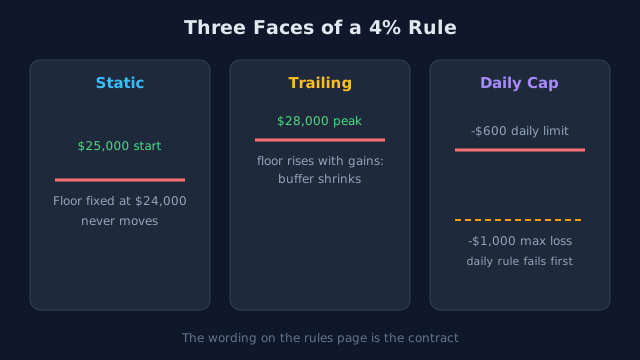
The second variable is measurement timing, and it is where an EOD drawdown differs from an intraday or a trailing drawdown. An EOD (end-of-day) drawdown is measured against your balance at the daily close: intraday swings below the floor are tolerated as long as you finish the day above it. An intraday drawdown counts floating losses in real time, so a deep excursion can breach you even if you recover by the close. A trailing drawdown follows your highest balance, while a static floor never moves from the initial level. Lucid publishes an EOD drawdown type; Apex's live 25K selection lists an Intraday Trail type.
| Drawdown variant | When it is measured | How the floor moves |
|---|---|---|
| Static | against the initial balance | never moves |
| Trailing | follows your highest balance | rises as your balance grows |
| EOD, end-of-day | at the daily close | holds at the level of the last close |
| Intraday | in real time during the session | enforced immediately |
How 4% converts to dollars at each account size
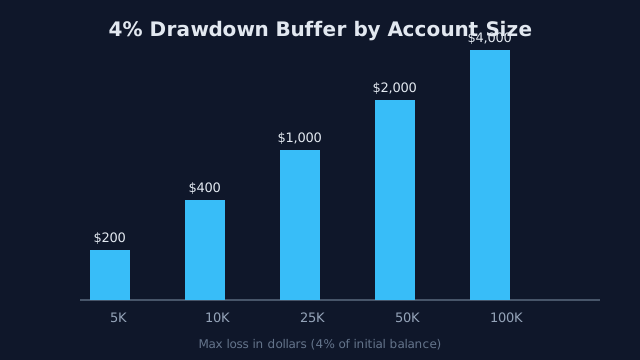
The third variable is scale: the same percentage buys a different dollar buffer at each size. Declared inputs for this conversion: a flat starting balance and 4% of it, so 25,000 × 0.04 = 1,000 on the 25K tier.
| Account size | 4% max loss in dollars | Balance floor |
|---|---|---|
| 5K | $200 | $4,800 |
| 10K | $400 | $9,600 |
| 25K | $1,000 | $24,000 |
| 50K | $2,000 | $48,000 |
| 100K | $4,000 | $96,000 |
The verified 25K terms in this article carry exactly that $1,000 maximum loss. A payout can reset the floor mid-cycle, which changes the arithmetic; see what a payout does to your drawdown for that case.
How real prop firms apply a 4%-type max loss today
Two verified terms show how differently firms treat the same headline percentage: Apex's live 25K selection lists a $1,000 max drawdown under an intraday trail type, while Lucid stacks a $600 daily loss limit under a $1,000 EOD max loss on the 25K PRO tier. Both firms publish these rules, and knowing how to audit a prop firm rules page catches the difference before you pay.
Apex 25K: $1,000 max loss, intraday trail drawdown
Apex's live 25K selection lists a Max Drawdown of $1,000 with Drawdown Type "Intraday Trail" (Apex Trader Funding, retrieved 2026-10-06). An intraday trail combines the tighter behaviors: the floor is evaluated continuously during the session and follows your highest balance, so profits raise it. The same page lets you select other types, including an EOD trail, so the type that governs your account is the one selected at purchase: re-check it on the rules page before checkout.
Lucid 25K PRO: $600 daily limit plus $1,000 max loss
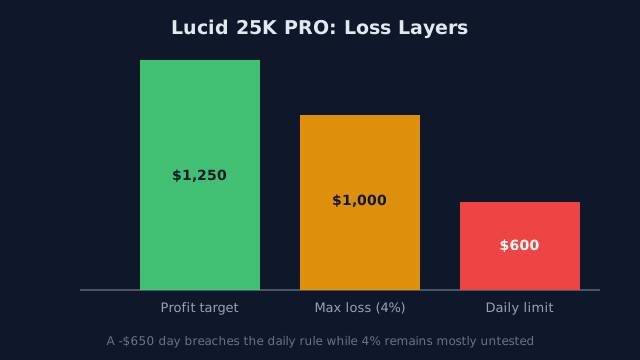
Lucid 25K PRO has a $600 daily loss limit and a $1,000 max loss, both under an EOD drawdown type: the rules list "Daily Loss Limit $600" (Lucid Trading, retrieved 2026-10-06). The daily cap ($600) is tighter than the maximum loss ($1,000). Our guide to the daily loss limit breaks down which balance it is measured against.
Why the daily limit is stricter than the 4% total
The daily rule is stricter because it binds first. On the Lucid figures, one day of -$500 stays inside the $600 daily cap and consumes $500 of the $1,000 total; a second day of -$500 is still allowed by the daily cap but takes the cumulative loss to $1,000, which breaches the maximum. A single day of -$650 breaches the daily limit immediately, even though only 65% of the total buffer is gone. The 4% headline never gets tested alone: the tighter layer fails you first.
What does breaching the 4% limit cost you: account, buffer and payout?
Breaching the 4% limit costs three things at once: the account itself, the remaining loss buffer and any profit not yet paid out. The mechanics of what happens when you breach a prop firm account are covered elsewhere; here the focus is cost.
The remaining loss buffer as your real risk budget
The drawdown already consumed is the part of the budget you do not get back. On a 25K account with a $1,000 max loss, a trader sitting at -$400 realized has $600 left as the real risk budget, and every new position must be sized against that remainder, not against the original $1,000. If the account does close, an account reset versus a new account is a cost decision worth making before paying again.
Unpaid profit and the 100% payout split the rule protects
What the trader still earns by remaining inside the limit is defined by the payout policy, not by the drawdown. Apex pays 100% of profits on the performance account, listed as "Payout Split None - 100%" (Apex Trader Funding, retrieved 2026-10-06). That is the trade in concrete terms: the drawdown decides how long the account lives, the split decides what leaves it. Stay inside the loss limit and accrued profit remains payable under conditions such as consistency rules and the prop firm withdrawal requirements; breach it and that profit is typically forfeited. The prop firm profit split and the drawdown are two separate rules, and a 100% split only matters while the account is alive. When a payout is delayed or refused, what to do when a prop firm denies your payout is a separate playbook.
What it costs to play by the 4% rule and the risk you accept
Playing by the 4% rule has a monetary cost and a constraint cost. The monetary cost: a breach forfeits accrued profit pending payout, all 100% of it on the Apex split verified above, plus the fee paid for the account. The constraint cost: with a $1,000 max loss and a $600 daily cap, staying inside caps what any single day may risk, forcing smaller positions in exchange for survival. The rule protects the simulated balance inside the account, not the real money outside it, and it coexists with prop firm hidden fees rather than replacing them; the total financial exposure of a prop firm trader is bigger than the buffer alone.
A worked illustration with declared inputs, not any firm's quote: an account fee of $100, a breach with $300 of profit pending payout. That breach costs $400, fee plus forfeited profit, after a simulated loss that ate the $1,000 buffer; surviving to payout turns the same $100 fee into a collected payout.
Sizing positions so a normal losing day stays inside the limit
Declared inputs for a worked example: a $600 daily loss limit, a $1,000 max loss, and a strategy whose normal losing day is three stops of $150 each. Three stops make -$450 for the day, inside the $600 daily cap, and the same day consumes 45% of the total $1,000 buffer. Two more days like that and the maximum loss is gone: plan the daily budget and the total budget together, sizing to the tighter limit. When the tier itself is the question, the trade-offs are covered in the guide to choosing a prop firm account size.
CFTC risk warning on leveraged markets
Whatever the drawdown model, the underlying market risk does not change. The CFTC warns the leveraged forex market is volatile and carries substantial risks (CFTC Customer Advisory, retrieved 2026-10-06). A 4% buffer limits the simulated loss inside the account; it does not remove the risk of losing the fee or the market risk taken while trading.
FAQ: 4% drawdown rule in prop firms
What is the 4% drawdown rule in prop firms?
The 4% drawdown rule is a maximum total loss limit: you may lose up to 4% of your initial account balance before the account is breached. On a $25,000 evaluation account, the account closes when total loss reaches $1,000. Apex's live 25K selection lists a $1,000 max drawdown under an intraday trail type.
Is the 4% drawdown rule static or trailing?
It depends on the firm. A static floor stays at 4% below the initial balance, a trailing floor rises as your balance grows, and an EOD drawdown is measured at the daily close. Lucid publishes an EOD drawdown type while Apex's live 25K selection lists an intraday trail, so the type varies by firm. Check the firm's rules page for the exact wording before paying.
What balance is the 4% drawdown measured from?
Ideally the initial balance, held static. Some firms calculate drawdown from account balance rather than equity, so open-trade swings do not consume the buffer while positions are live; equity-based variants are tighter because floating losses count toward the limit. The Apex and Lucid 25K terms verified here both quote the maximum loss in dollars, $1,000 on a $25,000 account.
How much is the 4% drawdown rule in dollars on each account size?
On a flat starting balance, 4% translates as follows: 5K equals $200, 10K equals $400, 25K equals $1,000, 50K equals $2,000, and 100K equals $4,000. The verified Apex and Lucid 25K tiers both carry the $1,000 maximum loss.
Can a daily loss limit breach you before the 4% drawdown rule does?
Yes. Lucid 25K PRO has a $600 daily loss limit against a $1,000 max loss, so the daily cap can fail you while most of the 4% buffer remains untouched. A single bad day of -$650 can end your day or your account even inside your total allowance.
Does a stricter drawdown rule make my payout safer?
No. Payout safety lives in the firm's payout policy, not in the loss limit. A breach typically closes the account and forfeits unpaid profit, and payouts are governed by separate conditions such as minimum trading days, consistency rules, and profit split percentages.
Sources
- Apex Trader Funding apextraderfunding.com Retrieved 2026-10-06.
- Lucid Trading lucidtrading.com Retrieved 2026-10-06.
- CFTC Customer Advisory cftc.gov Retrieved 2026-10-06.