Home · The Ordane Journal · Payouts · Prop Firm Denied Your Payout: What to Do First
Prop Firm Denied Your Payout: What to Do First
Ordane accounts operate on simulated capital. No live funds are traded and no deposits are accepted. Payouts depend on simulated performance under Rulebook v1.0; no level of performance is typical or assured.
Ordane sells one product, the Ordane Instant Account: direct access, no evaluation phase and no challenge, on simulated capital.
ESMA's product-intervention notice states that CFDs are complex instruments and come with a high risk of losing money rapidly due to leverage (ESMA, retrieved 2026-08-10). That instrument-risk frame is independent of any prop-firm marketing page.
A prop firm payout denial is a written refusal, indefinite hold, or silence following a withdrawal request, and the reason the firm gives determines which of four dispute routes stays open.
In one sentence: Export your account data first, get the denial reason in writing, classify it into one of four buckets, then escalate in the order that keeps every later option open.
Payouts depend on simulated performance under Rulebook v1.0; no level of performance is typical or assured.
Is Your Case Denied, Stalled, or Reversed?
The 40-word answer: if a prop firm denied, stalled, or stopped replying to a payout you requested, export your account data now, get the reason in writing, classify it into one of four buckets, and escalate in the order that keeps every later option open. Do not argue first.
Three cases, three different articles, one screen to sort yourself into
There are three situations that get lumped together as "the firm didn't pay me," and each one has a different fix:
If your firm has said no, said "under review" with no end date, or stopped answering entirely, stay here.
What this article does not cover
This is not legal advice, and it does not cover chargebacks or disputes with a regulated broker holding real client funds. It also does not cover a payout that already landed and was later pulled back, which is a reversal, not a denial, and follows a different evidence trail.
Why the written reason is the only thing that matters in hour one
The instinct after a denial is to reply immediately and make your case. That is the mistake. In hour one, nothing you write changes the outcome, because the firm has already decided and stated a reason, or has not stated one yet. What hour one actually determines is whether you still have access to the evidence that proves your side, because a dispute reply can be the trigger that closes the account and removes that access for good.
The mistake that costs the case: replying before exporting
Every artifact you might need, trade history, platform logs, dashboard screenshots, in-app chat, lives behind a login the firm controls. None of it is guaranteed to still be there tomorrow. Exporting first is not paranoia, it is the only action in this whole process that cannot be undone later if it is skipped now. Once you have the export, replying costs you nothing. Skip the export and reply first, and you may be arguing from memory about a screen you can no longer open.
What Are the Four Reasons a Payout Gets Held?
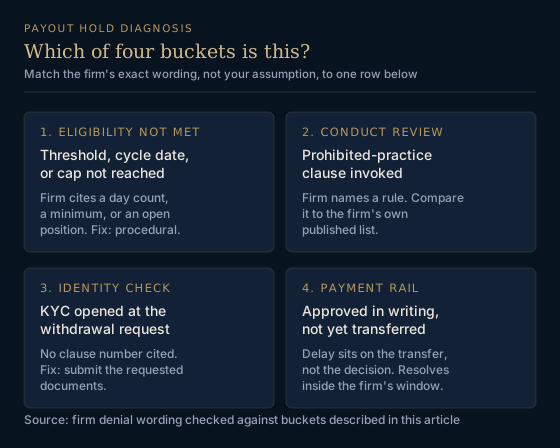
A payout hold or denial almost always falls into one of four buckets, and each bucket has its own route and its own deadline. Read the firm's own wording back against these four before deciding what to do next.
Conduct review: a prohibited-practice clause was invoked
This is the bucket where the firm names a specific rule, usually from its prohibited-trading-strategies or prohibited-conduct list, and states that the payout is held or denied because of it. If the denial names a specific practice, get the exact clause number and compare it to the firm's own published list. If the practice named is not on that published list, you have grounds to say so, in writing, calmly.
Identity check: KYC opened at the withdrawal request
Some holds are not about trading conduct at all. The firm may open an identity verification step triggered specifically by the withdrawal request, independent of anything you did on the account. If the message references documents, identity verification, or "compliance review" with no clause number attached, this is a KYC hold, not a conduct denial, and the fix is submitting the requested documents, not arguing a rule.
Table 1: What Two Named Firms Publish About Payout Review
Both rows are drawn from each firm's own published policy pages, not from an industry-wide estimate. Where a figure is not published, the cell says so rather than guessing.
| Field | FTMO | Topstep |
|---|---|---|
| Stated review window | 1 to 2 business days after the withdrawal request (FTMO FAQ, retrieved 2026-08-05) | Payouts on Topstep's live product reviewed every Monday morning, funds deposited within 1 to 2 business days of review (Topstep Help Center, retrieved 2026-08-09) |
| Eligibility gate before request | First reward claim available on day 14 or later from the first placed trade; all open positions and pending orders must be closed (FTMO FAQ, retrieved 2026-08-05) | Five winning days of $150+ net profit each, plus positive net profit since the last payout (Topstep Help Center, retrieved 2026-08-05) |
| Instant-payout speed claim | Not published on this page | Most approved payouts delivered in under 9 seconds on average; some payouts require additional review before being sent (Topstep, retrieved 2026-08-09) |
The Evidence File, and the Moment Each Item Expires
The single most useful thing to understand about a payout dispute is that not every piece of evidence has the same shelf life. Some of it disappears the moment the firm closes your account. Some of it survives forever because it lives outside the firm's system entirely.
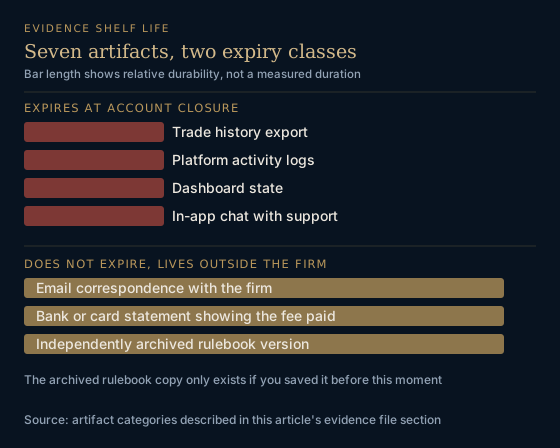
Table 2: Seven Artifacts and When Each Stops Being Obtainable
| Artifact | Where it lives | When it expires |
|---|---|---|
| Trade history export | Behind your platform login | The moment the account is closed or access is revoked |
| Platform activity logs | Behind your platform login | The moment the account is closed or access is revoked |
| Dashboard state (balance, cycle dates, status) | Behind your platform login | The moment the account is closed, or the next cycle overwrites the view |
| In-app chat with support | Behind your platform login | The moment the account is closed or the chat history is purged |
| Email correspondence with the firm | Your own inbox | Does not expire; survives account closure |
| Bank or card statement showing the fee paid | Your own bank or card record | Does not expire; survives account closure |
| Independently archived copy of the rulebook version you bought under | Wherever you archived it | Does not expire, but only exists if you archived it before this moment |
Why an export beats a screenshot
A screenshot proves what a screen looked like at one moment, taken by you, with no record of when or how. An export is a file the platform generates, timestamped, structured, and harder to dismiss as selectively cropped. When a dispute turns on what a dashboard showed on a specific date, the export is the version worth having, and it is worth generating everything exportable in the first hour, before any reply goes out, precisely because it is the one item on the list you can only get while the account is still open.
How to Escalate Without Closing Your Own Account
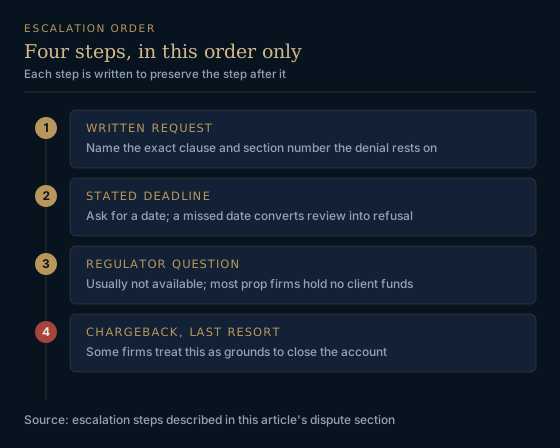
Each step below is written to preserve the step after it. Skipping the order forecloses options you may need.
Step 1: a written request naming the exact clause and section number
Ask, specifically, which clause and section number the denial rests on. A firm that cannot or will not answer this has effectively conceded there is no written basis for the denial. A firm that answers has given you something concrete to check against its own published list.
Step 2: a stated deadline, and what to do when it passes
Ask for a date by which the review will conclude or the payment will be sent. If that date passes with no answer, that silence is itself useful: it converts an ambiguous "under review" into something closer to a refusal, and it is the point at which escalation becomes reasonable rather than premature.
What Ordane Commits to When It Says No
Ordane is new. There is no payout history to point to yet, and none is manufactured here. What is written into the rulebook is a specific, dated commitment for what happens when a payout is refused or delayed.
Denial in writing, citing the rule by section number, within 24 hours
Every withdrawal request is approved, or denied in writing citing the exact rule breached by section number, within 24 clock hours. Past that deadline the request is treated as approved and the G-1 clock starts. (Ordane Rulebook v1.0, retrieved 2026-08-09) This is the direct answer to the wording problem raised earlier in this article: a trader dealing with Ordane never has to guess whether a hold is a review or a refusal, because The Ordane Guarantee removes the open-ended "under review" state after 24 hours by converting silence into approval.
What happens when the clock runs out
A payout approved and not paid within 48 clock hours, not business hours, triggers automatic compensation: a 100 percent refund of the account fee, plus the payout owed in full. (Ordane Rulebook v1.0, retrieved 2026-08-09) The Ordane Guarantee carries two objective exclusions, documented fraud or KYC review, and declared force majeure, both capped at 10 business days each, past which the standard penalty applies regardless. (Ordane Rulebook v1.0, retrieved 2026-08-09) The full text is published in Ordane Rulebook v1.0.
Worked payout-review arithmetic
Declared inputs for this check only: request filed day 0; firm review window 10 business days; calendar span 14.
| Input | Value | Arithmetic |
|---|---|---|
| Review window | 10 | Declared |
| Calendar span | 14 | Declared |
| Overrun | 4 | 14 - 10 = 4 |
Arithmetically: 14 - 10 = 4 calendar days past a 10-business-day window under these declared inputs.
For related published reading, see overnight and weekend holding rules, trading costs against drawdown, news trading restrictions, how to save prop firm rules before paying.
Questions traders ask after a payout is denied
How long can a payout stay "under review" before it is a refusal?
There is no single industry number, and this article does not invent one. What is published varies by firm: FTMO commits to a review and notification within 1 to 2 business days of a withdrawal request (FTMO FAQ, retrieved 2026-08-05), while payouts on Topstep's live product are reviewed every Monday morning with funds deposited within 1 to 2 business days of that review (Topstep Help Center, retrieved 2026-08-09). Check your firm's own published window rather than assuming one.
What if the firm simply stops replying?
Silence past a firm's own stated review window is functionally a refusal, even without a formal denial letter. At that point, escalate using the written record you built in Step 1 and Step 2 above, since your export and your dated request emails are what establish that the window was missed.
Can a firm pay part of a payout and hold the rest?
Some firms structure payouts this way by policy, not as a denial. Topstep's payout policy caps each payout request at 50 percent of the account balance up to a per-tier cap (Topstep Help Center, retrieved 2026-08-09), meaning a trader with a larger balance receives the full amount across multiple requests rather than one withdrawal. Check whether a partial payment matches a published cap before treating it as a denial of the remainder.
Is a denial ever reversed?
Published policies describe the review and appeal mechanics available, not outcomes or odds, and this article does not predict how often a denial gets overturned. What matters procedurally is whether the firm's own written policy allows a reconsideration path once a clause and section number are known, which is exactly the information Step 1 is designed to surface.
Does opening a chargeback end my account?
Not automatically, but it can, depending on the firm. Topstep's published refund policy states that excessive or unjustified chargebacks may result in account suspension or permanent removal from the program (Topstep Help Center, retrieved 2026-08-05). Treat a chargeback as a step that can close the account before it recovers anything, and use it last, once every written escalation route has already failed.
Questions traders ask after a payout is denied
How long can a payout stay "under review" before it is a refusal?
There is no single industry number, and this article does not invent one. What is published varies by firm: FTMO commits to a review and notification within 1 to 2 business days of a withdrawal request, while payouts on Topstep's live product are reviewed every Monday morning with funds deposited within 1 to 2 business days of that review. Check your firm's own published window rather than assuming one.
What if the firm simply stops replying?
Silence past a firm's own stated review window is functionally a refusal, even without a formal denial letter. At that point, escalate using the written record you built in Step 1 and Step 2 above, since your export and your dated request emails are what establish that the window was missed.
Can a firm pay part of a payout and hold the rest?
Some firms structure payouts this way by policy, not as a denial. Topstep's payout policy caps each payout request at 50 percent of the account balance up to a per-tier cap, meaning a trader with a larger balance receives the full amount across multiple requests rather than one withdrawal. Check whether a partial payment matches a published cap before treating it as a denial of the remainder.
Is a denial ever reversed?
Published policies describe the review and appeal mechanics available, not outcomes or odds, and this article does not predict how often a denial gets overturned. What matters procedurally is whether the firm's own written policy allows a reconsideration path once a clause and section number are known, which is exactly the information Step 1 is designed to surface.
Does opening a chargeback end my account?
Not automatically, but it can, depending on the firm. Topstep's published refund policy states that excessive or unjustified chargebacks may result in account suspension or permanent removal from the program. Treat a chargeback as a step that can close the account before it recovers anything, and use it last, once every written escalation route has already failed.
Sources
- Ordane Rulebook v1.0 Retrieved 2026-08-09.
- CFTC Press Release 8771-23 (full text mirror) Retrieved 2026-08-09.
- Customer Advisory: Understand the Risks of Virtual Currency Trading | CFTC Retrieved 2026-08-10.
- FTMO FAQ Retrieved 2026-08-05.
- FTMO FAQ, How do I withdraw my reward? Retrieved 2026-08-05.
- Notice of product intervention decisions on CFDs and binary options | ESMA Retrieved 2026-08-10.
- Quinn Emanuel, Historic Rule 11 Dismissal and Fee Victory Against the CFTC Retrieved 2026-08-09.
- Topstep Help Center, Live simulated account Parameters Retrieved 2026-08-09.
- Topstep Help Center, Refund Policies Retrieved 2026-08-05.
- Topstep Help Center, Topstep Payout Policy Retrieved 2026-08-05.
- Topstep, Instant Payouts page Retrieved 2026-08-09.