Home · The Ordane Journal · Risk and Exposure · Can You Lose Money With a Prop Firm? Your Real Exposure
Can You Lose Money With a Prop Firm? Your Real Exposure
With a prop firm account on simulated capital, a trader never trades personal money and cannot be billed for a loss: the account's balance is simulated, not a live deposit, so a breach simply closes it. The maximum exposure at a fee-only prop firm is the one-time fee paid to buy the account.
Ordane accounts operate on simulated capital. No live funds are traded and no deposits are accepted. Clause P-2 of the Ordane Rulebook v1.0 requires that declaration in every piece of Ordane communication (retrieved 2026-07-29), and that one fact reframes the whole risk question, from how much the market can take to whether a single fixed fee is worth the attempt.
The short answer: your exposure is the fee, not the market
A prop firm sells access to a test on simulated capital, not a brokerage account holding your own deposit. You never place your own money in the market, so a losing trade cannot turn into a debt you owe. The one-time fee you pay to attempt the account is the whole of your financial exposure.
That definition holds across the category, not just at Ordane. In a prop firm evaluation, firms place traders on simulated, or demo, accounts that mirror real market conditions instead of committing live funds (Spotware, retrieved 2026-07-29). On that kind of account the trader is not depositing margin like a retail broker client, and the only upfront risk is the evaluation fee (Alpha Capital Group, retrieved 2026-07-29).
Why simulated capital changes the risk question
In a live retail account, the money in the market is yours. A bad run draws down your own balance, and a big enough one can take all of it. On simulated capital the position is not real, so the same bad run draws down a number the firm tracks against its rules, not the cash in your bank. The market can end your attempt. It cannot reach your wallet. What you risk was decided once, at checkout, and it does not grow while you trade.
Can a prop firm ever make you cover a loss?
Here is the mechanism, not the reassurance, because the mechanism is what you can verify. On a simulated account there is no live position for you to be short, so there is nothing for the firm to bill back to you. When you breach a loss rule, the account closes. It does not open a debt. The firms' own documents put that model in writing. FTMO's FAQ states that all accounts it provides to clients are demo accounts with fictitious funds and any trading is in a simulated environment only (FTMO FAQ, retrieved 2026-07-29). Ordane's Rulebook makes the same declaration in clause P-2 (Ordane Rulebook v1.0, retrieved 2026-07-29).
There is one honest exception, and it is the reason to check the terms before you pay. The answer stops being true at any firm whose contract puts more than the fee at risk: one that takes a refundable deposit as a risk contribution you can lose, or one with a loss-sharing, negative-balance, or indemnity clause that makes you responsible for a shortfall. Exceptions can exist, so a trader should read the agreement and confirm it states they will not be responsible for the firm's funds and will owe nothing if they lose them (EarnForex, retrieved 2026-07-29).
So before you buy anywhere, search the terms for four words: "deposit", "liability", "indemnify", and "negative balance". If none of them attach an obligation to you, the fee is the ceiling. If one of them does, that firm has changed the answer, and you now know exactly where.
What one attempt actually costs you
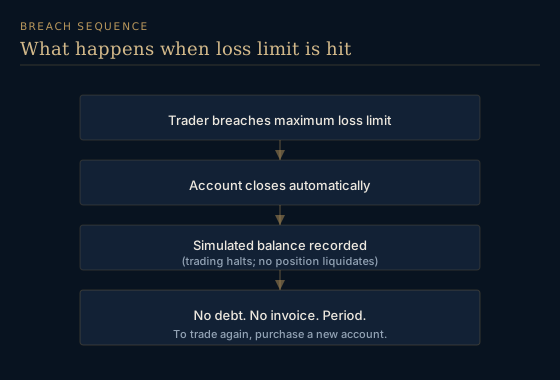
Turn the fear into arithmetic. Buy an account, trade it, and hit the loss limit on day two. Three things happen: the fee is spent, any simulated profit you had not yet withdrawn is forfeited with the account, and nothing further is owed. No one can invoice you for the drawdown.
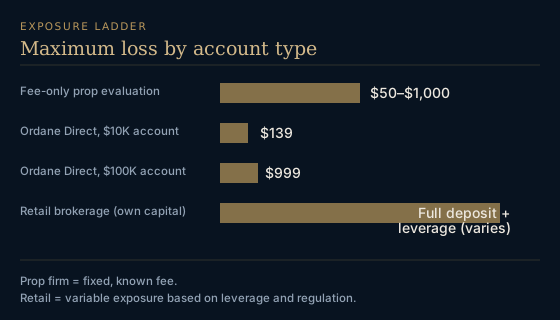
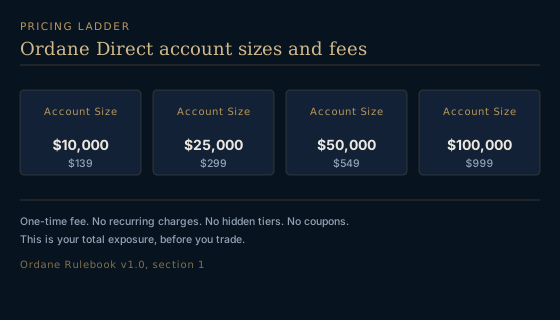
Prop firm evaluation fees in 2026 typically run from about $50 for small accounts to about $1,000 for large accounts, an estimate published on the blog of Alpha Capital Group, itself a prop firm (retrieved 2026-07-29). Ordane's one-time fee ranges from $139 for the $10,000 account to $999 for the $100,000 account, with no recurring fees, per Ordane Rulebook v1.0, section 1 (retrieved 2026-07-29). Take the smallest account: your worst case is $139, and you knew it before the first trade.
Now trade the same $10,000 in a retail brokerage account that is genuinely yours. A total loss there is $10,000 of your own money, and whether leverage can push the bill past the deposit depends on where the account sits. Regulators in the UK, Australia and the EU require negative balance protection on retail CFD accounts, a guaranteed limit that stops a retail client's loss at the funds in the account. The UK rule is the FCA's permanent CFD restrictions and the Australian rule is ASIC's product intervention order (both retrieved 2026-07-29). In the EU the protection now rests on the permanent national measures that national regulators adopted after ESMA's temporary 2018 order lapsed, a framework ESMA confirmed still in force in a statement dated 2026-02-24 (retrieved 2026-07-29). Where no such rule applies, a leveraged loss can run past the deposit. The prop-firm structure trades that jurisdiction question for a fixed, published entry price. The fee is your exposure, but it is not the full cost of getting and keeping an account. Activation, data, and platform charges sit elsewhere, and a full breakdown of prop firm hidden fees maps every one, so this page does not re-list them.
Maximum loss by account type
| Account type | What is exposed | Maximum loss |
|---|---|---|
| Fee-only prop firm evaluation, category-wide | One-time evaluation fee only | About $50 to $1,000, by account size (Alpha Capital Group's own blog estimate, retrieved 2026-07-29) |
| Ordane Instant Account, $10,000 account | One-time fee only, no deposit taken | $139 (Ordane Rulebook v1.0, section 1, retrieved 2026-07-29) |
| Ordane Instant Account, $100,000 account | One-time fee only, no deposit taken | $999 (Ordane Rulebook v1.0, section 1, retrieved 2026-07-29) |
| Retail brokerage account, own capital | Deposited capital, plus any leverage | Full deposit; more than the deposit only where negative balance protection is not required. Retail CFD accounts are protected in the UK (FCA) and Australia (ASIC), and in the EU by permanent national measures adopted after ESMA's 2018 order (all retrieved 2026-07-29) |
| Firm with a refundable-deposit or loss-sharing clause | Fee plus the deposit or shortfall the clause names | Not capped at the fee; read the contract |
What Ordane puts at risk, and what it does not
The concession comes first, because proof without it is just another pitch. Ordane is new and has no payout history. There is nothing to show yet, and no payout history will be manufactured (ordanemarkets.com, payout ledger section, retrieved 2026-07-29). Ordane is operated by Ordane Markets Ltd (in formation) (ordanemarkets.com, retrieved 2026-07-29). Read what follows against that, not around it.
What is verifiable today is the exposure. Ordane sells one product, the Ordane Instant Account: direct access, no evaluation phase and no challenge, on simulated capital. That is Ordane Rulebook v1.0, section 1 (retrieved 2026-07-29). No deposit is taken, so the one-time fee is the entire amount at risk. Ordane's maximum drawdown is 5 percent and static: account equity may never fall below 95 percent of the initial balance, and a breach closes the account, per Ordane Rulebook v1.0, clause R-1 (retrieved 2026-07-29). The floor is fixed on day one, never trails upward. "Drawdown" is simply the loss limit that closes the account. A breach closes the account; to trade again you purchase a new account under the rulebook version current at that time (ordanemarkets.com, FAQ, retrieved 2026-07-29).
| Where it is written | What it states | What it means for your exposure |
|---|---|---|
| Ordane Rulebook v1.0, clause P-2 (retrieved 2026-07-29) | All accounts operate on simulated capital; no live funds are traded and no deposits are accepted | No live position exists, so there is nothing for the firm to bill back to you |
| Ordane Rulebook v1.0, section 1 (retrieved 2026-07-29) | One product, the Ordane Instant Account: no evaluation phase and no challenge, sold for a one-time fee with no recurring fees | What you risk is decided once, at checkout, and does not grow while you trade |
| Ordane Rulebook v1.0, clause R-1 (retrieved 2026-07-29) | Maximum drawdown is 5 percent and static: account equity may never fall below 95 percent of the initial balance | The floor is fixed on day one and never trails upward; a breach closes the account |
| ordanemarkets.com, FAQ (retrieved 2026-07-29) | A breach closes the account; to trade again you purchase a new account under the rulebook version current at that time | A breach ends the attempt, it does not open a debt |
| ordanemarkets.com, payout ledger section (retrieved 2026-07-29) | Ordane is new and has no payout history, and no payout history will be manufactured | The concession to read every clause above against |
Read those clauses together and the exposure is a single published number. A breach closes the account. It does not open a debt. This is not a claim to be the safest firm in the category. It is the narrower, checkable claim that your total exposure here is one figure you can read before you buy. Whether the category can be trusted at all is its own question, worth checking with its own sources before you buy.
How to check your maximum loss before you buy
You can compute your true maximum loss at any firm from that firm's own pages. Four checks do it.
- Look for a deposit requirement. A fee-only firm asks for the fee and nothing else. Any "refundable deposit" or "risk contribution" is money exposed on top of the fee.
- Look for a loss-sharing, negative-balance, or indemnity clause. Confirm the agreement says you owe nothing if the account loses (EarnForex, retrieved 2026-07-29).
- Check what a breach triggers: account closed, or a balance owed. A closed account ends the exposure. A balance owed extends it.
- Confirm the fee is one-time, not a subscription that keeps drawing after you pay.
Run those four and you have your number. For the wider vetting checklist, from the rules to the reserve, apply the same discipline before you pay anywhere.
Questions traders ask about losing money at a prop firm
Can you lose money with a prop firm?
Yes, but at a fee-only firm the loss is the one-time fee paid to start. On a simulated account a trader does not trade personal money: firms place traders on simulated, or demo, accounts instead of committing live funds, per Spotware (retrieved 2026-07-29). Read the terms for any deposit or loss-sharing clause that would add to that.
Do you risk your own money with a prop firm account?
Not on a simulated account. Firms place traders on simulated, or demo, accounts that mirror real market conditions instead of committing live funds, per Spotware (retrieved 2026-07-29). The trader is not depositing margin like a retail broker client, and the only upfront risk is the evaluation fee, per Alpha Capital Group (retrieved 2026-07-29).
Will you owe the firm if you blow the account?
In the standard model, no. The accounts are simulated: FTMO, for example, states that all accounts it provides to clients are demo accounts with fictitious funds and any trading is in a simulated environment only, per its FAQ (retrieved 2026-07-29). At Ordane, a breach closes the account, and trading again requires purchasing a new account under the rulebook version current at that time, per ordanemarkets.com (retrieved 2026-07-29). No debt is created.
What is the most you can lose at a prop firm?
The fee, unless the contract says otherwise. Category evaluation fees in 2026 typically run from about $50 for small accounts to about $1,000 for large accounts, per an estimate on the blog of Alpha Capital Group, itself a prop firm (retrieved 2026-07-29). Ordane's one-time fee ranges from $139 for the $10,000 account to $999 for the $100,000 account, per Ordane Rulebook v1.0, section 1 (retrieved 2026-07-29).
Do prop firms take a deposit you can lose?
Most sell an evaluation for a one-time fee and take no deposit, so the fee is the ceiling. If a contract asks for a refundable deposit or a risk contribution, that money is exposed on top of the fee. Search the terms for "deposit", "liability", "indemnify" and "negative balance" before you pay: whatever those clauses attach to you is the real ceiling.
Sources
- Spotware, on firms placing traders on simulated, or demo, accounts that mirror real market conditions instead of committing live funds. spotware.com Retrieved 2026-07-29.
- Alpha Capital Group, on the trader not depositing margin like a retail broker client, with the only upfront risk being the evaluation fee. alphacapitalgroup.uk Retrieved 2026-07-29.
- Alpha Capital Group, on prop firm evaluation fees in 2026 typically running from about $50 to about $1,000 by account size. alphacapitalgroup.uk Retrieved 2026-07-29.
- FTMO FAQ, on all accounts provided to clients being demo accounts with fictitious funds, with any trading in a simulated environment only. ftmo.com Retrieved 2026-07-29.
- EarnForex, on making sure the agreement states you will not be responsible for the firm's funds and will owe nothing if you lose them. earnforex.com Retrieved 2026-07-29.
- Financial Conduct Authority, on permanent CFD restrictions requiring protections that guarantee a retail client cannot lose more than the total funds in their CFD account. fca.org.uk Retrieved 2026-07-29.
- Australian Securities and Investments Commission, media release 22-082MR, on the CFD product intervention order imposing negative balance protection on CFDs issued to retail clients. asic.gov.au Retrieved 2026-07-29.
- European Securities and Markets Authority, statement of 24 February 2026 on firms' obligations under CFD product intervention measures, including negative balance protection, with the temporary 2018 measures having lapsed and been replaced by permanent national measures. esma.europa.eu Retrieved 2026-07-29.
- Ordane Rulebook v1.0, sections 1 and R-1 and clause P-2, on the single Ordane Instant Account product, the one-time fee ladder from $139 to $999, the static 5 percent maximum drawdown, and all accounts operating on simulated capital with no deposits accepted. ordanemarkets.com/rulebook Retrieved 2026-07-29.
- Ordane Markets, FAQ and payout ledger section, on a breach closing the account with a new account required to trade again, on Ordane being new with no payout history to show or manufacture, and on Ordane being operated by Ordane Markets Ltd (in formation). ordanemarkets.com Retrieved 2026-07-29.