Home · The Ordane Journal · Rules and Mechanics · What Is the Consistency Rule? The Payout Delay Clause
What Is the Consistency Rule? The Payout Delay Clause
You passed. Then the payout did not come, and a clause you never read decided it. That clause is usually the consistency rule, and most traders meet it at withdrawal, not at purchase. Ordane accounts operate on simulated capital. No live funds are traded and no deposits are accepted. Clause P-2 of the published Rulebook v1.0 requires that declaration, and every threshold and payout in this article is measured against simulated performance, not real money. This page owns one rule and how to read it before you pay.
What the consistency rule actually is
The 40-word answer, quotable as written
Why firms impose it, stated without spin
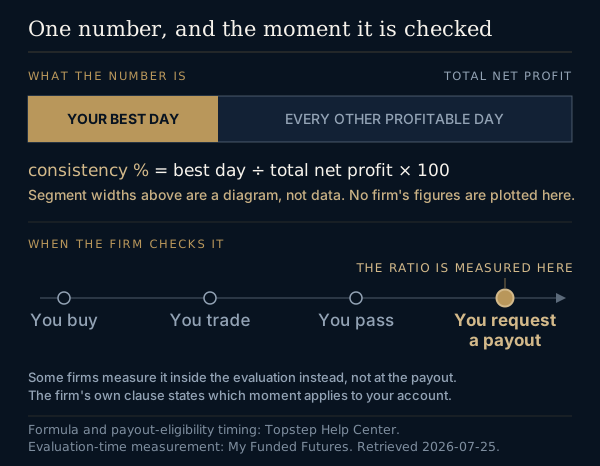
A firm that pays on process wants to filter out the trader who doubled the account in one session and flatlined the rest of the month. The consistency rule is that filter. It is not hidden malice; it is the mechanism that separates one good day from a method the firm is willing to keep paying.
The catch is timing. You rarely feel this rule while you trade. You feel it when you request the payout, because that is the moment the ratio is measured. Read it before you buy, not after you pass.
How the consistency rule is calculated
The one formula: best day over total profit
There is one formula, and Topstep's help center states it directly: largest single-day net profit divided by total net profit, expressed as a percentage (Topstep Help Center, retrieved 2026-07-24). That single number is your consistency percentage. Every firm below measures the same ratio; only the line they draw changes.
A worked example with real numbers
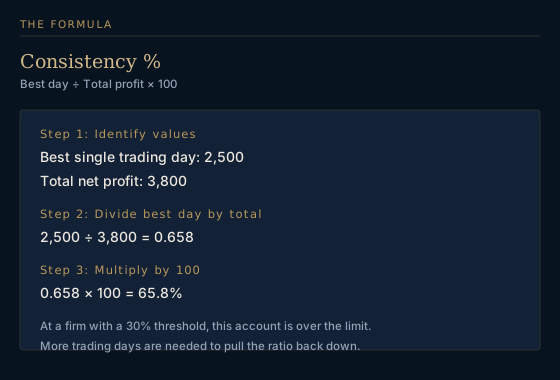
Take a hypothetical account, so you can redo the arithmetic yourself. Suppose your total net profit is 3,800, and your single best day inside that total was 2,500. Divide 2,500 by 3,800 and multiply by 100: that is 65.8 percent. Against a firm that draws its line at 40 percent, that account is over the limit, and the payout waits until more trading days pull the ratio back down. Those numbers are illustrative, not a firm's published figure; swap in your own and the method holds.
The threshold band real firms use
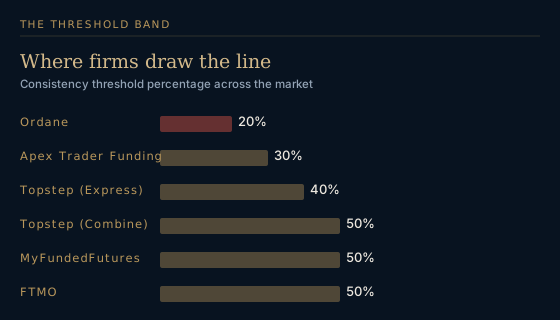
The line is not one industry number. Across the firms sourced in this article it runs from 20 percent to 50 percent. Ordane's clause R-4 sits at the low end at 20 percent; Topstep's Express payout test sits at 40 percent; and FTMO, Topstep's Trading Combine and MyFundedFutures all sit at 50 percent. Where a firm sits changes what counts as a clean payout. The named-firm table further down carries the exact figure, the consequence, and the source for each, all checked on 2026-07-24.
Next step. After you can name the limit in numbers, compare how an Instant Account changes that math versus an evaluation account in Instant Account vs evaluation, then read the live sizes on accounts.
Breach does not always mean fail: what really happens
Delay versus disqualification
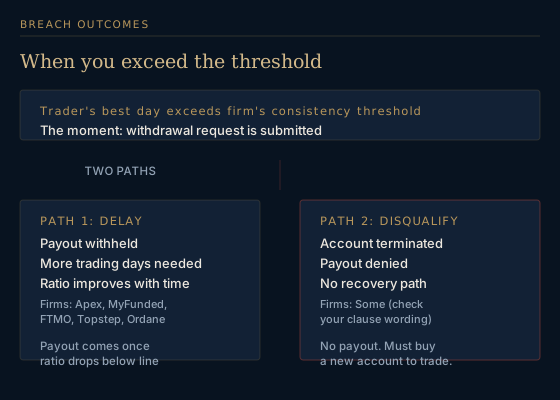
Here is the misconception that costs the most: that crossing the line kills the account. At most futures firms it does not. It withholds the payout request until further trading pulls the ratio back under the threshold, and then you are eligible again.
The sources say it plainly. MyFundedFutures' own help center states that exceeding the 50 percent target does not breach the account; the trader simply trades additional days until consistency is met (My Funded Futures Help Center, retrieved 2026-07-24). FTMO's trading objectives page states that exceeding the Best Day limit is not treated as a rule breach; a trader continues trading until the best day is 50 percent or less of positive days' profit (FTMO, retrieved 2026-07-24). Topstep's help center states that in the Trading Combine, going over the line raises the profit target rather than failing the account (Topstep Help Center, retrieved 2026-07-24). Three firms, one pattern: delay, not death. Whether the payout that follows actually lands is a separate question, and the answer to it lives in the firm's payout and guarantee terms, not in its consistency clause.
The version that voids a payout outright
That pattern is not a law of the industry. Some firms word the same clause as a hard disqualification, and the wording is where you find out. So read the clause for its consequence, not just its number. "Until the ratio is restored" is a delay. "Results in account termination" is a loss.
One rule for the fine print: a consistency clause that states a threshold but names no consequence is a clause whose penalty the firm decides later. Treat a blank consequence as the firm keeping the pen.
Where the consistency clause hides, and how to find it before you pay
The pages to open and the words to search
Open two pages before you buy: the rules or evaluation objectives page, and the terms. Then search the text (Ctrl+F or Cmd+F) for each of these: consistency, best day, daily profit, maximum daily profit, profit distribution, and the numbers 40%, 30%, 20%. One of those almost always lands on the clause.
If the clause is visible only after login or after purchase, you are being asked to agree to a rule you cannot read. That is a fail on its own, before you spend a cent.
Screenshot it before you enter card details
Screenshot the full objectives page before you enter card details. Rules pages change, and a dated image of the version you bought under is the only record you control if the page is edited later. For the wider pre-purchase document check that this clause is one part of, see the companion guide on how to audit a prop firm before you pay; this page stays on the one rule. If a firm denies the payout outright rather than merely delaying it, the recourse you have left is covered in how long prop firms take to pay.
Where named firms draw the line
This table is the honest part, and honesty means two things at once. It means conceding where a competitor publishes clearly: Topstep, MyFundedFutures and FTMO all put their consistency terms in their own help centers, in plain numbers, and every cell below is sourced to the firm's own page. It also means leaving a firm out rather than filling its row from someone else. Apex Trader Funding is a firm traders ask about constantly, and it is not in this table, because we could not read Apex's own documentation and we do not publish a competitor's threshold on the word of a third-party guide or an affiliate blog. Not found in Apex's own documentation is the honest answer, so Apex has no row here. Rules pages change: this table is marked volatile, valid for 90 days, checked 2026-07-24.
| Firm | Threshold | Applies to | Consequence in short | Source, retrieved 2026-07-24 |
|---|---|---|---|---|
| MyFundedFutures | 50% consistency target | evaluation | does not breach; trade more days until met | My Funded Futures Help Center |
| Topstep (Combine) | best day at or below 50% | evaluation | profit target increases, you earn more to pass | Topstep Help Center |
| Topstep (Express) | 40% or below | payout eligibility | above 40% does not qualify for that payout | Topstep Help Center |
| FTMO | best day at or below 50% of positive days' profit | account | not a breach; keep trading until compliant | FTMO, Trading Objectives |
FTMO is worth reading twice, because it is often called a firm with "no consistency rule," and that is not exact. FTMO publishes a Best Day Rule at 50 percent on its trading objectives page and separately states, on its own FAQ page, that provided you maintain sustainable risk management, there are no additional consistency requirements beyond its core objectives (FTMO, retrieved 2026-07-24). So it is one best-day cap, plus nothing extra, not a clean absence.
How Ordane handles it: the closed list
Concession first, without hedging: Ordane is new and has no payout history. There is nothing to show yet, and no payout history will be manufactured. What you can verify today is the rulebook and how its consistency clause is worded.
Ordane sells one product, the Ordane Instant Account: direct access, no evaluation phase and no challenge, on simulated capital (Ordane Rulebook v1.0, section 1).
Ordane does have a consistency-style clause, and it defers rather than disqualifies. Ordane's consistency rule is 20 percent: at the moment of a withdrawal request, no single trading day may account for more than 20 percent of the cycle's total profit. If a day exceeds 20 percent, the excess profit from that day is deferred to the next cycle. It is never confiscated, and the remainder of the cycle pays out normally. That is clause R-4 of Ordane Rulebook v1.0. The outsized day is not deleted and the account is not failed; the surplus simply moves forward.
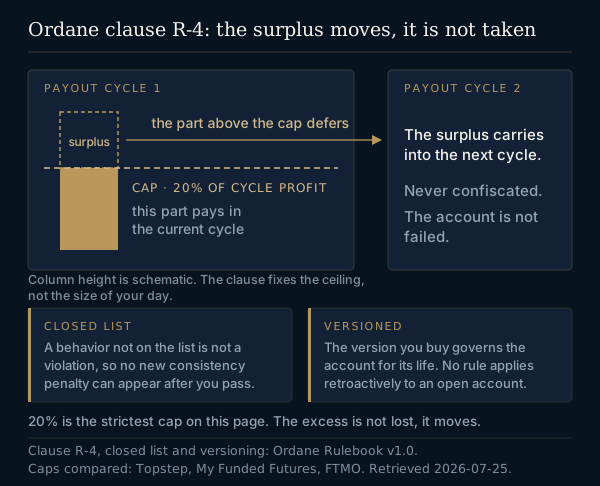
What protects you after that is the shape of the rulebook, not a promise. Ordane's prohibited-practice list is closed. Clause R-6 names six practices: latency, reverse or hedge arbitrage; high-frequency or bulk automated exploitation; copy trading between Ordane accounts; straddling news releases with paired opposing orders; platform or data-feed exploitation; and gap abuse. If a behavior is not listed in that section, it is not a violation. Discretion is not a rule. So a firm cannot invent a new consistency penalty after you pass, because a penalty not written in the list cannot be applied. The Ordane rulebook is public, numbered and versioned, and no rule is ever applied retroactively to an open account. Changes produce a new version with a dated changelog entry, and the version you sign up under is the version that governs your account. Check R-4 in the published Rulebook v1.0 yourself before you buy, the same way you would search any firm's page.
The rest of the rule surface is short by design. Ordane's profit split starts at 60 percent and rises 5 percentage points with every completed withdrawal, reaching 100 percent from the ninth withdrawal onward. Withdrawals #1 and #2 are each capped at 3 percent of initial balance. From withdrawal #3 onward there is no cap. The ladder is clause PA-2 and the caps are clause PA-3. What Ordane charges, and in which sizes, is published in section 1 of the rulebook rather than restated here; the fee is one-time and there is no subscription. Whether the split ever pays is decided by two rules together: this consistency clause and the drawdown rule. The other one, static versus trailing drawdown, the rule that decides whether a passing account ever pays, is covered in its own guide.
The Ordane clauses named in this section, reduced to rows. Every cell restates a clause already quoted above, all from Ordane Rulebook v1.0, retrieved 2026-07-25.
| Clause | What it sets | Consequence as written |
|---|---|---|
| Ordane R-4, consistency | At a withdrawal request, no single trading day may account for more than 20 percent of the cycle's total profit | The excess from that day defers to the next cycle; it is never confiscated, and the remainder of the cycle pays out normally |
| Ordane R-6, prohibited practices | A closed list naming six practices | If a behavior is not listed in that section, it is not a violation; discretion is not a rule |
| Ordane PA-2, profit split ladder | Starts at 60 percent and rises 5 percentage points with every completed withdrawal | Reaches 100 percent from the ninth withdrawal onward |
| Ordane PA-3, early withdrawal caps | Withdrawals #1 and #2 are each capped at 3 percent of initial balance | From withdrawal #3 onward there is no cap |
| Ordane Rulebook v1.0, versioning | The rulebook is public, numbered and versioned, with a dated changelog | No rule is ever applied retroactively to an open account; the version you sign up under governs your account |
Questions traders ask about the consistency rule
What is a consistency rule in a prop firm?
A consistency rule caps the share of your total profit that may come from your single best trading day. It exists so a passing account reflects a repeatable process, not one outsized session. At most firms it is measured when you request a payout, not while you trade.
How do I calculate my consistency percentage?
Topstep's help center states the formula as largest single-day net profit divided by total net profit, multiplied by 100 (Topstep Help Center, retrieved 2026-07-24). If your best day was 2,500 inside a 3,800 total, that is 65.8 percent. Compare that number to the firm's stated threshold before you request a withdrawal.
Does breaching the consistency rule fail my account?
Usually not. MyFundedFutures, FTMO and Topstep's Trading Combine all state in their own documentation that going over the line delays or adjusts the account rather than terminating it. But some firms word it as disqualification, so read the clause for its stated consequence, not only its number.
Can I get paid if I break the consistency rule?
At the delay-style firms, yes, once more trading pulls your ratio back under the threshold. MyFundedFutures' help center states that a trader who exceeds the 50 percent target simply trades additional days until consistency is met (My Funded Futures Help Center, retrieved 2026-07-24). At Ordane, clause R-4 of Rulebook v1.0 states the excess above 20 percent of cycle profit defers to the next cycle and is never confiscated.
Do any firms have no consistency rule at all?
Fewer than the marketing suggests. FTMO is often listed as rule-free, but its own trading objectives page publishes a Best Day Rule at 50 percent and its FAQ page only then states there are no additional consistency requirements (FTMO, retrieved 2026-07-24). Read the objectives page before trusting a "no rule" label.
Sources
- Topstep Help Center, Consistency at Topstep, on the consistency formula and the Combine and Express thresholds. help.topstep.com Retrieved 2026-07-24.
- My Funded Futures Help Center, Consistency Rule at My Funded Futures, on the 50 percent target and trade-more-days consequence. help.myfundedfutures.com Retrieved 2026-07-24.
- FTMO, Trading Objectives, on the Best Day Rule at 50 percent of positive days' profit. ftmo.com Retrieved 2026-07-24.
- FTMO, Do you have any consistency rules?, on there being no additional consistency requirements. ftmo.com Retrieved 2026-07-24.
- Ordane Rulebook v1.0, on simulated capital (clause P-2), the consistency clause (R-4), the closed list (R-6), versioning, the profit split ladder (PA-2) and the withdrawal caps (PA-3). ordanemarkets.com/rulebook Retrieved 2026-07-25.