Home · The Ordane Journal · Before you pay · How to Audit a Prop Firm: 5 Checks Before You Pay
How to Audit a Prop Firm: 5 Checks Before You Pay
Ordane accounts operate on simulated capital. No live funds are traded and no deposits are accepted. That disclosure comes first because it is the first thing an audit should force any firm to state. The five checks below run on FTMO, Topstep, The5ers and Hola Prime, and then on Ordane, including where Ordane's own Rulebook claims no payout history.
What a prop firm audit actually checks
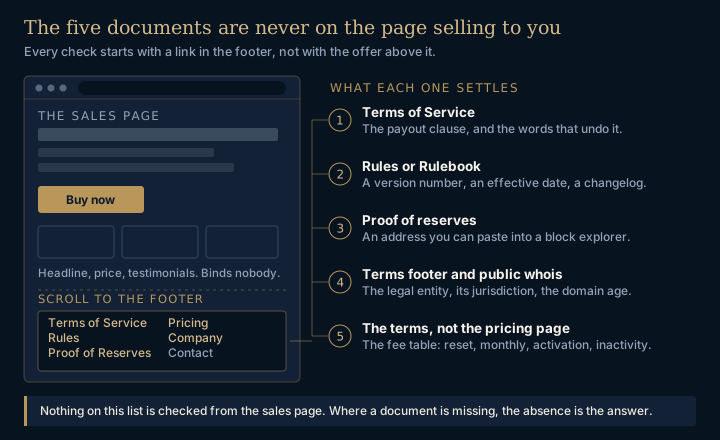
A prop firm audit is the practice of reading five specific documents before paying for an evaluation account, rather than trusting reviews or marketing copy: the payout clause, the rules page's version history, the proof-of-reserves page, the legal entity and registration record, and the fee table hidden inside the terms. You open the terms, the rulebook, the pricing page, and the reserve page, then search each for one exact clause. Where the clause is missing, that absence is your answer.
This article does not argue whether the category itself can be trusted. That question belongs to our separate look at whether prop firms are legitimate in the first place. Here you leave with five browser tabs open and a pass or fail bar for each firm, including Ordane.
Open all five before you spend anything.
| Check | Where to look | Exact wording to search for | What its absence means |
|---|---|---|---|
| 1. Payout clause | Footer link to Terms or Payout Policy | "payout", "withdrawal", "processing time", "sole discretion", "we may refuse" | A window with no stated consequence is a preference, not an obligation. |
| 2. Rule stability | Rules or Rulebook page | version number, effective date, "changelog", "we reserve the right to modify" | No version and no changelog means you can never prove a rule changed. |
| 3. The reserve | Proof-of-reserves or payout page | published wallet address, "reserve", dated ledger | A dashboard number with no address is a claim, not a reserve. |
| 4. Who and how long | Terms footer, public whois | legal entity name, jurisdiction, registration date | No named entity means no one to hold to the contract. |
| 5. The real price | Terms, not the pricing page | "fee", "monthly", "reset", "activation", "inactivity" | A price with no matching fee table in the terms is unpriced. |
Check 1: Can you read the payout clause before you pay?
Check this yourself. The claim is only as good as the document you can open. Run Ordane Verify on the firm you are about to pay, then open Rules Lab and read the matching clause before you size a trade. Also: Rulebook.
Next step. Once the checklist is clear, match the model in Instant Account vs evaluation, then open the rulebook and accounts side by side.
Where the payout terms hide
Start at the footer. The payout rule almost never sits on the sales page. It lives in a Terms of Service or Payout Policy link at the bottom. Open it and search the page for "payout", "withdrawal", and "processing time". Then search for the words that quietly undo the promise above them: "sole discretion", "at our discretion", and "we may refuse".
The wording that quietly undoes a payout promise
Here is the test. A payout window with no stated consequence for missing it is a preference, not an obligation. "We aim to process within 5 days" binds no one. And if the full payout clause is only visible after login or after purchase, you are agreeing to a term you cannot read. That is a fail on its own.
Ordane writes the consequence into the clause. Every withdrawal request is approved, or denied in writing citing the exact rule breached by section number, within 12 clock hours. Past that deadline the request is treated as approved and the G-1 clock starts. A payout approved and not paid within 24 clock hours, not business hours, triggers automatic compensation: a 100 percent refund of the account fee, plus the payout owed in full. Clause G-2 excludes documented fraud or KYC review and declared force majeure for at most 10 business days each; beyond that, G-1 applies regardless (Ordane Rulebook v1.5, clauses G-0, G-1 and G-2, retrieved 2026-10-10).
Reading the clause is not the same as seeing the money land. A clause tells you what a firm owes you. Only a dated payout record tells you what it has already paid. Ask any firm for both, and treat a missing ledger the way you treat a missing clause.
Check 2: Can the rules change after you pay?
Find the version number, the date, and the changelog
Open the rules page and look for three things: a version number, an effective date, and a changelog. If none exist, there is no way to ever prove a rule was changed on you. The page just silently becomes the new truth.
Search the terms for the catch-all clause
Search the terms for "we reserve the right to modify these rules at any time". Then search for the counter-wording that protects you: "changes apply to accounts purchased after the effective date". Also search for "including but not limited to", "prohibited strategies", and "sole discretion". An open-ended rule list has no fixed edge, which means a strategy can be ruled a violation after you use it. The exact drawdown wording to hunt for is covered in the difference between static and trailing drawdown.
Diff the rules page against an archived snapshot
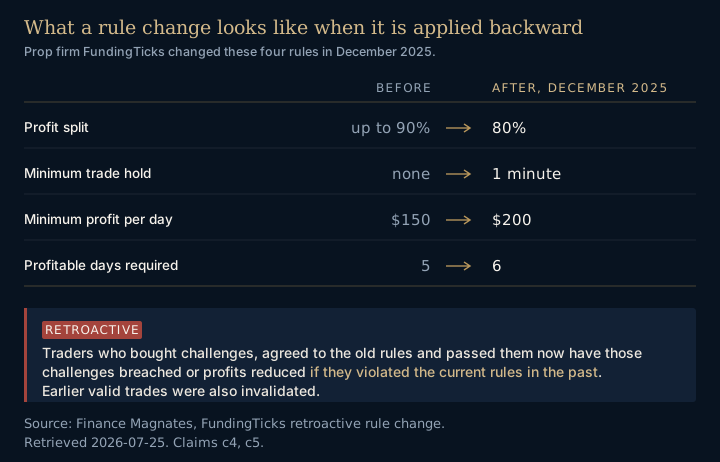
Paste the rules URL into the Internet Archive's Wayback Machine: launched in 1996, it stores dated snapshots of web pages and now holds over 150 billion captures (Bellingcat's Online Investigation Toolkit, retrieved 2026-07-24). Pull snapshots from roughly 6 and 12 months back, then compare drawdown, split, minimum days, and hold time. This is not theoretical: in December 2025, prop firm FundingTicks changed its trading rules and applied them retroactively to traders who had already passed under the old rules. The same change cut the profit split from up to 90% to 80%, added a one-minute minimum trade hold, raised the minimum daily profit to $200 from $150, and required six profitable days instead of five (Finance Magnates, retrieved 2026-07-24). Screenshot the full objectives page before you enter card details.
The Ordane rulebook is public, numbered and versioned. No change is applied against an open account unless it only widens a limit in the trader's favour, and every change gets a new version with a dated changelog entry; an account stays governed by the version accepted at its purchase (Ordane Rulebook v1.5, notice above section 0 and section 2A, retrieved 2026-10-10). The prohibited practices form a closed list in R-6, so a behavior that is not listed there is not a violation.
Check 3: Where does the money that pays you sit?
A dashboard number is not a reserve
A payout page is a webpage, and a webpage prints whatever number the database holds. A screenshot of "$2.1M in reserves" verifies nothing. It is a picture of a claim.
How to read a public address in a block explorer
A reserve you can check has a public address. Find the published wallet address, paste it into a public block explorer (a free website that shows any wallet's balance and full transaction history), and read the current balance. Then check the one thing most people skip: was the address published before you arrived, or only after you asked? A third-party attestation from a named auditor is a weaker but real alternative, weaker because you are trusting the auditor's word rather than reading the chain yourself. No address, no attestation, and no dated ledger together mean the reserve is a claim.
This is the check to run on Ordane first. Rulebook v1.5 clause PR-1 says the payout reserve address is disclosed on-chain for any purchase bound to that version, and the homepage identifies the public wallet it shows (USDT on TRON) as part of its company treasury (Ordane Rulebook v1.5, clause PR-1; ordanemarkets.com, company treasury section; both retrieved 2026-10-10). This article has not verified a balance or any payout history; Rulebook clause PR-2 says none is claimed. Check the address in an explorer yourself, not the sentence written about it.
Check 4: What can you verify today, and what only time proves?
Five signals you can check in ten minutes
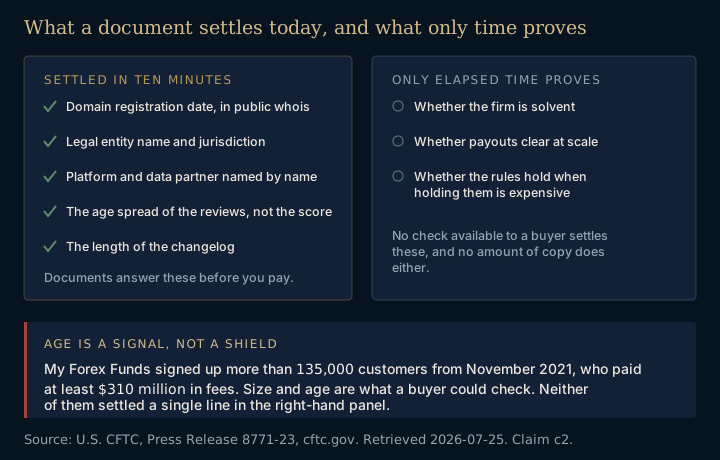
Some things a document settles now. Check the domain registration date in public whois, because a site registered last month with a decade of "history" in its copy is lying somewhere. Read the legal entity name and jurisdiction written inside the terms. Confirm the trading platform and data partner are named by name, not implied. Look at the age distribution of the reviews, not the score, since a wall of five-star reviews all posted in one week is a campaign. And read the length of the changelog as a rough proxy for how long the rules have actually existed.
The support test: ask one hard rules question before you pay
Send one specific rules question before paying, such as "Does clause X apply to a position held overnight?" Check whether the reply cites a clause number or repeats marketing copy. A firm that answers with a section number has rules it can stand behind.
Say this plainly: age is not safety, and no check available to a buyer predicts solvency. The CFTC charged the operator of My Forex Funds with fraudulently taking over $300 million from retail customers, and that firm was not young (U.S. CFTC, Press Release 8771-23, retrieved 2026-07-24). That case did not survive: in an order signed on May 13, 2025, a federal judge dismissed it with prejudice and sanctioned the CFTC, after a court-appointed Special Master found the agency had misled the court (Finance Magnates, retrieved 2026-07-29). Reuters put the court-ordered legal bill at $3.1 million (Reuters via TradingView, retrieved 2026-07-29).
Check 5: What does the price actually buy?
The charges that appear after you pass
Search the terms for "fee", "monthly", "subscription", "activation", "reset", "minimum", and "inactivity". Separate a one-time price from a recurring one. Then find whether a further charge appears at the exact moment of payout. A pricing page with no matching fee table in the terms is an unpriced product, and unpriced means the number can move. The charges that tend to surface after purchase are catalogued in the fees prop firms keep off the pricing page.
Ordane charges once. The fee runs from $59 for the $2,500 account to $999 for the $100,000 account across five sizes at list price, with no recurring fees and no hidden tiers; a promotion shown at checkout changes the amount charged, never the account rules. Ordane's profit split is 100 percent on every eligible withdrawal, fixed, with no ladder. The limit that belongs next to that split: withdrawals #1 and #2 are each capped at 3 percent of initial balance. From withdrawal #3 onward there is no cap (Ordane Rulebook v1.5, section 1 and clauses PA-2 and PA-3; fees on Ordane accounts, retrieved 2026-10-10). Every figure here is volatile, so recheck it against the rulebook on the day you buy.
The same five checks, run on FTMO, Topstep, The5ers, and Hola Prime
This table is honest by design. Where a competitor passes, it records the pass. FTMO and Topstep carry published operating histories and public reporting that this article does not find for Ordane, and that shows below. The table is volatile: rules and prices pages change, so treat it as accurate as of 2026-07-24 and recheck within 90 days. Cells with no cited source were left blank rather than guessed.
| Firm | Entity and jurisdiction stated | Years stated | Public payout reporting | Price or split stated |
|---|---|---|---|---|
| FTMO | Pass: FTMO s.r.o., Prague, Czech Republic, VAT CZ699005540 | Pass: since 2015 | Not found in sources | Not found in sources |
| Topstep | Pass: Topstep LLC, Chicago | Pass: founded 2010 | Pass: reports $1.4B+ paid and 7,000+ paid weekly; 33.3% of top-level participants received a payout in 2025 | Not found in sources |
| The5ers | Pass: FIVE PERCENT ONLINE LTD, UK, company 12553363 | Pass: since 2016 | Not found in sources | Partial: from $249, promo $149 for the $100K account, 75% split |
| Hola Prime | Pass: Hong Kong entity plus Cyprus (HE 454359) and Mauritius (FSC 220248) subsidiaries | Not found in sources | Not found in sources | Partial: splits from 80% to 95% |
Every filled cell was read on the firm's own live site on 2026-07-24: ftmo.com, topstep.com, the5ers.com, holaprime.com. No cell rests on a review site, a ranking page or an affiliate guide, and "Not found in sources" is left in place rather than filled with a guess.
Topstep's public payout reporting and Topstep's and FTMO's published operating histories are strengths this article does not find published for Ordane. An audit that hid that would be worthless.
The same five checks, run on Ordane
Ordane sells one product, Instant Supreme: direct access, no evaluation phase and no challenge, on simulated capital (Ordane Rulebook v1.5, section 1).
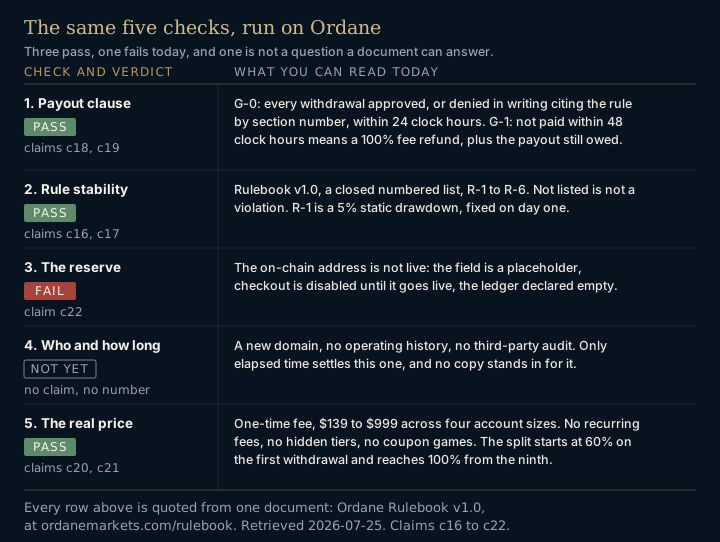
Concession first, without softening. This article has not verified any Ordane payout history, and Rulebook v1.5 clause PR-2 says none is claimed. Its accounts trade simulated capital, so there are no deposits and no live funds. Clause PR-3 says independent third-party attestation enters effect per the public roadmap milestone. The public entity name is Ordane Markets Ltd, and the About page says company registration details remain pending verification (Ordane About, retrieved 2026-10-10), so Check 4 does not clear either.
Now the proof you can verify today. The governing document is Ordane Rulebook v1.5, created 2026-10-08. Ordane's prohibited-practice list is closed. Clause R-6 names six practices: latency, reverse or hedge arbitrage; high-frequency or bulk automated exploitation; copy trading between Ordane accounts; straddling news releases with paired opposing orders; platform or data-feed exploitation; and gap abuse. If a behavior is not listed in that section, it is not a violation. Discretion is not a rule. Ordane's maximum drawdown is 12 percent and static: account equity may never fall below 88 percent of the initial balance. The floor is fixed on day one, never trails upward, and a breach closes the account (Ordane Rulebook v1.5, clauses R-6 and R-1, retrieved 2026-10-10). The G-0 and G-1 clocks, the G-2 exclusions, the fee and the fixed split with its 3 percent early cap are stated above with their clause numbers.
Check 3 for Ordane: the disclosure is documented (clause PR-1 and the homepage treasury statement); the balance and history are yours to verify in an explorer. This article cannot show payout history; only elapsed time and real withdrawals fill that gap. This is the section no competitor can reproduce without publishing its own balance and its own rule-change history.
Questions traders ask before paying
Can a prop firm change its rules after you buy?
It can, unless the terms say it cannot. Look for a version number, an effective date, and wording that limits changes to accounts purchased after the change. In December 2025 FundingTicks applied new rules retroactively to traders who had already passed (Finance Magnates, retrieved 2026-07-24). A versioned, never-retroactive rulebook is the counter to this.
What should you screenshot before entering card details?
Screenshot the full objectives or rules page, the payout clause, and the pricing table, each showing the date. If a rule later changes, your dated screenshot plus an Internet Archive Wayback Machine snapshot of the same page is your proof. Without it, you are arguing memory against a live page.
How do you check that a payout reserve is real?
Find a published wallet address, paste it into a public block explorer, and read the balance and history yourself. A screenshot is not verifiable. Ordane's Rulebook v1.5 (PR-1) says its reserve address is disclosed on-chain; this article has not verified the balance, so read it yourself.
Does a long operating history make a payout more likely?
It helps, but it does not guarantee anything. My Forex Funds signed up more than 135,000 customers since November 2021, who paid at least $310 million in fees, before the CFTC charged its operator with fraud (U.S. CFTC, Press Release 8771-23, retrieved 2026-07-24). A federal judge later dismissed that case with prejudice on May 13, 2025, and sanctioned the CFTC after a finding that the agency had misled the court (Finance Magnates, retrieved 2026-07-29). Age is a signal, not a shield.
What is the minimum you should read before paying?
The payout clause, the rule version and changelog, and the fee table inside the terms. Fifteen minutes across those three settles most of the risk a document can settle. The rest is time.
Disclaimers
This article is for information only and is not investment, financial, or tax advice.
Ordane accounts operate on simulated capital. No live funds are traded and no deposits are accepted. Payouts depend on simulated performance under Rulebook v1.5; no level of performance is typical or assured.
Sources
- CFTC Charges 'My Forex Funds' with Fraudulently Taking Over $300 Million From Customers Hoping to Become Professional Traders | CFTC cftc.gov Retrieved 2026-07-24.
- In a Blow to the CFTC, US Court Throws Out My Forex Funds Lawsuit, Finance Magnates financemagnates.com Retrieved 2026-07-29.
- CFTC ordered to pay $3.1 million legal tab in My Forex Funds case, Reuters via TradingView tw.tradingview.com Retrieved 2026-07-29.
- Prop Firm FundingTicks Faces Massive Backlash after “Retroactive Rule Change” | Finance Magnates financemagnates.com Retrieved 2026-07-24.
- FTMO – official site ftmo.com Retrieved 2026-07-24.
- About Us | Topstep topstep.com Retrieved 2026-07-24.
- Topstep – official site topstep.com Retrieved 2026-07-24.
- The5ers – official site the5ers.com Retrieved 2026-07-24.
- Hola Prime – official site holaprime.com Retrieved 2026-07-24.
- Wayback Machine | Bellingcat's Online Investigation Toolkit bellingcat.gitbook.io Retrieved 2026-07-24.
- Ordane Rulebook v1.5, notice above section 0, section 2A and clause R-6 ordanemarkets.com Retrieved 2026-10-10.
- ordanemarkets.com, company treasury section ordanemarkets.com Retrieved 2026-10-10.
- Ordane Markets at a glance | Ordane Markets ordanemarkets.com Retrieved 2026-10-10.