Home · The Ordane Journal · Rules and mechanics · Lucid Trading Prop Firm: Rules, Fees and Payouts
Lucid Trading Prop Firm: Rules, Fees and Payouts

Lucid Trading is a futures prop firm that sells four programs: LucidPro, LucidFlex, LucidDaily and LucidDirect. Ordane accounts operate on simulated capital. No live funds are traded and no deposits are accepted. Each program opens a different payout door; this article maps, for all four, the source of payout money, the fees, the drawdown rules and the payout conditions.
Ordane sells one product, the Ordane Instant Account: direct access, no evaluation phase and no challenge, on simulated capital.
What is Lucid Trading and what are you actually buying?
Lucid Trading is a futures prop firm: it evaluates traders on simulated accounts and connects passing traders to funded trading.
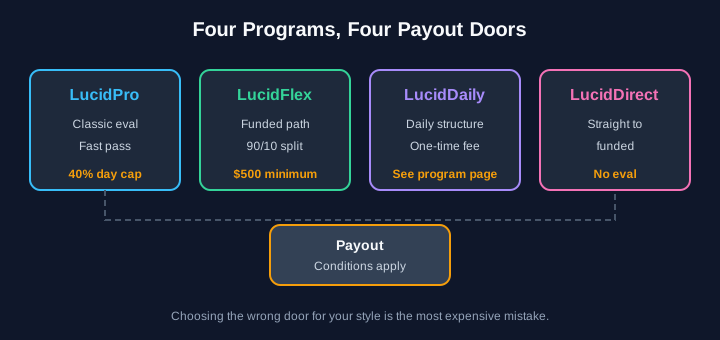
The firm sells exactly four account programs: LucidPro, LucidFlex, LucidDaily and LucidDirect. Lucid states "No monthly subscription or funded account activation fees": you pay once per evaluation, and breaching the max loss limit triggers a tier-specific reset fee.
The programs are not different sizes of one product. LucidPro is the classic evaluation with a fast pass but payout conditions attached. LucidFlex is the funded-account path with the 90/10 split. LucidDirect skips the evaluation entirely. LucidMaxx, an evaluation tier that required minimum trading days, now sits under a Legacy label in Lucid's support pages.
| Program | Path | Key payout condition |
|---|---|---|
| LucidPro | Classic evaluation | 40% Consistency Percentage to request a payout (35% grandfathered) |
| LucidFlex | Funded-account path | $500 minimum request on a 90/10 split |
| LucidDaily | One-time fee, daily structure | Figures on Lucid's program page |
| LucidDirect | Straight To Funded | Evaluation skipped entirely |
Your money depends on the firm honoring its published rules: our guide on how to audit a prop firm is worth running before you pay anyone.
What rules can end your account before you profit?
Fees are the visible cost; the rules below are the invisible ones: breach the max loss limit and your one-time fee buys a paid reset instead of a payout. On the PRO tiers, the 25K pairs a $1,250 profit target with a $1,000 max loss and no daily loss limit, and the 50K pairs $3,000 with a $1,200 daily loss limit and a $2,000 max loss.
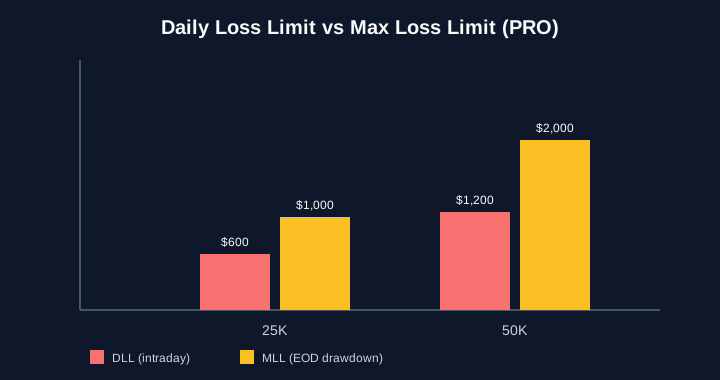
The two limits work differently. Hitting the daily loss limit is a soft breach: "you do not lose your account for hitting DLL", only "restricted from placing additional trades until the next trading session". The max loss limit is calculated "at the end of each trading session" from the "highest closing balance": the MLL rises with that balance until it "locks at the initial balance plus $100".
The consistency rule applies after you have made the money: it stops you from withdrawing it. Lucid applies 40% in two places. The legacy LucidMaxx terms required 40% consistency, alongside its profit target, max loss limit and minimum trading days. On LucidPro, "you must meet a Consistency Percentage of 40% to be eligible to request a payout" (accounts purchased or reset on or before November 28, 2025 keep 35%), a test that "resets and must be met again after each payout".
Note the scope: LucidPro's 40% applies to payout cycles, not to passing: one monster day blocks the withdrawal until your cycle profit catches up. For a deeper treatment, see what is the consistency rule at a prop firm.
What do you pay: fees and the promotional discount
Lucid's PRO pricing is one payment per evaluation with no recurring charges; reset fees scale with account size on the same pricing table. Firms stacking monthly subscriptions on top of evaluation fees are the contrast, a trap we break down in prop firm hidden fees.
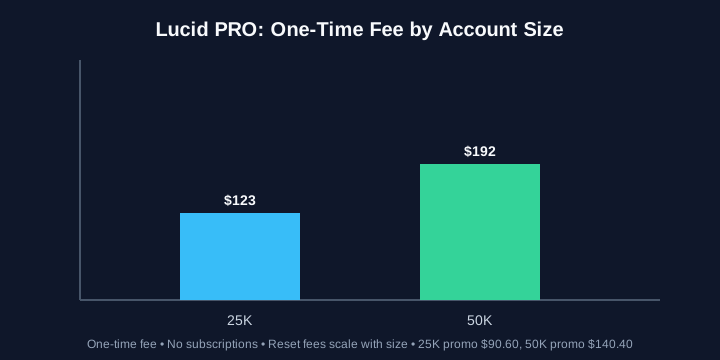
The headline prices are promotional: the 25K PRO evaluation lists $123 with a promotional price of $90.60, and the 50K lists $192 with a promotional $140.40. The 100K and 150K sizes sit on the same table, which states "No monthly subscription or funded account activation fees"; tier-specific reset fees and promotional pricing are the only other moving parts.
LucidDirect is "a simulated straight-to-funded account which does not have an evaluation phase": you skip the evaluation, with no simulated payout caps and no scaling plan. If you are weighing that trade, our comparison of instant accounts vs evaluation prop firms covers when each one makes sense.
The four programs compared: price, profit target, daily loss limit and max loss
Where an evaluation exists, these are the four numbers that decide whether you pass or lose your fee; LucidDirect, with no evaluation, is judged on its own terms. Where Lucid publishes no comparable figure in the terms verified here, the cell says so.
| Program | Price | Profit target | Daily loss limit | Max loss limit |
|---|---|---|---|---|
| LucidPro 25K | $123 one-time (promo $90.60) | $1,250 | None | $1,000 on EOD drawdown |
| LucidPro 50K | $192 one-time (promo $140.40) | $3,000 | $1,200 | $2,000 on EOD drawdown |
| LucidFlex | Published on Lucid's program page | Not published in the terms verified here | Documented as EOD drawdown | MLL calculated on EOD drawdown |
| LucidDaily | Published on Lucid's program page | On Lucid's program page | On Lucid's program page | On Lucid's program page |
| LucidDirect | Published on Lucid's program page | None: no evaluation to pass | Documented per account size | $1,000 to $5,000 by account size |
LucidPro publishes all four numbers tier by tier, and it is the tier Lucid markets as passable in one day. LucidFlex documents its loss accounting instead of a target ladder: its accounts "use an End-of-Day Drawdown (EOD Drawdown) system to calculate the Max Loss Limit (MLL)". LucidDirect has no evaluation phase, no simulated payout caps and no scaling plan. LucidDaily's figures sit on its program page.
LucidMaxx is legacy: its own support page is titled Legacy LucidMaxx Eval Rules. Under those terms it was a $25,000 evaluation with a $1,250 target, a $1,000 max loss limit, 40% consistency and 5 minimum trading days, and passing it transitioned the trader into a live funded account. The Legacy label means those numbers may no longer describe what you buy today.
The payout question: what is verified and what is marketing?
Lucid's homepage sells speed; its program pages set conditions.
What is marketing copy, in Lucid's own words:
- "The Best Prop Firm For Futures | Fast Payouts": the homepage tagline, the firm describing itself.
- "$700M+ earned by traders" and "500K+ traders": self-reported counters on the same page.
- "Pass in as little as one day": the program page's own marketing line.
What the program terms actually verify: the PRO one-time fees and promotional prices above, the tier-specific reset fees, the daily loss limit and EOD max loss figures per tier, the 90/10 split with its $500 minimum on LucidFlex, the buffer balance on LucidPro, and the rule that LucidFlex and LucidPro payout requests are final once submitted. These are conditions you can read before paying; the counters are not.
The payout mechanics the conditions gate
All LucidFlex funded-account payouts are split 90% to the trader and 10% to Lucid Trading, with a $500 minimum request, and the payout cycle requires "at least the minimum required profit on 5 separate days". How that split compares to scaling models elsewhere is covered in prop firm profit splits explained.
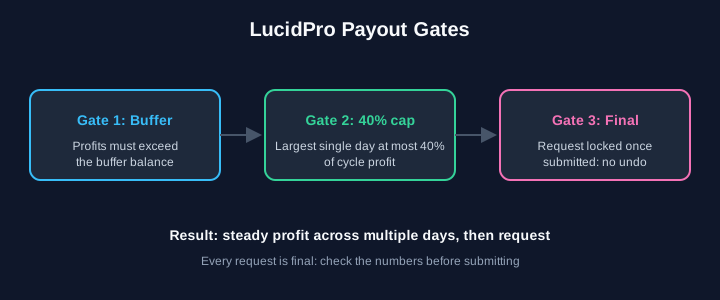
LucidPro adds a second gate: "your profits must exceed the buffer balance, which acts as a safety net to avoid hitting Max Loss Limit after a payout": a cushion must stay in the account so the post-payout balance can absorb losses.
One detail trips up new traders: on LucidFlex and LucidPro, "Payout requests are final once submitted, they cannot be edited or canceled". The moment you click submit, the amount is locked, with no undo; if a request is ever denied, our guide on what to do when a prop firm denies your payout is the next step.
| Payout gate | Condition |
|---|---|
| LucidFlex minimum | $500 minimum request on a 90/10 split |
| LucidPro consistency | 40% Consistency Percentage, reset after each payout (35% grandfathered) |
| LucidFlex and LucidPro requests | Final once submitted; cannot be edited or canceled |
Frequently Asked Questions (FAQ)
Is Lucid a real firm?
Lucid Trading operates a live site and publishes priced programs with written conditions, and this article sticks to those published terms. Whether the firm honors them is a conduct question the terms alone cannot answer: our how-to-audit-a-prop-firm guide lists the checks to run before you pay.
How much does a Lucid evaluation cost?
Lucid PRO evaluations are one-time fees: 25K at $123 (promo $90.60) and 50K at $192 (promo $140.40), with 100K and 150K sizes on the same pricing table. There are no monthly subscriptions or activation fees, and reset fees rise with account size.
How fast does Lucid pay out?
Lucid's payout terms state that "Payouts will be disbursed to your payment method within 2 business days"; anything faster in the tagline is marketing, not term. What the terms set are conditions: the $500 minimum on LucidFlex, LucidPro's 40% consistency scope, and requests final once submitted on Flex and Pro.
What is the minimum payout at Lucid?
On LucidFlex, the minimum payout request is $500, paid on a 90/10 split in your favor. On LucidPro, you must also clear the buffer balance and meet the 40% Consistency Percentage (35% on older accounts) before a request makes sense.
Can you pass a Lucid evaluation in one day?
Lucid markets PRO as passable in one day. Legacy LucidMaxx required 5 minimum trading days. Passing fast and withdrawing fast differ on LucidPro, where the 40% Consistency Percentage (35% grandfathered) applies during the payout cycle.
Can I cancel or edit a payout request after submitting?
No. LucidFlex and LucidPro payout requests are final once submitted, they cannot be edited or canceled. The amount is locked the moment you click submit, so verify your buffer and consistency math before requesting, every time.
Sources
- Lucid Trading lucidtrading.com Retrieved 2026-10-06.
- CFTC Customer Advisory cftc.gov Retrieved 2026-10-06.
- LucidFlex Payouts support.lucidtrading.com Retrieved 2026-10-06.
- Legacy LucidMaxx Eval Rules support.lucidtrading.com Retrieved 2026-10-06.
- LucidPro Consistency Percentage support.lucidtrading.com Retrieved 2026-10-06.
- LucidPro Payouts support.lucidtrading.com Retrieved 2026-10-06.
- LucidFlex Drawdown support.lucidtrading.com Retrieved 2026-10-06.
- LucidPro Daily Loss Limit support.lucidtrading.com Retrieved 2026-10-06.
- LucidPro Drawdown support.lucidtrading.com Retrieved 2026-10-06.
- LucidDirect Funded Account support.lucidtrading.com Retrieved 2026-10-06.