Home · The Ordane Journal · Pricing and Cost · Prop Firm Reset or a New Account: Which Costs Less
Prop Firm Reset or a New Account: Which Costs Less
A failed evaluation is not a mood. It is an arithmetic problem with four inputs: what the reset costs, what the reset restores, what the reset deletes, and which date it moves. Most traders only price the first one, and then wonder why the month cost more than the reset button said.
A prop firm reset is a paid or credited account operation that returns a failed evaluation to its starting balance, loss limit, consistency target and trading-day count, at the price of a new evaluation month rather than a new evaluation fee.
Ordane accounts operate on simulated capital. No live funds are traded and no deposits are accepted. (Ordane Rulebook v1.0, clause P-2, retrieved 2026-08-05)
This is a comparison of the reset against buying again, built on the reset documentation that firms publish themselves.
What Does a Prop Firm Reset Actually Restore?
A reset returns a failed or unwanted evaluation to its starting state. It restores the account balance, the loss limit, the consistency target and the count of trading days, and it does so at the price of a new evaluation month rather than the price of a new evaluation. That is the whole mechanism.
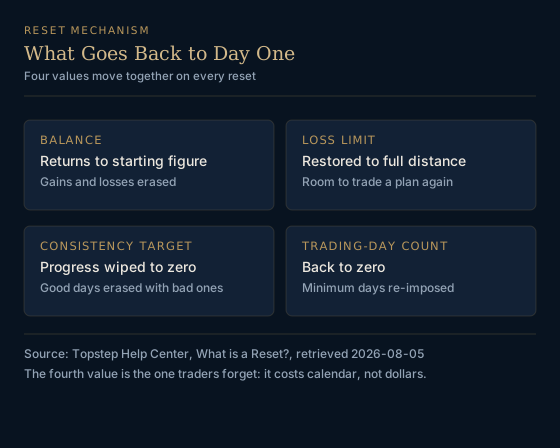
Topstep (prop firm), which documents its reset in plain language, defines it as a return to day one across all four of those values: "Account Balance, Maximum Loss Limit (MLL), Consistency Target, and trading days all go back to day one." (Topstep Help Center, What is a Reset?, retrieved 2026-08-05) Read that list carefully, because the fourth item is the one traders forget. The balance going back to the starting figure is obvious. The trading-day count going back to zero is the part that quietly costs you a week.
Balance, Loss Limit, Consistency Target, Day Count
Those four values move together, and it is worth separating what "restored" means for each.
The balance returns to the starting figure. If you were up and then broke a rule, the profit is gone. If you were down, the loss is gone. A reset is symmetric, and traders who are marginally up should notice that resetting is a decision to delete their own gains.
The loss limit returns to its full distance from the balance. This is the value the reset is really being bought for. A trader who is one bad session away from the floor has almost no room to trade a plan, and no plan survives being executed inside a two-tick corridor.
The consistency target returns to zero progress. If the firm requires that no single day accounts for more than a set share of your profit, a reset wipes the record of your good days along with your bad ones. Whether that is a gain or a loss depends entirely on whether your distribution was clean before the reset.
The trading-day count returns to zero. This is the input traders price at nothing and pay for in calendar. If a firm requires a minimum number of trading days before you can pass, a reset re-imposes every one of them. The floor you regain in dollars is paid for in days.
What Does a Reset Do to Your Billing Date?
Here is the mechanism most reset comparisons skip. On a subscription evaluation, the reset and the renewal are not two independent decisions. They are the same decision, entered from two different buttons.
Topstep's evaluation "is a monthly subscription. It Rebills every 30 days from your original sign-up date" (Topstep Help Center, Trading Combine Subscriptions, retrieved 2026-08-05), and it renews on that schedule whether or not the month went well. A reset does not sit outside that clock. "Resetting your account pushes your Rebill date out 30 days" (Topstep Help Center, What is a Reset?, retrieved 2026-08-05).
Read that as a cash-flow statement rather than a policy note. The reset is not only a charge, it is a postponement of the next charge. Whether that makes the reset cheap or expensive depends on where you were standing in the billing cycle when you pressed it.
- Day 2 of the cycle. You pay for the reset and give up 28 days you had already bought. The reset price understates the real cost by roughly a month of subscription.
- Day 28 of the cycle. You pay for the reset and the renewal you were about to be charged for slides a month out. The reset price overstates the real cost, sometimes to the point where the reset is close to free.
Same button, same price, opposite arithmetic. The variable is the calendar, not the trading.
Why Are a Reset and a Renewal the Same Decision?
If a reset moves the rebill and a rebill funds another month, then the honest question is never "should I reset?" It is "am I buying another month of this evaluation, and if so, do I want it to start from day one or from where I am?"
Framed that way, the choice gets simpler. If the account still has usable room and a clean consistency record, you are buying continuation. If the account has no room and a compromised record, you are buying a restart. The reset button is how you buy the restart. It is not a discount, it is a product choice inside a month you were going to pay for anyway.
Reset Credits, and What Earns One
Some firms hand you resets rather than selling them. At Topstep, "every monthly Rebill adds 1 Reset Credit to your Reset Bank. Works exactly like a purchased Reset" (Topstep Help Center, What is a Reset?, retrieved 2026-08-05). There is also a ceiling on how often the mechanism can be used: "Limit: 2 Resets per account each day" (Topstep Help Center, What is a Reset?, retrieved 2026-08-05).
Two things follow from that.
First, before you buy a reset, check whether you already own one. A credit earned by a rebill you already paid for is not a saving the firm is going to volunteer.
Second, a daily reset cap is a design signal. A firm that has to write down a limit of two per day has met traders who wanted three, which tells you what the reset mechanism gets used for in practice: not recovery, but rerolling.
Table 1: Reset Versus Buying a New Account
| Dimension | Reset an Existing Evaluation | Buy a New Evaluation Account |
|---|---|---|
| Price | Charged per reset; a monthly rebill may deposit a reset credit at no additional charge that works like a purchased one (Topstep Help Center, What is a Reset?, retrieved 2026-08-05) | Charged as a new subscription; on a monthly evaluation this is a fresh billing relationship, priced by account size and path (Topstep Help Center, Pricing and Payment Questions, retrieved 2026-08-05) |
| Balance | Back to the starting figure, up or down (Topstep Help Center, What is a Reset?, retrieved 2026-08-05) | Starting figure |
| Loss limit | Restored to full distance (Topstep Help Center, What is a Reset?, retrieved 2026-08-05) | Full distance |
| Consistency target | Progress wiped, target back to day one (Topstep Help Center, What is a Reset?, retrieved 2026-08-05) | Target starts at zero |
| Trading-day count | Back to zero (Topstep Help Center, What is a Reset?, retrieved 2026-08-05) | Starts at zero |
| Billing date | Pushed 30 days forward, so the next charge is postponed (Topstep Help Center, What is a Reset?, retrieved 2026-08-05) | New date, tied to the new sign-up (Topstep Help Center, Trading Combine Subscriptions, retrieved 2026-08-05) |
| Usage limit | Capped at two per account per day (Topstep Help Center, What is a Reset?, retrieved 2026-08-05) | Limited only by what you are willing to spend |
| Account history | Same account, restarted | New account, no carried record |
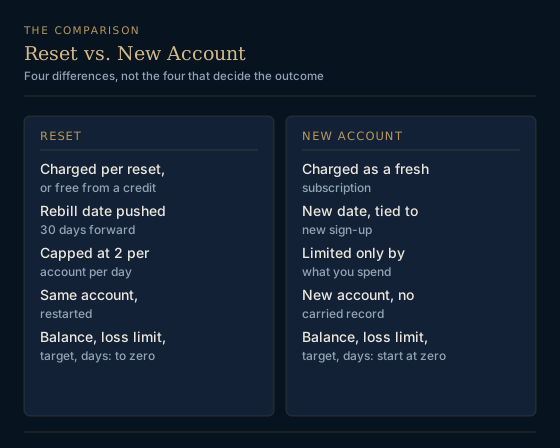
The table makes the pattern visible. On the four values that decide whether you can trade a plan, the reset and the new account are identical. They differ on price, on the billing date, and on whether the account keeps its identity. That is a narrow difference, and it is why the decision is arithmetic rather than strategy.
When Is a Reset the Cheaper Decision?
Run four numbers. That is the whole method.
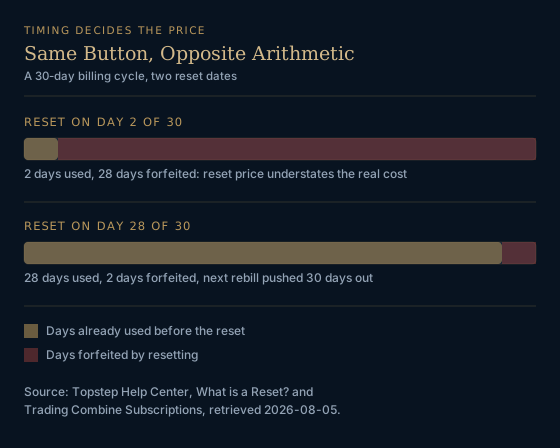
Table 2: The Four Inputs to the Arithmetic
| Input | What to Write Down | Why It Decides the Answer |
|---|---|---|
| Reset price | The charge for one reset, or zero if a rebill already deposited a credit (Topstep Help Center, What is a Reset?, retrieved 2026-08-05) | This is the only cost most traders count, and often not the largest |
| Days left in the paid cycle | Days remaining before the next scheduled rebill (Topstep Help Center, Trading Combine Subscriptions, retrieved 2026-08-05) | Days you forfeit on a reset. Late in the cycle, near zero. Early, close to a full month |
| Billing-date movement | Whether the reset pushes the next charge, and by how much (Topstep Help Center, What is a Reset?, retrieved 2026-08-05) | A postponed charge is a real credit against the reset price |
| New-account price | The subscription cost for the same size and path, from the firm's published pricing (Topstep Help Center, Pricing and Payment Questions, retrieved 2026-08-05) | The alternative you are actually comparing against |
Then compare two totals. The reset costs the reset price plus the forfeited days, minus the value of the postponed rebill. The new account costs the new subscription price, and it forfeits the same days.
Two conclusions fall out of that arithmetic, and neither depends on how you feel about the loss.
The reset usually wins late in the cycle. With days remaining near zero and a rebill about to land, a reset that pushes the charge 30 days forward is close to a wash. You are effectively converting a renewal you were going to pay into a restart.
The reset usually loses early in the cycle. Fresh into a paid month, a reset forfeits nearly all of it. The reset price is not the cost; the reset price plus most of a month is.
When Does a New Account Win Outright?
There is one case where a new account beats a reset regardless of the calendar. It is when the account size is wrong.
A reset restores the account you already have. If you failed because the size forced position sizes you could not manage inside the loss limit, restoring that same size restores the same trap with a full balance. That is not recovery, it is a retry of a configuration you already have evidence against. Buying a smaller account is more expensive per reset and cheaper per outcome.
The same logic applies to the evaluation structure itself. Some firms have removed the calendar constraint from the evaluation entirely: FTMO (prop firm) dropped the 30- and 60-day windows and stated that "the 30 or 60 calendar days to complete the Evaluation Process are gone. Free repeats and 14-day extensions are also no longer needed" once the deadline was gone (FTMO, Trade without any time limit, retrieved 2026-08-05). On a structure without a clock, the reset argument weakens considerably, because time pressure was doing most of the work of pushing traders toward it.
What a Reset Does Not Fix
A reset is an account operation. It restores four numbers. It has no opinion on anything else.
The Rule You Broke Is Still the Rule
If the daily loss limit stopped the account, the daily loss limit is unchanged after the reset. If a prohibited practice stopped the account, it is still prohibited. The reset restores your distance from the floor; it does not renegotiate where the floor is.
This matters because the reset arrives at the exact moment a trader most wants to believe something has changed. Nothing has, except the balance. A trader who resets without changing risk per trade has bought the same outcome at a later date, and paid for the delivery.
A Restored Day Count Is Not Restored Skill
The trading-day count going back to zero is the reset's most misread feature. It reads like a fresh start. It is actually a re-imposition of a waiting period.
If a firm requires a minimum number of trading days, then a reset does not give you a clean slate, it gives you a clean slate plus a queue. You regain the loss limit immediately and regain your eligibility to pass slowly. Any trader whose problem was patience should notice that the reset makes the patience requirement larger, not smaller.
Before paying again, separate the two failures. An account problem is when your method was sound and the account configuration or a single bad session ended it. That is worth a reset or a new account. A method problem is when your risk per trade was mathematically incompatible with the loss limit from the first day. That is worth neither, until the sizing changes.
What Does Ordane Do Instead of a Reset?
Ordane has no reset because Ordane has no evaluation to restart.
Ordane sells one product, the Ordane Instant Account: direct access, no evaluation phase and no challenge, on simulated capital. (Ordane Rulebook v1.0, section 1, retrieved 2026-08-05) The account comes in four sizes: $10,000, $25,000, $50,000 and $100,000. The fee is one-time: $139 for the $10,000 account, $299 for $25,000, $549 for $50,000 and $999 for $100,000. There are no recurring fees, no hidden tiers and no coupon games.
One Account, One Price, No Evaluation to Restart
Because the fee is one-time rather than a monthly subscription, there is no rebill date for a reset to push and no partially consumed month to forfeit. The billing-cycle arithmetic in Table 2 simply does not have inputs on this structure. That is not a claim of superiority, it is a structural difference: a one-time fee removes the calendar variable that makes the reset decision hard in the first place.
What replaces the reset is a clear consequence. A breach closes the account. That is the whole consequence: no partial confiscations, no surprise fees, no renegotiation. There is no reset bank, no credit ledger, no daily reset cap, because there is no mechanism to cap.
The rules the account runs under are fixed in writing before you buy. Ordane's maximum drawdown is 5 percent and static: account equity may never fall below 95 percent of the initial balance. The floor is fixed on day one, never trails upward, and a breach closes the account. The daily loss limit is 3 percent, measured against the balance at the start of the server day. A breach closes the account. Maximum risk per trade is 1.5 percent of current balance and a stop-loss is mandatory at entry. Two maximum losses equal the daily limit, which is the design rather than an accident.
The Ordane rulebook is public, numbered and versioned, and no rule is ever applied retroactively to an open account. Changes produce a new version with a dated changelog entry, and the version you sign up under is the version that governs your account. Ordane's prohibited-practice list is closed. Clause R-6 names six practices: latency, reverse or hedge arbitrage; high-frequency or bulk automated exploitation; copy trading between Ordane accounts; straddling news releases with paired opposing orders; platform or data-feed exploitation; and gap abuse. If a behavior is not listed in that section, it is not a violation. Discretion is not a rule.
Where Does the Full Fee Map Live?
This article deliberately stops at the reset arithmetic. The complete taxonomy of prop firm charges, including where reset fees sit relative to activation fees, data fees and platform fees, is covered in the canonical fee article in this cluster rather than rebuilt here. The same applies to what a breach costs, to evaluation deadlines and subscription billing, and to choosing the account size in the first place, each of which has its own canonical guide.
Ordane is new. Its live homepage says it will not fake a history; the rulebook says payout performance metrics begin with the first month in which a payout is requested. (Ordane Rulebook v1.0, clause PR-2, and ordanemarkets.com, payout ledger section, retrieved 2026-08-05) The governing document is Ordane Rulebook v1.0, published 23 July 2026. (Ordane Rulebook v1.0, section 6 Changelog, retrieved 2026-08-05)
Questions Traders Ask About Prop Firm Resets
Does a reset restart the minimum trading days?
Yes, where a firm publishes that value as part of the reset. Topstep's documentation lists trading days among the values that return to day one alongside balance, loss limit and consistency target (Topstep Help Center, What is a Reset?, retrieved 2026-08-05). Assume the day count resets unless the firm's own reset page says otherwise.
How many times can I reset?
There is usually a cap. Topstep limits resets to two per account per day (Topstep Help Center, What is a Reset?, retrieved 2026-08-05). A daily cap does not limit the total, but it does limit how fast the mechanism can be used, which is the point.
Do I ever get a reset for free?
Sometimes, and it is worth checking before paying. At Topstep, each monthly rebill deposits one reset credit that works exactly like a purchased reset (Topstep Help Center, What is a Reset?, retrieved 2026-08-05). Check your reset bank before buying one.
Does a reset delay my next subscription charge?
On a subscription evaluation, yes. A Topstep reset pushes the rebill date out 30 days (Topstep Help Center, What is a Reset?, retrieved 2026-08-05), against a subscription that otherwise renews every 30 days from the original sign-up date (Topstep Help Center, Trading Combine Subscriptions, retrieved 2026-08-05). That postponement is real money and belongs in the comparison.
Is a reset cheaper than a new account?
It depends on where you are in the paid cycle. Late in the cycle, a reset that pushes the next charge is often cheaper than a new subscription priced by size and path (Topstep Help Center, Pricing and Payment Questions, retrieved 2026-08-05). Early in the cycle, the reset forfeits most of a month you already paid for, and the price advantage often disappears.
Does a reset help if I ran out of time?
On a firm with a calendar limit, yes, that is largely what it is for. On a firm without one it matters less: FTMO removed the 30- and 60-day windows and stated that free repeats and extensions were no longer needed once the deadline was gone (FTMO, Trade without any time limit, retrieved 2026-08-05).
What happens to my profit if I reset while up?
It goes. The balance returns to the starting figure, and the reset is symmetric: it deletes gains the same way it deletes losses (Topstep Help Center, What is a Reset?, retrieved 2026-08-05). A trader who is marginally profitable and resets for a wider loss limit is paying, in profit, for room.
Does Ordane offer a reset?
No. Ordane sells one product, the Ordane Instant Account: direct access, no evaluation phase and no challenge, on simulated capital, so there is no evaluation to restart. A breach closes the account. That is the whole consequence: no partial confiscations, no surprise fees, no renegotiation.
Sources
- Topstep Help Center, on a reset returning the evaluation to day one across balance, maximum loss limit, consistency target and trading days. help.topstep.com, What is a Reset? Retrieved 2026-08-05.
- Topstep Help Center, on the cap of two resets per account each day. help.topstep.com, What is a Reset? Retrieved 2026-08-05.
- Topstep Help Center, on a reset pushing the rebill date out 30 days. help.topstep.com, What is a Reset? Retrieved 2026-08-05.
- Topstep Help Center, on every monthly rebill adding one reset credit to the reset bank that works exactly like a purchased reset. help.topstep.com, What is a Reset? Retrieved 2026-08-05.
- Topstep Help Center, on the Trading Combine being priced as a monthly subscription that varies by account size and by path. help.topstep.com, Pricing and Payment Questions Retrieved 2026-08-05.
- Topstep Help Center, on the Trading Combine rebilling every 30 days from the original sign-up date. help.topstep.com, Trading Combine Subscriptions Retrieved 2026-08-05.
- FTMO, on removing the 30 and 60 calendar day limits from the Evaluation Process, and on free repeats and 14-day extensions no longer being needed as a result. ftmo.com Retrieved 2026-08-05.
- Ordane Rulebook v1.0, clause P-2, on all accounts operating on simulated capital with no live funds and no deposits accepted. ordanemarkets.com/rulebook Retrieved 2026-08-05.
- Ordane Rulebook v1.0, section 1, on the Ordane Instant Account being the single product, with direct access and no evaluation phase, and clause R-6 on the closed list of prohibited practices. ordanemarkets.com/rulebook Retrieved 2026-08-05.
- Ordane Rulebook v1.0, clause PR-2 and section 6 Changelog, on payout performance metrics beginning with the first month a payout is requested, and on the rulebook being public, numbered and versioned. ordanemarkets.com/rulebook Retrieved 2026-08-05.