Home · The Ordane Journal · Rules and mechanics · CFD Prop Firm vs Retail Broker: Risk Mechanisms
CFD Prop Firm vs Retail Broker: Risk Mechanisms
A CFD prop firm provides simulated capital for traders to execute strategies within a virtual environment. Evaluation programs differ widely across the industry, but they generally replace margin calls with strict, rule-based limits. A retail margin account allows a trader to control a position with a deposit acting as collateral. This creates financial exposure.
Ordane accounts operate on simulated capital. No live funds are traded and no deposits are accepted. Payouts depend on simulated performance under Rulebook v1.4; no level of performance is typical or assured.
When exploring a simulated environment, a trader might research how to audit a prop firm to understand its fundamental structure. The differences dictate how limits are enforced and risks are measured.
Retail Broker vs CFD Prop Firm Models
The primary difference between these models is structural liability: a retail CFD broker requires a trader to deposit real margin to open positions that expose them to market losses, whereas a CFD prop firm evaluates traders using strictly simulated capital with rule-based loss limits. Comparing risk management between environments requires defining the exact entities and jurisdictions involved. Retail broker rules vary globally, and broad assumptions can be misleading.
Who Takes the Other Side of the Trade?
In Australia, the Australian Securities and Investments Commission (ASIC) MoneySmart guidance clarifies that a CFD is a contract between you and the issuer (MoneySmart CFDs, retrieved 2026-10-04). This means that Australian retail CFDs are traded over-the-counter (OTC) rather than on a licensed exchange. The issuer takes the other side of the trade, exposing the retail trader to counterparty risks and requiring them to post a small amount of margin for a larger position.
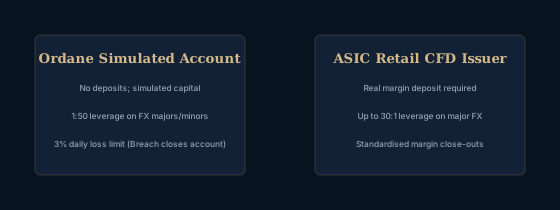
The table below compares Australian retail CFD protections under the ASIC product intervention order, which has been extended for a further five years to 23 May 2027 (ASIC product intervention order strengthens CFD protections | asic.gov.au, retrieved 2026-10-04), with the Ordane simulated Rulebook across four structural dimensions.
| Structural Dimension | Australian ASIC Retail CFD | Ordane Simulated Account |
|---|---|---|
| Margin Requirement | Real margin deposit required | No deposits; simulated capital |
| Leverage Caps | Up to 30:1 on major FX pairs | 1:50 on FX majors and minors |
| Stop-Out Trigger | Standardised margin close-outs | 3 percent daily loss limit |
| Account Balance Nature | Real margin deposit required | Virtual simulated funds |
Margin Accounts vs Simulated Capital
A retail margin account allows a trader to control a large position with a smaller real deposit acting as collateral. This creates direct financial exposure to the market. The Commodity Futures Trading Commission (CFTC) warns that leveraged forex trading carries substantial risk of loss (CFTC Customer Advisory, retrieved 2026-09-30). The regulator highlights the dangers of margin trading because the leverage mathematically amplifies potential losses, meaning a small adverse market movement can rapidly deplete the trader's actual deposited funds. When reviewing retail brokers, a concrete reader check is to examine the client agreement for the words "collateral", "margin call", and "negative balance". If these terms govern the trading balance, the trader is assuming real financial risk.
Conversely, in a simulated evaluation setting, traders must check for prop firm hidden fees within the terms and conditions rather than looking for margin rules. A practical reader check is to verify whether the platform explicitly denies accepting live deposits for trading. A trader's compensation depends strictly on the firm's documented conditions and its ongoing business continuity.
Execution and Internal Rules
In a retail setting, real funds are exposed to the market, and brokers pass financial consequences to the retail trader.
In a simulated prop firm environment, the platform operates under internal parameters. Traders often review what is the consistency rule prop firm constraints to understand how their simulated returns are evaluated.
How Simulated Environments Relate to Retail Leverage Caps
Simulated environments define their own internal leverage parameters for virtual trading, which often differ from the statutory leverage caps imposed on retail margin brokers. The table below maps the specific ASIC retail leverage caps alongside the settled Ordane simulated leverage rules, documenting the exact figures for different asset classes. (ASIC product intervention order, retrieved 2026-10-04) (Ordane Trading Specification, confirmed 2026-08-01)
The ASIC 30:1 Cap on Retail CFDs
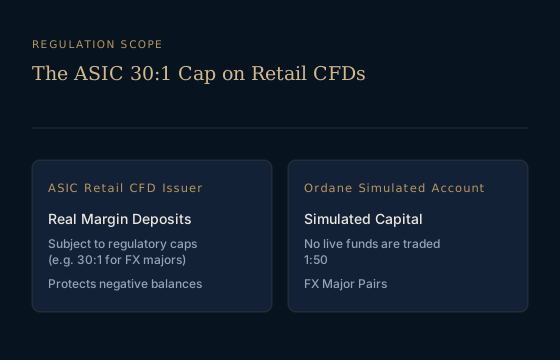
What is the leverage limit for retail CFD brokers? Retail leverage limits vary by jurisdiction. In Australia, the Australian Securities and Investments Commission (ASIC) caps retail contract for difference leverage at 30:1 for major currency pairs, and 20:1 for minor pairs, gold, and major stock market indices. (ASIC product intervention order, retrieved 2026-10-04). This regulatory framework is designed to throttle the speed at which retail investors can lose their deposited capital. The Australian ASIC product intervention order also protects against negative account balances by limiting a retail client's CFD losses strictly to the funds held in their CFD trading account. A concrete reader check involves verifying the broker's regulatory license number against the official government register to confirm these protections apply.
Asset-Specific Leverage Mapping
| Asset Class | ASIC Retail Leverage Cap | Ordane Simulated Leverage |
|---|---|---|
| FX Major Pairs | 30:1 | 1:50 |
| FX Minor Pairs | 20:1 | 1:50 |
Simulated Account Leverage Mechanics
Ordane's settled leverage is 1:50 on FX majors and minors, with full parameters available at the Ordane Trading Specification (confirmed 2026-08-01). Readers evaluating leverage differences should verify the platform's public specification sheet, matching the exact pair they intend to trade against the firm's stated limits. Do simulated accounts have leverage limits? Yes, simulated accounts have leverage limits defined internally by the firm's proprietary platform rules, such as Ordane's 1:50 limit on FX pairs.
What Is the Difference Between a Margin Call and a Daily Loss Limit?
A margin call is a standard mechanism in retail margin accounts, while a daily loss limit is the primary risk control in a simulated prop firm account. Both mechanisms exist to limit losses, but they operate on entirely different financial foundations.
Retail Margin Closeout Rules
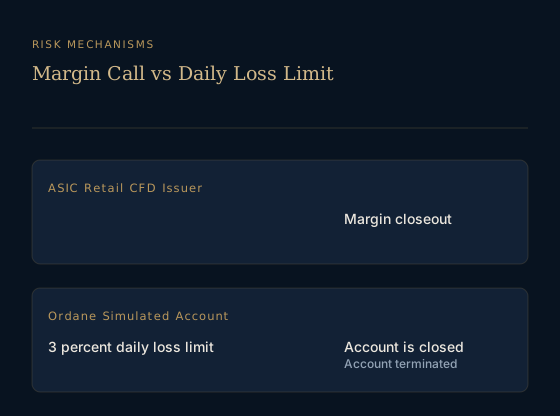
In the retail model, a margin call occurs when the account equity drops below a required maintenance threshold. If the trader does not rapidly deposit more funds to satisfy the requirement, the broker initiates an automated margin closeout. This mechanism liquidates live positions to manage the financial exposure on the margin collateral. In Australia, the ASIC intervention order standardises CFD issuers' margin close-out arrangements that act as a circuit breaker. Understanding a prop firm margin call vs loss limit is essential, as the retail mechanism is driven by actual market liquidity needs.
Prop Firm Breach and Account Termination
Conversely, prop firms utilize strict daily drawdowns. The Ordane daily loss limit is 3 percent, measured against the balance at the start of the server day. A breach closes the account. Traders often wonder, is a prop firm account a demo account?
What Markets Can You Trade at a CFD Prop Firm?
Market coverage at a CFD prop firm typically includes foreign exchange, major indices, metals, and cryptocurrency instruments, provided purely as simulated data feeds. The term CFD stands for contract for difference, which is a derivative mechanism that allows traders to speculate on price movements without owning the underlying asset. Prop firms utilize simulated CFDs to offer a variety of markets on their proprietary virtual platforms.
When comparing firms, CFD asset coverage is a primary consideration for traders aligning their specific strategies with a platform's offerings. To understand their financial obligations, participants often research can you lose money with a prop firm.
Traders must verify that their preferred asset class is actively supported before purchasing a simulated account, as markets and leverage variables differ between firms. The Ordane rulebook is public, numbered and versioned at Ordane Rulebook, ensuring the rules governing the account are documented clearly. Is a CFD propfirm the same as a CFD prop firm? Yes, "CFD propfirm" is simply shorthand for a CFD prop firm, referring to the exact same structural model of simulated capital trading.
Frequently Asked Questions About CFD Prop Firms
A CFD prop firm provides simulated capital for traders to execute strategies within a virtual environment. Evaluation programs differ widely across the industry, but they generally replace margin calls with strict, rule-based limits.
Are CFD prop firm trades routed to a live exchange?
At Ordane, accounts operate entirely on simulated capital; no live funds are traded and no deposits are accepted.
What Is the Difference Between a Margin Call and a Daily Loss Limit?
A margin call is a standard mechanism in retail margin accounts, while a daily loss limit is the primary risk control in a simulated prop firm account. Both mechanisms exist to limit losses, but they operate on entirely different financial foundations.
What is the leverage limit for retail CFD brokers?
Retail leverage limits vary by jurisdiction. In Australia, the Australian Securities and Investments Commission (ASIC) caps retail contract for difference leverage at 30:1 for major currency pairs, and 20:1 for minor pairs, gold, and major stock market indices.
Do simulated accounts have leverage limits?
Ordane's settled leverage is 1:50 on FX majors and minors. Leverage for metals, indices and crypto has not been set yet.
Sources
Primary sources are linked inline above.
Related reading
prop firm account reset vs new account
This article is for information only and is not investment, financial, or tax advice.
Ordane accounts operate on simulated capital. No live funds are traded and no deposits are accepted. Payouts depend on simulated performance under Rulebook v1.4; no level of performance is typical or assured.
Sources
- Ordane Rulebook v1.4, clause R-2 ordanemarkets.com Retrieved 2026-10-04.
- Ordane Trading Specification (confirmed 2026-08-01), mirrors canonical ordane-instruments-leverage-spreads ordanemarkets.com Retrieved 2026-08-01.
- ASIC 20-254MR product intervention order asic.gov.au Retrieved 2026-10-04.