Home · The Ordane Journal · Risk and exposure · What a Payout Does to Your Drawdown
What a Payout Does to Your Drawdown
What Does a Payout Do to Your Trading Buffer?
Ordane accounts operate on simulated capital. No live funds are traded and no deposits are accepted. Ordane sells one product, the Ordane Instant Account: direct access, no evaluation phase and no challenge, on simulated capital. That is the account this article is doing arithmetic on.
When a payout is deducted from a trading account, the balance falls by the deducted amount. What happens to the loss floor depends on the published rule. If the floor is static and anchored to the initial balance, it does not move, so the gap between balance and floor gets smaller by exactly the deduction. Some trailing programs instead reset the floor when a payout is processed.
Buffer is the distance between your current balance and the level at which your account closes, and it is the number that changes when you take a payout, not always by the amount you'd expect.
You passed the conditions, you asked for the money, the money arrived. Then a quieter question shows up on the next trading day: is this account easier to blow up now than it was yesterday?
A payout guide can explain how to request, how long approval takes and what split applies without showing what the deduction did to the distance between your balance and the line that closes your account. That distance is your buffer, and a payout can shrink it. Before any of this arithmetic matters, it helps to know how to check whether a firm pays at all.
The Short Answer: Your Balance Drops, Your Floor Might Not
That is the whole mechanism. Three numbers, not two.
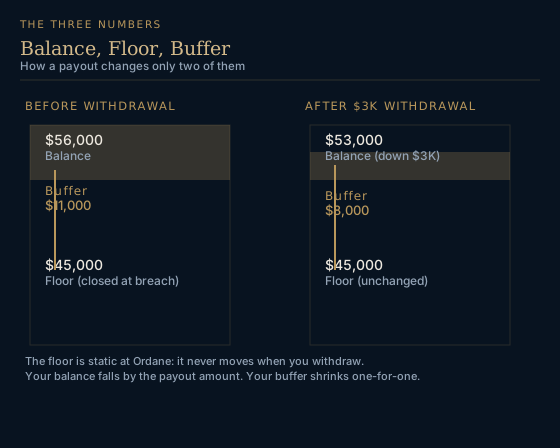
Balance is what the account shows right now.
Floor is the equity level at which the account closes. Call it the loss floor, the maximum loss limit, the drawdown line, the names vary by firm, and the mechanics behind that line are covered in our breakdown of static and trailing drawdown design.
Buffer is balance minus floor. It is the only one of the three that decides how much room you have left to be wrong, and it is the only one nobody prints on your dashboard.
A payout changes balance when the firm deducts it. Whether it changes the floor is a separate design decision. If the floor stays put while balance falls, buffer falls one-for-one with the deduction. This is exactly the kind of clause you should be reading before you pay, not after; see our checklist on how to vet a prop firm's rulebook before buying.
Static Floor vs Trailing Floor: What Happens After a Withdrawal?
Two designs behave very differently on the day after a payout.
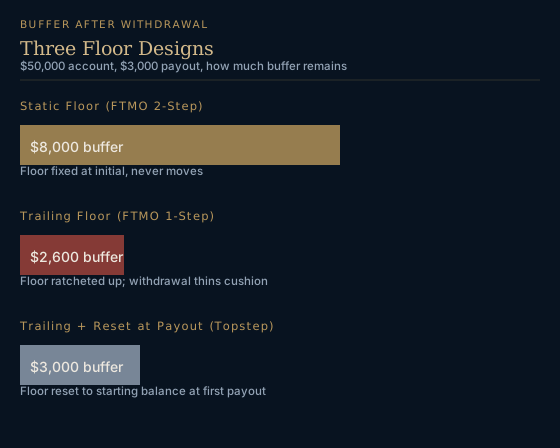
A static floor is fixed at a level derived from the initial balance and never moves. On the FTMO 2-Step Challenge, the Maximum Loss is a static limit fixed at the Initial Simulated Capital minus 10 percent, with no daily recalculation (FTMO.com, retrieved 2026-07-31). Under a static floor, a withdrawal is pure buffer reduction. Nothing offsets it.
A trailing floor moves upward as the account grows, but its payout reset rule must be checked separately. On the FTMO 1-Step Challenge, the Maximum Loss is an end-of-day limit recalculated daily from the highest balance achieved, or the Initial Simulated Capital if that is higher, minus 10 percent. Within that account the limit can only increase, never decrease. When a Reward is withdrawn and a new FTMO Account is provided, however, FTMO says the limit resets to 90 percent of Initial Simulated Capital (FTMO.com, retrieved 2026-08-04). Topstep's Maximum Loss Limit is also trailing: it rises as the end-of-day balance grows, never moves down and locks once it reaches the starting balance (Topstep Help Center, retrieved 2026-08-04).
With a trailing floor, the answer to "what does a payout do to my buffer" depends on two clauses: where the floor has already locked and whether the payout resets it. If the floor stays put, the deduction thins the existing buffer. If the payout resets the floor lower, recompute from the new floor before deciding how much room remains.
Topstep publishes an explicit post-payout rule for its Express account (XFA), or XFA: after the first payout, the Maximum Loss Limit is set to $0 regardless of where it was before (Topstep Help Center, retrieved 2026-08-04). The same page says an XFA balance starts at $0 and that the $50K, $100K or $150K label is buying power, not starting balance. Its worked example starts with a $10,000 balance, deducts a $5,000 payout and leaves a $5,000 balance against a $0 floor. Treating the 50K label as a $50,000 cash balance would produce the wrong arithmetic.
Here is the arithmetic without forcing unlike account models into one dataset.
| Case | Before payout | Payout rule | After payout | Buffer after |
|---|---|---|---|---|
| Illustrative static floor | $56,000 balance, $45,000 fixed floor | Deduct $3,000; floor stays fixed | $53,000 balance, $45,000 floor | $8,000 |
| FTMO 1-Step rule on $50,000 Initial Simulated Capital | End-of-day trailing floor within the account | A Reward withdrawal and new FTMO Account reset the floor to 90% of initial capital | $45,000 reset floor | Depends on the new account balance, which this rule does not state |
| Topstep XFA official example | $10,000 balance | Deduct $5,000; MLL becomes $0 | $5,000 balance, $0 floor | $5,000 |
The first row is computed: $56,000 minus $3,000 minus a fixed $45,000 floor equals an $8,000 buffer. The FTMO row stops where the source stops instead of inventing a new account balance. The Topstep row uses the XFA example published by Topstep, not the account's buying-power label.
The static-versus-trailing question itself, which shape is stricter overall and why the trailing version punishes a good week, belongs to our article on static and trailing drawdown. This one only answers what the withdrawal does to the floor.
How to Size a Payout Against the Buffer You Want to Keep
Work backwards from the buffer, not forwards from the profit.
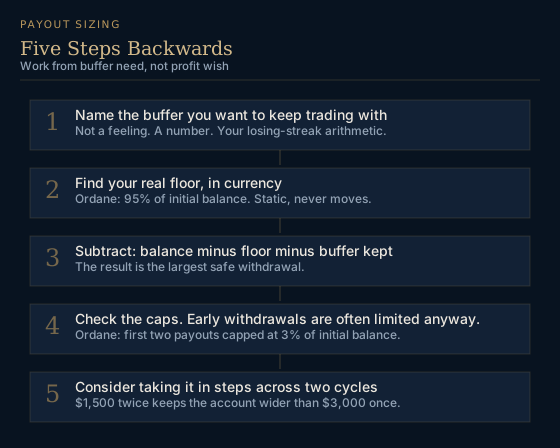
Step one: name the buffer you want to keep trading with. Not a feeling, a number. If your normal losing streak is four trades and each costs you a defined percentage of balance, your minimum working buffer is that streak plus room to be wrong about the streak. Write the number down before you look at the withdrawal screen.
Step two: find your real floor. Not the headline percentage, the actual level in currency. On a static design it is derived from the initial balance and you can compute it once and never again. On a trailing design you have to check where it has locked today, because it moved while you were winning.
Step three: subtract. Current balance minus floor is the buffer you have. Buffer you have minus buffer you want to keep is the largest withdrawal that does not put you into a thinner account than you are willing to trade.
Step four: check the caps. If the firm caps early payouts, the arithmetic may already be decided for you on the first couple of cycles. That is not a limitation to route around; on a fresh account it is the cap doing your risk sizing for you. The eligibility conditions behind those early cycles are laid out in our first-payout checklist.
Step five: consider taking it in steps. If the buffer maths says you can withdraw $3,000 but only just, withdrawing $1,500 twice across two cycles keeps the account trading at a width you can actually use, and the second half is still there.
The failure mode this prevents is specific: a trader takes the largest payout the rules allow, opens the platform the next day with the same position size they were using at the old buffer, and breaches on a losing sequence that the pre-payout account would have absorbed. Nothing changed about the strategy. The room changed. A separate clause that can quietly shrink what counts as payable profit before this stage is the consistency rule, worth checking alongside the buffer math.
| Question to answer before withdrawing | Where the number comes from |
|---|---|
| What is my floor, in currency? | Static: derived from initial balance and fixed. Trailing: today's recalculated level plus any published payout-reset rule (FTMO.com, retrieved 2026-08-04). |
| Does my floor move at the payout itself? | Firm's published rule. FTMO resets its 1-Step limit when a Reward is withdrawn and a new account is provided; Topstep sets the XFA limit to zero after the first payout (retrieved 2026-08-04). |
| Can my floor ever fall back? | A trailing floor may never move down during the account, yet still have a separate payout reset. Read both clauses. |
| What buffer do I need to trade normally? | Your own losing-streak arithmetic. |
| Am I capped this cycle anyway? | The firm's early-withdrawal caps. |
What Is Ordane's Rule on Floors and Payouts?
Ordane's answer is written into the rulebook rather than into a support reply, so you can check it before you buy.
Clause PA-4: withdrawals reduce the account balance, and the R-1 drawdown floor stays anchored to the initial balance (Ordane Rulebook v1.0, clause PA-4, retrieved 2026-07-31).
Clause R-1: Ordane's maximum drawdown is 5 percent and static: account equity may never fall below 95 percent of the initial balance. The floor is fixed on day one, never trails upward, and a breach closes the account (Ordane Rulebook v1.0, clause R-1, retrieved 2026-07-31).
Put those two clauses together and there is no ambiguity left. The floor is 95 percent of the initial balance on day one and it is 95 percent of the initial balance after your ninth payout. It never trails up behind a winning week, and it never resets down at a payout. The only number that moves when you withdraw is your balance, which means your buffer shrinks by exactly what you took out, and you can compute the result yourself with subtraction.
On a $50,000 Ordane Instant Account the floor is $47,500, permanently. Take a $2,000 payout from a $54,000 balance and you are at $52,000 against a $47,500 floor: buffer of $4,500 where it was $6,500. No lookup required, no support ticket, no recalculation at 00:00.
One more clause belongs in this picture. Clause PA-3: withdrawals #1 and #2 are each capped at 3 percent of initial balance, and from withdrawal #3 onward there is no cap (Ordane Rulebook v1.0, clause PA-3, retrieved 2026-07-31). On a $50,000 account that is $1,500 on each of the first two payouts, which is a third of the total buffer the account starts with. The cap is doing the sizing work described above for you while the account is youngest.
Ordane is new. Its live homepage says it cannot show years of payout history; the rulebook says payout performance metrics begin with the first month in which a payout is requested (ordanemarkets.com, checked 2026-08-04). What is checkable today is the arithmetic: a static floor stated as a clause number, and a clause saying the floor does not move when you withdraw.
Questions Traders Ask About Payouts and Drawdown
What happens to your drawdown after a payout?
When the payout is deducted, your balance falls by the deducted amount. A static floor stays where it was. A trailing floor may stay where it last ratcheted to or reset under a separate payout rule. Recompute the buffer from the post-payout balance and post-payout floor.
Does withdrawing shrink your buffer?
Under a static floor, yes, one-for-one. Deduct $2,000 and your buffer is $2,000 smaller because the floor is anchored. Under a trailing floor, you cannot know the result until you apply the payout-reset rule: a floor that stays put makes the buffer smaller, while a lower reset can offset part of the deduction.
Can you breach easier after taking a payout?
Yes, if the post-payout buffer is smaller and you keep trading the same size. A smaller buffer absorbs fewer losses of that size. The strategy did not change; the room did.
Does a payout lower your drawdown floor?
A static floor is unaffected by the payout. A trailing rule may reset the floor: FTMO resets its 1-Step limit to 90 percent of Initial Simulated Capital when a Reward is withdrawn and a new account is provided, while Topstep sets the XFA Maximum Loss Limit to $0 after the first payout (retrieved 2026-08-04). Read the specific clause, never assume.
Should you withdraw or keep the cushion?
Decide the buffer you need to trade your normal size, then withdraw the excess and nothing more. Taking the maximum the rules allow is not the same as taking the maximum the account can survive. Whether static and trailing floors change that calculation is covered in our article on the two floor designs.
Sources
- Trading Objectives | FTMO.com. ftmo.com Retrieved 2026-07-31.
- What is the Maximum Loss Limit? | Topstep Help Center. help.topstep.com Retrieved 2026-07-31.