Home · The Ordane Journal · Rules and mechanics · Prop Trading Futures
Prop Trading Futures
Prop trading futures is a model where traders pay a fee to access simulated capital and trade futures contracts without risking personal funds. Ordane accounts operate on simulated capital. No live funds are traded and no deposits are accepted. (Ordane Rulebook v1.0, clause P-2, retrieved 2026-09-29)
What Is Prop Trading Futures?
Prop trading futures is a model where traders pay a fee to access simulated capital and trade futures contracts. If the trader generates simulated profits while following risk rules, they receive a payout based on a profit split. The firm provides the platform and the data feed for the trader.
Futures markets operate on centralized exchanges like the Chicago Mercantile Exchange. Unlike spot forex, futures contracts have centralized pricing, standardized contract sizes, and specific expiration dates. Traders speculate on the price movements of equity indices, commodities, and interest rates. Popular instruments include the E-mini S&P 500, the E-mini Nasdaq 100, and crude oil. Data feeds are provided by dedicated technology companies, ensuring low latency and accurate pricing. Traders use sophisticated software platforms that display depth of market, footprint charts, and volume profiles to make informed decisions. These tools are standard in the industry and require robust infrastructure to function without interruption. The CME provides Level 1 and Level 2 data, allowing traders to see the order book and execute trades with precision. Understanding market microstructure is essential for anyone trading index futures or commodities, as the volume and volatility require fast decision-making and robust risk management software.
When participating in this model, the individual does not open a brokerage account or deposit margin. Instead, the firm grants access to a simulated trading environment connected to real-time market data. The firm monitors all activity. If the trader adheres to the maximum drawdown limits and achieves the required profit thresholds, they become eligible for a portion of the simulated gains. This structure removes the need for personal trading capital, replacing it with a fixed upfront cost and strict compliance with the firm's parameters.
How Do Payouts Work in Prop Trading?
Payouts are processed by withdrawing simulated profits from the account, subject to minimum withdrawal limits and processing timelines.
The most significant fear in the industry is passing an evaluation, following all the rules, and never getting paid. The payout process is where the mechanics of the firm are tested. Payouts are paid in real money from company fee revenue. To request a payout, the trader must usually reach a minimum profit threshold and navigate a waiting period. Traders must read the payout policies carefully before purchasing an account. Some firms restrict the first withdrawal to a specific dollar amount or require a minimum number of active trading days before a request can be submitted. The buffer zone is another common mechanic, meaning the trader must leave a portion of the simulated profits in the account to absorb future drawdowns. This protects the firm but delays the trader's ability to extract the full value of their performance.
Once requested, the timeline for approval and transfer varies wildly across the industry. Some firms process requests manually at the end of the month, while others utilize automated systems to disburse payments via cryptocurrency or bank transfer within a few days. The lack of a firm deadline often leads to weeks of delays.
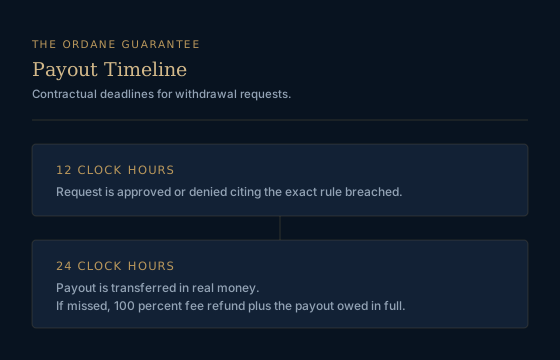
Clear deadlines solve this fear. Every withdrawal request is approved, or denied in writing citing the exact rule breached by section number, within 12 clock hours. Past that deadline the request is treated as approved and the G-1 clock starts. (Ordane Rulebook v1.3, clause G-0, retrieved 2026-09-29) A payout approved and not paid within 24 clock hours, not business hours, triggers automatic compensation: a 100 percent refund of the account fee, plus the payout owed in full. (Ordane Rulebook v1.3, clause G-1, retrieved 2026-09-29) This mechanism is known as The Ordane Guarantee, which contractually enforces the payment timeline.
Documented Rules
Documented rules establish the exact risk parameters, daily loss limits, and drawdown calculations that govern the simulated trading environment.
The second fear traders face is discovering a hidden rule that invalidates their work at the moment of withdrawal. Firms enforce daily loss limits, maximum drawdowns, and consistency rules. A daily loss limit dictates how much equity can be lost in a single trading day, usually measured against the balance at the start of the server day. The maximum drawdown dictates the absolute floor of the account.
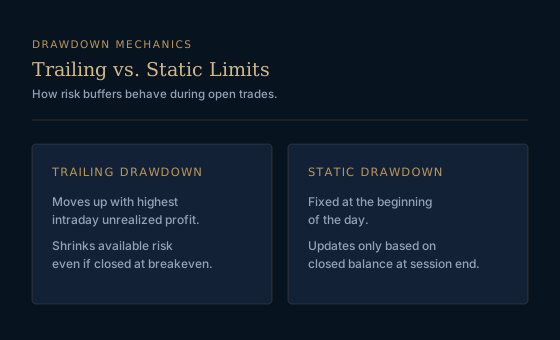
Some firms use a trailing drawdown that tracks the highest intraday unrealized profit. If a trade goes into profit but then reverses, the trailing drawdown moves up, artificially shrinking the available risk buffer even if the trade is closed at breakeven. Other firms use a static end-of-day drawdown, which is calculated only when the daily session closes, providing more room for intraday fluctuations.
Traders also face consistency rules, which prevent a single lucky trade from clearing an evaluation or generating a massive payout. A consistency rule ensures that the trader can demonstrate repeatable performance over multiple days, rather than relying on an anomalous market event like a major news release to hit a profit target in a single session. This rule requires careful position sizing and daily discipline.
To address the fear of changing parameters, documentation must be rigid. The Ordane rulebook is public, numbered and versioned, and no rule is ever applied retroactively to an open account. Changes produce a new version with a dated changelog entry, and the version you sign up under is the version that governs your account. (Ordane Rulebook v1.0, section 6, retrieved 2026-09-29)
Verification Before Paying
Before paying, traders must verify the firm's legal registration, the transparency of its payout mechanics, and the clarity of its rulebook.
The third fear is whether the firm will still exist in twelve months. Traders must perform rigorous due diligence before committing capital to any evaluation or instant account.
Regulatory oversight is a primary concern. The CFTC strongly urges the public to verify a company's registration with the Commission. (CFTC Customer Advisory, retrieved 2026-09-29) While many firms operate outside direct regulatory frameworks by offering simulated environments, transparency remains the only defense against insolvency. Traders should demand proof of liquidity rather than relying on promotional claims.
A firm that intends to operate long-term will publish its mechanisms for honoring payouts. The payout reserve address is disclosed on-chain for any purchase bound to this version of the Ordane Rulebook. (Ordane Rulebook v1.3, clause PR-1, retrieved 2026-09-29) This allows anyone to independently verify the existence of the funds designated for payouts, removing the need for blind trust.
| Verification Step | Purpose | What to Look For |
|---|---|---|
| Regulatory Status | Ensure the company is not operating a fraud | The CFTC strongly urges the public to verify a company's registration with the Commission. (CFTC Customer Advisory, retrieved 2026-09-29) |
| Payout Mechanics | Confirm how and when payouts are processed | Clear contractual deadlines, such as a 24 clock hour guarantee |
| Rulebook Clarity | Avoid hidden rules that deny payouts | A public, numbered, and versioned rulebook that never applies retroactively |
| Reserve Transparency | Verify the existence of payout funds | An on-chain payout reserve address disclosed for independent verification |
What Are the Costs and Profit Splits?
Traders pay evaluation fees, monthly data subscriptions, and activation fees, while receiving a percentage of their simulated profits.
The financial structure involves several layers of costs. The most visible cost is the initial fee to enter an evaluation or purchase an instant account. For evaluations, this fee is often structured as a recurring subscription until the trader passes or fails. For example, Topstep (prop firm) charges $49/month for the 50K Trading Combine. (Topstep Pricing, retrieved 2026-09-29)
Once a trader passes an evaluation, many firms require a separate activation fee to set up the payout-eligible stage. Additionally, futures traders require real-time market data from exchanges like the CME. This data is not free. Non-professional data feeds incur monthly exchange fees per market, which the trader must usually pay out of pocket or have deducted from their account balance.
Instant accounts bypass the evaluation phase completely. The trader pays the fee and immediately begins trading on an account where profits are eligible for withdrawal. Because the firm does not have a testing phase to filter traders, the risk parameters on instant accounts are often tighter, and the upfront fee is higher compared to a challenge of the same size. Ordane sells one product, the Ordane Instant Account: direct access, no evaluation phase and no challenge, on simulated capital. (Ordane Rulebook v1.0, section 1, retrieved 2026-09-29)
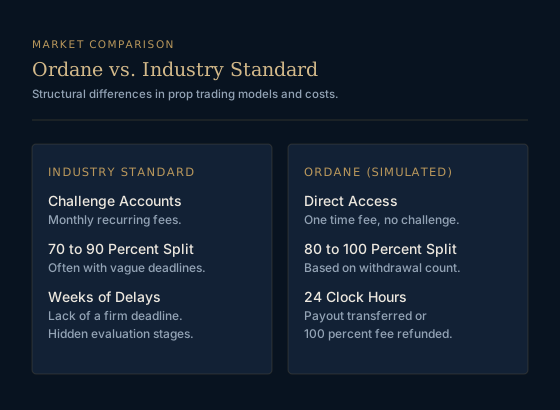
Profit splits determine how much of the simulated profit the trader actually receives. Prop firm traders typically keep 70 to 90 percent of profits, with top firms in 2026 offering 80 to 100 percent splits. (2026 Guide to Prop Firms, retrieved 2026-09-29) The split often depends on the specific program or the trader's history with the firm. Traders must verify whether the split applies to the gross profit or if data fees and platform commissions are deducted first.
| Feature | Ordane (Simulated) | Industry Standard |
|---|---|---|
| Capital Type | Simulated capital, no live funds | Most firms use either challenge/evaluation accounts or instant funding with stricter risk rules. (Prop Firm Rules Explained, retrieved 2026-09-29) |
| Profit Split | 80 to 100 percent based on withdrawal count | 70 to 90 percent of profits. (2026 Guide to Prop Firms, retrieved 2026-09-29) |
| Evaluation Cost | Paid once, direct access | Monthly recurring fees, such as evaluation subscriptions that bill every month until you pass. (Topstep Pricing, retrieved 2026-09-29) |
| Payout Deadline | 24 clock hours or fee refunded | Varies wildly, often weeks of delays |
FAQ: Prop Trading Futures
This section answers five common questions regarding prop trading futures, rules, platforms, and account types.
Do I need my own capital to trade futures?
No. In this model, you pay a fee for access to a simulated environment. You do not deposit margin or trade live funds. The firm provides the software, the data feed, and the risk framework.
What is the difference between a trailing drawdown and a static drawdown?
A trailing drawdown moves up as your open positions generate unrealized profit. If the market reverses, your available risk shrinks. A static drawdown is fixed at the beginning of the day and only updates based on your closed balance at the end of the trading session.
Are there monthly data fees in prop trading?
Many firms charge monthly data fees for exchange data like the CME, especially after you pass an evaluation.
What happens if I breach a rule?
If you breach a rule, such as the daily loss limit or the maximum drawdown, the account is closed. In an evaluation model, you can usually pay a reset fee to start over. In an instant model, you must purchase a new account.
How do I know the firm will pay me?
You should look for contractual guarantees and verifiable proof of liquidity. A firm should provide a transparent ledger or an on-chain reserve address. Promotional language is not a substitute for a documented payout policy.
Sources
- Topstep Pricing help.topstep.com Retrieved 2026-09-29.
- Topstep Terms of Use topstep.com Retrieved 2026-09-29.
- CFTC Customer Advisory cftc.gov Retrieved 2026-09-29.