Home · The Ordane Journal · Payouts · Prop Firm Withdrawal Requirements: First-Payout Checklist
Prop Firm Withdrawal Requirements: First-Payout Checklist
You passed. You are in profit. Then the request button will not move, and you cannot see why. That gap is where most first payouts stall: not because the firm refuses, but because one condition was left unmet. This page names every condition, in order, so you can tick it off yourself before you ask. Ordane accounts operate on simulated capital. No live funds are traded and no deposits are accepted. Clause P-2 of the Ordane Rulebook v1.0 requires that declaration, so an Ordane payout settles a simulated result rather than returning a deposit. The same holds across the prop model: a trader is paid on the result of a simulated account, not on money put in.
What prop firm withdrawal requirements actually are
Prop firm withdrawal requirements are the conditions an account must satisfy before a firm will allow a first payout request: a minimum number of trading days, a minimum profit or cleared buffer, completed identity verification, an approved payout method, and an open payout window, all met at once.
Miss one condition and the request does not process, no matter how large the profit.
Why the gates exist, stated without spin
The gates are not there to trap you. A minimum-day count separates a repeatable process from one lucky session. An identity check satisfies anti-fraud and payment rules before any money moves. A minimum withdrawal amount keeps processing costs sane. None of that is generosity and none of it is malice. It is a checklist, and a checklist can be cleared.
This page owns one link in the chain: eligibility, meaning what has to be true before you are allowed to request. It does not cover how long the money then takes to arrive, which is handed off in full at the end of this page, and it does not re-argue whether a firm honours a cleared request once the request is in.
The five gates before your first payout
The checklist table
| Gate | What it checks | Why a firm imposes it |
|---|---|---|
| Minimum trading days | A set number of active days, often days that clear a minimum net profit | Confirms a repeatable process, not one session |
| Minimum profit or buffer | A profit floor, or a cushion the account must keep above its start balance | Screens out marginal accounts and covers risk |
| KYC identity verification | Government ID, sometimes proof of address | Anti-fraud and payment-rail rules before money moves |
| Allowed payout method | The rails the firm actually supports, each with its own minimum | Determines whether your balance clears the processing floor |
| First-payout cycle | A waiting period from the first trade before the window opens | Sets the earliest date you may request |
The order to satisfy them in
Clear them in this order, because one gate blocks all the others if you leave it late.
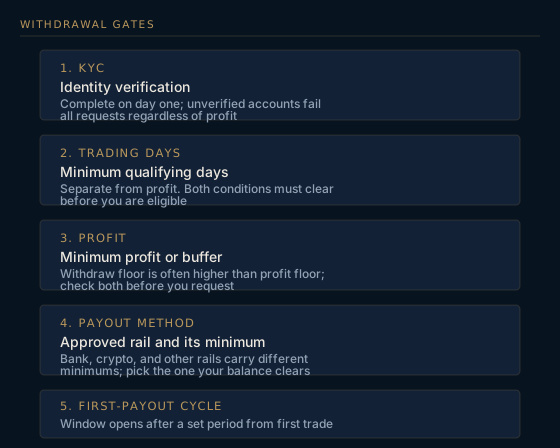
First, KYC. It is the only gate you can finish on day one, before you have traded a single session, and an unverified account fails automatically regardless of profit. Second, track your trading days. Third, confirm your profit clears the threshold, not just that you are green. Fourth, pick a payout method whose minimum your balance will pass. Fifth, watch the cycle so you request on the first eligible date, not before.
The rest of this page takes each gate in turn.
Minimum trading days: why hitting the profit target early does not pay you
This is the gate that surprises fast traders. You can reach the profit target in two sessions and still not qualify, because the day count is a separate condition from the profit condition. Both must clear.
What counts as a qualifying day
A qualifying day is usually not just a day you placed a trade. It is often a day that cleared a minimum net profit. At Topstep, a payout needs 5 winning days of $150 or more in Net P&L, per Topstep's own payout policy, retrieved 2026-07-24. At MyFundedFutures on the 25K Flex plan, a payout needs 5 winning days of at least $100 net profit each, per MyFundedFutures' own payout policy, retrieved 2026-07-24. A flat day does not count toward the total at either firm.
Consecutive versus unique days
The days must be distinct days, and what a firm counts is qualifying days, not calendar days. Whether they have to run back to back is not stated: Topstep's payout policy and MyFundedFutures' both give the count and neither answers that either way. Not found in sources is the honest reading, so check your own firm's payout page before you plan around it.
One caution that lives on another page. A consistency clause can withhold a payout even after your day count and profit both clear, by capping how much of your total can come from a single day. That mechanic is its own rule, covered in full at what the consistency rule caps and how it is calculated.
Minimum profit and buffer thresholds
Three numbers get conflated here. Separate them and the math gets simple.
Minimum profit versus minimum withdrawal amount
The minimum profit is what makes you eligible. The minimum withdrawal amount is the smallest sum the firm will actually process, and it is often higher. FTMO sets a minimum closed profit of at least $20 for bank wire and $50 for cryptocurrency, per FTMO's own FAQ, retrieved 2026-07-24. Topstep sets a minimum payout of $125, per Topstep's payout policy. MyFundedFutures sets $250 on Flex plans, $500 on Rapid after the buffer, and $1,000 on Pro, per MyFundedFutures' payout policy. Being in profit is not the bar. Clearing the withdrawal floor is.
The profit buffer some firms hold back
Some futures firms also require a buffer: a cushion the account must hold above its starting balance, so a payout cannot pull the account back to fragile ground. MyFundedFutures Rapid, for instance, sets its minimum withdrawal specifically after the buffer is met, per MyFundedFutures' payout policy.
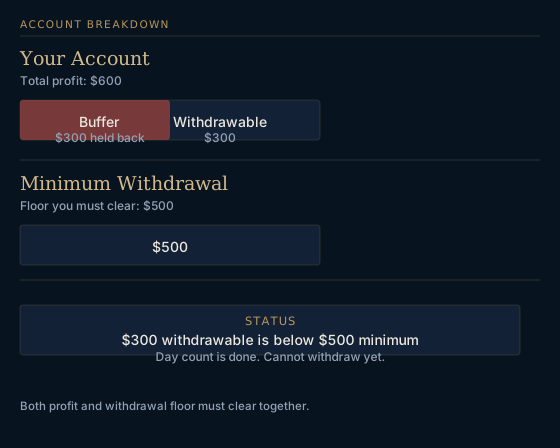
Worked example. Say you are on a plan with a $500 minimum withdrawal that only counts profit above the buffer. You have cleared your 5 winning days, and your account shows $600 in profit, but $300 of that is buffer the plan holds back. Your withdrawable figure is $300, below the $500 floor. The day count is done and you still cannot withdraw yet. Redo that subtraction on your own account before you press request.
KYC and payout methods: the identity check and how the money leaves
Two gates that have nothing to do with trading, and both can be prepared early.
What KYC asks for and how long it takes
KYC, know your customer, is a one-time identity verification: a government ID, and sometimes proof of address. Most firms run it before a first payout clears, and an unverified account fails the request no matter the profit. At MyFundedFutures, a first payout triggers an email to sign agreements via Riseworks before the money transfers, per MyFundedFutures' help center. At Ordane the timing is published in the FAQ on ordanemarkets.com; for when a prop firm runs KYC across the category, see the fuller breakdown. KYC happens once, at the first withdrawal request, not at purchase. There is no re-verification loop at every payout. Some firms do not publish this step in their payout policy, so treat it as a likely one-time check rather than assume it is absent. Either way, the fix is the same: get your documents ready early so identity is never the reason a cleared payout sits waiting.
Bank, crypto, and processor rails
The rails differ by firm, and each rail carries its own minimum. FTMO pays via bank wire, instant transfer through Visa Direct or Mastercard Send, Skrill, or cryptocurrencies, per FTMO's own FAQ. Topstep supports Prop-to-Brokerage, Aeropay, Wise, ACH, and Wire or SWIFT, per Topstep's payout policy. MyFundedFutures pays via bank transfer or cryptocurrency, per MyFundedFutures' help center. Pick the method whose minimum your first payout will clear, and set it up before you request.
The first-payout cycle: when the request window opens
Waiting period from first trade
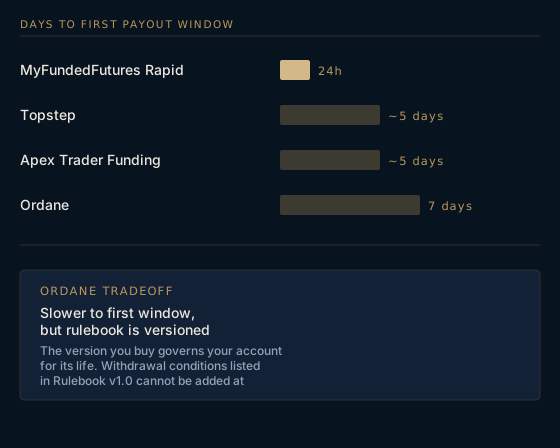
Many firms open the first payout window only after a fixed waiting period measured from your first trade. FTMO lets a trader request a first reward on the 14th day, or any following day, after the first placed trade, per FTMO's own FAQ. MyFundedFutures Rapid makes the first payout eligible just 24 hours after the first trade, with buffer and minimum profit still required, per MyFundedFutures' payout policy. Same industry, very different clocks.
Recurring payout cadence after the first
After the first payout, firms set a recurring cadence for later requests, and it is often shorter than the first wait. MyFundedFutures Rapid, for example, moves to daily payout frequency once eligible, per MyFundedFutures' payout policy.
Here is the boundary, in one line. Eligibility timing is when you are allowed to request, and that is what this page settles. Processing and arrival timing is how long the money takes once you have requested, and that is a separate question. For arrival speed and any pay-or-refund guarantee, read how long a payout takes to arrive.
First-withdrawal requirements at three named firms
Here is the first-payout bar at three live firms, on one screen. It is honest by design. Where a firm publishes its rules more clearly or opens the window faster than Ordane, that is recorded, not buried.
Two sourcing notes, and the first one costs us a row. Apex Trader Funding sat in this table until 2026-07-25 and does not any more: every Apex figure we held came from a third-party review guide rather than from Apex's own payout page, and a review guide is not a firm's documentation. The row is out until Apex's own page is readable. The three firms below each rest on that firm's own policy or FAQ. Second note: the KYC column asserts only what a source states, so where a firm's published payout policy does not mention KYC, the cell says exactly that instead of guessing a yes or a no.
As of 2026-07-24. Payout pages change often; reverify before you rely on any figure.
| Firm | Qualifying days required | What counts as a qualifying day | Min profit or withdrawal | KYC before first payout | First-payout window |
|---|---|---|---|---|---|
| FTMO | None stated; the gate is a calendar wait | Not applicable, the count runs from the first placed trade | $20 min closed profit on bank wire, $50 on crypto | Not stated in the sourced FAQ | The 14th day after the first placed trade |
| Topstep | 5 winning days | A day with $150 or more in Net P&L | $125 min payout; first payout exempt from the standing-profit rule | Not stated in the sourced payout policy | After 5 winning days |
| MyFundedFutures | Flex: 5 winning days; Rapid: none stated | Flex: a day with at least $100 net profit on the 25K plan | $250 Flex; $500 Rapid after buffer; $1,000 Pro | Sign agreements via Riseworks before the first payout | Flex: after 5 winning days; Rapid: 24 hours after the first trade |
Read the table for what it shows. On raw speed to the first window, MyFundedFutures Rapid at 24 hours is faster than Ordane, and we will say so plainly below.
How Ordane handles the first payout: the clauses you can read first
Concession first, no hedging. Ordane is new and has no payout history. There is nothing to show yet, and no payout history will be manufactured. On raw speed to the first window, the MyFundedFutures Rapid plan at 24 hours after the first trade is faster than Ordane, per MyFundedFutures' own payout policy. Being new is a fact we state, not one we dress up.
Ordane sells one product, the Ordane Instant Account: direct access, no evaluation phase and no challenge, on simulated capital (Ordane Rulebook v1.0, section 1).
What Ordane offers instead is a contract you can read before you pay, published in full at the Ordane Rulebook. Its standing notice is the part that governs a first payout. The Ordane rulebook is public, numbered and versioned, and no rule is ever applied retroactively to an open account. Changes produce a new version with a dated changelog entry, and the version you sign up under is the version that governs your account. So the withdrawal conditions printed in the version you bought are the ones your first request is judged against.
One boundary, because it is the thing most often stretched. The closed list of prohibited practices in clause R-6 governs how you may trade, not what you must clear to withdraw. Read it in the rulebook; it is not summarised here. The withdrawal gates are their own clauses.
Clause PA-1 sets the calendar. The first withdrawal is available 7 calendar days after account activation, and the cycle thereafter is every 14 days. Clause G-0 sets the answer clock. Every withdrawal request is approved, or denied in writing citing the exact rule breached by section number, within 24 clock hours. Past that deadline the request is treated as approved and the G-1 clock starts. The second half is the half that matters: a deadline alone is a promise, while a missed deadline that counts as an approval removes the open-ended "under review". Clause G-1 then prices the payment deadline. A payout approved and not paid within 48 clock hours, not business hours, triggers automatic compensation: a 100 percent refund of the account fee, plus the payout owed in full.
On the proof behind those clauses, the honest tense is future. Ordane's payout reserve is published at a public TRON address on ordanemarkets.com, with a dated observed balance, before the first account is sold. Ordane records that as clause PR-1, which is a commitment rather than a receipt, and this page will not call it anything else.
Price and split, last, because that is where they belong. An Ordane account is a one-time purchase, from $139 for the smallest of the four sizes to $999 for the largest, with no recurring fee, and the full four-row price table is owned by the rulebook rather than restated here. On the split, the ladder and its cap belong in the same breath, because a contract term with the limit removed is a different claim. Under clause PA-2, Ordane's profit split starts at 60 percent and rises 5 percentage points with every completed withdrawal, reaching 100 percent from the ninth withdrawal onward. The cap that travels with it is clause PA-3. Withdrawals #1 and #2 are each capped at 3 percent of initial balance. From withdrawal #3 onward there is no cap.
Questions traders ask about prop firm withdrawal requirements
What are the requirements for a first prop firm withdrawal?
Typically five conditions: a minimum number of trading days, a minimum profit or a cleared buffer, completed KYC identity verification, an approved payout method that your balance clears, and an open first-payout window. All must be met at once. Missing any single one holds the request, regardless of how large the profit is.
How many trading days do I need before my first payout?
It depends on the firm. Topstep and MyFundedFutures Flex ask for 5 winning days that clear a minimum net profit, per each firm's own payout policy. FTMO instead opens the window on the 14th day after your first placed trade, per FTMO's own FAQ. Count qualifying days rather than calendar days, because a flat day does not count at the firms that require winning days.
Do I have to complete KYC before I can withdraw?
Usually yes, once. It is a one-time identity check, and an unverified account fails automatically. MyFundedFutures has you sign agreements via Riseworks before the first payout, per its own help center. At Ordane, per the FAQ on ordanemarkets.com, KYC happens once, at the first withdrawal request, not at purchase. There is no re-verification loop at every payout. Complete it on day one so it never delays a cleared payout.
Why can I not withdraw after hitting my profit target?
Because the profit target and the payout requirements are separate. You may still owe trading days, a buffer above the start balance, KYC, or the opening of the first-payout window. Hitting the target proves the account can win. The gates prove it did so over a process, and clear anti-fraud checks, before money moves.
Do any firms let me withdraw with no minimum trading days?
One plan comes close. The MyFundedFutures Rapid plan makes the first payout eligible 24 hours after the first trade, with a buffer and minimum profit still required, per MyFundedFutures' own payout policy, retrieved 2026-07-24. No firm sourced on this page removes the profit and buffer conditions underneath. A short clock is not a shorter list of conditions.
Sources
- How do I withdraw my reward? | FTMO.com ftmo.com Retrieved 2026-07-24.
- Topstep Payout Policy | Topstep Help Center help.topstep.com Retrieved 2026-07-24.
- Payout Policy Overview, Best and Fastest Prop-Firm Payouts | My Funded Futures Help Center help.myfundedfutures.com Retrieved 2026-07-24.
- Guide to Your First Payout: Quick and Easy Process | My Funded Futures Help Center help.myfundedfutures.com Retrieved 2026-07-24.
- Ordane Rulebook v1.0, clause P-2 ordanemarkets.com Retrieved 2026-07-25.
- ordanemarkets.com, payout ledger section ordanemarkets.com Retrieved 2026-07-25.