Home · The Ordane Journal · Risk and exposure · Prop Firm Daily Loss Limit: Balance vs Equity
Prop Firm Daily Loss Limit: Balance vs Equity
Ordane accounts operate on simulated capital. No live funds are traded and no deposits are accepted. Payouts depend on simulated performance under Rulebook v1.0; no level of performance is typical or assured.
Ordane sells one product, the Ordane Instant Account: direct access, no evaluation phase and no challenge, on simulated capital.
The daily limit is only one kill switch. Compare it with static versus trailing maximum drawdown, then account for overnight and weekend exposure and news-trading windows. A separate stop-loss slippage buffer protects execution room without changing any firm rule.
By the Ordane desk The same 3 percent limit behaves like two different rules depending on whether it is measured against balance or equity.
The definition is a two-line job. Where firms actually differ, and where their documentation tends to go vague, is the reference and the reset clock. So the rest of this guide is about those two things, not the dictionary.
Does the daily loss limit measure balance or equity?
ESMA's product-intervention notice states that CFDs are complex instruments and come with a high risk of losing money rapidly due to leverage (ESMA, retrieved 2026-08-10). That leverage risk is the independent frame behind any prop CFD-style ticket.
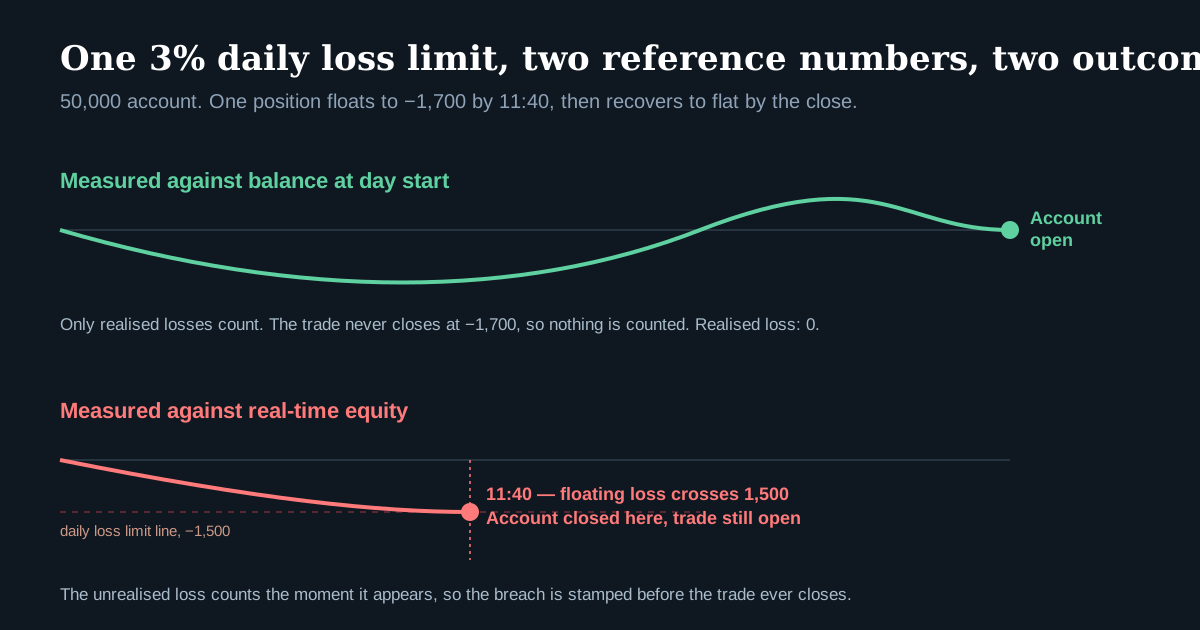
It measures whichever reference balance the firm's published rule names, and that single choice decides whether a floating loss can close the account before the trade closes.
The 45-word answer, quotable as written
A daily loss limit is the most an account may lose in one trading day before the account is closed, set as a percentage of a reference balance. If that reference is real-time equity, a floating loss counts immediately. If it is the balance at the start of the trading day, it does not count until the trade closes. Ordane's own daily loss limit is 3 percent, measured against the balance at the start of the server day, so a floating loss on an open position does not count until the trade closes (Ordane Rulebook v1.0, clause R-2).
What happens to the same trade under balance versus equity references?
Check this yourself. If the rule only makes sense as numbers, run Challenge Fit against your own size and loss floor, then confirm the written version in the Ordane Rulebook v1.0 (https://ordanemarkets.com/rulebook) before you pay.
Next step. After you can name the limit in numbers, compare how an Instant Account changes that math versus an evaluation account in Instant Account vs evaluation.
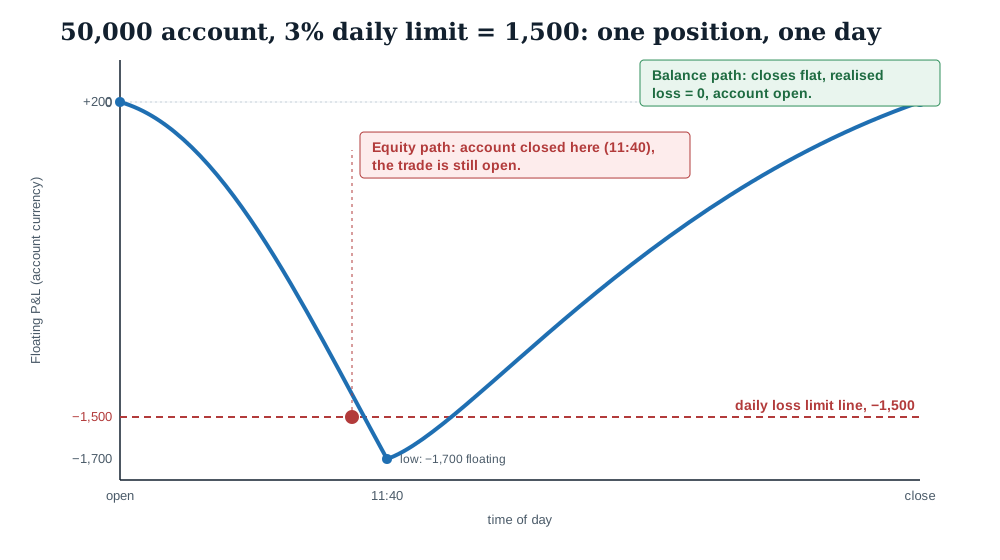
A 50,000 account with a 3 percent daily loss limit and the same intraday sequence produces one closed account under equity and one surviving account under balance.
Where exactly the two paths diverge
The two paths split at the exact instant the floating loss crosses 1,500. Under equity, that instant is the breach. Under balance, that instant is nothing, because no trade has closed. That single sentence is the whole difference.
| One trading day on the 50,000 account, 1,500 line | Equity-referenced limit | Balance-referenced limit |
|---|---|---|
| Reference the limit is measured against | Real-time equity, balance adjusted for every open position | Balance at the start of the trading day |
| Floating loss reaches 1,700 on the open position | Counts the moment it appears | Not counted while the trade is open |
| 11:40, the floating loss crosses 1,500 | Breach, the account is closed there | Nothing, because no trade has closed |
| End of the day | The afternoon recovery never happens, the account no longer exists | Position closes flat, realised loss zero, account open for the next session |
| Three trades closed at a realised 600 loss each, 1,800 on the day | Breach, realised losses count | Breach, realised losses count |
When does the reference balance reset?
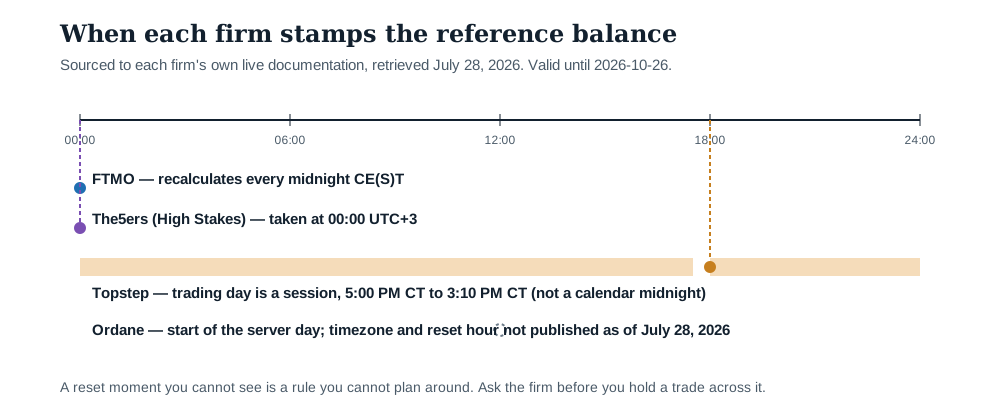
A balance-referenced limit is only as knowable as the moment the balance is stamped, and that moment is the firm's server day boundary, not the trader's local midnight.
How is the daily loss limit different from maximum drawdown?
The daily loss limit resets every trading day and caps a single day's loss, while the maximum drawdown is the account-life floor that never resets, so either can close the account independently.
Where do named firms draw the line and what do they measure it against?
The named firms below publish their daily-loss figure, measurement reference, floating-P&L treatment, reset boundary and timezone, so each column shows exactly where the line is drawn and what it is measured against.
| Attribute | FTMO (2-Step Challenge) | Topstep | The5ers (High Stakes) | Ordane |
|---|---|---|---|---|
| Daily-loss figure | 5% of the initial simulated capital (FTMO Academy, Maximum Daily Loss, retrieved July 28, 2026) | 1,000 on a 50K account, 2,000 on a 100K account, 3,000 on a 150K account (Topstep Help Center, Daily Loss Limit, retrieved July 28, 2026) | 5% daily drawdown (The5ers, High Stakes Program rules, retrieved July 28, 2026) | 3 percent (Ordane Rulebook v1.0, clause R-2) |
| Measured against | Account equity, including open positions, commissions and swaps (FTMO Academy, Maximum Daily Loss, retrieved July 28, 2026) | Net P&L during the trading day (Topstep Help Center, Daily Loss Limit, retrieved July 28, 2026) | Closing equity or balance of the previous day (The5ers, High Stakes Program rules, retrieved July 28, 2026) | Balance at the start of the server day (clause R-2) |
| Floating P&L counts? | Yes, equity is checked at any time (FTMO Academy, Maximum Daily Loss, retrieved July 28, 2026) | Yes, net P&L intraday (Topstep Help Center, Daily Loss Limit, retrieved July 28, 2026) | Not stated in The5ers' cited rule | No, balance-referenced (clause R-2) |
| Reset boundary and timezone | Recalculated every midnight CE(S)T (FTMO Academy, Maximum Daily Loss, retrieved July 28, 2026) | Trading day runs 5:00 PM CT to 3:10 PM CT (Topstep Help Center, Daily Loss Limit, retrieved July 28, 2026) | Taken at 00:00 UTC+3 (The5ers, High Stakes Program rules, retrieved July 28, 2026) | Server day; timezone and reset hour not published as of July 28, 2026 |
| Resets daily? | Yes | Yes | Yes | Yes (clause R-2) |
As of July 28, 2026. The three competitor columns carry a 90-day re-check, because these limits change without notice.
How does Ordane's daily loss limit work?
Ordane's daily loss limit is 3 percent, measured against the balance at the start of the server day, and a breach closes the account (Ordane Rulebook v1.0, clause R-2). Ordane sells one product, the Ordane Instant Account: direct access, no evaluation phase and no challenge, on simulated capital (Ordane Rulebook v1.0, section 1).
Every sentence about the rule in this section is copied from the Ordane rulebook, not restated. The governing document is Ordane Rulebook v1.0, published 2026-07-23.
In the language of this guide, Ordane is balance-referenced: a floating loss on an open position does not count until the trade closes.
Read it beside the risk rule and the design becomes visible. Maximum risk per trade is 1.5 percent of current balance and a stop-loss is mandatory at entry. Two maximum losses equal the daily limit, which is the design rather than an accident. That is Ordane Rulebook v1.0, clause R-3. Two maximum-risk losses reach the line exactly, which tells you in arithmetic how many full-size losses the rule expects you to survive in a day.
How do you size so two stops cannot reach the line?
No method removes the rule, but three habits keep the daily limit from being reached by a sequence you did not plan.
At Ordane the daily limit is designed to be reached by exactly two maximum-risk losses. Three habits keep you clear of it, and all three follow from the mechanic above.
What questions do traders ask about the daily loss limit?
Traders ask five practical questions about the rule, and each answer below is written to stand alone.
Is the daily loss limit based on balance or equity?
It depends on the firm, and it is the first thing to check. FTMO measures against account equity, which includes open positions, commissions and swaps, so a floating loss counts in real time (FTMO Academy, Maximum Daily Loss, retrieved July 28, 2026). Ordane measures against the balance at the start of the server day, so an open floating loss does not count until the trade is closed (clause R-2).
Does a floating loss count toward the daily loss limit?
Under an equity-referenced limit, yes: an unrealised loss on an open position counts the moment it appears, because equity moves with the open trade (FTMO Academy, Maximum Daily Loss, retrieved July 28, 2026). Under a balance-referenced limit, no, not until you close the trade and realise the loss. The reference decides it, which is why the reference is the first thing to confirm.
What time does the daily loss limit reset?
It resets at the firm's server day boundary, and firms define that boundary differently. FTMO recalculates every midnight CE(S)T (FTMO Academy, Maximum Daily Loss, retrieved July 28, 2026), The5ers takes it at 00:00 UTC+3 (The5ers, High Stakes Program rules, retrieved July 28, 2026), and Topstep runs a session from 5:00 PM CT to 3:10 PM CT (Topstep Help Center, Daily Loss Limit, retrieved July 28, 2026). Confirm which moment applies to you before you hold a trade across it.
What is the difference between the daily loss limit and the maximum drawdown?
The daily loss limit resets every trading day and caps a single day's loss. The maximum drawdown is the account-life floor that does not reset. A day can stay inside the daily limit and still breach the overall drawdown, and the reverse can happen too. They are two independent kill switches, not one rule stated twice.
What happens when you breach the daily loss limit?
It depends on the firm. At Ordane a breach closes the account (clause R-2). At Topstep, hitting the daily loss limit is not a rule violation but a temporary break, and the account stays eligible and resumes the next session (Topstep Help Center, Daily Loss Limit, retrieved July 28, 2026). Read your firm's consequence in its own rules before you pay, so it is never a surprise.
What disclosures apply?
For related published reading, see overnight and weekend holding rules, trading costs against drawdown, news trading restrictions.
Worked daily-loss arithmetic
Declared inputs for this check only: starting balance 100000; daily loss limit 0.05; already realized loss 3200; open floating loss 900.
| Input | Value | Arithmetic |
|---|---|---|
| Balance | 100000 | Declared |
| Daily dollars | 5000 | 100000 x 0.05 = 5000 |
| Realized | 3200 | Declared |
| Floating | 900 | Declared |
| Combined | 4100 | 3200 + 900 = 4100 |
| Room left | 900 | 5000 - 4100 = 900 |
Arithmetically: 100000 x 0.05 = 5000 and 3200 + 900 = 4100, so 5000 - 4100 = 900 under these declared inputs.
Sources
- Maximum Daily Loss | FTMO Academy academy.ftmo.com Retrieved 2026-07-28.
- Daily Loss Limit in the Trading Combine and Express Funded Account | Topstep Help Center help.topstep.com Retrieved 2026-07-28.
- What are the general rules for the High Stakes Program? | The5ers the5ers.com Retrieved 2026-07-28.
- Notice of product intervention decisions on CFDs and binary options | ESMA esma.europa.eu Retrieved 2026-08-10.
- Customer Advisory: Understand the Risks of Virtual Currency Trading | CFTC cftc.gov Retrieved 2026-08-10.