Home · The Ordane Journal · Before you pay · How to Choose a Prop Firm Account Size
How to Choose a Prop Firm Account Size
Ordane accounts operate on simulated capital. No live funds are traded and no deposits are accepted.
A prop firm account size is the dollar scale a percentage-based rulebook runs on, not a difficulty setting: choose it by the dollar loss and dollar risk per trade you can carry without changing how you trade, not by the size of the headline number.
If a firm's drawdown, daily limit and risk cap are percentages, they scale in dollars with the account but not in difficulty. A bigger account is not an easier account. It is a larger one. Before you even reach the size question, it is worth confirming the firm clears the basics: see how to check whether a prop firm is legit for the four checks to run first.
That is the whole answer, and most buyers get it backwards. The size page is where a trader talks themselves into paying more for a bigger headline number, on the theory that the extra room makes the rules kinder. It does not. Ordane sells one product, the Ordane Instant Account: direct access, no evaluation phase and no challenge, on simulated capital. It comes in four sizes, and the six rules apply unchanged to every one, with identical percentage limits where a rule uses a percentage. That is why the size decision here is a decision about dollars and nothing else. If you are still deciding between that instant-access model and a traditional evaluation, instant account vs evaluation covers how the two compare.
What Is the Real Difference Between Prop Firm Account Sizes?
The headline number on a prop firm's size ladder is a scale factor. It tells you what a percentage rule turns into in dollars. It tells you nothing about how hard the account is to keep.
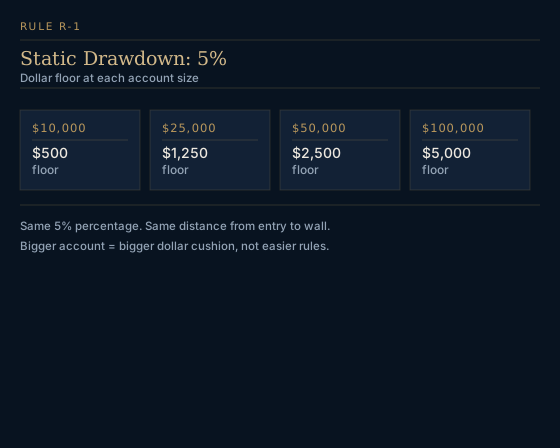
Work the arithmetic once and the point is obvious. A 5 percent static drawdown on a 10,000 dollar account is a 500 dollar floor to defend. The same 5 percent on a 100,000 dollar account is a 5,000 dollar floor. Ten times the dollars, identical percentage, identical distance from your entry to the wall. If your strategy loses 5 percent of the balance on a bad week, it loses 5 percent on both accounts and it closes both accounts. The bigger number did not buy you slack. It bought you a bigger number. The drawdown type behind that floor matters as much as the size; static vs trailing drawdown explains why a fixed floor and a floor that trails your equity behave very differently even at the same percentage.
What genuinely changes with size is the emotional weight of each swing and the one-time fee you pay to access the account. Those are the two variables worth thinking about. Everything else is multiplication.
Two things fall outside this article on purpose. Whether to buy an instant account or sit an evaluation is a separate decision that comes before this one, and the full cost picture that the one-time fee sits inside is its own subject covered in prop firm hidden fees. This page owns only the size choice.
What Actually Changes When the Account Gets Bigger?
When the rulebook is written in percentages, size is a multiplier applied to every limit at once. The account equity may never fall below 95 percent of the initial balance under Ordane's static drawdown rule, and that floor is fixed on day one, never trails upward, and a breach closes the account (Ordane Rulebook v1.0, clause R-1, retrieved 2026-08-04). Here is Ordane's rulebook translated into dollars at each of the four sizes it sells.
| Account size | 5% static drawdown floor (R-1) |
|---|---|
| $10,000 | $500, equity floor $9,500 |
| $25,000 | $1,250, equity floor $23,750 |
| $50,000 | $2,500, equity floor $47,500 |
| $100,000 | $5,000, equity floor $95,000 |
| Account size | 3% daily loss limit (R-2) |
|---|---|
| $10,000 | $300 |
| $25,000 | $750 |
| $50,000 | $1,500 |
| $100,000 | $3,000 |
| Account size | 1.5% max risk per trade (R-3) |
|---|---|
| $10,000 | $150 |
| $25,000 | $375 |
| $50,000 | $750 |
| $100,000 | $1,500 |
The daily loss limit is 3 percent, measured against the balance at the start of the server day, and a breach closes the account (Ordane Rulebook v1.0, clause R-2, retrieved 2026-08-04). Maximum risk per trade is 1.5 percent of current balance and a stop-loss is mandatory at entry; two maximum losses equal the daily limit, which is the design rather than an accident (Ordane Rulebook v1.0, clause R-3, retrieved 2026-08-04).
Read that table as four columns of dollars, not four products. Every row is the same account. The only thing that changed is the unit.
The drawdown type matters here as much as the dollar size, and it is worth checking separately, because a percentage that trails behind your equity behaves nothing like one anchored to your starting balance even when the percentage is identical.
That anchoring is where firms genuinely differ, and it is the difference a size table hides. FTMO's 2-Step Challenge sets Maximum Loss at 10 percent measured statically from the Initial Simulated Capital, with a 5 percent Maximum Daily Loss and a 10 percent profit target in phase one, 5 percent in Verification, over at least 4 minimum trading days (FTMO.com, Trading Objectives, retrieved 2026-08-04). Its 1-Step Challenge keeps the 10 percent Maximum Loss but recalculates it daily at 00:00 CE(S)T from the highest balance achieved, or the Initial Simulated Capital if higher, alongside a 3 percent Maximum Daily Loss (FTMO.com, Trading Objectives, retrieved 2026-08-04). Same firm, same percentage, two different walls.
Some firms drop percentages entirely and quote the limits in cash, which removes the scaling question and replaces it with a lookup. MyFundedFutures publishes its standard Flex Plan 50,000 dollar evaluation with a 3,000 dollar profit target, a 2,000 dollar maximum loss limit on an end-of-day trailing model, no daily loss limit by default, a 50 percent consistency rule at the evaluation stage and a 2 day minimum (MyFundedFutures Help Center, Flex Plan $50,000, retrieved 2026-08-04). Those dollar figures belong to that size and stage only. Move up or down the ladder and you have to look up a new set. That 50 percent figure is a consistency rule, a clause worth understanding on its own; see what is the consistency rule for how it can delay a payout regardless of account size.
Either way, the discipline is the same: convert to dollars before you compare.
Matching a Size to Your Capital and Temperament
The method is short and it runs in one direction, from your tolerance down to the product, never from the product up to your ambition.
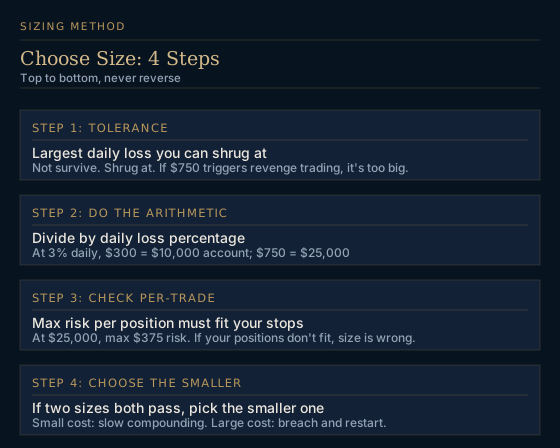
Start from the largest daily dollar loss you can absorb without trading differently the next morning. Not the largest you can survive. The largest you can shrug at. If a 750 dollar red day would have you revenge-trading at the open, 750 dollars is not your number, whatever the balance in the account says.
Divide by the daily loss percentage to get the account size. Under Ordane's 3 percent daily limit, a 300 dollar comfortable loss points at the 10,000 dollar account, 750 at the 25,000, 1,500 at the 50,000 and 3,000 at the 100,000. Do the same arithmetic with whatever percentage the firm you are evaluating publishes.
Sanity-check the risk per trade. Under the 1.5 percent cap, a 25,000 dollar account allows 375 dollars of risk per position. If your strategy's normal stop distance and position size do not fit inside that figure, the size is wrong regardless of how the daily number looked. Two maximum-risk losses reach the daily limit by design, so the per-trade cap is really a statement about how many mistakes a day the account tolerates: two. If your strategy depends on holding through the close or over a weekend, check overnight and weekend holding rules before you size the account around a stop distance that assumes forced flattening.
Then weigh the fee against the comfort, not against the balance. This is the step that gets skipped. The fee buys access to a dollar scale. It does not buy a softer rulebook. A larger fee on a percentage-based firm purchases larger numbers running under identical constraints, so the honest question is whether the larger dollar scale is one you can trade calmly, not whether you can afford the ticket.
If two sizes both pass the comfort test, take the smaller one. The trade-off is a smaller dollar scale. The risk of taking one too large is a breach, and a breach at Ordane closes the account: to trade again you purchase a new account under the rulebook version current at that time (Ordane Rulebook v1.0, retrieved 2026-08-04; ordanemarkets.com FAQ, retrieved 2026-08-04). Running the rulebook through its own checks before you commit is worth the ten minutes; see how to audit a prop firm for the five checks, Ordane included.
What Are Ordane's Account Sizes and Fees?
Ordane Instant Account comes in four sizes: $10,000, $25,000, $50,000 and $100,000 (Ordane Rulebook v1.0, section 1, retrieved 2026-08-04). The fee is one-time: $139 for the $10,000 account, $299 for $25,000, $549 for $50,000 and $999 for $100,000, with no recurring fees, no hidden tiers and no coupon games (Ordane Rulebook v1.0, section 1, retrieved 2026-08-04).

The six rules do not change across those four sizes. Same 5 percent static drawdown, same 3 percent daily limit, same 1.5 percent risk cap, same closed list of prohibited practices, same 20 percent consistency rule, same 30 day inactivity clause. The governing document is Ordane Rulebook v1.0, published 2026-07-23 (Ordane Rulebook v1.0, section 6 Changelog, retrieved 2026-08-04). The Ordane rulebook is public, numbered and versioned, and no rule is ever applied retroactively to an open account. Changes produce a new version with a dated changelog entry, and the version you sign up under is the version that governs your account (Ordane Rulebook v1.0, notice above section 0, and section 6 Changelog, retrieved 2026-08-04).
That is the entire proposition on sizing: choosing a size at Ordane is choosing a dollar scale, not a difficulty setting. There is no easier tier and no harder tier, because there is one rulebook.
Two things about Ordane belong in the same breath because they bear on whether the size you pick ever pays you anything. Ordane's payout reserve is published at a public TRON address on ordanemarkets.com and in Rulebook v1.0 clause PR-1. As of 2026-08-04, the homepage reports a dated observed balance and states that the wallet does not prove future solvency, total liabilities or future payouts (Ordane Rulebook v1.0, clause PR-1, and ordanemarkets.com reserve section, checked 2026-08-04). Ordane is new. Its homepage says it cannot show years of payout history, while the rulebook says payout performance metrics begin with the first month in which a payout is requested (ordanemarkets.com reserve section and Ordane Rulebook v1.0, clause PR-2, checked 2026-08-04). Judge sizing on the published rulebook, and verify the reserve evidence and any published payout metrics directly.
Questions Traders Ask About Choosing an Account Size
What size should I start with?
Start with the size whose daily loss limit, converted to dollars, is a number you can lose without changing your next session. Under Ordane's 3 percent daily limit that is $300 on the $10,000 account and $750 on the $25,000 (Ordane Rulebook v1.0, clause R-2, retrieved 2026-08-04).
Is a bigger prop firm account easier to pass?
No, when the rules are percentages. Ordane's 5 percent static drawdown is 5 percent on the $10,000 account and 5 percent on the $100,000, so the distance from your entry to the failure point is identical. The dollars grow; the difficulty does not move (Ordane Rulebook v1.0, clause R-1, retrieved 2026-08-04).
Does the drawdown change with account size?
The percentage does not. The dollar value does. Ordane's static floor sits at 95 percent of the initial balance on every size, which is a $9,500 floor at $10,000 and a $95,000 floor at $100,000. It is fixed on day one and never trails upward, so a larger balance means a larger cushion in dollars and the same one in percent (Ordane Rulebook v1.0, clause R-1, retrieved 2026-08-04).
How much can I risk per trade at each size?
Ordane's cap is 1.5 percent of current balance with a mandatory stop-loss at entry: $150 at $10,000, $375 at $25,000, $750 at $50,000 and $1,500 at $100,000. Two maximum-risk losses reach the 3 percent daily limit, so the cap effectively allows two full mistakes per day (Ordane Rulebook v1.0, clause R-3, retrieved 2026-08-04).
Is the bigger fee worth it?
Only if the larger dollar scale is one you can trade calmly. Ordane's fee runs from $139 to $999 one-time across the four sizes, and it buys account size, not softer rules. Paying more for a percentage-based account purchases bigger numbers under identical constraints, never an easier rulebook (Ordane Rulebook v1.0, section 1, retrieved 2026-08-04). Once an account is open and inside the rules, the fee eventually connects to the withdrawal side; prop firm withdrawal requirements covers what has to be true before that first payout request.
Sources
- Trading Objectives | FTMO.com. ftmo.com Retrieved 2026-08-04.
- Flex Plan $50,000, A Comprehensive Guide | My Funded Futures Help Center. help.myfundedfutures.com Retrieved 2026-08-04.
- ORDANE | The Standard Holds | Simulated Capital Trading Accounts. ordanemarkets.com Retrieved 2026-08-04.