Home · The Ordane Journal · Pricing and cost · Prop Firm Profit Split Explained: The Math That Pays
Prop Firm Profit Split Explained: The Math That Pays
You passed the evaluation. Now one number decides what actually lands in your account: the profit split. Sales pages print it in the largest font and leave out the two things that decide your take-home, how the number is calculated and what makes it move. This page owns both, and nothing else.
One disclosure before the math, because it changes what every percentage below is a percentage of. Ordane accounts operate on simulated capital. No live funds are traded and no deposits are accepted. (declaration required by Ordane Rulebook v1.0, clause P-2, retrieved 2026-07-25)
What a profit split actually is
The 45-word answer, quotable as written
A profit split is the share of net simulated-account profit a trader keeps at payout, written as trader/firm. An 80/20 split means the trader keeps 80 percent of each approved payout and the firm keeps 20 percent. The percentage applies to profit, never to account size.
Why a split exists at all, stated without spin
The split exists because the two sides bring different things. The firm carries the simulated capital and the exposure that comes with it. The trader supplies the process: the discipline, the hours, the risk control. The split is how that arrangement is priced.
One thing to hold onto before the math. The percentage on the sales page is a base, not a fixed rate for life. At many firms it can rise, and at some it cannot. That single distinction, base versus rate, is the reader's real question, and the rest of this page answers it.
How the split is calculated on a real payout
The arithmetic on a concrete number
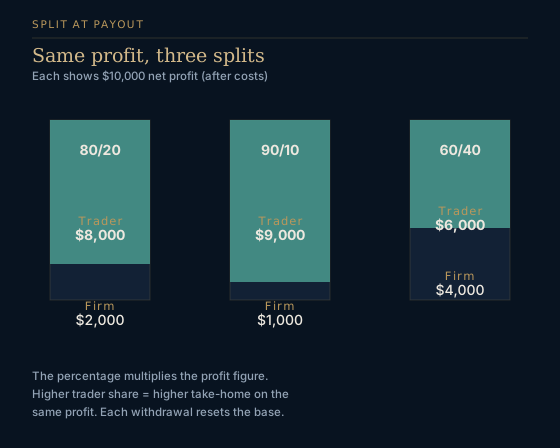
Take a concrete payout. On 10,000 in net simulated profit at an 80/20 split, you keep 8,000 and the firm keeps 2,000. Move the same 10,000 to a 90/10 split and you keep 9,000. Move it to 60/40 and you keep 6,000. The percentage is applied to the profit figure, and what is left is yours. That is the whole calculation.
Net profit since your last payout, not lifetime
Here is the first thing that trips traders up. At most firms the split is calculated on net profit since your last payout, not on your lifetime account profit. Each withdrawal resets the base. So if you take a payout at 10,000 and then earn another 6,000, the next split is applied to that 6,000, not to 16,000. You are never paid twice on the same profit.
Net of commissions and fees, before the split
The second thing that trips traders up: the profit the split applies to is already net of commissions and platform costs. The split is a slice of what remains after those are taken out, not a slice of your gross. A high split sitting on top of a heavy cost stack can hand you less than a lower split on a lean one. That cost stack is its own subject, and we do not re-teach it here. For the full breakdown, read the recurring fee stack a split sits on.
Next step. Normalize cost against the account model in Instant Account vs evaluation, then check Ordane’s one-time ladder on accounts.
What actually raises your split
The scaling ladder, plainly
A scaling plan is the mechanism that lifts your base split after you clear defined milestones. Think of it as a ladder: the base is the bottom rung, and each milestone you meet moves you up. The number on the sales page tells you where you start. The scaling plan tells you where you can finish, and how long it takes to get there.
The levers firms use: payouts taken, net growth, a rolling window
Firms move you up the ladder using a small set of levers. A minimum number of payouts already processed. A net-growth threshold on the account. Zero rule violations. And profitability held across a rolling multi-month window.
FTMO is a clean, sourced example of the shape. FTMO's own site states that a trader can earn up to 90 percent of simulated profits as a reward (ftmo.com, "How it works", retrieved 2026-07-24). To get there, FTMO's Scaling Plan asks for a minimum of 4 months as an FTMO Trader, at least 10 percent of the initial or scaled capital in total net simulated profit, and at least 2 processed rewards. Clearing those requirements increases the FTMO account size by 25 percent every 4 months (ftmo.com, "Scaling and Reward Growth Plan", retrieved 2026-07-24). That is the mechanic behind the word "scaling," made concrete.
One number this page is not printing: FTMO's base split. The only figure we held for it came from an affiliate blog, not from FTMO, so it stays out until it can be read off FTMO's own pages.
Base is not the ceiling, and not every firm scales the split
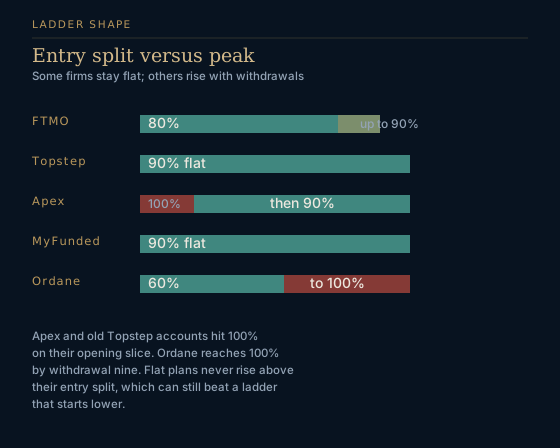
The base is not the ceiling. It is also not universal. Some firms do not scale the split at all and pay a flat rate from the first dollar. MyFundedFutures states that its Rapid plan pays a flat 90/10 on every payout with no graduated tier (My Funded Futures, Rapid plan page, retrieved 2026-07-24), and Topstep's published payout policy sets the trader's share at 90 percent (Topstep Help Center, payout policy, retrieved 2026-07-24). A flat 90 can out-pay a ladder that starts at 60, depending on how far up the ladder you actually climb. So the question that matters is never just "what is the split." It is "what raises this number, and by when."
Where four named firms set the split and how each scales
Split policies change, so read this as a snapshot, not a permanent record. Every filled cell below is taken from the firm's own documentation, retrieved 2026-07-24. Where we could not read a figure off the firm's own pages, the cell says so rather than borrowing one from a review site. Where a rival beats Ordane on an axis, it is recorded here as a rival win, because that is the information you came for.
| Firm | Trader share, from the firm's own pages | How or whether it scales | Notable per-slice tier |
|---|---|---|---|
| FTMO | Up to 90 percent of simulated profits, stated as a maximum | Scaling Plan: minimum 4 months as an FTMO Trader, at least 10 percent of initial or scaled capital in total net simulated profit, at least 2 processed rewards | Account size increased by 25 percent every 4 months on qualifying |
| Topstep | 90 percent under the published payout policy | No scaling tier appears in that policy | Accounts joined before 12 January 2026 keep 100 percent of the first $10,000 in lifetime profits, then the standard split applies |
| Apex Trader Funding | Not found in Apex's own documentation | Not found in Apex's own documentation | Not found in Apex's own documentation |
| MyFundedFutures | Rapid 90 percent; Pro 80 percent | Rapid is flat, with no graduated tier | None on Rapid: the rate is flat from the first payout |
Where each row comes from: FTMO, its "How it works" page and its Scaling and Reward Growth Plan page. Topstep, the Topstep Help Center payout policy. MyFundedFutures, its Rapid and Pro plan pages. All retrieved 2026-07-24, all first-party.
Two gaps in that table are deliberate. FTMO's base split and Apex Trader Funding's payout structure are absent because the figures we held for them came from an affiliate blog and a review directory, not from FTMO or Apex. A visible hole is cheaper than someone else's guess.
Read the concession plainly. Topstep's grandfathered tier, 100 percent of the first $10,000 in lifetime profits for accounts joined before 12 January 2026, out-pays a laddered base that starts lower for as long as that first $10,000 lasts, and it out-pays Ordane's opening rung outright. That is true, and hiding it would insult a reader who can check.
How Ordane's split ladder works
First, the concession, without hedging. Ordane is new and has no payout history. There is nothing to show yet, and no payout history will be manufactured. (ordanemarkets.com, payout ledger section, retrieved 2026-07-25) In a market where everyone inflates a track record, that is the honest starting point.
Ordane sells one product, the Ordane Instant Account: direct access, no evaluation phase and no challenge, on simulated capital (Ordane Rulebook v1.0, section 1).
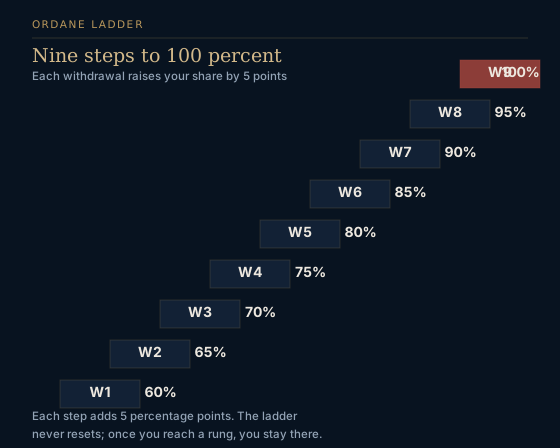
What exists today is a published ladder you can read yourself. Ordane's profit split starts at 60 percent and rises 5 percentage points with every completed withdrawal, reaching 100 percent from the ninth withdrawal onward. (Ordane Rulebook v1.0, clause PA-2) The same rulebook prints the limit that belongs beside it: withdrawals #1 and #2 are each capped at 3 percent of initial balance. From withdrawal #3 onward there is no cap. (Ordane Rulebook v1.0, clause PA-3) A ladder published without its cap is a contract term with the limit deleted, so the two travel together here.
Now the trade-off, said out loud. That 60 percent opening rung sits below the 90 percent Topstep and MyFundedFutures document on their own pages. The argument is not the entry number. The argument is the top of the ladder, 100 percent, paired with a payout mechanism you can inspect before you ever pay. A payout approved and not paid within 48 clock hours, not business hours, triggers automatic compensation: a 100 percent refund of the account fee, plus the payout owed in full. (Ordane Rulebook v1.0, clause G-1)
Where the money comes from is the other half of that. Payouts are paid in real money from company fee revenue. No client deposits are taken and no client capital is traded. Rulebook v1.0 clause PR-1 commits Ordane to publish the payout reserve at a publicly verifiable address, and that address is now live on ordanemarkets.com with a dated observed balance. (ordanemarkets.com FAQ and Ordane Rulebook v1.0 clause PR-1, checked 2026-08-11)
Be precise about that last part, because the industry is not. Ordane's payout reserve is published at a public TRON address on ordanemarkets.com and in Rulebook v1.0 clause PR-1, and the page carries a dated observed balance. (Ordane Rulebook v1.0, clause PR-1, and ordanemarkets.com, reserve section, checked 2026-08-11) The homepage states the limit of that evidence in its own words: the reserve is not a promise, it is an address. A dated balance at a public address is something you can check today, not a guarantee about tomorrow, and writing it any other way would be the exact move this page exists to warn you about.
Here is the same set of terms, one row per clause, so each can be checked against Rulebook v1.0.
| What is set | The term, as published | Where to verify |
|---|---|---|
| Opening split | Starts at 60 percent | Ordane Rulebook v1.0, clause PA-2 |
| Rise per completed withdrawal | 5 percentage points | Ordane Rulebook v1.0, clause PA-2 |
| Top of the ladder | 100 percent, from the ninth withdrawal onward | Ordane Rulebook v1.0, clause PA-2 |
| Cap on withdrawals #1 and #2 | 3 percent of initial balance each; no cap from withdrawal #3 onward | Ordane Rulebook v1.0, clause PA-3 |
| Payout approved but not paid within 48 clock hours | Automatic compensation: 100 percent refund of the account fee, plus the payout owed in full | Ordane Rulebook v1.0, clause G-1 |
| Payout reserve address | Published at a public TRON address on ordanemarkets.com, with a dated observed balance | Ordane Rulebook v1.0, clause PR-1 |
A split is only worth the mechanism that honors it. Whether a firm honors payouts at all is a separate question, and it is settled by reading the firm's payout clause and its dated record, not the percentage on its sales page. For how fast an approved payout reaches you, read how long a payout takes to arrive.
What the split number does not tell you
The split is one number inside a payout, not the payout itself. Three facts sit outside its edge.
The split is taken on profit that is already net of the fee stack, so a high split on a firm with heavy recurring costs can pay less than a lower split on a lean one: see the recurring fee stack. A split of any size is worth zero if the payout is never honored, which is a question about the firm's payout clause and its published record rather than its percentage. And the split you earned still has to arrive, on a clock: see how long payouts take.
Questions traders ask about the profit split
What does an 80/20 profit split mean?
An 80/20 profit split means the trader keeps 80 cents of every dollar of net simulated profit at an approved payout, and the firm keeps 20 cents. The percentage is applied to profit since your last payout, after commissions and platform costs are removed, not to your lifetime balance. It says nothing about whether that 80 can ever rise.
How is a prop firm profit split calculated?
A prop firm profit split is calculated by taking your net profit since your last payout, subtracting commissions and platform costs, then applying the split percentage to what remains. On 10,000 in net simulated profit at 80/20, you keep 8,000 and the firm keeps 2,000. Each withdrawal resets the base for the next calculation, so you are never paid twice on the same profit.
When does a prop firm profit split increase?
A prop firm profit split increases when you clear a firm's scaling milestones. FTMO's Scaling Plan asks for a minimum of 4 months as an FTMO Trader, at least 10 percent of initial or scaled capital in total net simulated profit, and at least 2 processed rewards, and FTMO states a trader can earn up to 90 percent of simulated profits as a reward (ftmo.com, retrieved 2026-07-24). Some firms never scale and pay a flat rate instead.
What is the difference between a base split and a scaling plan?
A base split is your starting share, the number on the sales page. A scaling plan is the mechanism that raises that share once you meet set milestones. A flat plan has no scaling: MyFundedFutures states that its Rapid plan keeps a flat 90/10 with no graduated tier (My Funded Futures, retrieved 2026-07-24). Ask a firm which one it actually runs before you buy.
Do any firms pay a 100 percent split?
Yes, on a slice of profit rather than on all of it. Topstep accounts joined before 12 January 2026 keep 100 percent of the first $10,000 in lifetime profits (Topstep Help Center, retrieved 2026-07-24). Ordane's ladder reaches 100 percent from the ninth completed withdrawal onward, with withdrawals #1 and #2 each capped at 3 percent of initial balance (Ordane Rulebook v1.0, clauses PA-2 and PA-3).
Disclosures
Ordane accounts operate on simulated capital. No live funds are traded and no deposits are accepted. Payouts depend on simulated performance under Rulebook v1.0; no level of performance is typical or assured.
This article is for information only and is not investment, financial, or tax advice.
Sources
- How it works | FTMO.com ftmo.com Retrieved 2026-07-24.
- Scaling and Reward Growth Plan | FTMO.com ftmo.com Retrieved 2026-07-24.
- Topstep Payout Policy | Topstep Help Center help.topstep.com Retrieved 2026-07-24.
- Rapid Plan, Daily Payouts, 90/10 Split | My Funded Futures myfundedfutures.com Retrieved 2026-07-24.
- Pro Plan | My Funded Futures myfundedfutures.com Retrieved 2026-07-24.
- Ordane Rulebook v1.0, clause P-2 ordanemarkets.com Retrieved 2026-07-25.
- ordanemarkets.com, payout ledger section ordanemarkets.com Retrieved 2026-07-25.