Home · The Ordane Journal · Rules and mechanics · Apex Trading Prop Firm: Rules & Payouts Explained
Apex Trading Prop Firm: Rules & Payouts Explained
An evaluation firm offers a simulated trading assessment in which a customer pays for access and attempts to meet specified performance and risk requirements. Passing an assessment and becoming eligible for a payout are separate steps; the applicable account documents determine what each step requires.
Ordane accounts operate on simulated capital. No live funds are traded and no deposits are accepted. Payouts depend on simulated performance under Rulebook v1.4; no level of performance is typical or assured.
Apex Trader Funding offers Intraday and EOD evaluations and distinguishes new products from legacy accounts (Apex homepage, read 2026-10-04). This article separates evaluation rules from Performance Account (PA) payout conditions. Identify the account family, stage and purchase-date terms before applying any figure below. Ordane's Rulebook does not establish Apex's conditions.
What Is the Apex Trading Prop Firm?
Apex's evaluation offering includes simulated accounts, with a possible later invitation to live trading (Apex homepage, read 2026-10-04). That possibility should not be presented as an entitlement or confused with the evaluation being purchased.
Read the product documents in sequence: evaluation requirements, drawdown mechanics, then PA payout requirements. A profit target answers whether an assessment requirement has been met. A payout document answers a different question: whether a request is eligible. Neither answer can safely be inferred from an account's advertised balance alone.
Keep a copy of the terms applicable to the purchase. The comparisons below concern the identified current products; they do not establish legacy-account fees or rules.
Does Apex Trader Funding Actually Pay Out?
The supplied documents establish payout conditions, not independently verified payout reliability. They do not establish the source of payout funding. An advertised split therefore cannot answer whether a particular request will be approved or paid promptly.
Payout Frequency
For a 25K Intraday PA, eligibility requires at least five qualifying days, not necessarily consecutive, each with at least $100 net profit. Its safety-net balance is $26,100, maintained throughout the PA; the minimum request balance is $26,600. Requests start at $500, with at most six payouts and a $1,000 maximum per payout (Intraday payout rules, read 2026-10-04). This is not an automatic five-day payment schedule.
EOD PAs also require five qualifying days, a $500 minimum request and allow at most six payouts. Qualifying daily net profit is $250 for EOD 50K, $300 for 100K and $350 for 150K (EOD payout rules, read 2026-10-04). Intraday 50K instead requires $200 per qualifying day (Intraday payout rules, read 2026-10-04).
Account Size and Approved Payout Split
The supplied current rules do not establish a $25,000 earnings threshold that changes the split. They specify a 100% split on approved payouts, subject to eligibility (Intraday payouts; EOD payouts, both read 2026-10-04). Account size, withdrawal limits and split percentage are distinct.
What Hidden Rules Can Breach an Apex Account?
Separate account-ending drawdown breaches from payout eligibility restrictions. Intraday thresholds follow realized and unrealized peaks in real time and never decrease. Touching the threshold fails an evaluation or closes a PA. PA trailing stops at starting balance plus $100; evaluation stopping behavior differs between Rithmic/Wealthcharts and Tradovate (Intraday drawdown explanation, read 2026-10-04).
EOD Trailing Drawdown Explained
The EOD threshold uses the highest end-of-day balance, never moves down, and is enforced in real time during the next session. Touching it triggers immediate liquidation and evaluation failure or PA closure. A separate daily loss limit pauses the session instead of closing the account (EOD drawdown explanation, read 2026-10-04). EOD calculation is not permission to cross the established floor intraday.
The 50% Consistency Rule
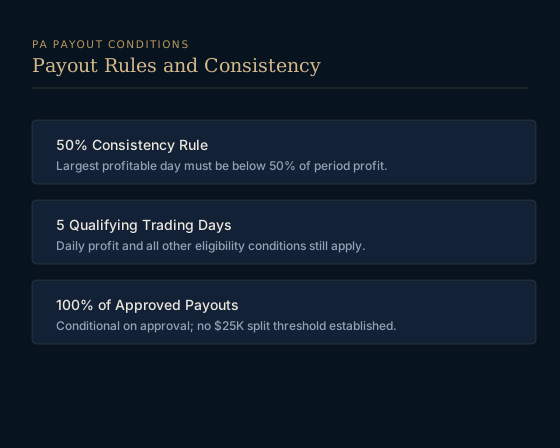
For Intraday PA payout eligibility, the largest profitable day must contribute less than 50% of total profit since the last approved payout. Exactly 50% is ineligible; this restriction alone does not close the account (Intraday payout rules, read 2026-10-04). EOD payouts likewise require a largest-day share below 50% (EOD payout rules, read 2026-10-04).
How Does the Consistency Rule Affect Payouts?
Consider hypothetical arithmetic, not a trading recommendation. If the largest profitable day is $600 and total profit for the applicable period is $1,200, the ratio is $600 ÷ $1,200 = 50%. That does not satisfy a strictly-below-50% condition. At $1,300 total profit, with the same largest day, the ratio is approximately 46.15%.
This calculation tests only the ratio. It does not establish enough qualifying days, the required balance, an available payout slot or approval. A spreadsheet showing a compliant percentage is therefore only one part of an eligibility check.
The example is not advice to cap gains or take additional trades to change the denominator. Further trading can reduce accumulated profit or breach a loss threshold. Keep account survival, qualifying-day requirements and request eligibility as separate checks rather than treating a desired withdrawal as a trading target.
Is Apex Trader Funding Regulated?
The supplied sources do not verify Apex's legal registration or regulatory status. A simulated-account description cannot establish that a business is outside oversight, what protections apply, or which remedies a customer has.
The CFTC foreign-currency advisory, read 2026-10-04, discusses forex risks and checking registration and background. It is not a finding about Apex and does not establish Apex's regulatory status or available legal recourse.
Treat product documentation and regulatory verification as separate evidence questions. Neither a marketing claim nor an account rule resolves both. This article makes no conclusion that internal support is the only route for a dispute.
How Much Does an Apex Evaluation Cost?
New evaluations use a one-time fee for 30 consecutive calendar days, without subscription renewal. Failed or expired evaluations cannot be extended or reset; another attempt requires a new purchase. Level 1 data is included, while additional feeds have platform-specific billing. The PA activation window is seven calendar days from being marked passed, not merely reaching the target (Evaluation fees and access, read 2026-10-04).
The supplied sources do not verify an exact current purchase or activation price. Check the applicable checkout and billing terms before budgeting; the figures below are assessment parameters, not fees.
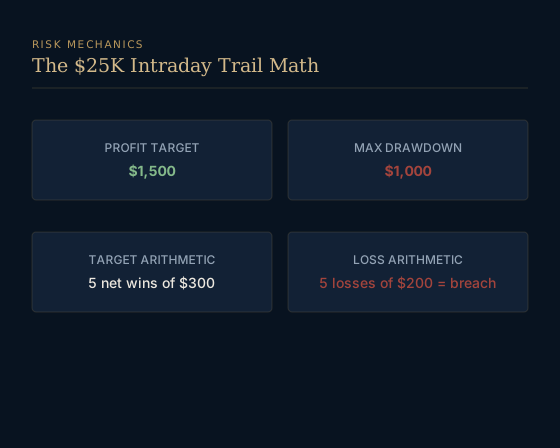
| Account and stage | Profit target | Maximum trailing drawdown | Contract limit |
|---|---|---|---|
| 25K Intraday Evaluation | $1,500 | $1,000 | 4 |
Table source: 25K Intraday Evaluation requirements, read 2026-10-04. This evaluation has no daily loss limit, and consistency and scaling do not apply during evaluation.
Hypothetically, five $200 losses total $1,000. Those hypothetical losses are not a safe allowance: touching the drawdown threshold fails the account, and costs or an earlier unrealized peak can reduce the remaining room (Intraday drawdown explanation, read 2026-10-04). Similarly, five $300 net wins total $1,500 arithmetically; that calculation alone does not demonstrate a pass. Neither example forecasts results or estimates how many attempts a customer will need.
Evaluation Market Comparison
Use the following checklist to compare documented products without assigning unverified terms to Ordane or any other provider.
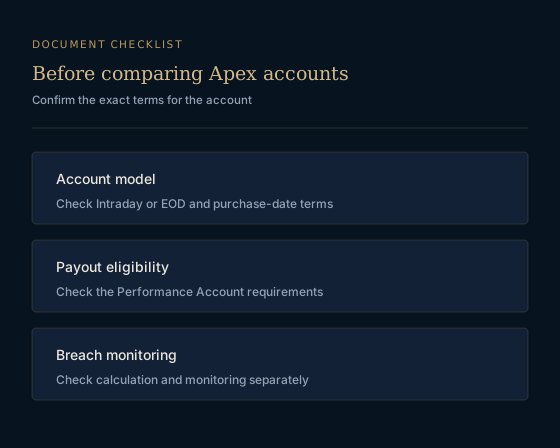
Do not infer an industry standard from one firm's account model. Compare the documented account terms for the specific product, including the entry requirements, loss calculation and payout eligibility.
| Question before purchase | Document to check | Assumption to avoid |
|---|---|---|
| Which account rules apply? | Exact account type and purchase-date terms | Treating Intraday and EOD as interchangeable |
| When is a payout eligible? | Performance Account payout requirements | Treating a stated split as automatic eligibility |
| How is a breach determined? | Drawdown calculation and monitoring rules | Assuming end-of-day calculation allows intraday breaches |
Ordane's conditions are separate from Apex's; consult the Ordane Rulebook for the former and the Apex account documents for the latter.
As an analytical checklist, compare entry conditions, threshold calculation, enforcement timing and payout eligibility separately. A label such as evaluation or direct access does not, by itself, establish a static risk floor or simpler conditions.
Apex Trader Funding FAQ
These answers apply only to the identified products, not automatically to legacy accounts.
What is the minimum time to pass?
The Intraday Evaluation has no minimum trading-day requirement and may be passed in one day if its requirements are met (Intraday Evaluation rules, read 2026-10-04). PA qualifying days are a separate requirement.
How does the trailing drawdown work?
Intraday tracks realized and unrealized peaks in real time; EOD calculates its threshold at market close. Both enforce their applicable thresholds in real time, and touching is enough to breach (Intraday explanation; EOD explanation, both read 2026-10-04).
What happens if I breach a rule?
Consequences depend on the rule: EOD drawdown breach ends the account, while its separate daily loss limit pauses the session (EOD explanation, read 2026-10-04). Failed new evaluations require repurchase, with no reset option (Billing rules, read 2026-10-04).
Can I trade during news events?
The supplied sources do not establish the applicable news-trading policy. Check the exact account's current terms; this article establishes neither permission nor prohibition.
Which Apex accounts have a 100% payout split?
The cited Intraday and EOD PA rules specify 100% on approved payouts, not automatic withdrawal of all displayed profit (Intraday payouts; EOD payouts, both read 2026-10-04).
Are the accounts real money?
The evaluations are simulated. Apex also describes possible later live invitations; that is separate from the evaluation product (Apex homepage, read 2026-10-04). These sources do not establish payout funding sources.
Related reading
- Can You Scalp on a Prop Firm Account? - Prop Firm Denied Your Payout: What to Do First - Audit a Prop Firm: 5 Checks Before Paying - Prop Firm Account Reset vs. New Account - One-Step vs. Two-Step Prop Firm Evaluations - Prop Firm Hidden Fees - How Long Do Prop Firms Take to Pay? - Prop Firm Profit Splits Explained - Prop Firm News Trading Rules
Sources
- Official product-specific source apextraderfunding.com Retrieved 2026-10-04.
- Official product-specific source apextraderfunding.com Retrieved 2026-10-04.
- Official product-specific source apextraderfunding.com Retrieved 2026-10-04.
- Official product-specific source cftc.gov Retrieved 2026-10-04.