Home · The Ordane Journal · Before You Pay · How to Save Prop Firm Rules Before Paying
How to Save Prop Firm Rules Before Paying
A rule snapshot is a dated, unedited copy of every page and document that defines the terms of a trading account, captured on or immediately after the day of purchase, stored so that a third person can open it and see what the page said and when it was captured.
Ordane accounts operate on simulated capital. No live funds are traded and no deposits are accepted. (Ordane Rulebook v1.0, clause P-2, and ordanemarkets.com payout-funding statement, retrieved 2026-08-05)
A prop firm rulebook is a live webpage. It can be edited at any hour, and the version you read on the day you paid may not be the version you are shown six weeks later when you request a withdrawal. That is not necessarily bad faith. Firms rewrite copy, restructure pages, renumber clauses and change hosting providers. But it means the sentence you relied on can quietly disappear, and once it is gone you are arguing from memory against a page that says something else. That is the same gap covered in how to audit a prop firm before you pay, and the same reason to check whether a prop firm can change its rules after you buy before you commit.
Ordane sells one product, the Ordane Instant Account: direct access, no evaluation phase and no challenge, on simulated capital. (Ordane Rulebook v1.0, section 1, retrieved 2026-08-04) The rulebook that governs it is public, numbered and versioned, which is exactly the property this article is asking you to look for in any firm before you spend money. If you are still comparing that model against a traditional challenge, see instant account vs evaluation.
This article is about a small, boring, fifteen-minute task you do once, at the moment of purchase, and then hopefully never need. You save a dated copy of the rules that governed your account. Not because you expect a dispute, but because the cost of having the evidence is fifteen minutes and the cost of not having it is your entire case.
Why should you preserve prop firm rules?
Because the thing you are buying is a contract, and the contract lives on a page that the other party controls.
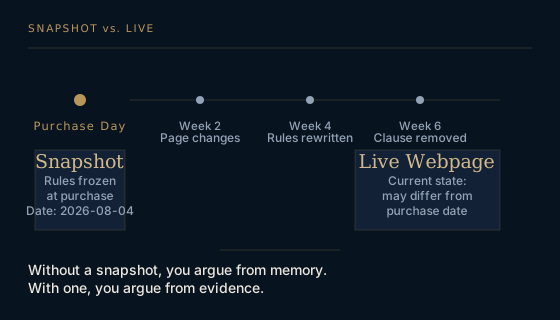
When you buy a simulated account, you are not buying software. You are buying a set of conditions under which a payout will or will not be approved: a drawdown limit, a daily loss limit, a consistency requirement, a list of prohibited practices, a payout schedule and a split. Every one of those is a number or a rule written on a page owned and edited by the firm. If a payout is later denied, the denial will cite a rule. Your only defence is knowing what that rule said on the day you agreed to it. The drawdown definition itself is worth pinning down first; see static vs trailing drawdown for why that single clause decides whether you ever get paid.
The CFTC advises building a timeline while events are still fresh in memory (U.S. Commodity Futures Trading Commission, retrieved 2026-08-04). Notice what that implies: the collection is expected to have already happened, or to happen immediately. A regulator cannot reconstruct a webpage that changed nine months ago.
A liftable definition of a rule snapshot
Three parts matter in that definition, and each one fails independently:
- Complete. If you save the rulebook but not the terms it links to, you have half a contract.
- Dated. A file with no reliable date is a claim, not evidence.
- Unedited. A screenshot you cropped, annotated or re-saved is weaker than the original, and in some cases is worthless.
Memory and a current webpage are not the same evidence
There are two failure modes people fall into, and they are opposites.
The first is trusting memory. You are certain the daily loss limit was 4 percent. You remember reading it. But "I remember" carries no weight in any dispute process, internal or external, and you will not be able to reproduce it.
The second is trusting the live page. Six weeks later you open the rulebook to check, find it says 3 percent, and conclude you misread it at the time. Maybe you did. Or maybe the page changed and there is no changelog to tell you. Without a snapshot, those two possibilities are indistinguishable, and the indistinguishability always favours whoever controls the page.
A snapshot collapses the ambiguity. Either your saved copy says 4 percent and something changed, or it says 3 percent and you misremembered. Both outcomes are useful. Only one of them is available to someone who did not save anything.
Which pages and records belong in the bundle?
The instinct is to save everything, which produces a folder nobody will ever open. The better instinct is to save a minimum complete set: the smallest collection where nothing essential is missing.
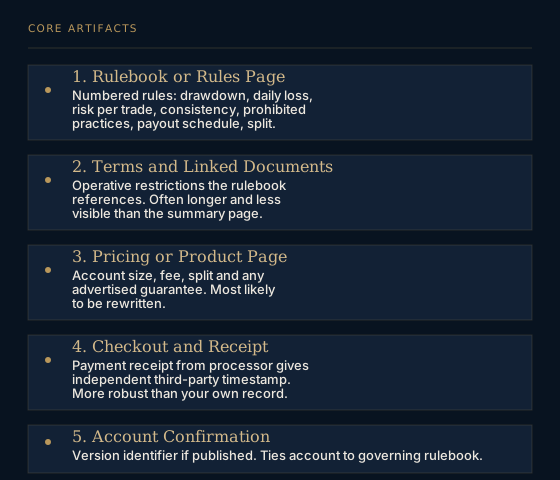
Rulebook, terms, pricing and checkout receipt
Five artifacts do almost all the work.
- The rulebook or rules page. The actual numbered rules: drawdown, daily loss, risk per trade, consistency, prohibited practices, payout schedule, split. This is the core document.
- The terms of service and any document the rulebook links to. Firms routinely put the operative restriction in the terms and a friendly summary on the rules page. If the rulebook says "subject to the Terms", the terms are part of the contract and belong in the bundle.
- The pricing or product page as it appeared at purchase. This is where account size, fee, split and any advertised guarantee live. It is also the page most likely to be rewritten, because it is the marketing page. If the fee structure itself is unclear, cross-check it against prop firm hidden fees.
- The checkout page and the payment receipt. The receipt gives you an independent timestamp from a third party, usually the payment processor. That external date is more robust than anything you generate yourself.
- The account confirmation, including any version identifier. If the firm tells you which rulebook version governs your account, that single string is the most valuable line in the entire bundle.
Two more are worth capturing if they exist: any published changelog, and any public payout ledger or reserve address. A changelog captured today lets you prove later that a change was not disclosed. The clauses most worth saving in full are the ones that quietly gate a payout, such as the consistency rule, any news-trading buffer window, and the firm's overnight and weekend holding policy.
Account identifier and governing version
The bundle should let a stranger answer one question without help: which rules governed which account, starting when.
That means three fields written in a plain text file next to the saved pages: your account identifier, the date and time of purchase with a time zone, and the rulebook version if one is published. If no version is published, write that down explicitly. "No version number was displayed on 2026-08-04" is itself a finding, and it tells you something about the firm before any dispute exists.
Do not collect more personal data than you need. You are not building a case file about yourself. Your own government ID and full payment card details do not belong in a folder you may later share with a third party. Redact the account number down to the last four digits if the firm's own confirmation email already does so.
How do you preserve the original context?
This is where most people lose the value of the exercise. They save the content and destroy the context, and the context is what makes it evidence.
NIST states that the preservation of digital evidence presents unique problems beyond traditional evidence preservation (National Institute of Standards and Technology, retrieved 2026-08-04). A paper contract sitting in a drawer stays what it was. A digital file changes properties every time you touch it.
URL, time zone and native file
Three pieces of context travel with the content or they are lost.
The full URL. Not "the rules page" but the complete address, including any anchor or query string. If the firm later moves the rulebook to a new path, the old URL is what proves where you read it. Save the URL as text in your notes as well, because some capture formats strip it.
The time zone. A timestamp without a zone is ambiguous by up to a day, and payout deadlines are measured in hours, the same clocks covered in how long prop firms take to pay. Write the capture time in a form that includes the offset, and state the same for the purchase time.
The native file. Where the firm publishes a PDF, download the PDF, not a screenshot of the PDF. Where it publishes HTML, save the page in a format that keeps the text selectable, then take a screenshot as a supplement. The order matters: native first, image second. An image proves what a page looked like; a text file proves what it said, and text is searchable and quotable.
Avoid edits that overwrite metadata
Here is the trap almost nobody knows about. NIST guidance warns that copying a file can change its creation time to the time the file was copied (National Institute of Standards and Technology, NIST SP 800-86, retrieved 2026-08-04). Move your bundle from your laptop to a cloud folder and back, and the "created" date on every file may now read as the date of the move, not the date of capture.
The practical consequence is that you must not rely on file system timestamps as your date of record. Instead:
- Write the date and time into the filename itself, in ISO form: 2026-08-04-rulebook.pdf. Filenames survive copying.
- Write the same dates into a plain text notes file inside the bundle, along with the URLs.
- Keep one copy untouched, and do any cropping, highlighting or annotating on a duplicate clearly named as such.
And avoid the three edits that quietly weaken a record: cropping a screenshot so the URL bar and clock are cut off, re-saving an image through a chat app that strips metadata and recompresses it, and "helpfully" converting an HTML page to a formatted document that renumbers or reflows clauses.
What does each file prove?
Different artifacts prove different things, and confusing them is how people overclaim and lose credibility in a dispute. A screenshot of a rules page does not prove what the linked terms said. A receipt does not prove what rules were displayed. Know the limits of each item before you rely on it.
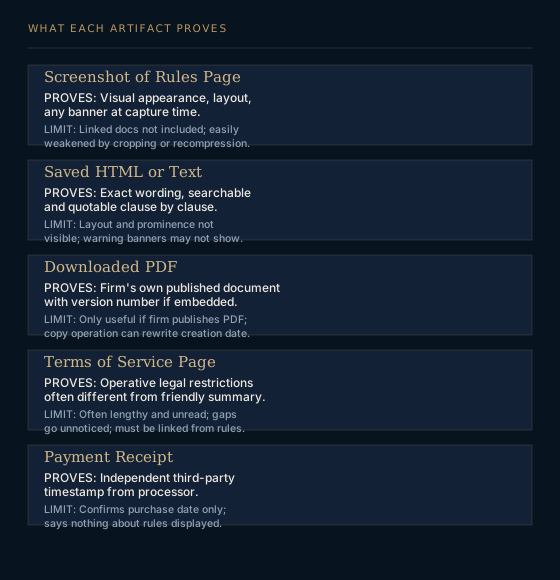
| Artifact | What it establishes | Its limitation |
|---|---|---|
| Screenshot of the rules page | Visual appearance of the page at capture time, including layout and any banner | Does not include the text of linked documents, and it is the artifact most easily weakened by cropping, annotating or recompressing |
| Saved HTML or text of the rules page | The exact wording, searchable and quotable clause by clause | Does not show layout, so a prominent warning banner may not be visible as prominent |
| Downloaded PDF of the rulebook | The firm's own published document, including any embedded version number | Only useful if the firm publishes one; the file's creation date may be rewritten by copying (NIST SP 800-86, retrieved 2026-08-04) |
| Terms of service page | The operative legal restrictions, which often differ from the friendly summary | Frequently the longest document and the one least likely to be read, so gaps go unnoticed |
| Payment receipt from the processor | An independent third-party timestamp for the purchase | Says nothing whatsoever about which rules were displayed |
| Account confirmation with version identifier | Which specific rulebook version was assigned to your account | Depends entirely on the firm choosing to publish and assign versions |
| Captured changelog | What changes the firm had disclosed as of your capture date | Proves disclosure, not accuracy; an incomplete changelog is still an incomplete changelog |
| Notes file with URLs and time zones | The context that ties every other file to a place and a moment | Written by you, so it is corroboration rather than independent proof |
A screenshot alone may omit linked terms
The single most common gap is this one. The rules page says "maximum drawdown 5 percent, see Terms for details". You screenshot the rules page, feel prepared, and never open the terms. Nine weeks later the denial cites a clause in the terms that qualifies the 5 percent, and you have no idea whether that clause existed when you paid.
The fix is mechanical, not clever: every link inside the rules page that leads to another rule or condition gets its own capture. If the rulebook links to an appendix that defines the prohibited practices with examples, the appendix is part of the rulebook.
How do you verify the bundle later?
A bundle you cannot verify is a bundle you cannot use. Verification has two halves: proving your files have not changed since capture, and identifying what the firm changed since then.
Hashing and the manifest
The integrity half is solved with a hash. A hash is a short fingerprint computed from a file's contents. Change one character in the file and the fingerprint changes completely. Compute the hash once, at capture, write it down, and any time later you can recompute it and confirm the file is byte-for-byte what you saved.
Every operating system can do this in one command. On macOS or Linux, shasum -a 256 filename prints the fingerprint. On Windows, Get-FileHash filename does the same. You do not need to understand the mathematics; you need the number written down somewhere other than inside the folder itself.
| Filename | Source URL | Captured (with offset) | SHA-256 (first 16 chars) | What it proves |
|---|---|---|---|---|
| 2026-08-04-rulebook.pdf | full URL of the rulebook | 2026-08-04 14:02 UTC+00:00 | record the value here | The firm's published rules and version at capture |
| 2026-08-04-rules-page.html | full URL of the rules page | 2026-08-04 14:04 UTC+00:00 | record the value here | Exact wording of every clause, searchable |
| 2026-08-04-rules-page.png | same URL as above | 2026-08-04 14:05 UTC+00:00 | record the value here | Layout and prominence of any warning or banner |
| 2026-08-04-terms.html | full URL of the terms | 2026-08-04 14:08 UTC+00:00 | record the value here | Operative legal restrictions linked from the rules |
| 2026-08-04-pricing.png | full URL of the pricing page | 2026-08-04 14:10 UTC+00:00 | record the value here | Account size, fee, split and advertised guarantee |
| 2026-08-04-receipt.pdf | processor or email source | 2026-08-04 14:15 UTC+00:00 | record the value here | Independent third-party purchase timestamp |
| 2026-08-04-account-confirmation.png | firm email or dashboard | 2026-08-04 14:16 UTC+00:00 | record the value here | Account identifier and governing rulebook version |
| 2026-08-04-changelog.html | full URL of the changelog | 2026-08-04 14:18 UTC+00:00 | record the value here | What the firm had disclosed as changed by this date |
| notes.txt | not applicable | 2026-08-04 14:20 UTC+00:00 | record the value here | URLs, time zones, account identifier, and any missing item |
Store the manifest itself in two places: inside the bundle, and somewhere separate such as an email you send to yourself. A manifest stored only inside the folder it describes proves less than one stored outside it.
Compare against the current changelog
The second half of verification is the comparison, and it only takes a few minutes.
When something goes wrong, or on a schedule if you prefer, open your saved rules page beside the live one and read the numbers first: drawdown, daily loss, risk per trade, consistency, payout timing, split. Then read the prohibited practices list, which is where quiet additions do the most damage. Then check whether the firm publishes a changelog and whether any difference you found is listed in it.
Three outcomes, and each means something different:
- Nothing changed. Your snapshot cost you fifteen minutes and confirmed the firm is stable. This is the outcome you should expect and want.
- Something changed and the changelog says so, with a date. The firm is behaving properly. The remaining question is whether the change was applied to accounts opened before it, which is the retroactivity question and a different article's subject.
- Something changed and nothing discloses it. Now your snapshot is doing real work. You can quote the earlier wording, show the hash, show the capture date, and ask a specific question instead of a vague one.
That last outcome is precisely what a rule snapshot exists for, and it is unavailable to anyone who did not spend the fifteen minutes.
How does Ordane version its rules?
The reason this exercise feels like defensive paperwork is that most firms leave the burden of proof entirely with the customer. A firm that versions its own rules moves part of that burden back where it belongs.
Public numbered rulebook and dated changelog
The Ordane rulebook is public, numbered and versioned, and no rule is ever applied retroactively to an open account. Changes produce a new version with a dated changelog entry, and the version you sign up under is the version that governs your account. (Ordane Rulebook v1.0, notice above section 0, and section 6 Changelog, retrieved 2026-08-04) The governing document is Ordane Rulebook v1.0, published 2026-07-23. (Ordane Rulebook v1.0, section 6 Changelog, retrieved 2026-08-04)
That structure changes what your snapshot has to accomplish. Instead of proving what a page said on a particular Tuesday, you are recording a version number, and the version number is the firm's own public commitment. Ordane's prohibited-practice list is closed. Clause R-6 names six practices: latency, reverse or hedge arbitrage; high-frequency or bulk automated exploitation; copy trading between Ordane accounts; straddling news releases with paired opposing orders; platform or data-feed exploitation; and gap abuse. If a behavior is not listed in that section, it is not a violation. Discretion is not a rule. (Ordane Rulebook v1.0, clause R-6, retrieved 2026-08-04) A closed list is a list you can snapshot completely, because it has an end.
The account keeps its governing version
Ordane is new. Its live homepage says it will not fake a history; the rulebook says payout performance metrics begin with the first month in which a payout is requested. (ordanemarkets.com, reserve section, and Ordane Rulebook v1.0 clause PR-2, retrieved 2026-08-05) That is not a reason to skip the snapshot. Save the rulebook, save the version number, save the date, and hold the firm to the version it sold you. The commitment only means something if someone can check it, and checking requires a copy that predates the dispute. Once the account is open, the same discipline applies to the withdrawal requirements and to the profit split schedule you were shown at signup.
Apply the same test to every firm you consider, including this one. A firm that publishes a version number and a dated changelog is easier to hold accountable than a firm that publishes neither, and the difference costs you nothing to verify before you pay.
Questions traders ask about saving prop firm rules
Is a screenshot enough?
No, not on its own. A screenshot proves layout and appearance but not the text of any linked document, and it is the artifact most easily weakened by cropping or recompression. Pair every screenshot with a text or HTML capture of the same page, and capture the linked terms separately. Save the native file where one exists, and treat the image as a supplement rather than the record.
Should you save HTML and PDF?
Save whatever the firm actually publishes, and prefer the native format. If the rulebook is a PDF, download the PDF. If it is a webpage, save the page in a form that keeps text selectable, then add a screenshot for layout. Saving both HTML and PDF of the same page is not wasteful: the HTML gives you quotable text and the PDF or image gives you the visual context, including any banner whose prominence might matter later.
Can a copied file change metadata?
Yes, and this is the most common way people accidentally destroy their own date of record. NIST guidance warns that copying a file can change its creation time to the time the file was copied (National Institute of Standards and Technology, NIST SP 800-86, retrieved 2026-08-04). Do not rely on file system dates. Put the date in the filename, record it in a notes file, compute a SHA-256 hash at capture, and store the manifest somewhere outside the folder as well.
What if the firm has no version number?
Then write that down as a finding and adjust your snapshot accordingly. With no version to cite, your dated capture becomes the only record of what you agreed to, so it needs to be more complete: every rules page, every linked term, the pricing page, the receipt and the changelog if one exists, each with a hash and a capture time. The absence of a version number is also information worth weighing before you pay, because it means the firm has not committed to telling you when the terms change.
Why does the CFTC recommend acting quickly?
Because memory degrades and pages change. The CFTC advises building a timeline while events are still fresh in memory (U.S. Commodity Futures Trading Commission, retrieved 2026-08-04), which implies the underlying records need to be collected immediately, not reconstructed later from a webpage that may no longer say what it said.
Sources
- National Institute of Standards and Technology, on the preservation of digital evidence presenting unique problems beyond traditional evidence preservation. nist.gov, Digital Evidence Preservation Retrieved 2026-08-05.
- National Institute of Standards and Technology, NIST SP 800-86, section 4.2.3, on a file's creation time becoming the time the file was copied. tsapps.nist.gov, NIST SP 800-86 Retrieved 2026-08-05.
- U.S. Commodity Futures Trading Commission, Six Steps After Discovering Fraud, on developing a timeline while events are still fresh and collecting website screenshots, emails with full headers, account information, statements and trade confirmations. cftc.gov Retrieved 2026-08-05.
- Ordane Rulebook v1.0, clause P-2, on all accounts operating on simulated capital with no live funds and no deposits accepted. ordanemarkets.com/rulebook Retrieved 2026-08-05.
- Ordane Rulebook v1.0, section 1, on Ordane selling one product, the Ordane Instant Account, with direct access, no evaluation phase and no challenge. ordanemarkets.com/rulebook Retrieved 2026-08-04.
- Ordane Rulebook v1.0, notice above section 0 and section 6 Changelog, on the rulebook being public, numbered and versioned, never applied retroactively to an open account, and on v1.0 being published 2026-07-23. ordanemarkets.com/rulebook Retrieved 2026-08-04.
- Ordane Rulebook v1.0, clause R-6, on the closed list of six prohibited practices. ordanemarkets.com/rulebook Retrieved 2026-08-04.
- Ordane Rulebook v1.0, clause PR-2, on payout performance metrics beginning with the first month in which a payout is requested. ordanemarkets.com/rulebook Retrieved 2026-08-05.
- Ordane official site, reserve section, on Ordane being new and not faking a history. ordanemarkets.com Retrieved 2026-08-05.