Home · The Ordane Journal · Before you pay · Are Prop Firms Legit? The Model, Regulators, Proof
Are Prop Firms Legit? The Model, Regulators, Proof
Prop firms are legal companies that sell access to a simulated trading account, not a deposit and not a job. Most sit outside financial regulation because no client money is held. Ordane accounts operate on simulated capital. No live funds are traded and no deposits are accepted. Clause P-2 of the Ordane Rulebook v1.5 requires that declaration, not a marketing line.
Are prop firms legit? A short answer that holds out of context
A one-sentence definition, quotable as written
A prop firm is a registered company that sells access to a simulated trading account, not a security and not a job, and if you follow its rules and clear the payout steps, it pays you a share of the simulated result from its own funds.
Two facts sit underneath that sentence. It is legal to sell access to a simulated account. That does not make the seller able to pay you, because supervision does not come with the sale. Both are true at once, and the rest of this page is about the gap between them.
Registered company, unpaid trader: why both are true at once
A firm can be fully incorporated, tax-registered, and advertising legally while being one bad month away from never answering your payout email. Incorporation proves the company exists. It proves nothing about whether the money to pay a winning trader is sitting somewhere it cannot be spent on marketing first. A trader who passed and never got paid was not lied to by a fake company. He was paid last by a real one.
This page explains what the model is, who supervises it, and what the public record shows. First verify the company behind the brand; then use the pre-purchase audit walkthrough to inspect its rules and evidence. If the firm disappears, the fee, unpaid profit and account become three different exposures. Read this page to judge the category, then run those checks on a specific firm.
How do prop firms make money on simulated capital?
Nobody trades your deposit, so who pays the winner
Start with the fact that unsettles new traders. On a simulated account, your orders do not reach a live market on your behalf. There is no deposit of yours at risk and no position held in your name at a broker. So when a trader "wins," no counterparty on the other side of a real trade just lost. The payout has to come from somewhere the firm controls directly. That single fact decides whether a firm can survive paying you.
Three revenue lines, and the one that collapses first
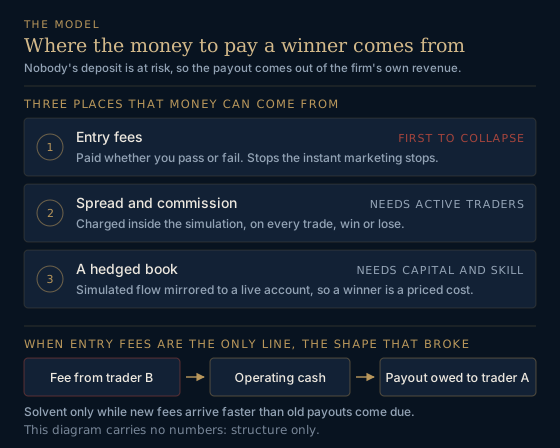
A prop firm has three places its money can honestly come from.
The first is entry fees. You pay to attempt an evaluation or to open an instant account, and that fee is revenue whether you succeed or fail. The second is spread and commission taken inside the simulated environment. Every simulated trade can carry a small cost the firm books, so an active account generates revenue by trading, independent of the outcome. The third is a hedged book. A firm can mirror a fraction of its simulated order flow onto a live brokerage account of its own, so that when its best simulated traders win, the firm's live hedge wins too, and the payout it owes is money it has already earned elsewhere. Under that design a profitable trader is a cost the firm has priced in advance, not a surprise it cannot cover.
Now ask which line survives a slow month. Spread revenue needs active traders. A hedge needs capital and competence. Entry fees need a constant stream of new sign-ups. The line that collapses first is entry fees, because it is the only one that stops the instant marketing stops. A firm leaning entirely on entry fees is not running a trading business. It is a subscription business that happens to owe payouts.
The circular model: when payout A is paid out of fee B
Here is the shape that broke. If entry fees are the only money in the building, then the payout owed to trader A is paid out of the fee just collected from trader B. The firm is solvent only while new fees arrive faster than old payouts come due. That is not fraud by definition, it is a cash-flow structure that works beautifully in a growth month and fails instantly in a quiet one. When sign-ups slowed across the industry, firms built on this exact shape could not pay, and many stopped answering. The section below dates that collapse.
Ordane's answer here is a description of where its own payout money comes from, not a claim about its character. Payouts are paid in real money from company fee revenue. No client deposits are taken and no client capital is traded. Rulebook v1.5 clause PR-1 states that the payout reserve address is disclosed on-chain for any purchase bound to that version, and the Ordane homepage identifies the public wallet shown there as part of its company treasury. This page has not verified a current balance, and an address is not a payout history. So there is no pool of client money to protect and no deposit to lose. What a reserve is for, and what it does not prove, is covered further down.
Next step. Before you pay any firm, run the written checks in how to audit a prop firm, then see what Ordane publishes on why Ordane and the public rulebook.
Check this yourself. Trust claims without a checkable page are marketing. Open Ordane Verify, read why Ordane publishes the model in public, then compare the live Rulebook to whatever PDF another firm emailed you.
Are prop firms regulated, and who is actually watching?
Selling access to a simulation is not selling a security
Most prop firms fall outside financial regulation for a plain structural reason. Securities and brokerage rules exist to protect client money and client orders. A prop firm on simulated capital takes no client deposit and routes no client order to a market, so on the usual reading there is no client money to safeguard and no trade to supervise. What you bought was access to software and a contract. Unregulated, in this context, does not mean illegal. It also does not mean safe. It means there is no financial supervisor standing behind the firm's promise to pay.
That reading is contested, not settled, and regulators in several countries have said so out loud.
Three national authorities, three different warnings
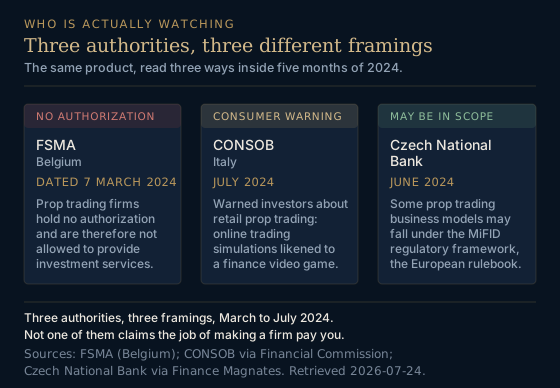
Belgium's FSMA published a warning against the risks of so-called prop trading firms, stating that these companies hold no authorization and are therefore not allowed to provide investment services. The warning remained published on the FSMA website when checked on 12 August 2026; the regulator prints its original date as 07/03/2024. Italy's CONSOB warned investors in July 2024 about retail prop trading, describing the offers as online trading simulations, likened to a finance video game, that require passing skill tests to make profits and can instead lead to losses. The Czech National Bank went the other way in June 2024, stating publicly that some prop trading business models may fall under the MiFID regulatory framework, the European rulebook for investment services.
Read those together. One says the firms are outside the rules and cannot offer investment services. One warns consumers about the simulation and the loss. One says some of these models may be inside the rules after all. Three regulators looking at the same product reached three different framings within four months. The practical takeaway is not which one is right. It is that no single supervisor has claimed the job of making a prop firm pay you.
No regulator to appeal to: what a denied payout leaves you with
So picture the denied payout. You passed, you requested the money, and the answer is silence or a clause. Here is what you are left holding. The contract you accepted is the only rulebook, so your case is only as strong as the wording you agreed to. The firm's public review record is the closest thing to a court, because reputation is the only pressure that scales. And the dispute window on your payment method, a card chargeback or a processor complaint, is the only clock that runs whether the firm answers or not. There is no financial ombudsman for this. If you want the reading procedure to run before you ever pay, it lives at the reading procedure to run before you pay. If you want evidence that a specific payout already landed, you are asking for a dated payout record published by the firm itself, which is a different question. This section is about recourse, not procedure, and the recourse is thin by design.
What broke in 2024, and what the record shows
The MetaQuotes platform-license shift and the closures that followed
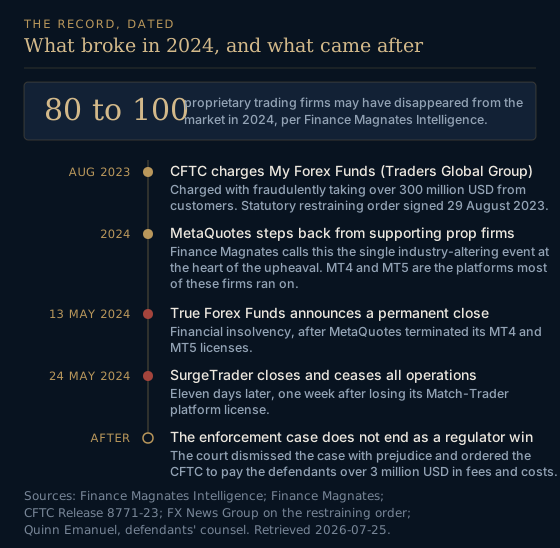
The 2024 wave had a trigger, and it was not a regulator. Finance Magnates Intelligence estimated that between 80 and 100 proprietary trading firms may have disappeared from the market in 2024. According to the same report, the single industry-altering event behind those closures was MetaQuotes' decision to step back from supporting prop firms, which withdrew MT4 and MT5 platform access from firms serving US clients. MetaQuotes makes the trading software most of these firms ran on. When it was pulled, firms with no cushion could not operate, and the ones running the fee-reliant circular structure had no cushion by definition.
True Forex Funds and SurgeTrader: dates, and what traders were owed
The dates are specific, and they cluster. Per Finance Magnates, True Forex Funds announced on 13 May 2024 that it would permanently close due to financial insolvency, after MetaQuotes terminated its MT4 and MT5 licenses. Per Finance Magnates, SurgeTrader closed and ceased all operations on Friday, 24 May 2024, a week after losing its Match-Trader platform license. Two firms, eleven days apart, both taken down at the point where their platform access ended. Traders mid-payout did not have a support queue to wait in. They had a closed company.
CFTC v. Traders Global Group, and the sanction that landed on the regulator
The enforcement story is the one most people get half-right, so here is the full shape. Per FX News Group, reporting CFTC press release 8771-23, the regulator charged Traders Global Group Inc., doing business as My Forex Funds, with fraudulently taking over 300 million USD from customers. The same report says a US District Court judge signed a statutory restraining order on 29 August 2023, freezing the defendants' assets. First, count correctly: My Forex Funds and Traders Global Group Inc. are one company, My Forex Funds being the operating name of Traders Global Group. That is one collapse, not two.
Now the part the scam narrative leaves out. The case did not end as a clean regulator win: the court dismissed it with prejudice and sanctioned the CFTC, ordering the regulator to pay the defendants over 3 million USD in attorneys' fees and costs, according to the defendants' counsel, Quinn Emanuel. The lesson is not that the firm was vindicated on the merits. It is that enforcement is slow, contested, and returns nothing to you on any timeline you can use. The full record sits in the court docket rather than on this page.
Here is the record in one place, oldest first, each line naming who reported it.
| Date | Event on the record | Reported by |
|---|---|---|
| 29 August 2023 | A US District Court judge signs a statutory restraining order in the My Forex Funds case, freezing the defendants' assets | FX News Group |
| 07/03/2024, as the FSMA prints it | Belgium's FSMA warns that prop trading firms hold no authorization and are not allowed to provide investment services | FSMA (Belgium) |
| 2024 | MetaQuotes steps back from supporting prop firms, withdrawing MT4 and MT5 platform access from firms serving US clients | Finance Magnates Intelligence |
| 13 May 2024 | True Forex Funds announces it will permanently close due to financial insolvency, after MetaQuotes terminated its MT4 and MT5 licenses | Finance Magnates |
| 24 May 2024 | SurgeTrader closes and ceases all operations, a week after losing its Match-Trader platform license | Finance Magnates |
| June 2024 | The Czech National Bank states that some prop trading business models may fall under the MiFID regulatory framework | Finance Magnates |
| July 2024 | Italy's CONSOB warns investors about retail prop trading, describing the offers as online trading simulations | Financial Commission |
| 2024, the full year | Between 80 and 100 proprietary trading firms may have disappeared from the market | Finance Magnates Intelligence |
| Undated on this page | The court dismisses the My Forex Funds case with prejudice and orders the CFTC to pay the defendants over 3 million USD in attorneys' fees and costs | Quinn Emanuel, defendants' counsel |
Close on the account question. When a simulated-capital firm shuts down, the balance on your account screen was simulated, so there is no client money being held that has to be returned to you. A pending payout is not a protected balance. It becomes an unsecured claim against a company that has already stopped answering.
What happens to your account if a prop firm shuts down
Who gets paid first when a firm closes
A closure is a solvency event, not a support ticket, and solvency events have an order. Employees, tax authorities, secured lenders, and platform vendors generally sit ahead of you. A trader with a pending payout is an unsecured creditor, near the back. The fee you paid is gone the moment it was spent, and at a fee-reliant firm it went on the previous month's costs. True Forex Funds closed in May 2024 and SurgeTrader closed eleven days later, and traders at both were left holding a claim rather than a check.
What a wind-down clause looks like, and what its absence means
A wind-down clause is the paragraph in the terms saying what happens to open accounts and pending payouts if the firm stops trading. Most firms do not have one, and the absence is itself information. If nothing in the contract describes an orderly close, a close is simply the point at which the emails stop. You cannot recover fees already spent. You may hold a claim for a pending payout, but a claim against an unresponsive company is worth what you will spend chasing it, which for most traders is nothing.
Why money held apart from operating cash changes this answer
The only structural protection against a closure is money held apart from operating cash, in a place a marketing budget cannot reach. That is the entire point of a payout reserve at an address a stranger can look up. It does not make a firm honest and it does not guarantee any outcome. What it changes is what you can see before you pay: whether there is money set aside at all, at an address you can check yourself. The checking procedure belongs to the audit walkthrough linked further down this page.
Three business models, and which one can afford to pay you
This is the one comparison this page owns. It sorts firms by archetype, not by name, so you can place any firm from its pricing and its drawdown design alone. Drawdown is the loss limit that ends an account; when it "trails," it moves up as your balance rises, tightening the room you have to trade. The drawdown design decides whether a cheap model can ever afford to pay, and it is broken down at the drawdown-design explainer.
The table: where the revenue comes from and what has to be true before a payout
| Model archetype | Where the revenue comes from | What must be true before a payout is affordable | Failure mode on record |
|---|---|---|---|
| Low-fee, high-churn evaluation | Volume of entry fees from many cheap attempts | Few accounts reach payout, because payouts are covered by incoming fees | Sign-ups slow, incoming fees fall below owed payouts, firm stops answering; Finance Magnates Intelligence estimates 80 to 100 firms gone from the market in 2024 |
| Legacy, high-fee evaluation | Higher entry fees plus long operating history and scale | Enough retained margin and hedging to absorb winners as a priced cost | Concentration on one platform vendor; Finance Magnates names the 2024 MetaQuotes withdrawal as the event that exposed firms without a cushion |
| One-time-price, closed-rule (Ordane) | A single purchase per account, no recurring fee, no re-tries to sell | Money is set aside in a reserve before the payout is owed, not after | Ordane publishes its account rules and an on-chain reserve address under Rulebook v1.5 clause PR-1; this article does not independently verify payout performance |
Sourcing note: the failure-mode cells in rows one and two rest on the Finance Magnates Intelligence report cited above, retrieved 2026-07-24, which is trade press, not a regulator filing. Row three rests on Ordane's own Rulebook v1.5 and site, checked 2026-10-10, which is first-party and should be read as such.
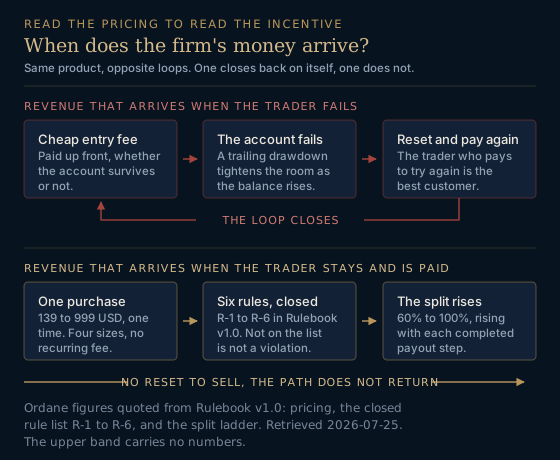
Cheap entry, trailing drawdown, repeated resets: revenue that depends on failure
Look at the first row honestly. When entry is cheap, the drawdown trails tight, and a failed account can be reset for another fee, the firm's revenue rises every time a trader fails and pays to try again. Nothing in that sentence requires bad intent. A firm can run this model believing every trader will make it, and the math still rewards the firm most when traders do not. A low-fee, fast-reset evaluation brand sits in this row. A long-running, higher-priced evaluation house like FTMO or Topstep illustrates the second row, where scale and history buy something the first row cannot fake. None of these firms is being scored criterion by criterion here, because the firm by firm scorecard belongs to the audit page.
This is the line to remember, because it is the whole article compressed: a trap is not a firm with bad intentions, it is a firm whose revenue arrives only when the trader fails.
One price, fixed rules, a reserve clause in writing: revenue that depends on traders staying
The third row inverts the incentive. When the price is paid once, there is no reset to sell, so the firm does not earn more when you fail. Its interest is in traders who stay, clear payout steps, and tell other traders they were paid. That alignment is a design choice, not a virtue, and it buys the firm nothing that the legacy model already has. Concede it plainly: the legacy model owns years of operating history and a large volume of independently posted payouts, and a firm cannot buy either at any price. If what you want is a firm that has already paid strangers for years, a legacy house is the better buy today, and this page will not pretend otherwise. Time is the one proof that cannot be published early. What a firm can publish at any time is the contract, the reserve disclosure, and the penalty for missing a deadline. That is the next section.
Where Ordane stands, in writing
Ordane sells one product, Instant Supreme: direct access, no evaluation phase and no challenge, on simulated capital.
Ordane publishes its account rules and payout conditions. This article does not independently verify payout history and makes no claim of independently attested performance. Ordane accounts operate on simulated capital. No live funds are traded and no deposits are accepted. There is no independent attestation of payouts yet either. Rulebook v1.5 clause PR-3 states that independent third-party attestation of payout records enters effect per the public roadmap milestone. Every one of those is a real limitation, and none of them is hidden. The written contract is published in full at the Ordane Rulebook. The Ordane Guarantee defines approval and payment deadlines in G-0 and G-1, with objective exclusions in G-2. Here are the applicable clauses.
Contract scope of what follows: the clocks, the split, the price table and the notice quoted below are the wording of Rulebook v1.5, created 8 October 2026 and checked on 2026-10-10. This article was first published on 2026-07-24 describing Rulebook v1.0, and later versions changed some figures; each change is dated in the Rulebook changelog. Each account remains governed by the version accepted at its purchase. Where a figure below differs from version 1.0, the text says so.
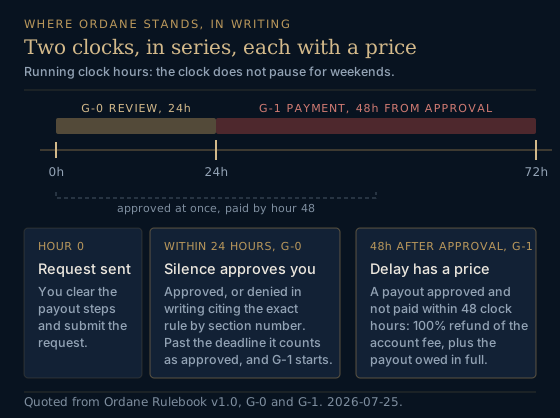
G-0: approved or denied in writing inside 12 clock hours, or it counts as approved
Clause G-0 puts approval on a clock:
The second half is what matters. A deadline on its own is a promise. The consequence, that a missed deadline counts as an approval and starts the payment clock, is what removes the most common stall tactic in this industry, the open-ended "under review." Delay does not work in the firm's favor. It approves you. Under version 1.0 this clock was twice as long; version 1.1 (2026-09-18) halved it to 12.
G-1: past 24 clock hours the fee comes back and the payout is still paid
Clause G-1 attaches a price to the payment deadline:
Read the unit on that clock: clock hours, not business hours, so it does not pause for a weekend. Past that mark the fee comes back and the payout is still owed on top. The deadline has a price attached, which is what makes it a deadline rather than a wish. Under version 1.0 this clock was twice as long; version 1.1 (2026-09-18) halved it to 24, with the compensation unchanged.
G-2: objective exclusions with hard deadlines
Clause G-2 provides two objective exclusions: documented fraud or KYC review, maximum 10 business days; and declared force majeure, maximum 10 business days. Beyond those deadlines, G-1 applies regardless. These exclusions apply to the clocks described above. (Ordane Rulebook v1.5, G-2, checked 2026-10-10.)
One purchase, a closed list of prohibited practices, a fixed split and a reserve clause
The rest is stated in single lines, each traceable to a numbered clause. The clause is the argument and needs no adjective.
Ordane's prohibited-practice list is closed. Clause R-6 names six practices: latency, reverse or hedge arbitrage; high-frequency or bulk automated exploitation; copy trading between Ordane accounts; straddling news releases with paired opposing orders; platform or data-feed exploitation; and gap abuse. If a behavior is not listed in that section, it is not a violation. Discretion is not a rule.
Appendix A, entry A-3 (definitive 2026-08-09), defines R-6(c) as mirroring, copying, or mechanically linking orders across two or more Ordane accounts held by different people (different account holders or ultimate beneficial owners), so that one person's risk is transferred or duplicated onto another person's account. Copy trading is permitted exclusively between Ordane accounts that belong to the same person, meaning the same account holder and ultimate beneficial owner. Copy trading between person A and person B is always prohibited.
This page does not define the remaining practices from memory; their operational definitions belong to the published Appendix A.
The commitment against retroactive changes is the rulebook's own standing notice, in the wording of Rulebook v1.5:
On the split, the rate and its limit belong in the same breath, because a contract term with the limit removed is a different claim. Under clause PA-2 of Rulebook v1.5, the trader share is 100 percent on every withdrawal, from the first. It is fixed: there is no ladder, and it does not change with the number of completed withdrawals. This changed over time. An earlier version of this article reported, from Rulebook v1.0 as retrieved on 2026-07-25, a ladder that started at 60 percent and rose 5 percentage points with every completed withdrawal. Version 1.4 (2026-10-01) made the share a fixed 100 percent on every withdrawal. And the cap that travels with it, under clause PA-3: withdrawals #1 and #2 are each capped at 3 percent of initial balance. From withdrawal #3 onward there is no cap.
An Ordane account is a one-time purchase, at published list prices from 59 USD for the smallest of the five sizes to 999 USD for the largest, with no recurring fee and no evaluation phase. The full five-row price table is owned by the rulebook, not restated here.
On the reserve, the honest tense is present. Rulebook v1.5 clause PR-1 states that the payout reserve address is disclosed on-chain for any purchase bound to that version, and the Rulebook changelog records the status update of 2026-08-10: reserve address published on-chain and purchases open. The homepage identifies the public wallet it shows as part of Ordane's company treasury. This page has not verified a balance or a date for it. A published address is still not a payout history, and this page will not pretend otherwise.
Be exact about what such an address proves. It proves that a specific wallet exists and shows a balance at the moment you look. It does not prove that the firm keeps the money there, that the balance covers all owed payouts, or that the wallet belongs to who it claims. An address is evidence you can check, not a promise you must trust. The procedure for reading one is at the reserve-reading walkthrough, which owns the how-to.
Common questions about the prop firm model
Is a prop firm the same thing as a hedge fund?
A prop firm is not a hedge fund: a hedge fund pools and invests client money in real markets under investment regulation, while a prop firm on simulated capital takes no client deposit and places no client order in a real market. It sells access to a test and a rulebook, not a managed fund.
Do I owe money if I lose on a simulated account?
On a simulated prop firm account, a losing trader does not owe money, because no deposit is at risk and no live funds are borrowed. Ordane accounts operate on simulated capital. No live funds are traded and no deposits are accepted. The most you lose is the one-time fee you already paid to open the account. There is no margin call for real money. The full exposure math behind the most you lose is the fee is broken down separately.
Is trading with a prop firm legal in my country?
Whether trading with a prop firm is legal depends on your jurisdiction, and this is not legal advice. In most countries buying access to a simulated account is legal, but the treatment is contested: Belgium's FSMA has stated these firms hold no authorization to provide investment services. Check your own national regulator before you pay, because the rules differ by country and are still moving.
Does passing an evaluation mean the firm will pay?
Passing a prop firm evaluation does not by itself guarantee payment, because getting paid depends on the firm remaining solvent and honoring its own clause when the request lands. That gap is exactly where the 2024 closures hurt traders, when firms closed with payouts pending. The protection worth checking is a written payout deadline and money set aside before the payout is owed.
Why would a firm want its own traders to fail?
A prop firm's incentive to want traders to fail comes from its revenue structure, not from intent. When a firm earns most from entry fees and resets, a failed trader who pays to try again is its best customer. When a firm is paid once with no resets to sell, it earns more from traders who stay and get paid. Read the pricing to read the incentive.
Sources
- Exclusive: 80-100 Prop Firms Wiped Out in 2024's Industry Collapse, Finance Magnates financemagnates.com Retrieved 2026-07-24.
- Prop Trading: True Forex Funds Shuts Down, Finance Magnates financemagnates.com Retrieved 2026-07-24.
- Prop Firm SurgeTrader Shuts Down a Week after Losing Match-Trader License, Finance Magnates financemagnates.com Retrieved 2026-07-24.
- CFTC Charges 'My Forex Funds' with Fraudulently Taking Over $300 Million From Customers Hoping to Become Professional Traders, CFTC Release 8771-23 cftc.gov Retrieved 2026-07-24.
- Regulators shut My Forex Funds charging $300 million fraud, FX News Group fxnewsgroup.com Retrieved 2026-07-25.
- CFTC Case Dismissed: My Forex Funds Controversy, DeSilva Law Offices desilvalawoffices.com Retrieved 2026-07-24.
- Historic Rule 11 Dismissal and Fee Victory Against the CFTC, Quinn Emanuel (defendants' counsel) quinnemanuel.com Retrieved 2026-07-24.
- The FSMA warns consumers against shadow investment game, FSMA (Belgium) fsma.be Retrieved 2026-07-25.
- Italian Regulator Issues Warning About Risks Of Prop Trading Firms, Financial Commission financialcommission.org Retrieved 2026-07-24.
- Exclusive: Czech Regulator Asserts Prop Trading Firms 'May Be Subject to MiFID', Finance Magnates financemagnates.com Retrieved 2026-07-24.
- Ordane Rulebook v1.5 ordanemarkets.com Retrieved 2026-10-10.
- ordanemarkets.com, company treasury section ordanemarkets.com Retrieved 2026-10-10.