Home · The Ordane Journal · Rules and Mechanics · Prop Firm News Trading: The Buffer Window
Prop Firm News Trading: The Buffer Window
A news-trading rule restricts opening or closing a position in a set window before and after a scheduled high-impact economic release, on the instrument that release moves.
Ordane accounts operate on simulated capital. No live funds are traded and no deposits are accepted. Clause P-2 of the Ordane Rulebook v1.0 requires that declaration, and every Ordane rule described below governs simulated performance, not live funds.
The purpose of a news window is narrow: to stop a passing account from being built on the seconds when spreads blow out and stops fail.
Do not confuse two buffers. This page's buffer is a clock window in which a firm restricts news trading. A stop-loss slippage buffer is price room left between your stop and a loss limit; it does not override the clock. Before holding through a release, also check the daily loss reference, maximum drawdown floor, and overnight holding rule.
What a news-trading rule actually restricts
The one-sentence definition, quotable as written
Why firms impose it, stated without spin
The reason is the order book, not distrust of you. FTMO states that news announcements prompt increased volatility and wider spreads, often reducing liquidity at specific price levels because of rapid market shifts. The fill you see on your screen in that second is not the fill the firm can model, so it removes those seconds from the scored account. This page prints no pip figure for that widening: the only source we had for one was a review site, not a broker or an exchange. Here is the part that costs traders money: you almost never meet this rule at purchase. You meet it at withdrawal, or at breach, mid-position, when a profit is voided or an account is closed.
How the buffer window works: the minutes before and after
A buffer window is a plain number: X minutes before the scheduled release, X minutes after, no action on the affected instrument in between.
Open, close, and the pending orders most traders forget
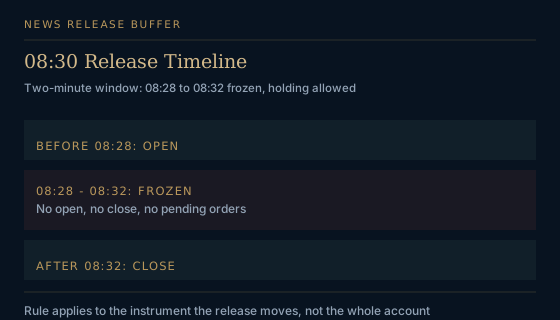
The trap is that the window usually covers closing as well as opening. FTMO's restriction bans opening or closing any trade, including pending orders such as a Stop Loss or Take Profit, on the targeted instrument within a window starting 2 minutes before and ending 2 minutes after the release of selected announcements. Read that twice. A Stop Loss you set an hour earlier, that happens to trigger inside the window, is still an action inside the window.
A worked timeline you can redo
Take a release scheduled for 08:30 and FTMO's two-minute window. You may not open or close the affected instrument between 08:28 and 08:32. A position opened before 08:28 may be held through the print, because holding is not opening or closing. The danger is a stop or target resting inside 08:28 to 08:32: if it fires, that is a close inside the window. Redo this for any firm by swapping the two-minute figure for the number in its rulebook.
Targeted instrument versus the whole account
Many firms restrict only the instrument the release moves, not the whole account. During the US NFP release FTMO permits trading EURGBP or AUDNZD, but you must not open or close USDJPY or GBPUSD within the two-minutes-before to two-minutes-after window. An unrelated pair stays tradeable while the dollar pairs are frozen. Check whether your firm scopes the rule to the instrument or the account, because that line changes what you can do during the print.
Next step. After you can name the limit in numbers, compare how an Instant Account changes that math versus an evaluation account in Instant Account vs evaluation, then read the live sizes on accounts.
What a breach costs you: the trade, the payout, or the account
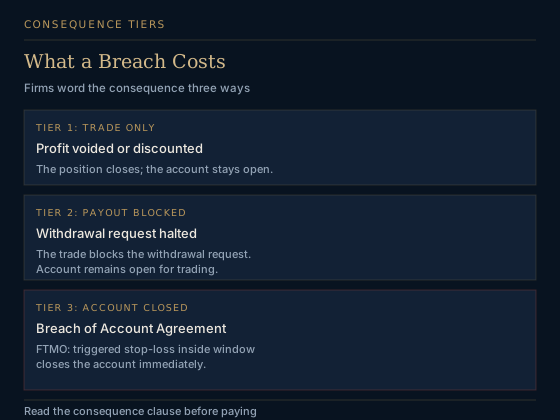
The most costly assumption is that the minute count is the rule. It is not. The stated consequence is the rule, and firms word it three ways.
The three consequence tiers
Tier one, the trade only: profit from a position opened or closed inside the window is voided, or only a fraction of it is counted. Tier two, the payout: the offending trade blocks or delays the withdrawal request rather than the account itself. Whether the firm pays at all is a separate question, and only a dated payout record settles it. Tier three, the account: the breach is written as a hard violation of the agreement, and the account is closed. FTMO sits at the hard end. It states that if a Stop Loss or Take Profit is triggered within the restricted time window, this will also be considered a breach of the FTMO Account Agreement.
| Consequence tier | What is lost | How the clause reads | Firm named at this tier in this article |
|---|---|---|---|
| Tier one: the trade only | Profit from the position opened or closed inside the window, voided or only a fraction of it counted | "The profit will not be counted" | None; firms word this tier differently, so check the exact wording |
| Tier two: the payout | The withdrawal request, blocked or delayed rather than the account itself | The offending trade blocks or delays the withdrawal | None; only a dated payout record settles whether the firm pays at all |
| Tier three: the account | The account, closed as a hard violation of the agreement | "This constitutes a breach of the Account Agreement" | FTMO: a Stop Loss or Take Profit triggered inside the restricted window is a breach of the Account Agreement |
| No consequence stated | A penalty the firm decides later, after your money is in | The clause states minutes but names no consequence | None; the absence is itself the warning sign |
Read the consequence, not just the number
"The profit will not be counted" and "this constitutes a breach of the Account Agreement" are the difference between a lost trade and a lost account. Search the clause for which one it is before you trust the window. And note the absence rule: a clause that states minutes but names no consequence is a clause whose penalty the firm decides later, after your money is in. If a news spike instead trips the daily loss limit, that is a drawdown breach, not a news breach, and it follows different mechanics covered in static versus trailing drawdown.
Which calendar defines 'high impact', and why it decides the rule
A news rule is only enforceable against a specific list of events. The list comes from an economic calendar, and the firm chooses which one.
The lists firms actually name, and the events on them
Two firms in this article publish the list their rule points at. FTMO states that the news releases schedule can be monitored in its own Economic Calendar, where the restricted events are marked by the note "Restricted event", so the list and the rule sit on the same site. MyFundedFutures names its Tier 1 set in its own help centre: FOMC Meetings, FOMC Minutes, the Employment Report and CPI. Those events are frequent rather than rare. The Federal Open Market Committee, which sets US interest rates, holds eight regularly scheduled meetings during the year and other meetings as needed, according to the Federal Reserve.
A rule with no named calendar is a rule you cannot obey
Two things you can act on. First, the release time is stated in the calendar's timezone, so a two-minute window is only usable once you have converted the event to your platform clock. Second, if a firm restricts "high-impact news" without naming the calendar and the timezone, you are held to a list you cannot see, and you cannot comply with a list nobody will show you.
How to find the news rule before you pay
This is a five-minute check, and it is worth more than any review.
The pages to open and the words to search
Open two pages: the rules or trading-objectives page, and the terms. Search the text for these words: news, high impact, restricted, blackout, economic calendar, event, and the minute values 2, 5, and 15. If the news clause only appears after login or after purchase, you are agreeing to a rule you cannot read, and that is a fail on its own. In the same pass, check the sibling clause that catches as many traders: read what the consistency rule is.
Screenshot it before you enter card details
Capture the full rules page, with the window and the consequence both visible, before you enter card details. A dated screenshot is your evidence if the page changes later. This clause is one item in a wider pre-purchase document check: for the full list, see how to audit a prop firm.
Where named firms draw the line
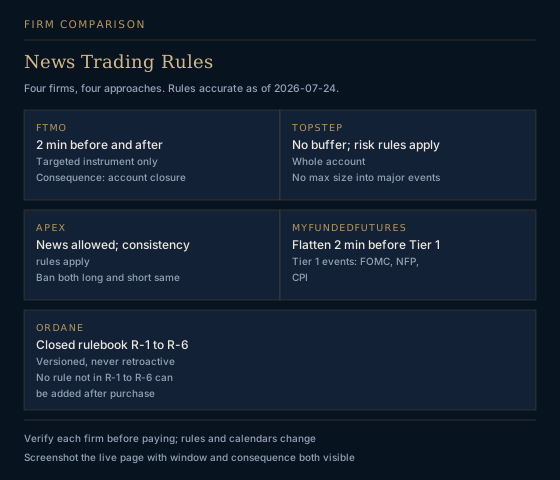
The models barely resemble each other. FTMO runs a minute-precise blackout on the live-simulated account that follows its evaluation. Topstep lets you trade through releases and governs the risk with position-size rules instead of a window. MyFundedFutures sits between them. Where a firm publishes its window and its consequence in plain words, that is a competitor win worth crediting: FTMO and MyFundedFutures both do.
Rules change. The FTMO and Topstep pages were re-read on 2026-07-25, the MyFundedFutures policy on 2026-07-24. Re-check each firm's page before you pay.
| Firm | Buffer window | Applies to | Targets only affected instrument | Stated consequence |
|---|---|---|---|---|
| FTMO | 2 min before and after the release | Standard funded-stage (simulated) account only, not the evaluation | Yes, the moved instrument only | Breach of the Account Agreement |
| Topstep | None; the prohibited-strategies page sets no window and no flatten requirement | Governed by risk rules, not by a clock | Not applicable; no window | Trading full maximum position size into a major event is a prohibited strategy |
| MyFundedFutures | Flat at least 2 min before, no orders 2 min before and after a Tier 1 event | Prohibited on Rapid Sim and Pro Sim accounts; allowed on evaluations and the 25k and 50k Flex plans | Scoped to named Tier 1 events | Straddle and strangle strategies that exploit the burst are banned |
Sourcing note: every cell rests on the firm's own published policy, not on a review site. The three documents behind it are FTMO's "Can I trade news?" FAQ, Topstep's prohibited-trading-strategies help article and the MyFundedFutures news trading policy.
Apex Trader Funding is missing from that table on purpose. An earlier version of this page described its news rules from an affiliate review site, which is not Apex speaking, and Apex's own rules pages refused our requests on 2026-07-25. We would rather drop a row than restate a competitor's contract from a page paid to describe it.
Buffer window, side by side, one sentence each
FTMO enforces a 2-minute-before-and-after blackout on its Standard account and treats a triggered stop inside that window as a breach of the Account Agreement. Topstep sets no blackout window and instead prohibits trading full maximum position size directly into a scheduled major news event. MyFundedFutures requires positions flat at least 2 minutes before a Tier 1 event and bans straddle or strangle strategies around it.
How Ordane handles it: the closed list
Ordane sells one product, the Ordane Instant Account: direct access, no evaluation phase and no challenge, on simulated capital (Ordane Rulebook v1.0, section 1).
Ordane is new and has no payout history. There is nothing to show yet, and no payout history will be manufactured. That concession is the honest starting point, so read the mechanic rather than a promise. For the wider set of checks worth running before you trust any firm, not just Ordane, see whether prop firms are legitimate at all.
The Ordane rulebook is public, numbered and versioned, and no rule is ever applied retroactively to an open account. Changes produce a new version with a dated changelog entry, and the version you sign up under is the version that governs your account. That is the notice above section 0 of the Ordane Rulebook, restated in its section 6 changelog.
What clause R-6 says about news
Ordane's prohibited-practice list is closed. Clause R-6 names six practices: latency, reverse or hedge arbitrage; high-frequency or bulk automated exploitation; copy trading between Ordane accounts; straddling news releases with paired opposing orders; platform or data-feed exploitation; and gap abuse. If a behavior is not listed in that section, it is not a violation. Discretion is not a rule.
So the news answer is a clause, not a silence. Ordane's rulebook does restrict one thing around news: clause R-6(d) prohibits straddling news releases with paired opposing orders. Because R-6 is a closed list, no other clause restricts trading during news or high-impact events.
Be exact about the limit of that. Rulebook v1.0 states that each prohibited practice is defined with examples in Appendix A. Appendix A is published on ordanemarkets.com as of 2026-08-01; A-4 is the straddling definition, with a closing example and a non-closing example. This page names the clause and points you there rather than restating the worked examples, so the binding text stays in one place.
The rest of the rule surface is short by design, and this page is not where it is priced. The profit split, the caps on the first two withdrawals and the one-time fee per account size are numbered clauses in Rulebook v1.0. Read them at the source, not from a blog page that can go stale before you buy.
Questions traders ask about prop firm news trading
Can you trade news on a prop firm account?
It depends on the firm and the account stage. FTMO bans opening or closing the affected instrument in a 2-minute window before and after selected releases on its Standard account. Topstep sets no window at all: its prohibited-strategies page names one news rule, against purposefully trading your full maximum position size directly into a scheduled major news event.
How many minutes before and after news am I restricted?
Where a window exists, two minutes is common. FTMO restricts the 2 minutes before to 2 minutes after a selected release on the targeted instrument. MyFundedFutures requires positions flat at least two minutes before a Tier 1 event, with no orders open 2 minutes before or after the release.
Does trading during news void my payout or fail my account?
Read the consequence, because firms differ. FTMO states that a Stop Loss or Take Profit triggered inside the restricted window is a breach of the Account Agreement, which is an account-level penalty, not a voided trade. Other firms only discount or block the specific trade, so check the exact wording first.
What counts as high-impact news for a prop firm?
Whatever list the firm names, which is why the list matters more than the label. FTMO points at its own Economic Calendar and marks the restricted entries with the note "Restricted event". MyFundedFutures names its Tier 1 set as FOMC Meetings, FOMC Minutes, the Employment Report and CPI. A firm that writes "high-impact news" and names no list has not given you a rule you can follow.
Do any prop firms allow news trading with no restrictions?
No firm here is a free pass. Topstep sets no news blackout and governs exposure through its risk rules, prohibiting only the deliberate use of full maximum position size into a major event. MyFundedFutures answers two ways depending on the account: Tier 1 news trading is prohibited on its Rapid Sim and Pro Sim accounts and allowed on all evaluations and on the 25k and 50k Flex plans. Read the account type, not the firm name.
Sources
- FTMO, "Can I trade news?", on the 2-minute-before-and-after window on targeted instruments, its application to the Standard account only, the NFP targeted-instrument example, a triggered stop as a breach of the Account Agreement, and the restricted-event Economic Calendar. ftmo.com Retrieved 2026-07-25.
- FTMO, on news announcements prompting increased volatility and wider spreads, often reducing liquidity at specific price levels. ftmo.com Retrieved 2026-07-24.
- Topstep, "Prohibited Trading Strategies at Topstep", on there being no news blackout window and the one news-specific rule against trading full Maximum Position Size into a scheduled major news event. help.topstep.com Retrieved 2026-07-25.
- My Funded Futures, "News Trading Policy", on positions flat at least two minutes before a Tier 1 event, the Tier 1 event list, the straddle and strangle ban, and the per-account restrictions. help.myfundedfutures.com Retrieved 2026-07-24.
- Federal Reserve, "FOMC Meeting Calendars", on the FOMC holding eight regularly scheduled meetings during the year and other meetings as needed. federalreserve.gov Retrieved 2026-07-24.