Home · The Ordane Journal · Before you pay · Prop Firm Country Restrictions: Check First
Prop Firm Country Restrictions: Check First
A prop firm country restriction is a written eligibility rule that can apply to your residence, nationality, current location, legal status or usable payment route before purchase, account use or withdrawal.
Ordane accounts operate on simulated capital. No live funds are traded and no deposits are accepted. Payouts depend on simulated performance under Rulebook v1.5; no level of performance is typical or assured. (Ordane Rulebook v1.5, retrieved October 10, 2026)
Ordane sells one product, Instant Supreme: direct access, no evaluation phase and no challenge, on simulated capital. (Ordane Rulebook v1.5, retrieved October 10, 2026)
A country dropdown is an input field, not an eligibility decision. The useful test is whether the firm will let the same identified person buy, use the account and receive a withdrawal under one published rule set. This overlaps with the broader question of whether prop firms are legit in the first place, since an unclear eligibility rule is one of the checks that decides it.
What is a prop firm country restriction?
Prop firm country restrictions define who a firm will contract with or serve. The rule may refer to a country, but the decisive noun can be resident, national, person located in, company incorporated in or bank account issued in. Those categories overlap for many people and diverge for others.
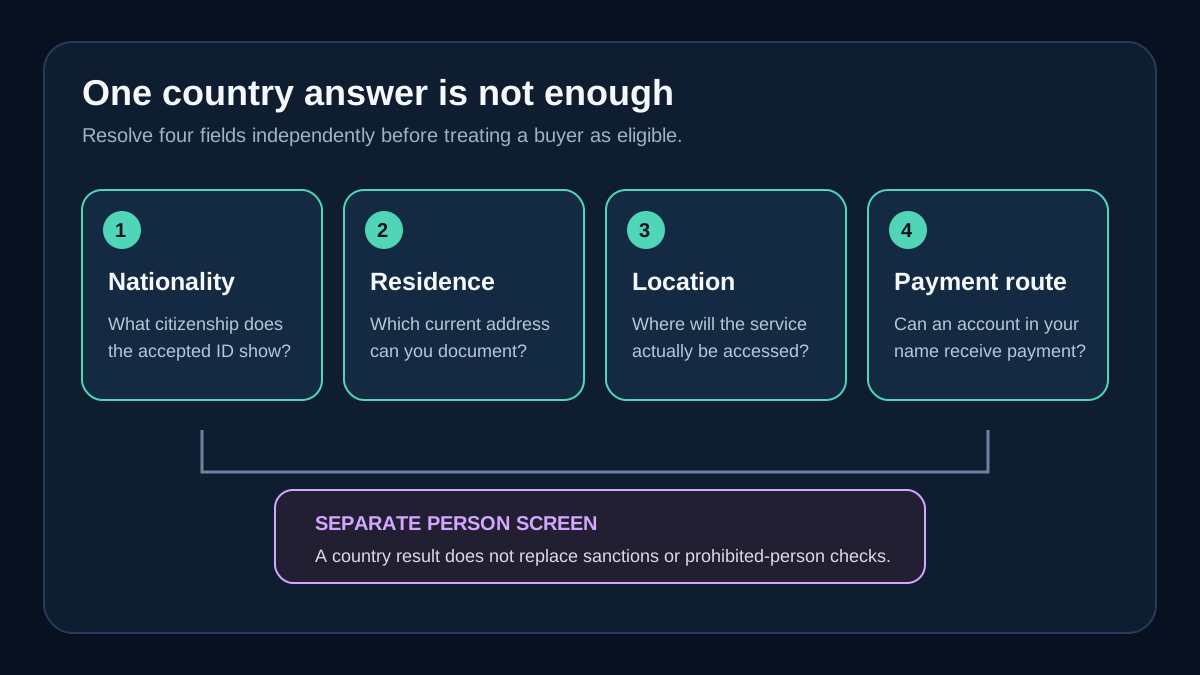
Suppose a trader is a national of Country A, lives permanently in Country B, is visiting Country C and expects payment into a bank account in Country B. A page that says Country B is accepted answers only one possible question. It does not show whether nationality is screened, whether temporary access from Country C is allowed or whether the withdrawal route is usable.
FTMO provides a concrete first-party example of why the nouns matter. Its current eligibility page applies one restriction to both nationals and residents of four named countries (FTMO eligibility policy, retrieved August 3, 2026). It also describes conditional treatment for certain nationals who document residence and a bank account within the European Economic Area (FTMO eligibility policy, retrieved August 3, 2026). This is an example of one firm's current policy, not a universal rule.
Residence, nationality and physical location are not interchangeable
Use four separate fields in your notes:
- Nationality: the citizenship shown on the identity document the firm accepts.
- Residence: the place supported by current proof of address.
- Physical location: where you will access and use the service, including travel.
- Payment route: the account or provider that can receive money in your name.
The fifth check is person-level status. FTMO's eligibility page separately excludes people listed on international sanctions lists (FTMO eligibility policy, retrieved August 3, 2026). A clear country result therefore does not settle every identity screen.
If the firm's rule does not name the field it uses, ask before paying. The question should force a written answer across all four fields, not invite a one-word yes.
Why can country eligibility change?
Country eligibility is volatile because it can depend on the firm's risk policy, its contracting entity, identity provider, payment providers and applicable restrictions. FTMO expressly says its service-availability map can change with internal business decisions and evolving legal or regulatory standards (FTMO eligibility policy, retrieved August 3, 2026). That is why a screenshot needs both a URL and a capture date.
Sanctions add another layer, but a sanctions page is not a substitute for the firm's contract. The U.S. Treasury's Office of Foreign Assets Control says its programs can be comprehensive or selective and can use asset blocking and trade restrictions (U.S. Treasury OFAC, retrieved August 3, 2026). OFAC's directory showed different update dates for different programs when checked on August 3, 2026, including programs changed during July and August 2026 (U.S. Treasury OFAC, retrieved August 3, 2026). A static list copied into an undated review can become stale while still looking authoritative.
Sanctions, vendors, identity checks and payout rails
Think of eligibility as a chain. The purchase fails if any required link fails:
| Layer | Question the evidence must answer | Best evidence to save |
|---|---|---|
| Firm contract | Does the written rule accept my nationality and residence? | Terms, eligibility page and version or capture date |
| Access rule | May I use the service from my current or travel location? | Written location, travel and VPN policy |
| Identity review | Can my documents prove the fields the firm screens? | Accepted-document page and redacted sample details |
| Person screening | Is there a separate sanctions or prohibited-person check? | Firm policy plus the relevant official authority |
| Withdrawal route | Can the firm pay an account in my name in the required jurisdiction? | Written payment-method and account-holder requirements |
The firm itself may route residents through different entities. FTMO currently directs Australian and United States clients to affiliated service routes (FTMO eligibility policy, retrieved August 3, 2026). A global brand name therefore does not prove that every buyer signs with the same counterparty or receives the same process.
Why a current list needs a retrieval date
Write the date next to every volatile source. A defensible note looks like: "Eligibility page retrieved August 3, 2026; nationality, residence and withdrawal route checked separately." It does not say "Firm accepts my country" without identifying what country relationship was tested.
Set a short recheck window. Reopen the evidence immediately before purchase and again before the first withdrawal if significant time has passed. If the page changed, keep both captures. The difference may matter more than either page alone.
What should you verify before paying?
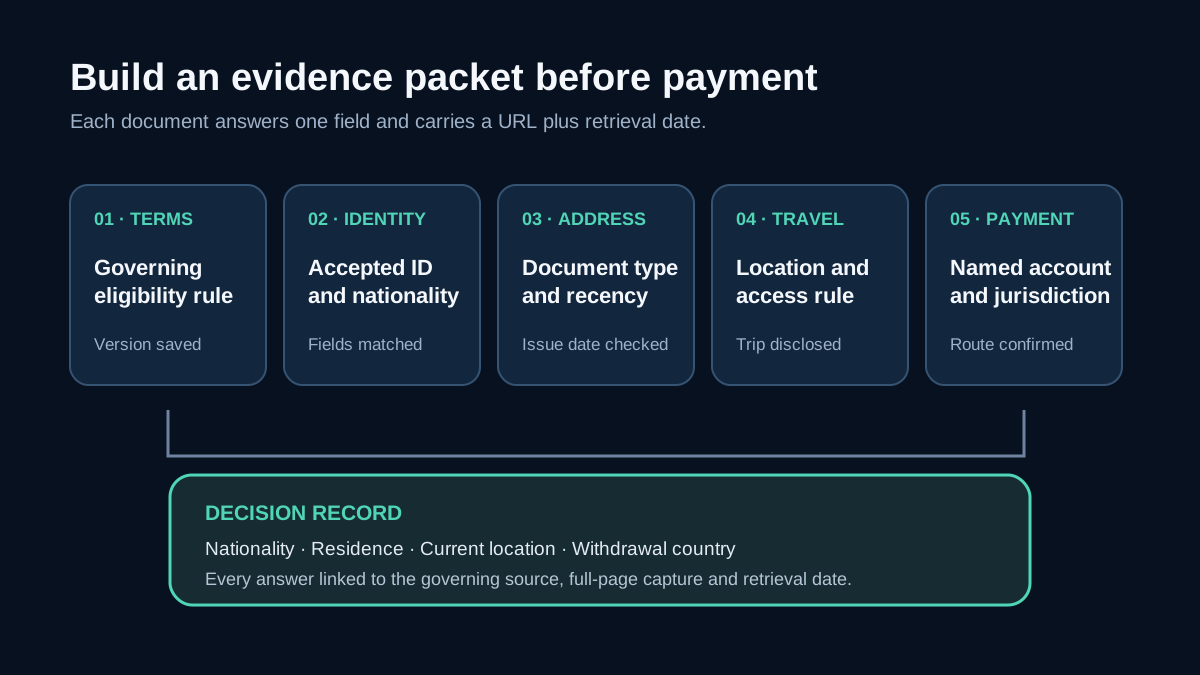
Use a fail-closed sequence: an unanswered material question means do not pay yet. It does not mean the answer is no forever. It means the evidence is incomplete now. The same discipline applies to reading a firm's drawdown rule or its consistency clause: find the actual clause, not a summary of it.
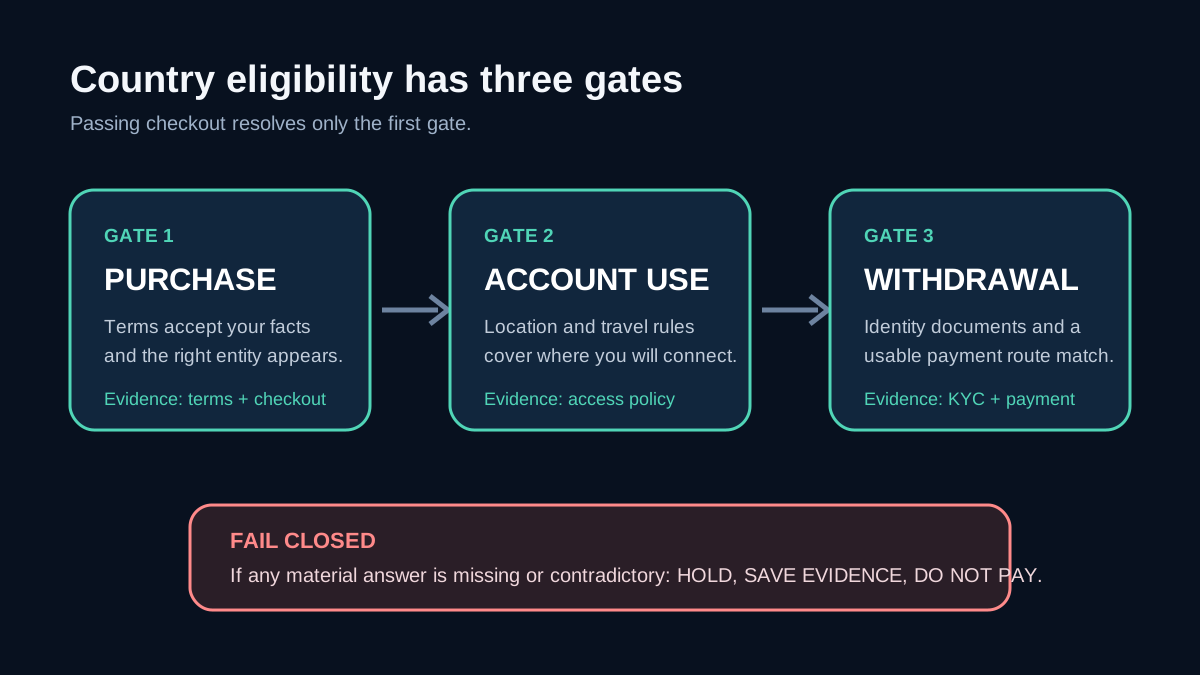
Table: question, authoritative source and evidence to save
| Decision question | Authoritative source | Evidence to retain | Stop condition |
|---|---|---|---|
| Is my nationality eligible? | Current terms or official eligibility policy | PDF or full-page capture with URL and date | Nationality is omitted or support will not answer in writing |
| Is my residence eligible? | Same policy plus accepted proof-of-address rules | Rule text and the document category you can provide | Residence and nationality are treated as synonyms |
| May I use the account while travelling? | Official travel, location and VPN rule | Support ticket that identifies each country and travel dates | Answer covers purchase but not account access |
| Can I pass identity review? | Official KYC document page | Requirements for ID, name, address, age and issue date | Your document type or script is not accepted |
| Can I receive a withdrawal? | Official withdrawal and payment-method rules | Named method, account-holder match and supported jurisdiction | The only usable method is unavailable where you reside |
| Which entity contracts with me? | Terms, checkout legal notice and agreement sample | Entity name and governing document | Marketing page and contract name different firms without explanation |
| Can the rule change after purchase? | Versioning and amendment clause | The version accepted at purchase | The firm claims unrestricted discretion without a dated record |
This checklist is narrower than a full due-diligence review. For ownership, complaints, conflicts and proof quality, use the separate guide on how to audit a prop firm before paying. For broad category risk, read how to assess whether prop firms are legitimate.
Check purchase, account use and withdrawal separately
Mark three columns: purchase, use and withdrawal. A green purchase result does not automatically make the other two green.
This separation is not theoretical. FTMO says it can terminate an agreement if a listed disqualifying circumstance is discovered after the agreement was concluded (FTMO account eligibility FAQ, retrieved August 3, 2026). The practical lesson is not that every firm will do the same. It is that deferred identity or eligibility checks can turn a checkout success into a later contract problem.
Before you rely on a withdrawal answer, compare it with the firm's other withdrawal requirements and its written payout timeline. Country eligibility and payment timing are different questions, but both must be satisfied for a payment route to work.
How do residence and nationality interact?
A prop firm residence versus nationality rule can follow several structures:
| Rule structure | What it means | The question to ask |
|---|---|---|
| Either field can disqualify | A restricted nationality or a restricted residence is enough | "Do you screen both fields independently?" |
| Residence controls | Current documented residence is decisive | "Which documents prove residence, and how recent must they be?" |
| Nationality controls | Citizenship remains decisive despite another residence | "Does permanent residence elsewhere create an exception?" |
| Conditional exception | One field can be overcome by specified evidence in another | "List every condition and accepted document in writing." |
| Entity-specific route | Your field determines which affiliate contracts with you | "Which legal entity and terms apply to me?" |
Do not assume the most favorable structure. Ask the firm to classify your facts under its rule.
What proof of address does a prop firm accept?
There is no single document list for every firm. Check the firm's own current KYC page. FTMO's present individual standard, for example, requires proof issued within six months that shows the person's full name, full residential address and issue date. It lists examples including a bank statement, lease, public-authority letter and utility bill (FTMO identity requirements, retrieved August 3, 2026).
That same FTMO page asks for a passport or identity card showing nationality and says a driving licence or residence permit that does not display nationality is not accepted for that purpose (FTMO identity requirements, retrieved August 3, 2026). One document can prove address without proving the separate nationality field.
Before uploading anything, compare four strings character by character: legal name, residential address, country and document date. Ask whether transliteration, abbreviations or a recent move require another document. Redact sensitive data only if the firm confirms that redaction is allowed. Never email full identity documents to an address that you have not verified from the firm's official domain.
Travel and relocation edge cases to ask about
Send one dated support request that states:
Replace the brackets before sending. Ask about relocation if it is planned, not after it happens. If the firm forbids VPN use or requires notice before travel, request the exact written rule. This is a distinct question from whether overnight and weekend holding is allowed once your account is active; this article intentionally leaves detailed VPN mechanics to the firm's policy rather than guessing from country eligibility.
What if the website and support answer disagree?
Treat the stricter published rule as controlling until the firm publishes a correction. A support promise can be useful evidence of what you were told, but it does not safely erase contradictory contract language.
Use a written discrepancy process
- Save the web page in full, including URL and retrieval date.
- Save the support answer with ticket number, timestamp and agent identity if displayed.
- Reply with the exact conflicting passages side by side.
- Ask which text governs the purchase and request a dated published correction.
- Do not pay while the conflict remains material.
If the restriction appears only after a dispute, the relevant issue becomes whether the firm is trying to enforce a rule that was absent from the agreement. Keep the disagreement packet and obtain professional advice for the applicable jurisdiction.
For adjacent rule checks, the same evidence discipline appears in how to verify news-trading restrictions: find the governing text, date it and do not substitute a summary for the actual rule.
Can a prop firm deny payout because of country restrictions?
A firm may assert that a country or identity rule defeats eligibility, but whether that assertion is contractually valid depends on the actual agreement, the facts, the timing and applicable law. This article cannot decide a dispute.
The prevention step is concrete: confirm withdrawal eligibility before purchase, preserve the governing version and repeat the check before requesting payment. If a firm relies on a restriction that was not disclosed, ask it to identify the clause, version, effective date and the exact fact it says triggered the rule. Do not send more money to "release" a withdrawal.
What can be said about Ordane eligibility?
Only the current published record should answer that question. As retrieved on August 3, 2026, Ordane's public homepage says availability is subject to local law and that its offer is not directed at residents where it would be prohibited (Ordane homepage, retrieved August 3, 2026). Ordane's Terms list unavailable jurisdictions: Mauritius, North Korea, Russia, Iran, Myanmar, Cuba, Sudan, Syria and the Crimea region, plus wherever UN/EU sanctions prohibit service (Ordane Terms, retrieved October 10, 2026).
That general wording is not enough to confirm a specific buyer before placing an order. It would be wrong to infer global availability, legal jurisdiction or payout eligibility from a country selector, marketing reach or the absence of your country from the published list.
The safe Ordane-specific answer is therefore fail-closed: no named country can be represented as accepted on the evidence cited here. Before any future purchase, the buyer should require current published terms that state the screened fields, accepted documents, contracting entity and withdrawal route. If those materials do not answer the buyer's actual nationality and residence combination, the decision remains on hold.
How to check prop firm country eligibility before paying
Open the firm's terms, official eligibility page, KYC document page and withdrawal-method page. Then run this sequence:
- Search the terms for your country, nationality, residence, jurisdiction, sanctions, location and payment method.
- Write your nationality, residence, current location and intended withdrawal country on separate lines.
- Map each line to a clause or official answer.
- Confirm the same legal entity appears at checkout and in the terms.
- Confirm your proof of address meets the firm's recency and content requirements.
- Confirm the withdrawal method accepts an account in your name and jurisdiction.
- Capture every source with URL and date.
- Ask one combined support question for every gap.
- Recheck immediately before paying.
- Stop if one material field remains unanswered.
This is how to check prop firm country eligibility without confusing a visible checkout with contractual acceptance. It also exposes hidden friction early, alongside the separate review of fees beyond the displayed price and how those fees compare to the instant account model some firms sell instead of a challenge.
Frequently asked questions
Does a prop firm accept traders from my country?
No general directory can answer for every firm. Check that firm's current terms and eligibility page against your nationality, residence, physical location and withdrawal route. A country dropdown alone is not evidence that every stage is eligible.
Where can I find a prop firm restricted countries list?
Use the firm's official eligibility page or governing terms, not an affiliate summary or an undated comparison. Save the URL and retrieval date because firm policies and external restrictions can change. An official sanctions directory can inform one part of the check, but it does not replace the firm's contract.
Can nationality and residence produce different results?
Yes. A firm can screen both fields, choose one field, or publish a conditional exception that requires documents tied to the other. The FTMO policy retrieved August 3, 2026 provides a current example in which nationality, residence and a bank-account condition interact.
Can eligibility change after purchase?
It can. A firm's published eligibility policy may change, or a later identity review may identify facts not resolved at checkout. Preserve the version accepted at purchase and ask how amendments affect existing agreements.
Is a checkout dropdown enough proof?
No. It proves only that a form accepts a selection. It does not prove nationality eligibility, residence eligibility, permitted access location, successful identity review or an available withdrawal route.
What proof of address does a prop firm accept?
The firm's own KYC page controls. Look for accepted document types, required name and address fields, issue-date limits, language rules and redaction rules. Do not assume a residence permit proves nationality or that a bank statement accepted by one firm will be accepted by another.
Can a prop firm deny payout because of country restrictions?
The firm may make that claim, but a real dispute turns on the agreement, evidence, timing and applicable law. Ask for the exact clause, version, effective date and triggering fact, then obtain qualified advice if money is already disputed.
Sources
- Ordane Rulebook v1.5 ordanemarkets.com Retrieved 2026-10-10.
- ORDANE | The Standard Holds | Simulated Capital Trading Accounts ordanemarkets.com Retrieved 2026-08-03.
- Ordane Markets Terms ordanemarkets.com Retrieved 2026-10-10.
- Sanctions Programs and Country Information ofac.treasury.gov Retrieved 2026-08-03.
- Who can join FTMO? ftmo.com Retrieved 2026-08-03.
- What is the legal relationship between an FTMO Trader and FTMO after signing the FTMO Account Agreement? ftmo.com Retrieved 2026-08-03.
- How do I become an FTMO Trader? ftmo.com Retrieved 2026-08-03.