Home · The Ordane Journal · Pricing and Cost · Instant Account vs Evaluation: How Prop Models Differ
Instant Account vs Evaluation: How Prop Models Differ
Two products, one decision. Before you pay any prop firm, you are choosing between an evaluation challenge and an instant account.
Ordane accounts operate on simulated capital. No live funds are traded and no deposits are accepted. Clause P-2 of the Ordane Rulebook v1.0 requires that declaration, not a marketing line.
The names sound like a feature list. They are really a question about who carries the risk on the first trade, and what that costs you.
Instant account vs evaluation challenge, in one paragraph
The answer, quotable as written
Ordane sells one product, the Ordane Instant Account: direct access, no evaluation phase and no challenge, on simulated capital (Ordane Rulebook v1.0, section 1).
Why the choice is really about who carries the risk
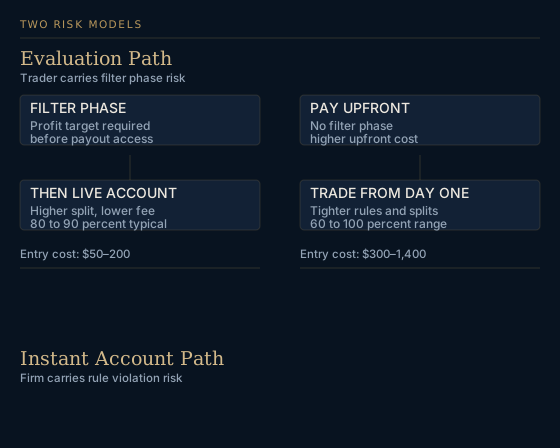
On an evaluation, the trader carries the risk of the filter phase. He pays a smaller fee and proves himself first. On an instant account, the firm carries the rule-violation risk from the very first trade, so it prices that risk into a higher fee and tighter limits. Everything below is detail.
How each model works, step by step
The evaluation path: one-step and two-step
An evaluation sets a profit target you must reach under a daily loss limit and a maximum drawdown. A two-step challenge splits that into two phases: a target in phase one, a smaller target in phase two, both under the same guardrails. A one-step compresses the test into a single target, usually with a tighter daily loss because there is only one phase to contain risk. FTMO added a one-step format to its lineup, announced in a company blog post dated February 6, 2026, and that path sets its maximum daily loss at 3 percent of the initial simulated balance (FTMO, "Introducing the 1-Step FTMO Challenge", retrieved 2026-07-24).
The instant path: pay, then trade under rules from day one
The instant path removes the phases. You pay the fee, receive a payout-eligible account immediately, and there is no target to clear before your profit share begins. That is the appeal, and it is real. What it is not is a shortcut past the rules.
What "instant" does and does not remove
Instant removes the target. It does not remove the rulebook. Daily loss limits, maximum drawdown, minimum trading days, and payout conditions still apply from the first trade, and some firms add monthly or reset fees on top. Map any product you are shown to one of three shapes before you pay: two-step, one-step, or instant.
What an instant account really costs, and why it is not unconditional
The upfront price gap, read at one account size
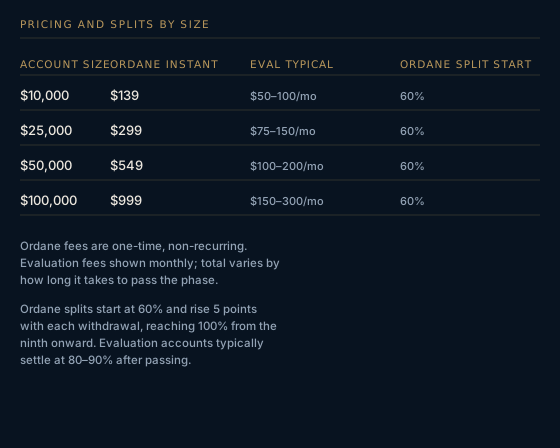
The gap is not small, and the honest way to show it is at the same account size, with both numbers read from each firm's own page rather than from a review site. Topstep's Trading Combine at 50K of buying power is a subscription at 49 USD a month, with a further 149 USD activation fee once a trader passes (Topstep, retrieved 2026-07-25). Topstep shows that monthly figure as a discount off its list price, so read it on the day you buy. Ordane's instant account at the 50,000 USD simulated size is a one-time 549 USD (Ordane Rulebook v1.0, section 1).
One is a low monthly entry with a test in front of it. The other is a single larger payment with no test.
A lower starting split is the second half of the price
The headline fee is only half the cost. The second half is the split. Topstep states that a trader who passes the Trading Combine keeps 90 percent of the profits (Topstep, retrieved 2026-07-25). On the 1-Step FTMO path a trader starts with a 90 percent simulated profit split on the first and all subsequent rewards after progressing to an FTMO Account (FTMO, retrieved 2026-07-24). The instant account on this page starts lower than either, and the Ordane section below prints its ladder and its early withdrawal caps in full. So the real price of skipping the phase is two numbers, not one: a higher payment at the door, and a lower split until the ladder climbs.
Here is the whole trade at the same 50,000 size, both sides read from the sources already cited in this section. As of 2026-07-25, and volatile: verify each figure on the firm's own page before you buy.
| At the same 50,000 size | Evaluation path (Topstep) | Instant path (Ordane) |
|---|---|---|
| Fee at the door | 49 USD a month until the trader passes, shown as a discount off list price | 549 USD, one-time |
| Fee after the test | 149 USD activation fee on passing | None, the fee is one-time with no recurring fees |
| Test before a payout-eligible account | Pass the Trading Combine | None, no evaluation phase and no challenge |
| Starting profit split | 90 percent after passing the Trading Combine | 60 percent, rising 5 percentage points with every completed withdrawal to 100 percent from the ninth onward; withdrawals #1 and #2 each capped at 3 percent of initial balance, no cap from #3 |
Where the fee stack and drawdown mechanics live
This article owns the model choice, not the full ledger. The recurring charges, activation fees, reset fees and payout minimums behind the headline price are broken down in the full hidden-fee stack behind the ticket price. How a trailing drawdown erodes a balance differently from a static one lives in the static vs trailing drawdown breakdown. Read both before you treat any upfront number as the real cost.
Which account model each major firm offers
The table below places two named firms and Ordane on the model map. Every cell was read from the firm's own site, not from a review guide. As of 2026-07-25, and volatile: verify each figure on the firm's own page before you buy.
| Firm | Model | Instant option today | Upfront price | Main tradeoff |
|---|---|---|---|---|
| FTMO | Two-step evaluation, plus a one-step challenge added February 2026 | No, evaluation only | Not found in sources | You must pass a phase first; the one-step sets a 3 percent maximum daily loss and a 90 percent split after you progress |
| Topstep | One-step evaluation, the Trading Combine | No | 49 USD a month at 50K buying power, 99 at 100K, 199 at 150K, plus a 149 USD activation fee on passing | You subscribe monthly until you pass, and there is no bypass |
| Ordane | Instant account, no evaluation phase, on simulated capital | Yes | One-time, from 139 USD at the 10,000 USD size to 999 USD at 100,000 | You pay the full fee before you have proved anything, and the split starts at 60 percent |
Two gaps in that table, named rather than filled. An earlier version carried a fourth row for Apex Trader Funding, priced from an affiliate blog that disagreed with itself about where the Apex band starts. On 2026-07-25 apextraderfunding.com refused retrieval, so the row was deleted. The FTMO price cell reads "Not found in sources" for the same reason. Neither gap is filled with an estimate.
Where a competitor is the better fit, say so. FTMO requires every trader to pass an evaluation before reaching an FTMO Account, either a 1-Step FTMO Challenge or a 2-Step Evaluation Process (FTMO, retrieved 2026-07-25), and Topstep requires a trader to pass the Trading Combine before it backs him with buying power (Topstep, retrieved 2026-07-25). So if your budget is small and you would rather prove yourself for a low entry fee than pay a large sum upfront, an evaluation firm is the honest choice, and Topstep at 49 USD a month is a cheaper way through the door than any Ordane account. If skipping the phase is worth a single larger payment to you, Ordane is the option here that sells an instant account.
How Ordane's one instant account compares
Start with the concession, because you have earned it. Ordane is new and has no payout history. There is nothing to show yet, and no payout history will be manufactured (ordanemarkets.com, payout ledger section). What you can verify today, before the first customer, is the contract itself.
The Ordane rulebook is public, numbered and versioned, and no rule is ever applied retroactively to an open account. Changes produce a new version with a dated changelog entry, and the version you sign up under is the version that governs your account (Ordane Rulebook v1.0, notice above section 0 and section 6). The fee is one-time and the full four-size ladder is published in section 1 of that rulebook, running from 139 USD at the 10,000 USD size to 999 USD at 100,000, with no recurring fees and no coupon games.
Ordane's profit split starts at 60 percent and rises 5 percentage points with every completed withdrawal, reaching 100 percent from the ninth withdrawal onward (Ordane Rulebook v1.0, clause PA-2). Withdrawals #1 and #2 are each capped at 3 percent of initial balance. From withdrawal #3 onward there is no cap (Ordane Rulebook v1.0, clause PA-3). That cap is the limit on the ladder, and it belongs beside it every time.
Now the three fears, answered with clauses, not enthusiasm.
Worried the fine print changes after you pay? Ordane's prohibited-practice list is closed. Clause R-6 names six practices: latency, reverse or hedge arbitrage; high-frequency or bulk automated exploitation; copy trading between Ordane accounts; straddling news releases with paired opposing orders; platform or data-feed exploitation; and gap abuse. If a behavior is not listed in that section, it is not a violation. Discretion is not a rule (Ordane Rulebook v1.0, clause R-6). One limit on that: Rulebook v1.0 states that each prohibited practice is defined with examples in Appendix A. Appendix A is published on ordanemarkets.com as of 2026-08-01. Gap abuse is defined in Appendix A (A-6).
Worried the firm vanishes with your fee? Finance Magnates Intelligence estimated that between 80 and 100 proprietary trading firms may have disappeared from the market in 2024 (Finance Magnates, retrieved 2026-07-24), so the fear is rational. The answer is not a promise. It is a public, versioned rulebook and a declared simulated-capital model you can read before paying.
Hold the honesty line: an instant account, Ordane included, costs more at the door than a monthly evaluation subscription and still runs on a rulebook. Instant is a simpler surface, not an unconditional one. Check Ordane against the same map you just used on two competitors.
How to choose between an evaluation and an instant account
This is a framework, not a recommendation.
Pick the evaluation when
Your upfront budget is small, you want the lowest possible entry price, and you are willing to trade a filter phase for a higher starting split. Topstep's 49 USD a month at 50K of buying power and its stated 90 percent split are the shape of that trade. The cost is time and a test you must pass first.
Pick the instant account when
You value skipping the target, you accept a higher upfront fee and tighter day-one rules, and you have read the drawdown and payout clauses before buying. You are paying to remove the phase, not to remove the rules.
One rule applies to both models: read the rulebook before you pay. The model decides your entry price, but the clauses decide whether a passing account ever pays out. When you are ready to run that check, the five-check audit to run before you pay walks the full pre-purchase document review.
Questions traders ask about instant accounts and evaluations
What is the difference between an instant account and an evaluation challenge?
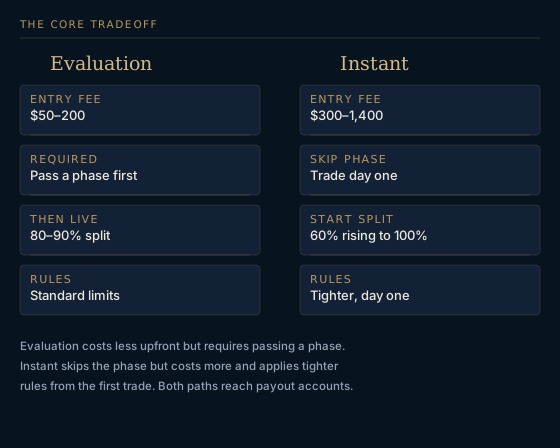
An evaluation makes you hit a profit target under set rules, across one or two phases, before you reach a payout-eligible account. An instant account skips that test for a higher upfront fee and starts under stricter rules immediately. One pays less to prove itself first; the other pays more to skip the proving.
Does an instant account still have trading rules?
Yes. Instant removes the profit target, not the rulebook. Daily loss limits, maximum drawdown, minimum trading days, and payout conditions all still apply from the first trade, and some firms add monthly or reset fees. If a page sells "instant" as unconditional, it is describing the marketing, not the account you receive.
Why does an instant account cost more than a challenge?
Because the firm carries rule-violation risk from your first trade instead of filtering you through a phase. At the same 50,000 size, Topstep charges 49 USD a month plus a 149 USD activation fee on passing, while Ordane charges a one-time 549 USD with no phase to pass. You pay upfront for the test you skipped.
Can you fail an instant account?
Yes. An instant account is payout-eligible from day one, but it is still governed by rules, and breaching a daily loss limit or maximum drawdown can end it just as it ends an evaluation account. Instant means no target to reach first. It does not mean the account cannot be lost.
Which prop firms offer an instant account instead of an evaluation?
Among the firms on this page, Ordane sells a single instant account, while FTMO and Topstep are evaluation-only, with no instant path published on their own sites today. Always confirm on the firm's own page, since these formats change.
Sources
- FTMO.com, on FTMO requiring every trader to pass a 1-Step FTMO Challenge or a 2-Step Evaluation Process before reaching an FTMO Account, with no instant path. ftmo.com Retrieved 2026-07-25.
- FTMO.com, "Introducing the 1-Step FTMO Challenge", on the one-step format announced February 6, 2026, its 3 percent maximum daily loss, and a 90 percent simulated profit split after progressing to an FTMO Account. ftmo.com/en/blog Retrieved 2026-07-24.
- Topstep, on the Trading Combine as a monthly subscription of 49 USD at 50K, 99 USD at 100K and 199 USD at 150K of buying power, a 149 USD activation fee on passing, and a 90 percent profit split. topstep.com Retrieved 2026-07-25.
- Finance Magnates Intelligence, on an estimated 80 to 100 proprietary trading firms that may have disappeared from the market in 2024. financemagnates.com Retrieved 2026-07-24.
- Ordane Rulebook v1.0, sections 1 and 6 and clauses P-2, PA-2, PA-3 and R-6, on simulated capital, the Ordane Instant Account, the one-time price ladder from 139 USD to 999 USD, the profit-split ladder and its early-withdrawal caps, the closed prohibited-practice list, and the public, versioned, never-retroactive rulebook. ordanemarkets.com/rulebook Retrieved 2026-07-25.
- Ordane Markets, payout ledger section, on Ordane being new with no payout history to show and none that will be manufactured. ordanemarkets.com Retrieved 2026-07-25.