Home · The Ordane Journal · Risk and Exposure · Static vs Trailing Drawdown at Prop Firms
Static vs Trailing Drawdown at Prop Firms
Most traders read the price and the profit split first. The rule that decides whether they are ever paid sits further down the page: the drawdown rule. Two accounts can carry the same headline balance and the same split, and one will survive an ordinary losing week while the other closes on a winning one.
Ordane accounts operate on simulated capital. No live funds are traded and no deposits are accepted. Clause P-2 of the Ordane Rulebook v1.0 requires that declaration, and both rules below are worked week by week on a simulated 100,000 account.
Last verified 12 August 2026: clause R-1 of the live Ordane Rulebook still fixes maximum drawdown at 5 percent of initial balance and states that the floor never trails upward. To see how the account can fail before that floor is reached, compare balance versus equity in the daily loss limit, overnight and weekend holding risk, and the news-trading buffer window. For execution room around a stop, use the separate stop-loss slippage buffer guide.
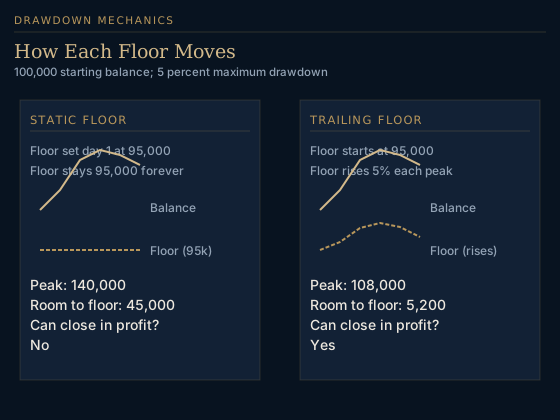
A static drawdown is a loss floor measured from your starting balance, and it never moves. A trailing drawdown is a loss floor measured from your highest balance, so it climbs behind you as you profit. Same percentage, opposite consequence: one widens your room as you make money, the other holds your room constant and can close an account that is still in profit.
What drawdown really measures
Drawdown is the loss limit on a trading account. Cross it and the account is closed. Every firm publishes it as a percentage, and the percentage is the part traders compare. It is not the part that decides outcomes.
Two questions decide outcomes. Which balance is the percentage measured against, and does that reference balance move while you trade? Static and trailing answer in opposite directions, which is why two rules that both read "5 percent maximum drawdown" produce different results from identical trading.
Static drawdown meaning, in one line
Take a simulated 100,000 account with a 5 percent static maximum drawdown. The floor is 95,000. Reach 140,000 three months later and the floor is still 95,000. Fall back to 101,000, still 95,000. One number, set once.
The practical consequence is that results buy you room. At 108,000 you sit 13,000 above the floor instead of 5,000, so a losing sequence that would have closed the account in week one is survivable in week five. Nothing about that widening depends on how a support agent reads a clause.
Next step. After you can name the limit in numbers, compare how an Instant Account changes that math versus an evaluation account in Instant Account vs evaluation, then read the live sizes on accounts.
What is trailing drawdown in a prop firm account?
Traders search "what is trailing drawdown prop firm" after an account closed on a green week. Here is that week.
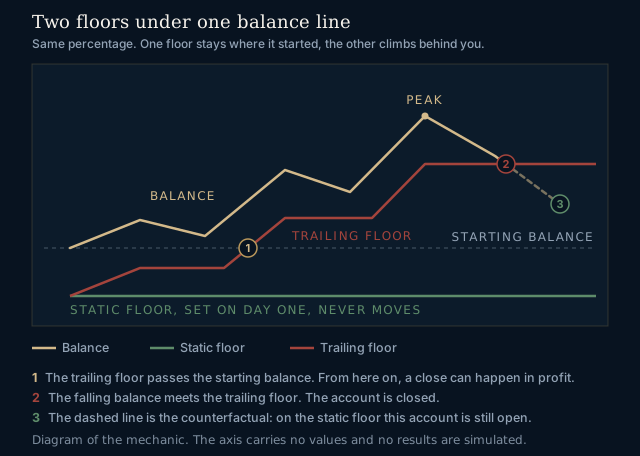
Same simulated 100,000 account, same 5 percent, trailing this time. The floor opens at 95,000. Reach 103,000 and it moves to 97,850. Reach 108,000 and it moves to 102,600. Give back 5,500 from that peak, a pullback most strategies produce monthly, and the account closes at 102,500 while still 2,500 above where it started.
The floor moved because you made money. That is the entire mechanic.
Two details in the wording change that arithmetic, both in the rulebook.
- Balance or equity? A floor that trails closed balance moves when you close a winning trade. A floor that trails equity moves on unrealized profit, so a position that spikes in your favor and returns to entry can raise the floor without ever paying you a cent.
- Does it lock? Some trailing rules stop moving once the account reaches a defined profit level. Others never stop. A drawdown clause that describes a trailing floor and says nothing about a lock is describing a floor that keeps rising for the life of the account.
Static vs trailing drawdown, side by side
Same 5 percent, same simulated 100,000 account, eight objective criteria.
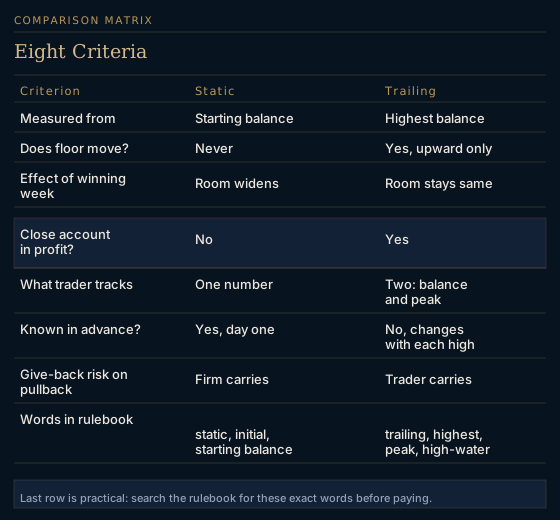
| Criterion | Static drawdown | Trailing drawdown |
|---|---|---|
| Measured from | Starting balance, fixed on day one | Highest balance the account has reached |
| Does the floor move? | Never | Yes, upward only, never back down |
| Effect of a winning week | Room to the floor widens | Room to the floor stays the same |
| Can it close an account in profit? | No, the floor stays below the starting balance | Yes, once the peak is more than 5 percent above the start |
| What the trader must track | One fixed number | Two numbers: current balance and running peak |
| Known in advance? | Yes, on day one | No, it changes with every new high |
| Who carries give-back risk | The firm | The trader |
| Wording to look for | static, initial balance, starting balance | trailing, highest, peak, high-water mark |
The last row is the one to use in practice. A rulebook rarely says "we use a trailing drawdown". It says "measured from the highest balance achieved", and a skimming trader misses the sentence.
The same five weeks, on both floors
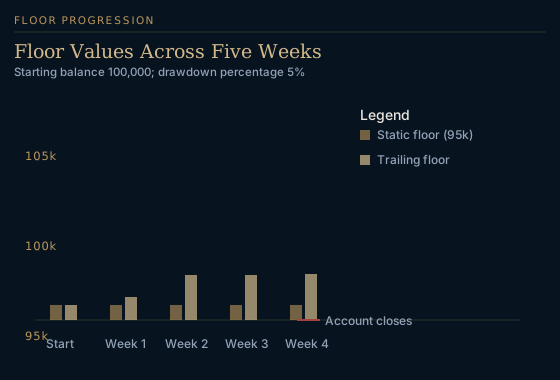
One trader, one sequence of results, priced under both rules. Starting balance 100,000 simulated, maximum drawdown 5 percent in both columns.
| Week | Closed balance | Peak so far | Static floor | Trailing floor |
|---|---|---|---|---|
| Start | 100,000 | 100,000 | 95,000 | 95,000 |
| 1 | 103,000 | 103,000 | 95,000 | 97,850 |
| 2 | 108,000 | 108,000 | 95,000 | 102,600 |
| 3 | 105,500 | 108,000 | 95,000 | 102,600 |
| 4 | 102,500 | 108,000 | 95,000 | 102,600 |
Week 4 is the lesson. Under the static rule the trader is 7,500 clear of the floor and 2,500 up on the account, and trades on Monday. Under the trailing rule the same trader is 100 below the floor and the account is closed, while still in profit.
Notice where the trailing floor crossed 100,000: week 2. Once the peak passed 105,263 the floor sat above the starting balance, so every day after that the account could close while showing a gain. The trader did nothing different. The rule did.
Why this decides whether you get paid
A payout only happens if the account is alive on payout day. A trailing floor penalizes the exact behavior that produces payouts: bank profit, give a little back, take the next setup. Traders who broke no rule they could see still lose accounts to a floor that crept up behind them.
The sector already paid for unclear terms once. Finance Magnates Intelligence estimated that between 80 and 100 proprietary trading firms may have disappeared from the market in 2024 (Finance Magnates, retrieved 2026-07-25). In the largest enforcement action of that era, the CFTC charged Traders Global Group, operator of My Forex Funds, with fraudulently taking over $300 million from customers (CFTC Release 8771-23, retrieved 2026-07-24). That case did not survive: in an order signed on May 13, 2025, a federal judge dismissed it with prejudice and sanctioned the CFTC, after a court-appointed Special Master found the agency had misled the court (Finance Magnates, retrieved 2026-07-29). Reuters put the court-ordered legal bill at $3.1 million (Reuters via TradingView, retrieved 2026-07-29). Marketing was not the variable in either case. Terms were.
Why any firm would choose a trailing floor
There is a real reason, and pretending otherwise would be dishonest. A trailing floor caps what a single account can cost the firm. Under a static floor the gap between an account's best moment and its failure point grows without limit: an account that peaks at 140,000 can fall 45,000 before it closes. Under a trailing floor that gap stays 5 percent of the peak.
The second reason is behavioral. A trailing floor pushes traders to withdraw rather than compound, because held profit that is given back costs the account. A firm paying from a reserve prefers many small bounded obligations to one open-ended one.
None of that makes a trailing rule dishonest. A disclosed trailing floor you understood before paying is a trade you chose. What is not defensible is a rulebook that never says which balance it trails, never defines a lock, or can be edited after you pay. The mechanic is not the problem. Silence about the mechanic is the problem.
Is static always better?
At the same percentage, on the same starting balance, with the same daily limit, yes. Those three conditions are rarely all true at once, so the label alone does not settle it.
Compare distance to failure, not vocabulary. A static 4 percent gives you 4,000 of room on day one. A trailing 6 percent gives you 6,000, which looks better until you profit: after a run to 108,000 the static account has 12,000 of room and the trailing account has 6,480 from its peak. The ranking flips the moment the strategy works.
Two more rules interact with the drawdown and deserve the same reading: the daily loss limit, which can close an account long before the maximum drawdown is in range, and the payout schedule, which decides how long you have to survive.
How to verify which rule a firm uses, in five minutes
- Open the rulebook, not the sales page. A numbered, dated document is the only text that can be held against a firm later. A landing page bullet or a support chat reply is a claim.
- Search the document for literal words. Use Ctrl+F or Cmd+F on each of these in turn: trailing, highest, peak, high-water, initial balance, starting balance, equity, lock, static.
- Read what you find. "Static", "initial balance" or "starting balance" next to the drawdown percentage means a fixed floor; confirm no later sentence reintroduces a peak. "Highest", "peak" or "high-water" means trailing, and you now need two more answers: does it trail balance or equity, and does it lock.
- Treat absence as the finding. If none of those words appear anywhere near the percentage, the document does not define what the percentage is measured against. An undefined reference balance is resolved by whoever operates the platform, on the day it matters, and not by you. That is not a gap in your reading. It is a gap in the rule.
- Check the version and the date. A rule with no version number can read differently on the day you request a withdrawal. Ask in writing whether changes apply to accounts already sold, and keep the reply.
- Save a dated copy. Print the clause to PDF or screenshot it with the date visible before you pay.
Six steps, and the answer is binary. For the full pre-purchase sequence, see how to audit a prop firm. For whether the model deserves your money at all, see are prop firms legit.
Where Ordane stands
Ordane's maximum drawdown is 5 percent and static: account equity may never fall below 95 percent of the initial balance. The floor is fixed on day one, never trails upward, and a breach closes the account. That is clause R-1 of the Ordane Rulebook v1.0, retrieved 2026-07-25.
The versioning notice carries the other half of the position. The Ordane rulebook is public, numbered and versioned, and no rule is ever applied retroactively to an open account. Changes produce a new version with a dated changelog entry, and the version you sign up under is the version that governs your account (Ordane Rulebook v1.0, retrieved 2026-07-25).
Ordane is new and has no payout history. There is nothing to show yet, and no payout history will be manufactured. What exists today is a clause, a version number and a date, all readable before you pay.
Ordane sells one product, the Ordane Instant Account: direct access, no evaluation phase and no challenge, on simulated capital (Ordane Rulebook v1.0, section 1).
Questions traders ask about static and trailing drawdown
What is the difference between static and trailing drawdown?
A static drawdown is measured from the account's starting balance and never moves, so profit widens the gap between your balance and the floor. A trailing drawdown is measured from the account's highest balance, so the floor rises with every new high and the gap stays constant. At the same percentage, the static rule is the more forgiving of the two.
Can a trailing drawdown close an account that is in profit?
Yes. On a simulated 100,000 account with a 5 percent trailing rule, a peak of 108,000 lifts the floor to 102,600, which is above the starting balance. A fall to 102,500 closes the account while it is still 2,500 in profit against day one.
Does a trailing drawdown stop moving after a profit target?
Some do and some do not. A trailing floor stops only if the rulebook contains a sentence saying so, together with the level at which it stops. If a drawdown clause describes a trailing floor and never defines a lock, read it as a floor that keeps rising for the life of the account.
Why do prop firms use trailing drawdown at all?
A trailing floor caps the distance between an account's best moment and its failure point, so a firm's worst case on one account stays a fixed percentage instead of growing with the trader's peak. It is a solvency control, and the objection is not the mechanic but a rulebook that never defines the lock.
Which drawdown rule does Ordane use?
Ordane's maximum drawdown is 5 percent and static: account equity may never fall below 95 percent of the initial balance. The floor is fixed on day one, never trails upward, and a breach closes the account. Ordane accounts are simulated and the clause is R-1 of the public Ordane Rulebook v1.0.
Where do I find a firm's drawdown rule?
In the firm's rulebook or terms document, not on its sales page. Search it for the words trailing, highest, peak, high-water, static and starting balance. If none appear near the drawdown percentage, the document does not define what the percentage is measured against, and that silence is the finding.
Sources
- Finance Magnates Intelligence, on an estimated 80 to 100 proprietary trading firms that may have disappeared from the market in 2024. financemagnates.com Retrieved 2026-07-25.
- U.S. Commodity Futures Trading Commission, on charging Traders Global Group Inc., doing business as My Forex Funds, with fraudulently taking over $300 million from customers. cftc.gov, Press Release 8771-23 Retrieved 2026-07-24.
- Finance Magnates, on the order signed May 13, 2025 dismissing the CFTC's case against Traders Global Group with prejudice and sanctioning the agency, after a court-appointed Special Master found it had misled the court. financemagnates.com Retrieved 2026-07-29.
- Reuters, via TradingView, on the CFTC being ordered to pay a $3.1 million legal bill in the My Forex Funds case. tradingview.com Retrieved 2026-07-29.
- Ordane Rulebook v1.0, clause R-1, on the static 5 percent maximum drawdown measured from the initial balance. ordanemarkets.com/rulebook Retrieved 2026-07-25.
- Ordane Rulebook v1.0, notice above section 0 and section 6 Changelog, on the rulebook being public, numbered, versioned, and never applied retroactively to an open account. ordanemarkets.com/rulebook Retrieved 2026-07-25.
- Ordane Rulebook v1.0, clause P-2, on all accounts operating on simulated capital with no live funds and no deposits accepted. ordanemarkets.com/rulebook Retrieved 2026-07-25.
- Ordane Markets, payout ledger section, on Ordane being new with no payout history to show and none that will be manufactured. ordanemarkets.com Retrieved 2026-07-25.