Home · The Ordane Journal · Payouts · How Long Do Prop Firms Take to Pay? The Two Clocks
How Long Do Prop Firms Take to Pay? The Two Clocks
You passed. You requested the payout. Now you are watching an empty account and wondering if the "instant" on the sales page meant anything.
Ordane accounts operate on simulated capital. No live funds are traded and no deposits are accepted. Every payout figure on this page, ours and every other firm's, describes simulated performance rather than live-market returns.
This page answers one question and does it cleanly: how long the money actually takes, and what a payout-time guarantee actually forces a firm to do. No superlatives, one number and one source per claim, and an honest table you can re-check yourself.
What "payout time" actually means
One number the ads quote almost never covers both clocks at once. The approval clock is the firm checking your request against its rulebook and its daily cutoff. The transfer clock is a payment rail moving that money and your own bank settling it.
Here is the fear this section serves. The number a firm advertises, the "instant" or the "1-hour", is almost always the approval clock alone, not money-in-account. The transfer clock sits behind it, unmentioned. This page assumes the payout does land and explains how long it takes. Whether a firm pays at all is a different question, and it is not the one answered here. If you are still deciding whether a firm is worth trusting before you ever reach a request, start with are prop firms legit.
The two clocks: approval time versus transfer time
Split any advertised payout time into these two clocks and the spin falls away.
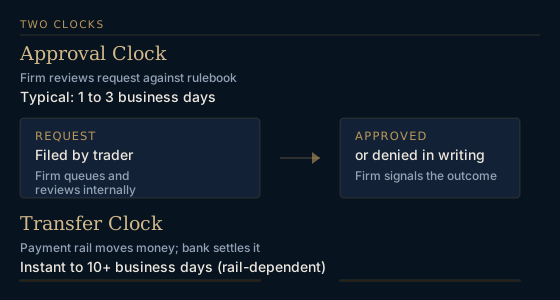
The approval clock: firm-side review
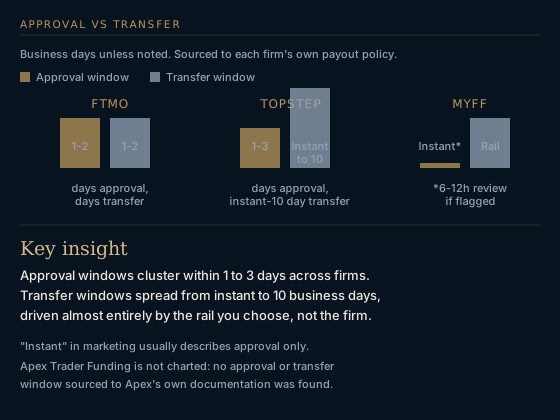
The approval clock is the firm checking your request against its rulebook and its daily cutoff. This is a review, and a review takes time. FTMO reviews a withdrawal and notifies the trader within 1 to 2 business days of submission, according to FTMO's own withdrawal FAQ, retrieved 2026-07-24. Topstep states that its internal approval can take 1 to 3 business days, per the Topstep Payout Policy, retrieved 2026-07-24. MyFundedFutures approves most payouts instantly, and only routes to a manual review that can take 6 to 12 business hours on weekdays when something needs a human, according to the MyFundedFutures payout policy overview, retrieved 2026-07-24.
Two things stretch this clock, and both are about queues. A request filed after the daily cutoff waits for the next business day before the clock even starts. A request flagged for manual review waits behind every other flagged request. Neither shows up in a headline number, and neither is visible to you while you wait.
The transfer clock: rails and bank settlement
Once the firm approves, the money still has to travel. That is the transfer clock, and it is set by the rail you chose, not by the firm's goodwill. A rail is simply the payment method that carries the money.
The spread here is wide. On Topstep, the rail decides everything: Aeropay is instant after approval, Wise and ACH take 1 to 3 business days, and a Wire or SWIFT transfer takes 5 to 10 business days, all excluding weekends and holidays, per Topstep's own Payout Policy. FTMO states that once the invoice is approved, it typically sends the reward within 1 to 2 business days, and that is before your own bank settles it, per FTMO's withdrawal FAQ.
There is a second lesson in that spread. A domestic electronic rail and an international wire are not close. On Topstep the same approved payout is instant on Aeropay and 5 to 10 business days on a wire, a gap of over a week created entirely by the rail. If you trade from outside the firm's home country and it routes you to a wire, your transfer clock is the long one, no matter how fast the approval was.
Now the worked timeline you can map to your own case. Say a firm approves your request in 1 business day and you chose a domestic transfer that takes 2 business days. Your real total is about 3 business days, even if the sales page said "instant". The word "instant" measured the approval clock and stayed silent on the transfer clock. Read every payout time as two clocks and you will predict your real total instead of the advertised one.
How long the major firms actually take
Here is the honest comparison, one row per firm, approval clock and transfer clock kept separate. Where a firm's instant rail genuinely beats a fixed clock, that is recorded as a win for that firm, not hidden. Every cell rests on the firm's own documentation, linked in the last column.
As of 2026-07-24. Payout and rails pages change often, so re-check this table by 2026-10-22.
| Firm | Approval window | Transfer after approval | Typical total | Rails offered | Evidence |
|---|---|---|---|---|---|
| FTMO | 1 to 2 business days | 1 to 2 business days, before your bank settles | Roughly 2 to 4 business days | Bank wire, instant transfer via Visa Direct / Mastercard Send (up to $20,000), Skrill (up to $3,000), or crypto | FTMO withdrawal FAQ |
| Topstep | 1 to 3 business days | Aeropay instant; Wise and ACH 1 to 3 business days; Wire or SWIFT 5 to 10 business days | Same day to about 3 days on a fast rail | Aeropay, Wise, ACH, Wire or SWIFT | Topstep Payout Policy |
| MyFundedFutures | Most instant; manual review up to 6 to 12 business hours | Via Riseworks, by bank transfer or crypto, after a one-time KYC step | Fast when approval is instant and KYC is done | Riseworks: bank transfer or crypto | MyFundedFutures payout policy |
Why Apex Trader Funding is not in this table. Apex is one of the largest futures firms and it belongs here. It is absent because the approval and transfer windows we could find for it sit on affiliate comparison sites rather than on Apex's own help pages, and this table carries only cells sourced to the firm itself. That standard costs us a row. It is the same standard that lets you re-check every cell that is here. When Apex publishes those windows in its own documentation, the row goes in with a retrieval date attached.
Read the table by column, not by row. Line up the three approval windows, then the three transfer windows, and the headline "instant" claims stop competing with each other on equal footing.
Two concessions, stated plainly. Topstep's Aeropay is instant after approval, which beats any fixed 48-hour clock outright when your approval lands fast, according to Topstep's Payout Policy. MyFundedFutures approves most payouts instantly, so on a clean account with KYC already done it can move quicker than a firm that reviews for a full business day, per the MyFundedFutures payout policy overview. Those are real advantages, and hiding them would make this page worth less to you.
What makes a payout slow, and whose fault it is
A slow payout has an owner. Sort your delay into the ones you control and the ones the firm controls, and you will know what to fix before your next request.
Delays you control: KYC, method, cutoff times
The single most common cause of a slow first payout is unfinished identity verification. MyFundedFutures pays through Riseworks, and the first payout requires a one-time Rise KYC step you complete in the dashboard before any money moves, per the MyFundedFutures first payout guide, retrieved 2026-07-24. Skip it and the fastest approval in the world still stalls.
The second is the rail you pick. On Topstep, choosing a Wire over Aeropay turns an instant transfer into a 5 to 10 business day one, per Topstep's Payout Policy. The third is timing. File after the daily cutoff or into a weekend and the approval clock does not start until the next business day.
Delays the firm controls: review queue and rails
The firm owns its manual-review queue. MyFundedFutures routes flagged payouts to a review that can run 6 to 12 business hours on weekdays, according to the MyFundedFutures payout policy overview. The firm also owns which rails it offers, and which of them your country is allowed to use. On Topstep that menu runs from Aeropay, instant after approval, to a Wire or SWIFT transfer at 5 to 10 business days, per Topstep's Payout Policy. If your country only gets the slow end of a firm's menu, that is the firm's choice, not yours.
One boundary. This section is about how long a payout takes, not whether you have earned the right to one. The minimum trading days, the profit floor, and the consistency rule that unlock a first withdrawal are a separate checklist. If you are not sure you qualify yet, start with prop firm withdrawal requirements and come back here for the timing.
What a payout-time guarantee actually enforces
Now the mechanic half of the question, and the part most reviews skip.
Read the guarantee for the penalty, not the headline number
A "24-hour payout guarantee" is only as real as its penalty clause. The headline number is a promise. The penalty is the enforcement. So do not read the hour. Search the guarantee for one thing: what happens to the firm if it misses the window. A time promise with no stated consequence is a target the firm sets for itself and grades itself on. That is marketing, not a guarantee.
Firms that pay you for being late
A real penalty takes one of two shapes. The first is compensation added when the window is missed. Blue Guardian's 24-hour payout guarantee states that if a payout is not processed within the timeframe, the trader automatically receives $1,000 in compensation, according to Blue Guardian's own guarantee page, retrieved 2026-07-24. Read the fine print with the same eye, though: that timer runs on business days only, is paused during weekends, and delays caused by compliance checks, risk reviews, or your own slow response do not qualify, on the same page. The penalty is real, and so are its exclusions. Both matter.
The second shape is a refund of what you paid. If the firm misses, the account fee comes back, and the payout is still owed on top. That structure is worth more than a bigger advertised number, because it costs the firm something real every time it is late.
So classify every payout guarantee as one of two things. Enforceable: it names a penalty the firm pays when it misses. Decorative: it names an hour and nothing else.
How Ordane handles it: a 24 hour decision, 48 clock hours to pay, or the fee is refunded
Ordane sells one product, the Ordane Instant Account: direct access, no evaluation phase and no challenge, on simulated capital (Ordane Rulebook v1.0, section 1).
The concession comes first, because it is the honest place to start. Ordane is new and has no payout history. There is nothing to show yet, and no payout history will be manufactured. The payout ledger section of ordanemarkets.com says exactly that, read 2026-07-24.
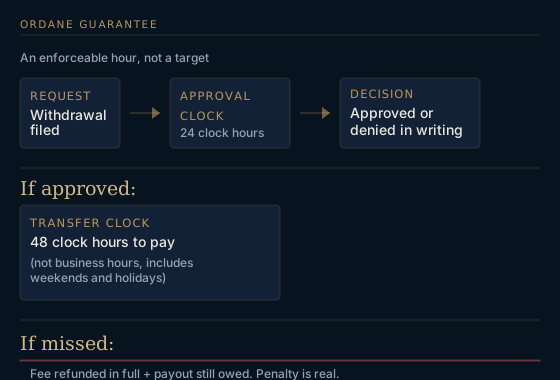
What exists before the first customer is the written mechanic, and it is two clauses rather than one slogan: The Ordane Guarantee. Every withdrawal request is approved, or denied in writing citing the exact rule breached by section number, within 24 clock hours. Past that deadline the request is treated as approved and the G-1 clock starts. Clause G-0 of the Ordane rulebook, version 1.0, sets that decision clock, read 2026-07-25. Then the payment clock. A payout approved and not paid within 48 clock hours, not business hours, triggers automatic compensation: a 100 percent refund of the account fee, plus the payout owed in full. Rulebook v1.0 clause G-1 sets that penalty, on the same page.
By the test from the previous section, that is the enforceable shape: an hour with a penalty attached, not an hour on its own. Notice which way the silence runs. If Ordane says nothing inside 24 clock hours, the request counts as approved and the payment clock starts anyway, so quiet costs the firm rather than the trader.
What a new firm cannot show, and what it can
Cash in view is the second half, and today it is a dated commitment rather than something you can click. Ordane's payout reserve is published at a public TRON address on ordanemarkets.com, with a dated observed balance, before the first account is sold. Rulebook v1.0 clause PR-1 is where that commitment is written down. Rulebook v1.0 commits Ordane to a dated payout ledger from payout number one, and to payout performance metrics published with dates on a fixed monthly schedule. As of 2026-07-25 the ledger is empty, because no payout has happened yet. Rulebook v1.0 clause PR-2 carries that second half.
The same four clauses in one view. Rulebook v1.0, read 2026-07-25.
| Clause | What it binds Ordane to | Status, read 2026-07-25 |
|---|---|---|
| Rulebook v1.0, clause G-0 | Approve every withdrawal request, or deny it in writing citing the exact rule breached by section number, within 24 clock hours. Past that deadline the request is treated as approved and the G-1 clock starts | Published; readable in full |
| Rulebook v1.0, clause G-1 | Pay an approved payout within 48 clock hours, not business hours, or trigger automatic compensation: a 100 percent refund of the account fee, plus the payout owed in full | Published; readable in full |
| Rulebook v1.0, clause PR-1 | Hold the payout reserve at a public TRON address, with a dated observed balance, published on ordanemarkets.com before the first account is sold | Address live on ordanemarkets.com |
| Rulebook v1.0, clause PR-2 | Publish a dated payout ledger from payout number one, and payout performance metrics with dates on a fixed monthly schedule | Ledger empty, because no payout has happened yet |
That is the honest position of a new firm. The penalty clause is published today and you can read it in full. The reserve address and the ledger are commitments with a deadline attached, not screenshots. When the on-time record exists it will be dated and public.
The rest sits lightly here, because timing is the point of this page. Ordane's profit split starts at 60 percent and rises 5 percentage points with every completed withdrawal, reaching 100 percent from the ninth withdrawal onward. Rulebook v1.0 clause PA-2 sets that ladder. The limit that belongs with it, and that most comparisons quietly drop, is the early cap. Withdrawals #1 and #2 are each capped at 3 percent of initial balance. From withdrawal #3 onward there is no cap. Rulebook v1.0 clause PA-3 sets it. For the full mechanics of how that split scales, see how prop firm profit splits scale. The account fee itself is one-time and runs from $139 to $999 depending on size, with the full four-row price table published in the rulebook. These terms, like every firm's payout page above, can change, so read them at the source before you buy.
Questions traders ask about prop firm payout times
How long do prop firms take to pay?
It depends on two clocks. Approval runs from instant to about 3 business days: Topstep can take 1 to 3, FTMO 1 to 2, according to each firm's own payout policy. Transfer then depends on your rail, from instant on a fast option to 5 to 10 business days on a wire, per Topstep's Payout Policy. Budget for both, not one.
Why does my payout say "instant" but takes days?
Because "instant" almost always describes the approval clock, not money-in-account. The transfer clock sits behind it, set by your rail. Two clocks, one advertised number.
What is the difference between approval time and transfer time?
Approval time is the firm reviewing your request against its rules and cutoff. Transfer time is the payment rail moving the money once approved, plus your bank settling it. FTMO reviews within 1 to 2 business days, then sends within 1 to 2 more after approval, according to FTMO's withdrawal FAQ. The ads usually quote only the first.
What happens if a firm misses its payout guarantee?
Only what the penalty clause says. If there is no clause, nothing happens, and the hour was decorative. A real one names a consequence: Blue Guardian's guarantee pays the trader $1,000 in compensation when a payout is not processed in time, though its timer excludes weekends and certain review delays. Read for the penalty, not the number.
Do crypto payouts arrive faster than a bank transfer?
Crypto is an offered rail at several firms, including FTMO and MyFundedFutures, per each firm's own payout documentation. Whether it beats a bank transfer depends on the firm and your country. On Topstep, an instant rail like Aeropay settles same day while a wire runs 5 to 10 business days, so the rail choice, not the asset, drives the speed.
Sources
- How do I withdraw my reward? | FTMO.com ftmo.com Retrieved 2026-07-24.
- Topstep Payout Policy | Topstep Help Center help.topstep.com Retrieved 2026-07-24.
- Payout Policy Overview, Best and Fastest Prop-Firm Payouts | My Funded Futures Help Center help.myfundedfutures.com Retrieved 2026-07-24.
- Guide to Your First Payout: Quick and Easy Process | My Funded Futures Help Center help.myfundedfutures.com Retrieved 2026-07-24.
- 24 Hours Payout Guarantee | Blue Guardian help.blueguardian.com Retrieved 2026-07-24.
- Ordane Rulebook v1.0, clause G-0 ordanemarkets.com Retrieved 2026-07-25.
- Ordane Markets, payout ledger section ordanemarkets.com Retrieved 2026-07-24.