Home · The Ordane Journal · Before You Pay · The Disclaimers a Prop Firm Ad Has to Carry
The Disclaimers a Prop Firm Ad Has to Carry
Ordane accounts operate on simulated capital. No live funds are traded and no deposits are accepted. Payouts depend on simulated performance under Rulebook v1.0; no level of performance is typical or assured.
Ordane sells one product, the Ordane Instant Account: direct access, no evaluation phase and no challenge, on simulated capital.
What does a prop firm have to disclose about simulated results?
A prop firm advertisement is a regulated document: under 17 CFR 4.41 and 16 CFR Part 465, any page selling simulated trading must disclose that its results are not actual trading, may be shaped by hindsight, and may not reflect the experience of other clients.
Ordane, a prop firm on simulated capital, applies the same standard to its own marketing.
Every disclosure question in this article follows from that fact, because a page presenting the results of a simulated account is presenting something other than an actual trading record, and the rules below are written about exactly that gap. Before you weigh any of the marketing claims below, it helps to run the broader check in are prop firms legit, which lays out the four checks to run before you pay a firm at all.
Who do the disclosure rules actually bind?
They bind commodity pool operators and commodity trading advisors registered or acting as such in the United States, not automatically every business that shows a chart. Here is the part most articles on this subject skip, and skipping it turns a useful check into a false accusation.
Two different rules, two different questions. One asks whether a performance claim concedes its own limits. The other asks whether praise is genuine, independent and disclosed.
What does the hypothetical performance disclaimer say, word for word?
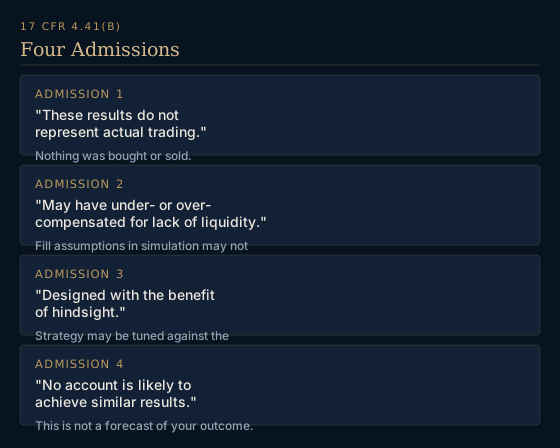
The standard disclaimer, taken from 17 CFR 4.41(b), says that simulated results do not represent actual trading, may misstate liquidity, are designed with hindsight, and do not predict your results.
What each clause of it concedes
Read the four admissions slowly, because each one deletes a specific inference you were about to make.
"These results do not represent actual trading." Nothing was bought. Nothing was sold. No counterparty took the other side. The number on screen is the output of a model of a market, not a receipt from one.
"No representation is being made that any account will or is likely to achieve profits or losses similar to those shown." The presented result is not being offered as a forecast of your result. Not a conservative forecast, not an average one. No forecast.
What do testimonials, payout screenshots and paid endorsements have to disclose?
A testimonial, payout screenshot or paid endorsement must carry the disclosures required by 17 CFR 4.41(a)(3) and must not misrepresent whether the reviewer exists, was paid, or spoke from real experience under 16 CFR Part 465.
The three disclosures a testimonial has to carry
Three disclosures, and the word "prominently" governs all of them. A disclosure in grey text at 9 pixels under a fold is not the same object as a disclosure beside the claim.
Read those three prohibitions as three questions. Did this person exist and use the product? Are these all the reviews, or the surviving ones? And is the site telling me it is independent while being owned by a firm it ranks?
Why a payout screenshot proves less than it looks
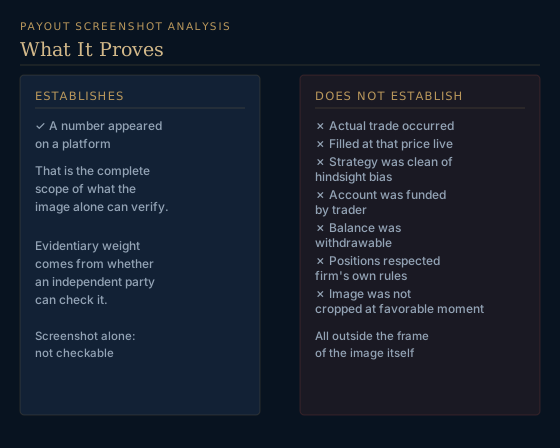
The payout screenshot is the most persuasive artefact in this industry and the least verifiable. It is an image of a number, produced by the party who benefits from you believing it, showing a transaction you cannot inspect, at a date you cannot confirm, in a currency and to an account you cannot see.
So the test is not "does this look real". The test is: what would I have to be able to open, count and date to move this from claim to record? If the answer is nothing, then whatever you are feeling when you look at it is persuasion, not proof.
How do you spot a review site that the firm owns?
A comparison or review site that the firm owns must disclose that ownership; 16 CFR 465.6 forbids presenting a controlled site as independent.
What does 16 CFR 465.6 forbid in plain words?
Note what is and is not prohibited. Owning a comparison site is not the violation. Ranking your own product on it is not, by itself, the violation. Presenting it as independent when you control it is the conduct the section names.
How to tell a controlled site from an independent one
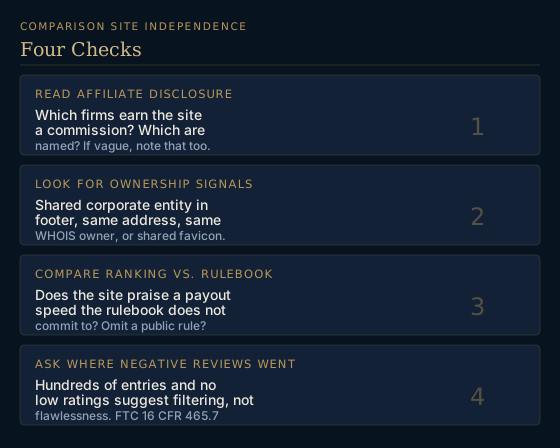
Four checks, none requiring special tools.
Read the affiliate disclosure like a contract, not a formality. Whether the site earns a commission on the firms it ranks is the first fact. If a disclosure exists, note which firms it names. If it exists and is vague, note that too.
Look for common ownership signals. Shared corporate entity in the footer, the same registered address, the same privacy-policy contact address, a WHOIS record pointing at the same organisation, one firm's logo appearing as the site's own favicon. None of these is conclusive alone. Two or three together are worth a pause.
Compare the ranking against the primary documents. Take the top-ranked firm and read its actual rulebook. If the site praises a payout speed the rulebook does not commit to, or omits a drawdown rule the rulebook states plainly, the ranking was not built from the documents.
Independence is not a vibe emitted by a clean design. It is a claim, and like every claim in this article, it is checkable.
Which marketing claims map to which disclosure rules?
The table below matches each marketing claim you are likely to see with the written disclosure standard that governs it and the rule section where that standard lives.
| Marketing claim you see | Written disclosure standard | Where the standard lives |
|---|---|---|
| Simulated or hypothetical performance results, equity curves, backtests | Must state the results do not represent actual trading, may have under- or over-compensated for factors such as lack of liquidity, are designed with the benefit of hindsight, and that no representation is made any account will or is likely to achieve similar results | 17 CFR 4.41(b) |
| A trader testimonial or success story | Must prominently disclose that it may not be representative of other clients' experience, that it is no guarantee of future performance or success, and, if more than a nominal sum was paid, that it is a paid testimonial | 17 CFR 4.41(a)(3) |
| A reviewer who appears to be a customer | Misrepresenting that the reviewer exists or had experience with the product is prohibited | 16 CFR Part 465, fake or false reviews section 465.2 |
| A wall of overwhelmingly positive reviews | Misrepresenting that displayed reviews represent most or all reviews submitted, when reviews were suppressed based on rating or negative sentiment, is prohibited | 16 CFR Part 465, review suppression section 465.7 |
| A comparison site presenting itself as independent | Materially misrepresenting that a site the business controls, owns or operates provides independent reviews or opinions about a category including its own product is an unfair or deceptive act or practice | 16 CFR 465.6 |
| Reviews positioned by an insider or bought outright | Buying positive or negative reviews, and insider reviews and testimonials, are addressed as separate prohibited categories | 16 CFR Part 465, sections 465.4 and 465.5 |
| Inflated follower or engagement counts on the firm's channels | The misuse of fake indicators of social media influence is addressed as a distinct category | 16 CFR Part 465, section 465.8 |
What do firms say about their own accounts in their own terms?
The sales page and the terms page are written for different audiences, and reading them side by side shows whether the plain description survives outside the marketing copy.
| Firm | What its own document states about the account | Document type, retrieved |
|---|---|---|
| FTMO (prop firm) | All accounts it provides to clients are demo accounts with fictitious funds, and any trading is in a simulated environment only | FAQ, retrieved 29 July 2026 |
| Topstep (prop firm) | Trades in a simulated account are not made in live markets and do not incur actual profits or losses | Terms of Use, retrieved 29 July 2026 |
| Ordane | Accounts operate on simulated capital with no live funds traded and no deposits accepted | Rulebook v1.0, retrieved 6 August 2026 |
Three firms, three documents, one shared description of the product. That consistency is worth holding onto, because it sets the baseline. If a marketing page anywhere in this industry implies you will be trading live capital, it is contradicting the category's own paperwork, including its own.
The check to run on any firm: open the terms or the FAQ, find the sentence describing what the account is, then reread the headline on the homepage. Where those two sentences disagree, the terms page is the one that governs, and the gap between them is a measurement of how the firm chooses to sell.
What does Ordane publish about itself, and what does it not publish?
Ordane publishes its rulebook commitments and declines to publish track records, testimonials, or ranking tables that do not yet exist.
A new firm with no history to show
Applying this standard to Ordane produces an uncomfortable result, and it is more useful published than hidden.
Ordane is new. Its live homepage says it will not fake a history; the rulebook says payout performance metrics begin with the first month in which a payout is requested.
Dated ledger from payout number one
What exists instead is a written commitment, and it should be read as exactly that and nothing more.
What questions do traders ask about prop firm advertising?
Below are direct answers to the five questions traders ask most often about prop firm advertisements, with the relevant firm or rule named in each answer.
A testimonial has no disclosure at all. How much should that move me?
It should move you to reread what the rule actually says binds. The disclosure rules bind commodity pool operators and commodity trading advisors registered or acting as such in the United States. If a firm is not registered in either category and states so clearly, then a missing disclosure is a signal to investigate further, not a proof of violation.
For related published reading, see overnight and weekend holding rules, trading costs against drawdown, news trading restrictions, and how to save prop firm rules before paying.
Questions traders ask about prop firm advertising
Who do the disclosure rules actually bind?
They bind commodity pool operators and commodity trading advisors registered or acting as such in the United States, not automatically every business that shows a chart. Here is the part most articles on this subject skip, and skipping it turns a useful check into a false accusation. Two different rules, two different questions. One asks whether a performance claim concedes its own limits. The other asks whether praise is genuine, independent and disclosed.
What does 16 CFR 465.6 forbid in plain words?
Note what is and is not prohibited. Owning a comparison site is not the violation. Ranking your own product on it is not, by itself, the violation. Presenting it as independent when you control it is the conduct the section names.
A testimonial has no disclosure at all. How much should that move me?
It should move you to reread what the rule actually says binds. The disclosure rules bind commodity pool operators and commodity trading advisors registered or acting as such in the United States. If a firm is not registered in either category and states so clearly, then a missing disclosure is a signal to investigate further, not a proof of violation.
Sources
- 17 CFR 4.41, Cornell Law School Legal Information Institute Retrieved 2026-08-06.
- 16 CFR 465.6, Cornell Law School Legal Information Institute Retrieved 2026-08-06.
- 16 CFR Part 465, Cornell Law School Legal Information Institute Retrieved 2026-08-06.
- FAQ, FTMO.com Retrieved 2026-07-29.
- Terms of Use, Topstep Retrieved 2026-07-29.
- Ordane Rulebook v1.0 Retrieved 2026-08-06.
- Ordane, homepage and Rulebook v1.0 Retrieved 2026-08-06.
- Customer Advisory: Understand the Risks of Virtual Currency Trading, CFTC Retrieved 2026-08-10.