Home · The Ordane Journal · Before You Pay · Prop Firm Challenge Time Limits Explained
Prop Firm Challenge Time Limits Explained
A prop firm challenge time limit is the deadline by which a trader must hit the evaluation's profit target while staying inside its risk rules; if the deadline passes without the target met, the evaluation ends and a new one must be purchased.
Ordane accounts operate on simulated capital. No live funds are traded and no deposits are accepted. (Ordane Rulebook v1.0, clause P-2, and ordanemarkets.com payout-funding statement, retrieved 2026-08-05) That means the timing question in this article does not exist inside Ordane's own product, which is exactly why it is worth explaining carefully rather than selling around.
Marketing collapses three different clocks into one phrase. "No time limit" usually answers one of them and stays silent on the other two. This article separates them, shows how two live firms structure the clock in their own documents, and gives you a way to derive the only date that actually matters to you. If you want the wider question of whether a firm is worth paying at all, that groundwork is covered in a checklist for auditing a prop firm before you pay.
What is a prop firm challenge time limit?
That is the narrow, honest definition. Everything else people call a "time limit" is a different mechanism wearing the same name.
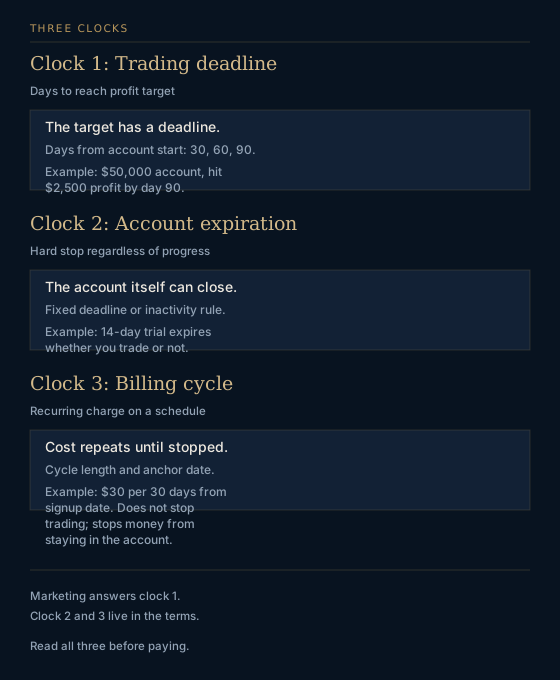
Deadline, expiration and billing are separate
Three clocks run in parallel in an evaluation product, and they are governed by different clauses:
- Clock one: the trading deadline. How many calendar days a trader has to reach the profit target. This is the clock the phrase "time limit" was invented to describe.
- Clock two: account expiration. Whether the account itself stops existing after some period of use or non-use, regardless of progress. An account can have no trading deadline and still be closed for inactivity, or still be a trial that ends on a fixed day.
- Clock three: billing. Whether a trader pays once or repeatedly, and on what cycle. This clock does not stop trading. It stops money from staying in the account. The full cost picture, including fees that show up after the ticket price, is mapped in a breakdown of the recurring and hidden fees prop firms charge.
Marketing tends to answer clock one loudly and leave clocks two and three in a help-centre article. That is not necessarily dishonest. It is just incomplete, and incomplete is what costs money at the checkout.
The test to apply to any firm: read the phrase "no time limit" and then ask, out loud, "no time limit on what, and what does it cost per month while taking that time?" If the sales page cannot answer the second half, the answer is in the billing terms, and those should be read before paying. That same instinct, checking the document rather than the sales page, is the basis of a broader answer to whether prop firms are legit.
What does no time limit actually mean?
Trading deadline versus account access
"No time limit" is a statement about clock one. It says the profit target has no expiry date attached to it. FTMO states that its challenge has no time limit (FTMO, retrieved 2026-08-04). Topstep says its subscription model has no time limit for passing (Topstep, retrieved 2026-08-04).
Both statements are true and both are narrow. Neither is a statement about how long access to the account lasts, and neither is a statement about cost.
Notice also that the same firm can run different clocks on different products. FTMO says its free trial demo account lasts fourteen days (FTMO, retrieved 2026-08-04). That is a hard expiration on a specific product, sitting alongside a no-time-limit statement on the paid challenge. Both facts come from the same firm's own pages. There is no contradiction, only two products with two different clocks, and a reader who only saw one of the two pages would walk away with a confident wrong impression.
Why the fee schedule still matters
If an evaluation charges once and never again, unlimited trading time is genuinely unlimited in cost. If an evaluation charges on a cycle, unlimited trading time is a bounded budget wearing an unlimited label.
Topstep says its evaluation subscription rebills every thirty days from the original signup date (Topstep, retrieved 2026-08-04). Put that beside the no-time-limit statement from the same document and the picture is complete rather than contradictory: a trader can take as long as wanted, and every thirty days from signup a charge follows.
That is a real deadline. It is not a trading deadline, it is a financial one, and it is the one that decides how many attempts a trader can afford. A trader with a fixed budget and a thirty-day cycle has a limited number of cycles whether or not the word "limit" appears anywhere in the product description. This is one reason a fixed drawdown floor matters as much as the clock does; see how static and trailing drawdown rules decide whether you ever get paid.
So the question to ask is not "is there a time limit?" It is "what is the cost per unit of time, and how many units can be funded?" One of those questions has a marketing answer. The other has an arithmetic answer, and arithmetic does not have a marketing department.
How do FTMO and Topstep structure the clock?
Every fact below is a first-party statement from the firm's own page. Nothing here is inferred.
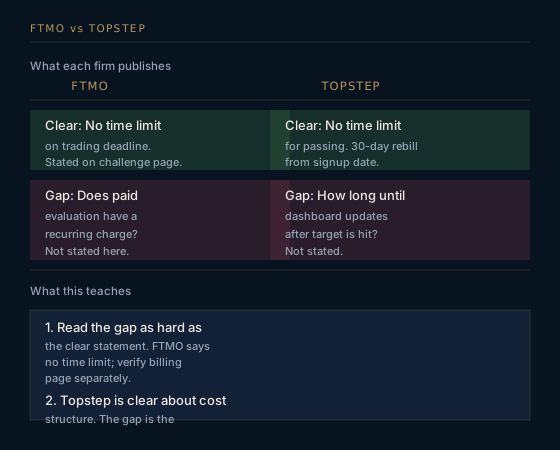
Table 1: official time and billing comparison
| Question | FTMO | Topstep |
|---|---|---|
| Time limit on passing the paid evaluation | No time limit (FTMO, retrieved 2026-08-04) | No time limit for passing (Topstep, retrieved 2026-08-04) |
| Billing cycle stated on the same product | Not stated in the sources retrieved for this article | Rebills every thirty days from the original signup date (Topstep, retrieved 2026-08-04) |
| Separate product with a fixed expiration | Free trial demo account lasts fourteen days (FTMO, retrieved 2026-08-04) | Not stated in the sources retrieved for this article |
| Stated condition for stopping the next charge | Not stated in the sources retrieved for this article | Dashboard must show a pass before the rebill date (Topstep, retrieved 2026-08-04) |
| Source type | Firm's own challenge and trial pages | Firm's own help-centre subscription article |
| Retrieved | 4 August 2026 | 4 August 2026 |
Two honest gaps in that table are worth naming rather than filling. "Not stated in the sources retrieved for this article" means exactly that: the fact may well be published elsewhere on the firm's site, and this article did not verify it, so it is not asserted. A comparison table that invents a number to look symmetrical is worse than a table with holes in it, because the holes are visible and the invention is not.
Concession where each model is clearer
Each model is clearer than the other on a different point, and pretending otherwise would be marketing rather than analysis.
The subscription model is clearer about the money. Topstep publishes the cycle length and the anchor date for it: thirty days from the original signup date (Topstep, retrieved 2026-08-04). That can be put on a calendar the day of purchase. It also publishes the condition that stops the next charge, which is that the dashboard shows a pass before the rebill date (Topstep, retrieved 2026-08-04). That is a testable, dated instruction rather than a vibe.
The one-time-fee model is clearer about the trading. If there is no time limit and no recurring charge, then the phrase "no time limit" means what a plain reading of it suggests, and there is no second clock quietly narrowing the first one. FTMO's challenge page states no time limit (FTMO, retrieved 2026-08-04). Whether a recurring charge exists alongside it is precisely the thing this article did not verify from FTMO's own pages, so the honest position is to verify it on the checkout and terms pages before treating the phrase as complete.
The general lesson is structural. A firm that publishes the cycle length, the anchor date and the stop condition has given a trader enough to plan with. A firm that publishes only the reassuring phrase has given enough to feel good with. Those are not the same thing.
How do you calculate your real deadline?
Three kinds of date govern an evaluation. Only one of them is usually printed in large type on the sales page.
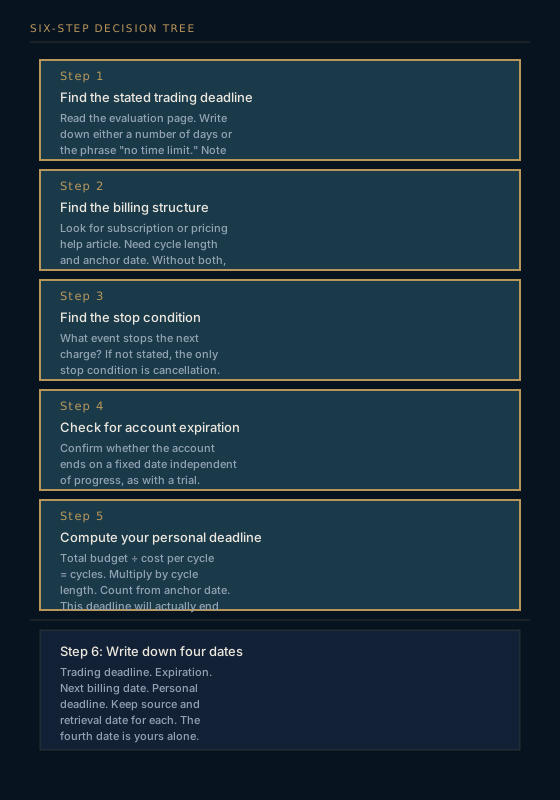
Table 2: fixed, rolling and self-imposed dates
| Date type | What sets it | Where it is documented | Verified example from this article |
|---|---|---|---|
| Fixed expiration | A stated duration from account start, running whether or not trading occurs | Product page or trial terms | FTMO free trial demo account lasts fourteen days (FTMO, retrieved 2026-08-04) |
| Rolling billing date | A cycle length plus an anchor date, repeating until a stop condition is met | Billing or subscription help article | Topstep rebills every thirty days from the original signup date (Topstep, retrieved 2026-08-04) |
| Stop condition on the rolling date | An event that must be visible before the next cycle charges | Same billing article | Topstep dashboard must show a pass before the rebill date (Topstep, retrieved 2026-08-04) |
| Stated trading deadline | A profit-target deadline set by the evaluation itself | Challenge or evaluation page | FTMO states no time limit (FTMO, retrieved 2026-08-04); Topstep states no time limit for passing (Topstep, retrieved 2026-08-04) |
| Self-imposed deadline | Total budget divided by the cost per cycle | Nowhere. It has to be written down | Not applicable, this is yours to compute |
The last row is the one that decides outcomes, and it is the only one no firm will print.
A worked decision sequence without invented prices
This sequence uses no prices, because inventing a price to make an example tidy is the same failure as inventing a table cell. Substitute the real numbers from the checkout page in question.
- Find the stated trading deadline. Read the evaluation page and write down either a number of days or the phrase "no time limit." If it says no time limit, note which document said it and on what date it was read, because that phrase can be revised.
- Find the billing structure. Look for a billing, subscription or pricing help article rather than the sales page. Two facts are needed: the cycle length and the anchor date it counts from. Topstep's own article gives both, thirty days from the original signup date (Topstep, retrieved 2026-08-04). Without both facts, the product's cost over time is unknown, and the trading deadline should not be treated as the only constraint.
- Find the stop condition. Ask what event stops the next charge, and where that event becomes visible. Topstep names the dashboard and the rebill date as the pair that matters (Topstep, retrieved 2026-08-04). If a firm never names a stop condition, the only stop condition to rely on is cancellation, and how cancellation works should be confirmed before it is needed.
- Check for a separate expiration. Confirm whether the account itself can end on a date independent of progress, as with a trial. FTMO's fourteen-day trial is the clean example of a product where the expiration is the whole clock (FTMO, retrieved 2026-08-04).
- Compute the deadline nobody prints. Take the total budget for the attempt, divide by the cost per cycle, and round down. That integer is the number of cycles that can be funded. Multiply by the cycle length and count forward from the anchor date. That date is the real deadline, and it is the one that will actually end the attempt.
- Write down the four dates. Trading deadline if any, expiration date if any, next billing date, and the computed budget deadline. Keep them in the same place, with the date each one was retrieved and the URL it came from. Three weeks in and tired, that note is the difference between a decision and a guess.
What happens when a pass lands near a rebill date?
Dashboard status is the evidence
Passing and being recorded as having passed are two different events separated by an unknown interval. The firm that names which system counts as the record has communicated something useful. Topstep says the dashboard must show a pass before the rebill date (Topstep, retrieved 2026-08-04).
Read that carefully, because it locates the burden of proof. The evidence is not a trader's own trade log, not arithmetic on the profit target, and not the moment the final trade closed. It is a status displayed in the firm's own interface. If the status has not updated by the rebill date, the rebill date arrives with the old status in place.
The practical consequence is that a pass achieved close to a billing date is not obviously a pass achieved before it. If the target is reached with days rather than hours to spare, the gap is probably irrelevant. If it is reached with hours to spare, the gap is the entire question. Once a payout is finally approved, a separate clock starts on when the money actually arrives; that clock is covered in a look at how long prop firms take to pay once a payout is approved.
Cancellation and review timing questions
There are questions here that no responsible article answers with a general rule, because the answers are firm-specific and can change. Ask them of the specific firm, in writing, and keep the reply.
How long does the status take to update after the final qualifying trade? Is there a manual review step between meeting the target and the dashboard reflecting it, and if so, what is its stated turnaround? If a charge lands while a pass is under review, is it refunded, credited, or neither? Does cancelling the subscription before the rebill date affect an evaluation already in progress, or does it end it?
Two things make those answers durable. First, get them in writing rather than on a call, so there is a document rather than a memory. Second, save the dashboard status with a timestamp before the rebill date arrives. A screenshot with a visible date is a weak record but it is a record, and it is better than reconstructing a sequence of events after money has moved.
Notice what all four questions have in common: they are about the seam between two systems, the trading system and the billing system. Rules are usually clear inside each system and vague at the joint. The joint is where money is lost, so the joint is where to read closely.
How is the Ordane Instant Account different?
No evaluation phase or challenge
Ordane sells one product, the Ordane Instant Account: direct access, no evaluation phase and no challenge, on simulated capital. Ordane Instant Account comes in four sizes: $10,000, $25,000, $50,000 and $100,000 (Ordane Rulebook v1.0, section 1, retrieved 2026-08-05). The fee is one-time: $139 for the $10,000 account, $299 for $25,000, $549 for $50,000 and $999 for $100,000. There are no recurring fees, no hidden tiers and no coupon games (Ordane Rulebook v1.0, section 1, retrieved 2026-08-05).
That structure removes clock one and clock three by construction rather than by promise. There is no profit-target deadline because there is no evaluation to pass, and there is no billing cycle to outrun because the fee is one-time.
Clock two still exists and is published rather than implied. Accounts with no trading activity for 30 consecutive days are closed (Ordane Rulebook v1.0, clause R-5, retrieved 2026-08-05). That is an expiration condition, it is numbered, and it is the kind of clause this article has been arguing should be found on every product under consideration.
The governing document is Ordane Rulebook v1.0, published 2026-07-23 (Ordane Rulebook v1.0, section 6 Changelog, retrieved 2026-08-05). The Ordane rulebook is public, numbered and versioned, and no rule is ever applied retroactively to an open account. Changes produce a new version with a dated changelog entry, and the version you sign up under is the version that governs your account (Ordane Rulebook v1.0, section 6 Changelog, retrieved 2026-08-05).
One sentence and a canonical link, not a second product comparison
This section is deliberately short. Comparing a no-evaluation product against evaluation products on the specific question of evaluation deadlines produces a foregone conclusion, and a foregone conclusion is not an argument. The honest statement is narrow: the timing question in this article is a property of evaluation products, and it does not arise inside a product that has no evaluation. The full comparison between instant access and evaluation models belongs in a dedicated comparison of instant accounts against evaluation challenges rather than crammed in here.
Questions traders ask about challenge time limits
Can an unlimited evaluation expire?
Yes, because "unlimited" and "permanent" are different claims. A no-time-limit statement addresses the profit-target deadline. Separate clauses can still close the account, whether for inactivity or because the product is a trial with a stated duration. FTMO's free trial demo account lasts fourteen days, which is a fixed expiration sitting alongside a no-time-limit statement on the paid challenge (FTMO, retrieved 2026-08-04). Read the expiration clause separately from the deadline clause, every time.
Does no time limit mean no recurring fee?
No. They are answers to different questions, and one firm's own documentation states both. Topstep says there is no time limit for passing, and the same subscription article says the plan rebills every thirty days from the original signup date (Topstep, retrieved 2026-08-04). Unlimited time with a recurring charge means the trader's budget sets the deadline instead of the firm's rulebook. Find the cycle length and the anchor date before deciding how much time actually remains.
Can rules change while the account is open?
That depends entirely on the firm's versioning policy, and it is one of the highest-leverage questions to ask before paying. The question to put in writing: if the rules change after purchase, does the new version apply to an open account, or does the version bought under continue to govern it? At Ordane the answer is published rather than promised. The Ordane rulebook is public, numbered and versioned, and no rule is ever applied retroactively to an open account. Changes produce a new version with a dated changelog entry, and the version you sign up under is the version that governs your account (Ordane Rulebook v1.0, section 6 Changelog, retrieved 2026-08-05). Whatever answer another firm gives, get it in writing and note the date, because an undated verbal assurance is not a policy.
What date should you save?
Save four, with the URL and retrieval date for each. The stated trading deadline, or the phrase "no time limit" and where it was read. The account expiration date, if the product has one. The next billing date, computed from the cycle length and the anchor date. And the budget deadline calculated independently, which is total budget divided by cost per cycle, rounded down, counted forward from the anchor date. The first three come from the firm. The fourth is the one that will actually decide when the attempt ends, and it is the one only the trader can write down. Before any of this matters, confirm the firm meets the basics covered in four checks to run on a prop firm before you pay.
The pattern underneath all four questions is the same. A dated clause with a section number is a fact that can be planned around. An undated reassurance is a sentence that cannot be quoted back to anyone.
Sources
- FTMO Challenge, on the challenge having no time limit. ftmo.com Retrieved 2026-08-04.
- FTMO Free Trial, on the free trial demo account lasting 14 days. ftmo.com Retrieved 2026-08-04.
- Topstep Trading Combine Subscriptions, on the subscription rebilling every 30 days from the original sign-up date. help.topstep.com Retrieved 2026-08-04.
- Topstep Trading Combine Subscriptions, on there being no time limit for passing. help.topstep.com Retrieved 2026-08-04.
- Topstep Trading Combine Subscriptions, on the dashboard having to show a pass before the rebill date. help.topstep.com Retrieved 2026-08-04.
- Ordane official site, payout-funding statement, on no live funds being traded and no deposits being accepted. ordanemarkets.com Retrieved 2026-08-05.
- Ordane Rulebook v1.0, on the clauses cited in this article: section 1 (the Ordane Instant Account, its four sizes and its one-time fee ladder), P-2 (simulated capital), R-5 (accounts closed after 30 consecutive days without trading activity) and section 6 Changelog (versioning, non-retroactivity and the 2026-07-23 publication date). ordanemarkets.com/rulebook Retrieved 2026-08-05.