Home · The Ordane Journal · Before You Pay · One-Step vs Two-Step Prop Firm Evaluation
One-Step vs Two-Step Prop Firm Evaluation
Ordane accounts operate on simulated capital. No live funds are traded and no deposits are accepted. Payouts depend on simulated performance under Rulebook v1.0; no level of performance is typical or assured.
Ordane sells one product, the Ordane Instant Account: direct access, no evaluation phase and no challenge, on simulated capital.
Every number below comes from the paying firm's own published objective table, not a review page or a forum thread, because the objective table is the contract you actually sign.
A prop firm evaluation is a pass or fail test on simulated capital that a trader must clear before an account activates.
What Is the Difference Between One-Step and Two-Step?
ESMA's product-intervention notice states that CFDs are complex instruments and come with a high risk of losing money rapidly due to leverage (ESMA, retrieved 2026-08-10). That leverage risk is the independent frame behind any prop CFD-style ticket.
A one-step evaluation is a single phase: hit the profit target while staying inside the loss limits, and the account activates. A two-step evaluation splits the same test across two phases, usually with a smaller target in phase two, and requires you to pass both before activation. The number of phases is packaging. The variable that actually changes what you can survive is the daily loss limit, and that number moves in the opposite direction from what the phase count suggests.
The 40-word answer, quotable as written
One step is a single pass-or-fail phase; two step splits the same evaluation across two phases with a lighter second target. The real trade is the daily loss limit: one-step paths are usually tighter, two-step paths usually wider. Phase count is not the risk variable.
Phases Are Packaging; the Objective Table Is the Product
Ordane sells one product, the Ordane Instant Account: direct access, no evaluation phase and no challenge, on simulated capital (Ordane Rulebook, retrieved 2026-08-11). It is not on either side of this comparison, but it is the reference point for what removing the phase step costs and does not cost, covered later in this article. For a broader view on this model, read about the differences between an instant account vs evaluation prop firm.
What Four Fields Decide an Evaluation, and Where Do You Read Them?
Before comparing any firm's numbers, learn what to look for. Every legitimate prop firm evaluation is defined by exactly four fields, and a firm that does not publish all four in one place has not published an objective table, whatever its marketing page implies. To understand how to verify these claims, consider how to audit a prop firm before you commit.
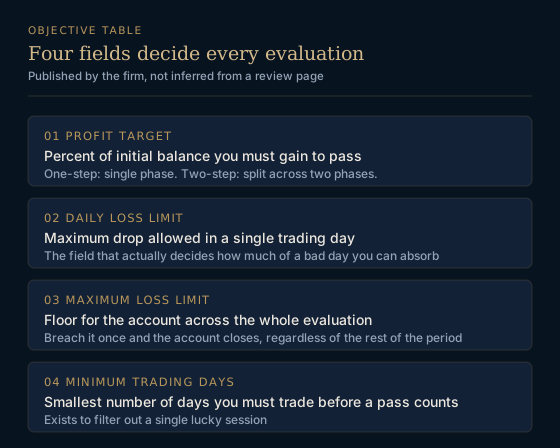
Profit Target, Daily Loss Limit, Maximum Loss, Minimum Trading Days
FTMO's own objectives page states a minimum of at least 4 trading days on its two-step path (FTMO Trading Objectives, retrieved 2026-08-05). That is not a suggestion, it is a pass condition as binding as the profit target itself, and a trader who hits the target in three days still has not passed.
Table 1: the two structures compared field by field
| Field | One-step (FTMO example) | Two-step (FTMO example) | Source |
|---|---|---|---|
| Profit target | 10 percent, single phase (FTMO Trading Objectives, retrieved 2026-08-05) | Split across two phases, starting at 10 percent (FTMO Trading Objectives, retrieved 2026-08-05) | FTMO Trading Objectives |
| Daily loss limit | Not published in the quotation cited here for the one-step path | 5 percent of initial simulated capital (FTMO Trading Objectives, retrieved 2026-08-05) | FTMO Trading Objectives |
| Maximum loss limit | Not published in the quotation cited here for the one-step path | Not published in the firm's objective table alongside the daily figure cited here | FTMO Trading Objectives |
| Minimum trading days | Not published in the firm's objective table for the one-step path cited here | At least 4 trading days (FTMO Trading Objectives, retrieved 2026-08-05) | FTMO Trading Objectives |
| After activation | No profit target on the subsequent account (FTMO Trading Objectives, retrieved 2026-08-05) | No profit target on the subsequent account (FTMO Trading Objectives, retrieved 2026-08-05) | FTMO Trading Objectives |
Read that table by field, not by column. The daily loss limit row is the one that overturns the easy assumption: the two-step path buys you a wider daily cushion in exchange for a second phase and a minimum day count that guarantees more calendar time exposed to the market.
What a Second Phase Is Actually Testing, and What It Is Not
A second phase does not test whether you can trade profitably twice. It tests whether the first pass was signal or noise. A trader who clears phase one on a single outsized win and then grinds through phase two on ordinary, repeatable decisions has demonstrated something a one-step pass cannot: consistency across two separate measurement windows. That is the actual value of the second phase, and it is unrelated to whether the loss limit that phase carries happens to be wider or tighter.
Worked Example: the Same Losing Week Under Both Structures
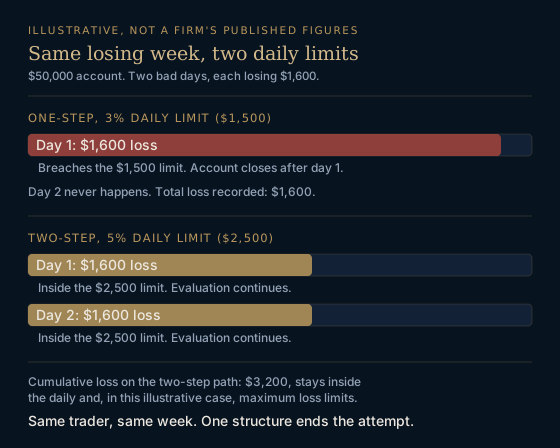
The figures in this example are illustrative, declared as such, not any firm's published numbers.
Declared inputs: starting balance $50,000. Trader has two bad days in the same week, each losing $1,600. Illustrative one-step daily limit = 3 percent of $50,000 = $1,500. Illustrative two-step daily limit = 5 percent of $50,000 = $2,500.
Worked arithmetic tied to those declared inputs only: 1,600 compared with 1,500 breaches the one-step day; 1,600 compared with 2,500 stays inside the two-step day; cumulative two-day loss 1,600 + 1,600 = 3,200.
| Structure | Daily limit (illustrative) | Day 1 loss | Day 2 loss | Outcome |
|---|---|---|---|---|
| Illustrative one-step, 3 percent daily limit | $1,500 | $1,600 (breaches limit) | Never reached | Account closes after day 1; 1,600 > 1,500 |
| Illustrative two-step, 5 percent daily limit | $2,500 | $1,600 (inside limit) | $1,600 (inside limit) | Both days absorbed; cumulative $3,200 stays inside the daily and, in this illustrative case, maximum loss limits |
Same trader, same losing week, same total dollars lost. One structure ends the evaluation after day one. The other absorbs both days and lets the trader keep trading. That gap is the entire practical difference between one-step and two-step, and it has nothing to do with how many phases either path advertises.
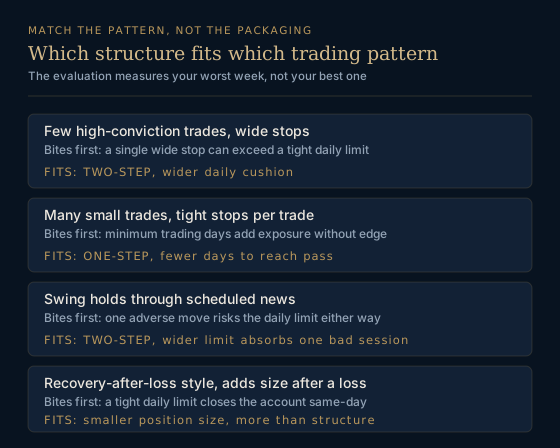
Table 2: which structure fits which trading pattern
| Trading pattern | Constraint that bites first | Better-suited structure |
|---|---|---|
| Few high-conviction trades, wide stops | A single wide stop can exceed a tight daily limit in one session | Two-step, for the wider daily cushion (5 percent of initial simulated capital, FTMO Trading Objectives, retrieved 2026-08-05) |
| Many small trades, tight stops per trade | Minimum trading day requirement adds calendar exposure without adding edge (at least 4 trading days, FTMO Trading Objectives, retrieved 2026-08-05) | One-step, fewer days needed to reach the pass condition |
| Swing holds through scheduled news | A single adverse move on a held position risks the daily limit regardless of structure | Two-step, wider daily limit absorbs one bad session without ending the attempt (FTMO Trading Objectives, retrieved 2026-08-05) |
| Recovery-after-loss trading style, tends to add size after a loss | A tight daily limit closes the account on the first attempt to recover same-day | Two-step, or better, a smaller position size regardless of structure |
The mistake this table exists to prevent: buying the structure that fits your best week rather than your worst one. A trader who has never had a $1,600 day evaluates the tighter path favorably because the tighter limit has never mattered to them yet. The evaluation does not know your best week. It only measures your worst one, and the daily loss limit is the field that decides how much worst week it can absorb before the attempt ends.
One Instant Account, Six Rules, One Price
Ordane sells one product, the Ordane Instant Account: direct access, no evaluation phase and no challenge, on simulated capital (Ordane Rulebook, retrieved 2026-08-11). There is no phase one, no phase two, no minimum trading day count to clear before the account activates. That single fact answers the whole one-step versus two-step question by removing the question: there is no structure to choose because there is no evaluation to structure. For a deeper understanding of this model, explore instant account vs evaluation prop firm.
For related published reading, see overnight and weekend holding rules, trading costs against drawdown, news trading restrictions.
Questions traders ask about evaluation structures
Is a one-step challenge actually easier than a two-step challenge?
No, not in an absolute sense. A one-step path is shorter and usually carries a tighter daily loss limit, which makes it less forgiving of a single bad session. A two-step path takes longer and carries a minimum trading day requirement, but usually offers more daily cushion. Easier depends on your trading pattern, not on the phase count.
Can you switch from a one-step to a two-step evaluation after buying?
Firms generally sell these as separate products with separate checkout flows, so switching typically means buying the other product outright rather than converting an existing purchase. Confirm this directly on the firm's own checkout and refund pages before assuming either is possible.
Does failing phase one of a two-step evaluation refund phase two?
No. A two-step evaluation is priced and sold as one attempt covering both phases; failing phase one ends that attempt entirely and a new attempt, whether a reset or a fresh purchase, is required to try again, per the firm's own reset policy.
What carries over between phase one and phase two on a two-step path?
Nothing carries over except having cleared phase one's target and stayed inside its limits. Phase two typically resets to a fresh balance figure and its own, usually smaller, profit target, measured independently of how phase one was traded.
Does the number of phases affect the profit split after activation?
Not directly. The profit split is set by the firm's payout policy, not by the evaluation structure. A one-step and a two-step product from the same firm can carry the same split ladder, a different one, or no relationship between the two at all. Check the split terms directly rather than inferring them from the phase count. For more information, read about prop firm profit split explained.
Payouts depend on simulated performance under Rulebook v1.0; no level of performance is typical or assured.
Sources
- Ordane Rulebook Retrieved 2026-08-11.
- Customer Advisory: Understand the Risks of Virtual Currency Trading | CFTC Retrieved 2026-08-10.
- FTMO Trading Objectives Retrieved 2026-08-05.
- FTMO, How it works Retrieved 2026-08-05.
- Notice of product intervention decisions on CFDs and binary options | ESMA Retrieved 2026-08-10.
- Topstep Help Center, Trading Combine Subscriptions Retrieved 2026-08-05.