Home · The Ordane Journal · Risk and Exposure · Prop Firm Stop Loss Slippage Buffer
Prop Firm Stop Loss Slippage Buffer
A stop-loss buffer is the gap you deliberately leave between your stop's expected loss and the rule threshold that closes your account, sized to absorb slippage and trading costs the stop itself does not cover.
Ordane accounts operate on simulated capital. No live funds are traded and no deposits are accepted. (Ordane Rulebook v1.0, clause P-2, and ordanemarkets.com payout-funding statement, retrieved 2026-08-05)
A stop loss placed exactly at a loss limit is not a safety measure. It is a coin flip. The order tells the platform where to start selling, not where the trade will end. The rule tells the firm where your account dies. Those two numbers are measured in different units: one is an instruction, the other is a contract threshold. When the instruction lands past the threshold, the account is closed and the argument that "my stop was at the limit" carries no weight, because the rule was never written about your stop price. The same confusion sits under an argument about whether a prop firm actually pays: the trader is arguing about intent, and the firm is enforcing a number.
Ordane sells one product, the Ordane Instant Account: direct access, no evaluation phase and no challenge, on simulated capital (Ordane Rulebook v1.0, section 1, retrieved 2026-08-05). That means the numbers in this article are contractual thresholds inside a rulebook, not brokerage margin calls, and the mechanics of a stop fill are the same either way. If you have not compared how that model differs from a multi-phase evaluation, see instant access versus a staged evaluation before sizing anything.
This article covers what a buffer actually is, why a stop can fill beyond its trigger, which trading costs eat the space you thought you had, how two named firms describe the risk in their own documentation, and a calculation framework you can run before a trade. It does not hand you a universal buffer percentage. Anyone who gives you one has stopped describing markets and started selling comfort.
What Is a Stop-Loss Buffer?
A stop-loss buffer is the distance you deliberately leave between the worst loss your stop is designed to produce and the loss threshold that closes your account. It exists because the loss your stop produces is an estimate, and the threshold is exact.
A Liftable Definition
A Rule Threshold Is Not a Fill Price
A daily loss limit or a static drawdown floor is a number in a contract. It does not move. It does not negotiate. It does not care whether the market was thin, whether a headline printed, or whether the spread tripled for four seconds. The distinction between a threshold that moves and one that does not is exactly what separates static drawdown from trailing drawdown, and it is worth knowing which kind you are trading against before you size a stop.
A stop loss is a conditional instruction sent to a platform. Once the condition is met, the instruction becomes an order that has to find a counterparty at whatever price is available. Slippage is the difference between the expected price and the executed price (FTMO, retrieved 2026-08-05). The same firm states plainly that a stop loss does not guarantee a fill at the requested price (FTMO, retrieved 2026-08-05).
So the reader who sets a stop at exactly the loss limit has built a system with zero tolerance for the one thing that is not under their control. The correct mental model is not "my stop is my loss". It is "my stop is my best case, and the rule is my hard boundary".
The two most common versions of this mistake:
- Sizing a position so the stop produces a loss identical to the daily loss limit, then treating the trade as compliant.
- Sizing against the static drawdown floor while a second open position is also running, so the two combined can cross the floor before either stop triggers.
Both are the same error: confusing an instruction with an outcome.
Why Can a Stop Fill Beyond Its Trigger?
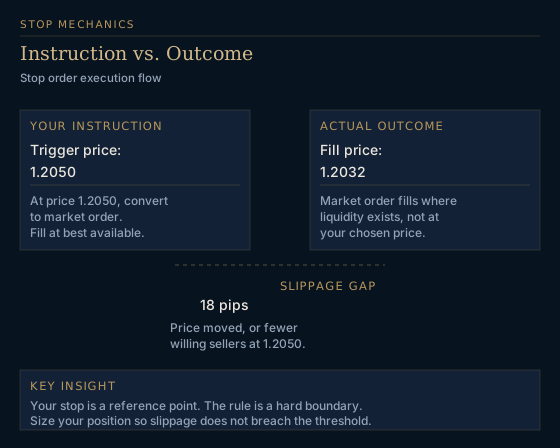
A stop order converts into a market order once the trigger price is touched, and a market order fills at the best available price, not a guaranteed one, so a fast or thin market can produce a fill worse than the trigger. The U.S. Securities and Exchange Commission states the mechanism in one line: when the specified price is reached, your stop order becomes a market order (SEC, Investor.gov, retrieved 2026-08-05).
Market Order After Activation
A stop order is dormant until price touches the trigger. At that moment it becomes a market order (SEC, Investor.gov, retrieved 2026-08-05). A market order asks for the best available price, not for a specific price. If the best available price is worse than the trigger, that is the price you get. The same regulator names the consequence: the price at which your trade is executed may differ from the stop price, especially in a fast-moving market (SEC, Investor.gov, retrieved 2026-08-05).
This is not a defect. It is the definition. The alternative, an order that refuses to fill unless it gets the exact price, would leave you in the position during a fast move, which is the outcome a stop exists to prevent. The design accepts a worse fill in exchange for certainty of exit.
Liquidity, Volatility and Spread Widening
Slippage is not random noise sprayed evenly across the trading day. It clusters. FTMO identifies low liquidity, volatility, news releases, market rollovers and weekend gaps as slippage conditions (FTMO, retrieved 2026-08-05).
Each of those is a description of the same underlying problem: fewer willing counterparties at the price you wanted, or a sudden repricing that skips your level entirely.
- Low liquidity. The order book is thin. Your order consumes the nearby offers and fills the remainder further away.
- Volatility. Price is moving faster than orders are being matched. By the time your market order arrives, the level is gone.
- News. Both of the above at once, on a schedule that everyone can read in advance. If you trade around scheduled releases at all, check the prop firm news trading rules for your firm before you widen anything.
- Rollovers. The session handover where spreads routinely widen and depth thins out.
- Weekend gaps. Price does not travel from Friday's close to Monday's open. It reappears somewhere else. A stop sitting in the space between the two does not get the trigger price; it gets the reopening price. Whether you can even hold into that gap depends on the firm's own rule on overnight and weekend holding.
Notice that this list is a schedule, not a mystery. Four of the five are predictable. That predictability is the practical basis for sizing a buffer: you widen it when you are trading through a known slippage condition, and you can narrow it when you are not.
Nothing here requires a theory of manipulation. A stop that fills past its trigger during a scheduled release is the mechanism working exactly as documented.
Which Costs Consume the Buffer?
Commission, Spread and Swap
Slippage is the component nobody controls. It is also, for most traders, not the largest one. The costs that reliably eat headroom are the ones that arrive on every trade, quietly, and get excluded from the mental arithmetic because they are not part of the price chart.
FTMO warns that commission, swap and possible slippage must be taken into account when setting risk below a loss limit (FTMO, retrieved 2026-08-05). Read that list carefully, because it contains three different kinds of number:
- Commission is known before entry, per lot, and scales with size.
- Swap is a financing charge or credit for holding past the daily rollover. It is known in advance as a rate, but the total depends on how long you hold, which you do not know at entry.
- Slippage is unknown by definition.
Spread belongs in the same bucket even when a firm does not name it separately, because a position is measured against the price at which it can actually be closed. A trade opened at the ask and closed at the bid has already paid the spread before the market has moved at all. Widen the spread and you have widened the loss without a single tick of adverse price movement. None of these costs are one-time; they stack quietly the same way recurring and hidden prop firm fees stack after the ticket price.
Open Positions Count Before the Stop Fills
This is the part that catches disciplined traders. A loss threshold is usually measured against account equity, and equity includes floating losses on positions that are still open. Topstep monitors its Maximum Loss Limit, a trailing limit, on unrealised profit and loss in real time (Topstep, retrieved 2026-08-05). Your stop has not fired yet. Your equity has already fallen.
Two consequences follow.
First, a single position can breach a limit through a floating loss during a spike that never reaches the stop level, if the threshold sits closer than the spike's depth. Second, and more common, multiple simultaneous positions each sized against the full limit are collectively sized at a multiple of it. Two positions each risking the daily limit are risking twice the daily limit, and the account can close with both stops still pending.
Topstep says slippage may push the liquidation fill slightly above or below the limit (Topstep, retrieved 2026-08-05). Note the direction of that sentence: it is about the firm's own liquidation, the automatic action taken when the threshold is crossed. Even the firm closing your position on its own terms does not get a guaranteed price. If the mechanism that enforces the rule cannot guarantee a fill price, an individual trader's stop certainly cannot.
How Do FTMO and Topstep Describe the Risk?
Table 1: Source, Mechanism and Consequence
Both firms publish on this. They describe the same physics from two different sides of the transaction: one from the trader's stop order, the other from the firm's liquidation engine.
| Firm | What the documentation states |
|---|---|
| FTMO | Slippage is the difference between the expected price and the executed price |
| FTMO | A stop loss does not guarantee a fill at the requested price |
| FTMO | Low liquidity, volatility, news releases, market rollovers and weekend gaps are slippage conditions |
| FTMO | Commission, swap and possible slippage must be taken into account when setting risk below a loss limit |
| Topstep | Slippage may push the liquidation fill slightly above or below the limit |
| Firm | Mechanism described | Consequence for the trader |
|---|---|---|
| FTMO | Definition of the gap between instruction and outcome | The requested level is a reference, not a result |
| FTMO | Stop converts to an order seeking available liquidity | Worst-case loss must be estimated above the stop level, not at it |
| FTMO | Named list of conditions where the gap widens | Buffer requirements change by session and event, not by preference |
| FTMO | Three cost components sit between the stop and the threshold | Position size must be solved backwards from the threshold, net of costs |
| Topstep | Firm-side liquidation is also subject to slippage | Crossing the threshold is not a controlled exit even when the firm acts |
Sources: FTMO Slippage and Order Execution (FTMO, retrieved 2026-08-05); FTMO Challenge Mistakes (FTMO, retrieved 2026-08-05); Topstep Maximum Loss Limit (Topstep, retrieved 2026-08-05).
Where Liquidation Language Differs
The difference worth noticing is not a contradiction, it is a shift in perspective.
FTMO's published material addresses the trader's own order: your stop, your commission, your swap, your responsibility to account for slippage when you choose a risk level (FTMO, retrieved 2026-08-05). The burden sits with the person sizing the position.
Topstep's language addresses what happens at the threshold itself, describing fills that may land above or below the limit (Topstep, retrieved 2026-08-05). The subject there is the liquidation event, not the trader's discretionary stop.
Put side by side, they close the loop. Slippage applies to your exit and to theirs. There is no version of this where a number in a contract is enforced with tick-perfect precision. Which is why the buffer belongs in your sizing, before entry, where you still control it.
One caution on both entries: execution policy, loss-limit formulas, spreads, commission schedules and swap rates are firm-specific and change. Every figure above is a description of published mechanism, not a current fee table. Read the live document for the firm you are actually trading with, on the day you trade it. Checking the live document instead of a summary is one of the checks worth running before you pay any prop firm at all.
How Do You Build a Buffer Calculation?
Table 2: Rule Headroom Minus Known Costs
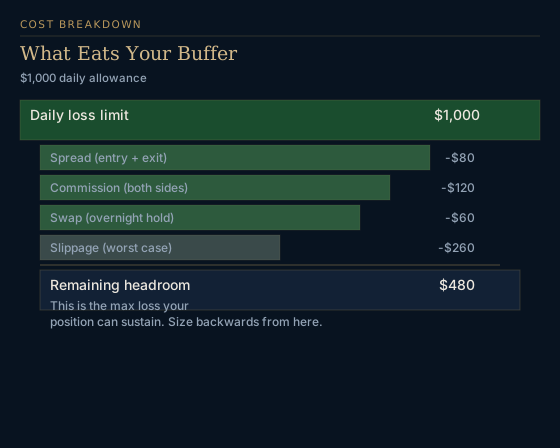
The framework is subtraction, run in the right order. You start from the contract threshold, remove everything you can price, and treat what remains as the room available for the one thing you cannot price.
| Step | Input | Direction |
|---|---|---|
| 1 | Rule headroom | Starting figure |
| 2 | Floating loss on open positions | Subtract |
| 3 | Spread at exit | Subtract |
| 4 | Commission | Subtract |
| 5 | Swap | Subtract |
| 6 | Remaining headroom | Working figure |
| 7 | Slippage allowance | Subtract, generously |
| 8 | Position size | Output |
| Step | Where the number comes from | Notes |
|---|---|---|
| 1 | The contract threshold, minus any loss already realised in the period | Daily limit and static floor are separate calculations; run both, use the tighter |
| 2 | Account equity, not entry prices | Applies before your stop fires; see the open-position section above |
| 3 | Instrument spread, widened for the session you are in | Paid whether or not price moves against you |
| 4 | Per-lot schedule, both sides | Known in advance; scales with size |
| 5 | Financing rate multiplied by intended holding period | Zero for an intraday close, non-zero the moment you hold past rollover |
| 6 | Result of steps 1 to 5 | This is the real space your stop must fit inside |
| 7 | Not calculable; stressed, not estimated | See below |
| 8 | Solved backwards from step 7 | Size is a result of the calculation, not an input to it |
The single most important line in that table is step 8. Most traders choose a position size, then place a stop where the chart suggests, then check whether the loss fits under the limit. The order is backwards. The threshold is fixed and the costs are known; size is the only free variable, so size is what gets solved.
Stress the Unknown Slippage Component
There is no defensible universal number for step 7, and this article will not invent one. Slippage depends on the instrument, the session, the depth of the book at that moment, and whether an event is printing. A percentage that is conservative for a major pair at midday is negligent for the same pair thirty seconds after a release, and irrelevant for an instrument with a different liquidity profile entirely.
What you can do is stress it rather than estimate it. Three practical moves:
- Test against your own worst historical fill. Your execution history contains the largest gap you have personally absorbed on that instrument. Use it as a floor for the allowance, not an average.
- Widen for named conditions. FTMO's list is a schedule: low liquidity, volatility, news releases, market rollovers and weekend gaps (FTMO, retrieved 2026-08-05). If any of those apply, the allowance goes up before the trade, not after.
- Check the answer for absurdity. If the buffer required by an honest stress test leaves a position size too small to be worth taking, the correct conclusion is that the trade does not fit the account today. That is a valid output. Forcing the size and hoping is not a plan.
The buffer is not a fixed percentage you memorise. It is a variable you recompute when conditions change, and the conditions that change it are published in advance.
What Does Ordane Require?
Canonical Stop-Loss and Risk-Per-Trade Clause
Ordane does not leave the stop loss to preference. Maximum risk per trade is 1.5 percent of current balance and a stop-loss is mandatory at entry. Two maximum losses equal the daily limit, which is the design rather than an accident (Ordane Rulebook v1.0, clause R-3, retrieved 2026-08-05).
Read the second sentence again, because it is the buffer logic written into the contract. Two maximum-risk trades consume the entire daily allowance. There is no third. The relationship between per-trade risk and the daily limit is not left for the trader to discover after a breach; it is stated as intent.
The Ordane rulebook is public, numbered and versioned, and no rule is ever applied retroactively to an open account. Changes produce a new version with a dated changelog entry, and the version you sign up under is the version that governs your account. The governing document is Ordane Rulebook v1.0, published 2026-07-23 (Ordane Rulebook v1.0, section 6 Changelog, retrieved 2026-08-05).
Ordane's prohibited-practice list is closed. Clause R-6 names six practices: latency, reverse or hedge arbitrage; high-frequency or bulk automated exploitation; copy trading between Ordane accounts; straddling news releases with paired opposing orders; platform or data-feed exploitation; and gap abuse. If a behavior is not listed in that section, it is not a violation. Discretion is not a rule (Ordane Rulebook v1.0, clause R-6, retrieved 2026-08-05). A stop that fills past its trigger is not on that list, and a wide buffer is not on that list either. Slippage is a market condition, not an infraction.
Static and Daily Limits Remain Separate
The two thresholds are computed differently and must be checked separately.
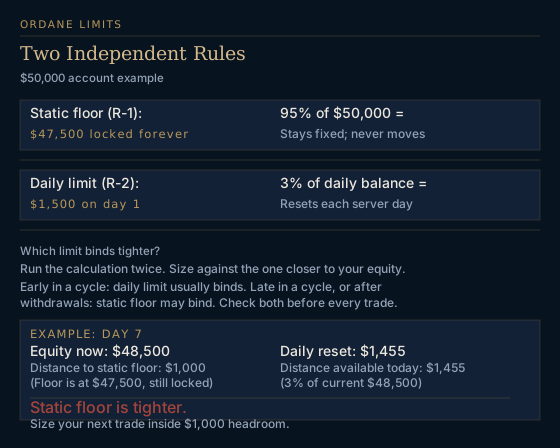
Ordane's maximum drawdown is 5 percent and static: account equity may never fall below 95 percent of the initial balance. The floor is fixed on day one, never trails upward, and a breach closes the account (Ordane Rulebook v1.0, clause R-1, retrieved 2026-08-05).
The daily loss limit is 3 percent, measured against the balance at the start of the server day. A breach closes the account (Ordane Rulebook v1.0, clause R-2, retrieved 2026-08-05).
Those are two independent boundaries. The static floor is anchored to the initial balance and does not move as the account grows. The daily limit resets against a new reference each server day. On any given trade, the binding constraint is whichever one is closer. Run step 1 of the calculation twice, once against each, and size against the tighter result.
One further note on the static floor, because it interacts with withdrawals. Withdrawals reduce the account balance, and the R-1 drawdown floor stays anchored to the initial balance (Ordane Rulebook v1.0, clause PA-4, retrieved 2026-08-05). Taking money out narrows the distance between your equity and a floor that does not follow you down. That is a headroom change, and headroom is step 1 of the calculation. The conditions that unlock the first withdrawal in the first place are covered in the first-payout checklist, and the clock that starts once you request one is covered in how long a payout actually takes.
And when the boundary is crossed, the outcome is stated rather than negotiated. The account closes. That is the whole consequence: no partial confiscations, no surprise fees, no renegotiation (ordanemarkets.com, FAQ, retrieved 2026-08-05). This is why the buffer is a sizing problem rather than a dispute problem: once the threshold is crossed there is no clause left to argue under.
Questions traders ask about stop-loss buffers
Does a stop guarantee the exit price?
No. FTMO states directly that a stop loss does not guarantee a fill at the requested price (FTMO, retrieved 2026-08-05). The trigger level determines when the order activates. Available liquidity determines where it fills. Treat the stop level as the best case in your calculation, and size so that a worse case still sits inside the threshold.
Can positive slippage happen?
Yes, in the sense that a fill can land on the favourable side of the trigger. Topstep's language on liquidation acknowledges that slippage may push the fill slightly above or below the limit (Topstep, retrieved 2026-08-05).
Do not build a plan around it. Favourable slippage is a windfall that reduces a loss; unfavourable slippage is the event that closes an account. The two are not symmetric in consequence, so they should not be treated as symmetric in planning. Size for the bad tail and let the good tail be a pleasant surprise.
Should the buffer be fixed?
No, and a fixed buffer is the more dangerous of the two errors, because it feels rigorous while ignoring the variable it was built to absorb.
FTMO's named conditions, low liquidity, volatility, news releases, market rollovers and weekend gaps, are exactly the moments when a fixed buffer under-covers (FTMO, retrieved 2026-08-05). Meanwhile the cost side also moves: commission, swap and possible slippage all need to be taken into account when setting risk below a limit, and swap in particular depends on how long you intend to hold (FTMO, retrieved 2026-08-05).
A buffer that does not change when the session changes is not a discipline. It is a number you stopped checking.
What evidence supports a dispute?
Start by being honest about what is disputable. Slippage is documented mechanism at both firms cited here, so a fill past the trigger during a named slippage condition is not a case (FTMO, retrieved 2026-08-05; Topstep, retrieved 2026-08-05).
What is worth preserving is the record: timestamps for order placement, trigger and fill; the requested level and the executed level; the spread at the moment of execution; the commission and swap applied; and account equity immediately before and after. That set separates a documented slippage event from an accounting error, and only one of those is arguable. It is also the same kind of documentation habit worth building before you ever pay for an account; see the broader question of whether prop firms are legitimate for the checks that matter before money changes hands.
What happens to a withdrawal request while this is being sorted out?
Where the process itself is contractual, read the process clause. At Ordane, every withdrawal request is approved, or denied in writing citing the exact rule breached by section number, within 24 clock hours. Past that deadline the request is treated as approved and the G-1 clock starts (Ordane Rulebook v1.0, clause G-0, retrieved 2026-08-05). The Ordane Guarantee applies to payout timing, with the mechanism named in clauses G-0, G-1 and G-2; a written denial citing a section number is the artefact that makes the reasoning checkable, which is the point of publishing a closed list in the first place.
The buffer is what keeps you out of that conversation. It costs position size and it buys the only thing worth buying here: the account is still open tomorrow.
Sources
- FTMO Slippage and Order Execution, on slippage being the difference between the expected price and the executed price. ftmo.com Retrieved 2026-08-05.
- FTMO Slippage and Order Execution, on a stop loss not guaranteeing a fill at the desired price level because widened spreads can cause slippage. ftmo.com Retrieved 2026-08-05.
- FTMO Slippage and Order Execution, on market rollovers, spread widening, significant news releases, volatile markets, low liquidity and weekend gaps as slippage conditions. ftmo.com Retrieved 2026-08-05.
- FTMO Challenge Mistakes, on having to take commission, swap and possible slippage into account when setting risk below a loss limit. ftmo.com Retrieved 2026-08-05.
- Topstep Maximum Loss Limit, on slippage possibly pushing the liquidation fill slightly above or below the limit. help.topstep.com Retrieved 2026-08-05.
- Topstep Maximum Loss Limit, on the limit being calculated on real-time unrealized profit and loss. help.topstep.com Retrieved 2026-08-05.
- U.S. Securities and Exchange Commission, Investor.gov glossary, Stop Order, on a stop order becoming a market order when the specified price is reached. investor.gov Retrieved 2026-08-05.
- U.S. Securities and Exchange Commission, Investor.gov glossary, Stop Order, on the price at which a trade is executed possibly differing from the stop price. investor.gov Retrieved 2026-08-05.
- Ordane official site, FAQ, on a breach closing the account with no partial confiscations, no surprise fees and no renegotiation. ordanemarkets.com Retrieved 2026-08-05.
- Ordane Rulebook v1.0, on the clauses cited in this article: section 1 (the Ordane Instant Account and its one-time fee), P-2 (simulated capital), R-1 (static 5 percent drawdown floor), R-2 (3 percent daily loss limit), R-3 (1.5 percent maximum risk per trade and the mandatory stop-loss), R-6 (the closed prohibited-practice list), PA-4 (withdrawals against the anchored floor), G-0 (the 24 hour approval clock) and section 6 Changelog (versioning and the 2026-07-23 publication date). ordanemarkets.com/rulebook Retrieved 2026-08-05.