Home · The Ordane Journal · Risk and Exposure · What Happens If a Prop Firm Shuts Down? Account and Unpaid Profit
What Happens If a Prop Firm Shuts Down? Account and Unpaid Profit
If a prop firm shuts down, three separate things are at stake: the fee you already paid, any profit the firm approved but never sent, and your access to the account itself. Whether client capital is ever at risk depends on the model. On the simulated model, there is no trading balance of yours to return.
Ordane accounts operate on simulated capital. No live funds are traded and no deposits are accepted. Ordane sells one product, the Ordane Instant Account: direct access, no evaluation phase and no challenge, on simulated capital. That structure matters for this question, and the second half of this article explains exactly how, including what Ordane cannot yet prove. It also matters when you are still deciding whether a firm is legit in the first place, since a shutdown is the worst-case version of the same trust question.
Last verified 12 August 2026: the CFTC still hosts the court-appointed Special Master's 13 May 2025 report and recommendation, which recommends granting the defendants' sanctions motion in the My Forex Funds litigation. That primary record is why this page separates the regulator's original allegations from the later court outcome.
Why Does the Answer Depend on What You Had at Risk?
Traders picture a shutdown as one vague loss. It is not one loss. It is three exposures with different odds of recovery, and confusing them is why people either panic about the wrong thing or ignore the right one.
Fee, unpaid profit, and account, three different exposures
The fee is money that left your bank account and became the firm's revenue the moment you paid. In a wind-down it sits with every other unsecured creditor claim, unless the firm chooses to refund it. The size of that fee, and whatever else got billed alongside it, is worth checking against the full list of costs a prop firm can charge beyond the ticket price before you ever get near a shutdown scenario.
Approved but unpaid profit is the sharpest exposure. The firm has already agreed you earned it. Whether it arrives depends entirely on whether cash exists and whether anyone is still operating the payment rail. The clock that governs how long that should take, and what a missed deadline is supposed to trigger, is covered in how long a prop firm is supposed to take to pay.
Account access disappears immediately. On the two dominant prop-firm models the account is a simulated or demo account. Instead of committing live funds immediately, firms place traders on simulated, or demo, accounts that mirror real market conditions (Spotware, retrieved 2026-07-31). There is no balance in it that belonged to you, which is why nobody sends you a closing statement. That distinction between an instant account and a challenge-style evaluation account is explained in more depth in how the two prop firm account models actually differ.
What Actually Happens to Your Account and Your Profit?
The mechanism is simpler than the anxiety around it. If the account was simulated, the numbers on your dashboard were never custodial funds. They were a scorecard. When the firm stops operating, the scorecard stops being scored, and what survives is only whatever the firm owed you in real money.
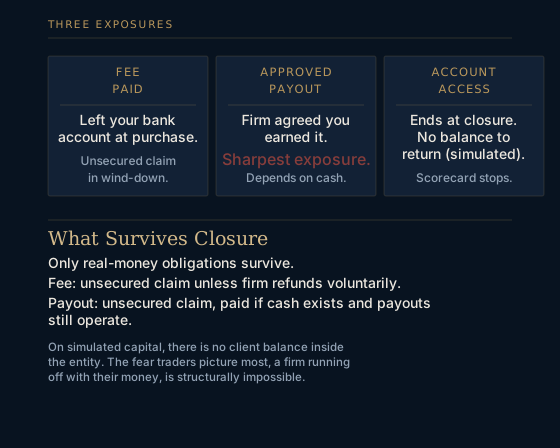
That leaves two live claims: the fee and the approved payout. Both are ordinary commercial obligations of the company. Neither is segregated, insured, or held by a third party unless the firm's own contract says so, which is why the contract is the only thing worth reading before you buy. The clause to look for is the one that limits your liability for the firm's simulated losses. That kind of clause protects you on the downside; nothing in it obliges the firm to still exist on the upside.
| Exposure | Survives a shutdown? | What recovers it |
|---|---|---|
| Fee already paid | Yes, as an unsecured claim | A voluntary refund by the firm, or a creditor process |
| Payout approved, not yet sent | Yes, as an unsecured claim | Cash on hand at the firm, plus someone still operating payouts |
| Account access | No, ends at closure | Nothing. On the simulated model there is no client balance to return |
| Your own deposited capital | Not applicable on the simulated model | No deposit was taken, so nothing is held to lose |
The row that surprises people is the last one. On a simulated-capital model, the thing traders fear most, a firm running off with their money, is structurally impossible, because there is no client money in the entity. The real risk is narrower and more specific: unpaid obligations in real money.
Next step. Before you pay any firm, run the written checks in how to audit a prop firm, then see what Ordane publishes on why Ordane and the public rulebook.
Two Real Cases, and What Each One Shows
Two dated cases from the last three years mark the actual range of outcomes, and they land in opposite places.
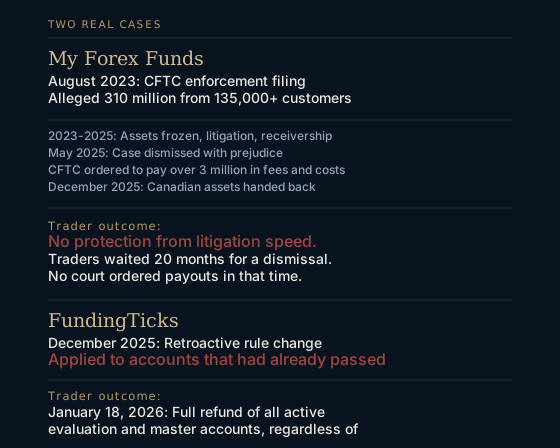
My Forex Funds. On August 28, 2023, the CFTC filed an enforcement action against Traders Global Group Inc., doing business as My Forex Funds, alleging approximately $310 million taken from more than 135,000 customers. On May 13, 2025, Judge Edward S. Kiel dismissed the case with prejudice, adopting Special Master Jose L. Linares's finding that the agency had misled the court, and ordered the agency to pay the defendants' fees and costs. A dismissal with prejudice means the same claims cannot be refiled. The separate Canadian receivership over the firm's Ontario assets opened on December 21, 2023, with Grant Thornton appointed as receiver (Insolvency Insider Canada, retrieved 2026-08-05), and it ran for two years: on 10 December 2025 the firm said the Ontario Superior Court had approved a Canadian Asset Handover Order and that it was regaining control of its assets, data and systems (Finance Magnates, retrieved 2026-08-05). The 2023 filing stated the platform had more than 135,000 customers who had signed up since November 2021 and paid at least $310 million in fees (Finance Magnates, retrieved 2026-07-31). The court ordered the CFTC to pay the defendants over $3 million in attorneys' fees and costs (Quinn Emanuel, retrieved 2026-08-05).
The lesson traders usually take from this case is the wrong one. It is not that regulators are always right, and it is not that they are always wrong. It is that a firm can be frozen, litigated, and receivership-managed for more than two years while traders wait, and none of that process was designed around getting a trader's approved payout out the door.
FundingTicks. In December 2025 the firm changed its trading rules and applied them retroactively to accounts that had already passed, reducing or invalidating booked profit. Traders who bought challenges under the old rules, agreed to those rules, and passed them had their challenges breached or profits reduced for conduct that only violated the newer rules (Finance Magnates, retrieved 2026-07-31). After the backlash, the firm announced on 18 January 2026 that it was winding down operations, with all active evaluation and master accounts refunded in full regardless of profit or drawdown (Finance Magnates, retrieved 2026-07-31).
That is the orderly end of the range: fees returned, no litigation, closure inside a month. It is also the case that shows the sequence to watch. The retroactive rule change came first and the wind-down came second. A firm rewriting its rules against accounts that already passed is a firm short of cash, and the rewrite is the tell that arrives weeks before the announcement does. That same retroactive-change risk shows up in narrower rules too, including how a prop firm's consistency rule can quietly delay or block a payout if it gets tightened after you have already banked profit.
| Case | Rule change | Outcome | Trader result |
|---|---|---|---|
| My Forex Funds / Traders Global | Not the dispute; this was a regulator action | CFTC action filed August 2023, dismissed with prejudice 13 May 2025 (Finance Magnates, retrieved 2026-08-05); CFTC ordered to pay over $3 million in fees and costs (Quinn Emanuel, retrieved 2026-08-05) | Assets frozen August 2023, Canadian receivership opened December 2023, assets handed back under an Ontario court order two years later in December 2025 (Finance Magnates, retrieved 2026-08-05) |
| FundingTicks | Retroactive, December 2025 (Finance Magnates, retrieved 2026-07-31) | Wind-down announced 18 January 2026 (Finance Magnates, retrieved 2026-07-31) | All active evaluation and master accounts refunded in full (Finance Magnates, retrieved 2026-07-31) |
Two firms, two endings, same underlying question. Neither trader group was protected by the firm's promise to survive. One group was protected by a refund decision, and the other was left waiting on a court docket.
What Protects You Before a Firm Ever Gets There?
Nothing you do after the announcement changes the outcome. What changes the outcome is the shape of the deal before it fails. Three structural features do the work, and none of them is a survival promise.
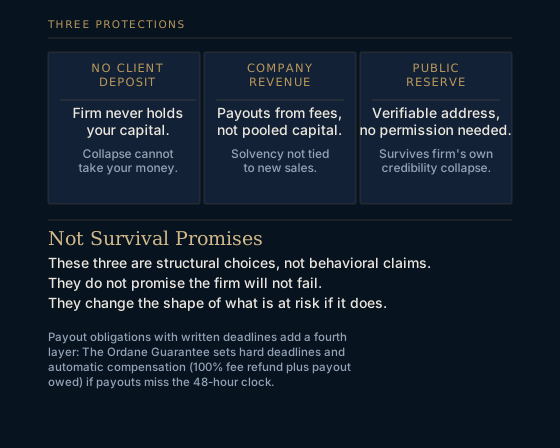
No client deposit taken. If the firm never holds your capital, a collapse cannot take your capital. On the simulated model there is no custodial balance to freeze. This does not protect your fee or your approved payout, and any firm implying otherwise is overselling it.
Payouts paid from company revenue, not from pooled trader money. If payouts come out of the same pot that new fees flow into, the model needs new sales to pay old traders. That works until sales slow. If payouts come from declared company revenue with a reserve behind them, a slow month is a slow month, not a solvency event.
A reserve you can inspect yourself. A promise to pay is a sentence. A reserve at a public address is a number a stranger can check without asking permission. The difference matters because in every shutdown the firm's own reassurance was available right up until the day it was not. A verifiable reserve is the only claim in this category that survives the firm's own credibility collapsing, and it is the reason a reserve commitment is worth more than a decade of marketing copy.
These three are structural, not behavioural. They sit alongside, and do not replace, the pre-purchase checks worth running before you pay any firm, and the wider legit-or-scam question that sits above all of this.
Ordane in a Shutdown, Stated Plainly
Ordane is new. Its homepage says so in one line, and that line is the whole position: we are new, and we will not fake a history. Rulebook v1.0 commits Ordane to a dated payout ledger from payout number one, and to payout performance metrics published with dates on a fixed monthly schedule. As of 2026-07-25 the ledger is empty, because no payout has happened yet. If a track record is your deciding factor, Ordane does not have one yet and should be judged accordingly.
What can be verified today is structural, and it maps directly onto the three protections above.
Ordane accounts operate on simulated capital. No live funds are traded and no deposits are accepted. That answers the first protection completely: there is no client capital inside the entity, so no shutdown scenario reaches your deposited money, because there is no deposited money.
Payouts are paid in real money from company fee revenue. No client deposits are taken and no client capital is traded. Rulebook v1.0 clause PR-1 commits Ordane to publish the payout reserve on-chain; the live rulebook and homepage publish the TRON address. Ordane's payout reserve is published at a public TRON address on ordanemarkets.com and in Rulebook v1.0 clause PR-1. The page carries a dated observed balance and states that the reserve is not a promise, it is an address. Read that limit literally, because it is the honest one: a balance a stranger can check proves what sits at that address on the day they look, and nothing about solvency, total liabilities, or what will be there later.
On the rules side, the FundingTicks sequence is the exact failure Ordane's rulebook is written against. The Ordane rulebook is public, numbered and versioned, and no rule is ever applied retroactively to an open account. Changes produce a new version with a dated changelog entry, and the version you sign up under is the version that governs your account. Ordane's prohibited-practice list is closed. Clause R-6 names six practices: latency, reverse or hedge arbitrage; high-frequency or bulk automated exploitation; copy trading between Ordane accounts; straddling news releases with paired opposing orders; platform or data-feed exploitation; and gap abuse. If a behavior is not listed in that section, it is not a violation. Discretion is not a rule.
On the payout clock, The Ordane Guarantee sets hard deadlines rather than intentions. Every withdrawal request is approved, or denied in writing citing the exact rule breached by section number, within 24 clock hours. Past that deadline the request is treated as approved and the G-1 clock starts. A payout approved and not paid within 48 clock hours, not business hours, triggers automatic compensation: a 100 percent refund of the account fee, plus the payout owed in full. The Ordane Guarantee has two objective exclusions: documented fraud or KYC review, and declared force majeure. Both carry a hard deadline, and beyond it G-1 applies regardless.
Ordane is operated by Ordane Markets Ltd (in formation). None of this is a claim that Ordane cannot fail. It is a description of what a trader would and would not have at risk if it did: no deposited capital, a fee already paid, and a payout obligation with a written clock and a stated reserve address. Compare any firm's shutdown exposure against that shape and the marketing falls away.
Questions Traders Ask About a Prop Firm Shutting Down
What happens to my account if a prop firm shuts down?
Access ends at closure. On the simulated model the account held no capital of yours, so there is no balance to return. Instead of committing live funds immediately, firms place traders on simulated, or demo, accounts that mirror real market conditions (Spotware, retrieved 2026-07-31). What survives closure is the firm's real-money obligations to you, not the dashboard.
Do I lose profit that was already approved?
Approved-unpaid profit becomes an unsecured claim against the company. It is only paid if cash exists and someone is still operating payouts. FundingTicks refunded all active evaluation and master accounts in full when it wound down on 18 January 2026 (Finance Magnates, retrieved 2026-07-31); that was a company decision, not a legal guarantee.
Can I get my fee back?
Sometimes, and only because the firm chooses to. FundingTicks refunded active accounts in full regardless of profit or drawdown (Finance Magnates, retrieved 2026-07-31). In a contested case the picture is different: the My Forex Funds matter ran from an August 2023 CFTC filing to dismissal with prejudice on 13 May 2025, with a separate Canadian receivership opened in December 2023 over the firm's Ontario assets and handed back under an Ontario court order in December 2025 (Finance Magnates, retrieved 2026-08-05).
Is my own money safe?
On a simulated-capital model there is no deposit to lose, because none was taken. Your exposure is limited to money you already handed over as a fee and to profit the firm approved but did not send. Confirm the liability terms in writing before you buy, in the firm's own contract rather than its marketing page, and check the requirements the firm sets for that first withdrawal in the checklist for what a prop firm requires before your first payout.
How can I tell whether a firm will still be around next year?
Watch for a retroactive rule change, which is the loudest signal available. FundingTicks changed rules in December 2025 and applied them to accounts that had already passed (Finance Magnates, retrieved 2026-07-31), then announced a wind-down on 18 January 2026 (Finance Magnates, retrieved 2026-07-31). Then check whether the rulebook is versioned, whether the prohibited list is closed, and whether a reserve is published somewhere you can verify without asking.
Sources
- Finance Magnates, on the order signed May 13, 2025 in which Judge Edward S. Kiel dismissed the CFTC's case against Traders Global Group with prejudice and directed the agency to pay the defendants' fees and costs. financemagnates.com Retrieved 2026-08-05.
- Finance Magnates, on the August 2023 CFTC action stating the My Forex Funds platform had more than 135,000 customers who signed up since November 2021 and paid at least $310 million in fees. financemagnates.com Retrieved 2026-07-31.
- Quinn Emanuel, on the court dismissing the entire case with prejudice and ordering the CFTC to pay the defendants over $3 million in attorneys' fees and costs. quinnemanuel.com Retrieved 2026-08-05.
- Insolvency Insider Canada, on Traders Global Group Inc. being placed into receivership on December 21, 2023, on application by the Ontario Securities Commission. insolvencyinsider.ca Retrieved 2026-08-05.
- Finance Magnates, on the Ontario Superior Court approving a Canadian Asset Handover Order and My Forex Funds regaining control over its assets, data and systems, reported 10 December 2025. financemagnates.com Retrieved 2026-08-05.
- Finance Magnates, on FundingTicks winding down on 18 January 2026 with all active evaluation and master accounts refunded in full, regardless of profit or drawdown. financemagnates.com Retrieved 2026-07-31.
- Finance Magnates, on the December 2025 FundingTicks rule change applied retroactively to traders who had bought challenges under the old rules and passed them. financemagnates.com Retrieved 2026-07-31.
- Spotware, on firms placing traders on simulated, or demo, accounts that mirror real market conditions instead of committing live funds immediately. spotware.com Retrieved 2026-07-31.
- Ordane Markets, homepage reserve section, on the company being new and not faking a history, and on the reserve being an address rather than a promise. ordanemarkets.com Retrieved 2026-08-05.