Home · The Ordane Journal · Risk and Exposure · Prop Firm Margin Call vs Loss Limit
Prop Firm Margin Call vs Loss Limit
A margin call is a platform-level capacity check on a single position; a loss-limit breach is a firm-level contract event that closes the account. They are not the same system, and confusing them means gathering the wrong evidence and blaming the wrong party.
Ordane accounts operate on simulated capital. No live funds are traded and no deposits are accepted. Ordane sells one product, the Ordane Instant Account: direct access, no evaluation phase and no challenge, on simulated capital. That means the margin arithmetic on your screen is simulated arithmetic, and the loss limit sitting above it is a contract term. Both are real in the sense that both will act on your position. Neither is a debt.
This article separates the two controls, shows how they can fire on the same trade, and gives you the fields to capture before you contact anyone. If you have not vetted the firm behind those thresholds yet, start with how to audit a prop firm before you pay, since a static drawdown floor only matters if the firm publishing it is still solvent.
What Is the Difference Between Margin and a Loss Limit?
Margin is the capital a position requires to exist. A loss limit is the point at which your account stops existing.
A liftable definition
Margin is a per-position calculation. It answers a question about capacity: given your current equity, can this instrument at this size be held? If the answer is no, the platform refuses or unwinds the position. The account itself is untouched.
A loss limit is an account-level threshold written into a contract. It answers a question about survival: has cumulative or daily loss crossed the number the firm published? If yes, the firm acts under the rule that governs it. At Ordane that action is closure. At other firms a daily limit can instead flatten open positions and pause the session without ending the account, which is why the rule text matters more than the label (Topstep, retrieved 2026-08-04). Individual positions are incidental. The distinction matters most when the loss limit is static rather than trailing, because a static floor never moves once it is set, while a trailing one can chase your equity upward and shrink the room you have left.
The confusion is linguistic. Both controls produce a screen that says you cannot trade. Only one of them ends the relationship.
Position Capacity Versus Account Survival
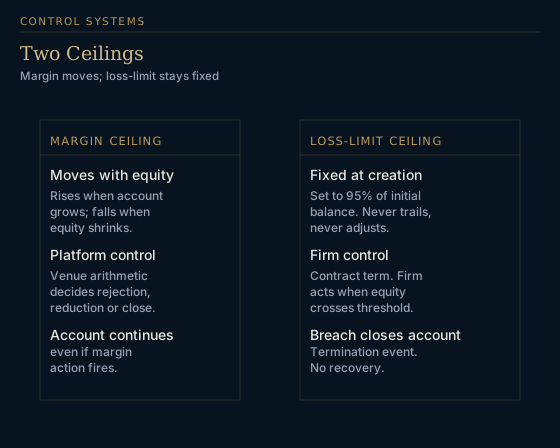
Think of it as two ceilings at different heights.
The margin ceiling moves. It rises and falls with your equity, with the instrument's requirement, with volatility adjustments the venue applies. You can bump into it a hundred times in a career and never lose an account. Hitting it means "not this size, not right now."
The loss-limit ceiling is fixed by contract and does not care about instrument or size. It cares about one number: how far your account has fallen from a defined reference point. Hitting it means the contract's termination condition has been met.
A trader who cannot distinguish these two will misread the platform message, blame the wrong party, and gather the wrong evidence.
What Does a Broker Margin Call Do?
Initial and Maintenance Margin
The conventional mechanism is documented by the venues themselves rather than by any prop firm.
CME Group defines initial margin as the amount required to initiate a futures position (CME Group, retrieved 2026-08-04). This is the entry toll. Without it, the position does not open, and the platform rejects the order before anything else happens.
CME Group defines maintenance margin as the minimum amount that must remain in the account (CME Group, retrieved 2026-08-04). This is the holding requirement, and it is lower than the initial figure. A position can be opened at one level and legally held at a slightly lower one. The gap between the two numbers is where margin calls live.
Note the direction of the arithmetic. Initial margin looks forward at a position you want. Maintenance margin looks at a position you already have and asks whether the account still supports it.
Warning, Position Reduction and Liquidation
CME Group says falling below maintenance margin may trigger a call to restore the account to initial margin (CME Group, retrieved 2026-08-04). In a real-money futures account, that call is a request for funds. You wire money, or the position is reduced.
On a simulated account there is no wire. There is no address to send anything to, because Ordane accepts no deposits. So the platform-level response collapses to the mechanical parts of the sequence: the order is rejected, or the position is trimmed, or the position is closed to bring margin usage back inside the envelope.
That closing is not a breach. It is a platform arithmetic operation. The account continues. Your equity is whatever the close left behind, and your loss limit threshold has not moved because of it.
The failure mode here is a trader who sees a forced position close, assumes the account is gone, stops trading, and only discovers three days later that the account was open the whole time. The reverse failure mode is worse: a trader who sees a forced position close, assumes it was routine, and does not check whether the resulting equity crossed the contract threshold.
What Does a Prop Firm Loss-Limit Breach Do?
Contract Threshold and Account Outcome
A loss limit is not a margin control that has been renamed. It is a clause.
Topstep says that if the balance hits its Maximum Loss Limit at any point during the trading day, including on unrealized profit and loss, the account is liquidated immediately (Topstep, retrieved 2026-08-04). That limit is trailing rather than static: it rises as the end-of-day balance grows and never moves down (Topstep, retrieved 2026-08-04). Read the liquidation sentence for what it says about actor and speed. The actor is the firm, not the exchange. The speed is immediate, not after a warning window. The mechanism is defined by the firm's own documentation rather than by any venue's margin table.
At Ordane, the equivalent thresholds are published and numbered. Ordane's maximum drawdown is 5 percent and static: account equity may never fall below 95 percent of the initial balance (Ordane Rulebook v1.0, clause R-1, retrieved 2026-08-04). The floor is fixed on day one, never trails upward, and a breach closes the account. The daily loss limit is 3 percent, measured against the balance at the start of the server day (Ordane Rulebook v1.0, clause R-2, retrieved 2026-08-04). A breach closes the account.
Notice what those two clauses contain that a margin table never contains: a reference point that is contractual rather than market-derived. Ninety-five percent of the initial balance is a number set when the account was created. It does not adjust for volatility, it does not shrink when a position closes, and it does not care which instrument you were holding.
Maximum risk per trade is 1.5 percent of current balance and a stop-loss is mandatory at entry (Ordane Rulebook v1.0, clause R-3, retrieved 2026-08-04). Two maximum losses equal the daily limit, which is the design rather than an accident. That is the layer between position sizing and account survival, and it is also written as a rule rather than a margin requirement.
A breach closes the account. The Ordane FAQ states the consequence and stops there: no partial confiscations, no surprise fees, no renegotiation (ordanemarkets.com, FAQ, retrieved 2026-08-04).
Simulation Does Not Erase the Rule
The most common objection is that a simulated account cannot really be closed, because nothing real was lost.
The account is a product with terms. The capital is simulated; the contract is not.
At Ordane the same logic runs through the guarantee side of the contract. Payouts are paid in real money from company fee revenue. No client deposits are taken and no client capital is traded. Rulebook v1.0 clause PR-1 commits Ordane to publish the payout reserve on-chain; the live rulebook and homepage publish the TRON address (ordanemarkets.com, FAQ, and Ordane Rulebook v1.0, clause PR-1, retrieved 2026-08-04). Real money moves in one direction, from fee revenue to trader, under conditions. Simulated capital moves in the other direction, inside the platform, as a measurement device.
So the answer to "does a breach on simulated capital matter" is that it terminates a product you paid for. That is the only sense in which it matters, and it is sufficient.
Can Both Controls Trigger on the Same Trade?
Yes, and this is where most diagnostic errors happen.
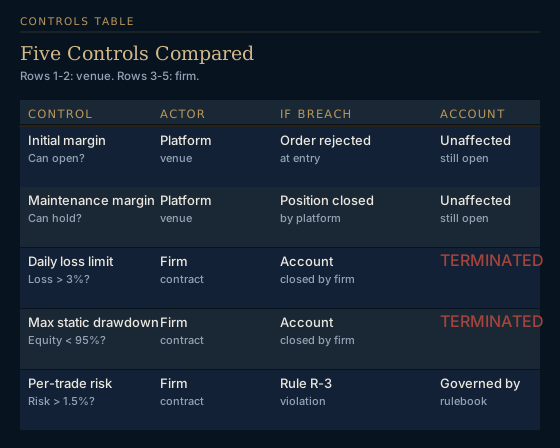
A single position can be too large for margin and simultaneously carry enough open loss to cross an account threshold. The order of events determines what you see in the log.
If margin acts first, the position is closed by the platform, equity settles at some value, and that value may or may not be inside the loss limit. If the account survives, you have a margin event and nothing more. If the settled equity is below the contract floor, you have a margin event followed by a breach, and the breach is what ends the account.
If the loss limit acts first, the account is closed under the rule and the margin question becomes irrelevant. There is no position left to margin.
Table 1: Trigger, Actor and Outcome
| Control | What crosses the line | Who acts | Immediate outcome | Account status |
|---|---|---|---|---|
| Initial margin | Account equity insufficient to open the position | Platform or venue | Order rejected at entry | Unaffected |
| Maintenance margin | Account equity falls under the holding requirement | Platform or venue | Call to restore, position reduced, or position closed (CME Group, retrieved 2026-08-04) | Unaffected |
| Daily loss limit | Loss from the balance at the start of the server day crosses 3 percent | Firm, by contract | Account closed | Terminated |
| Maximum static drawdown | Equity falls below 95 percent of initial balance | Firm, by contract | Account closed | Terminated |
| Per-trade risk cap | Risk on a single trade exceeds 1.5 percent of current balance, or a stop-loss is missing at entry | Firm, by contract | Rule violation under R-3 | Governed by the rulebook |
The first two rows are venue arithmetic sourced from exchange documentation (CME Group, retrieved 2026-08-04). The bottom three rows are Ordane clauses, published, numbered and versioned.
Order Rejection Versus Rule Breach
Learn to read three platform states as three different things.
Rejected at entry means the trade never existed. There is no fill, no exposure, no loss. Nothing has happened to your account except that you were told no. This is almost always an initial margin refusal, and it is the least consequential of the three.
Closed by the platform means the trade existed and was unwound by arithmetic rather than by you. Check the resulting equity against your thresholds immediately. This is the state that hides breaches.
Closed by the firm means the contract's termination condition was met. Under a published rulebook this arrives with a rule reference, and you should expect one.
Ordane's prohibited-practice list is closed. Clause R-6 names six practices: latency, reverse or hedge arbitrage; high-frequency or bulk automated exploitation; copy trading between Ordane accounts; straddling news releases with paired opposing orders; platform or data-feed exploitation; and gap abuse (Ordane Rulebook v1.0, clause R-6, retrieved 2026-08-04). If a behavior is not listed in that section, it is not a violation. Discretion is not a rule. The news-related clause has its own edge cases, covered in prop firm news trading rules, and the overnight and weekend question, which is not on this list either, has its own answer in holding trades overnight or over the weekend.
That closed list is the reason the third state should be legible. A firm operating from a closed list can only close an account for something named in it, or for crossing a published numeric threshold. A firm operating from open discretion can close an account for anything and describe it afterwards.
What Evidence Should You Capture?
Support cannot review a feeling. It can review timestamps.
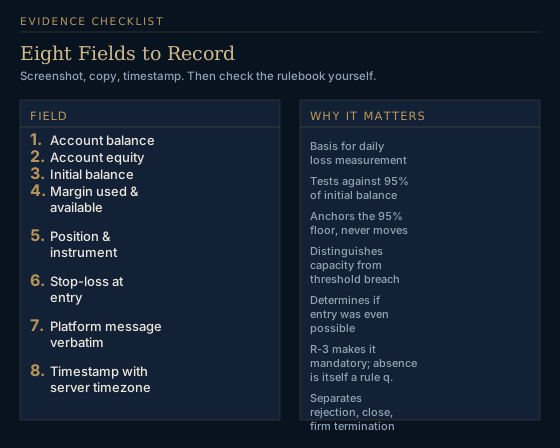
Before you write to anyone, capture the numbers as they stood. A screenshot taken twenty minutes later, after the platform has recalculated, is not evidence of the moment you are describing.
Table 2: Balance, Equity, Margin and Threshold
| Field | What to record | Why it matters |
|---|---|---|
| Account balance | Closed-trade balance at the moment of the event | Establishes the reference for daily loss measurement against the start-of-server-day balance |
| Account equity | Balance plus open profit and loss | This is the figure the static drawdown floor tests against 95 percent of initial balance |
| Initial balance | The size the account was created at | The 95 percent floor is anchored here and never trails upward |
| Margin used and margin available | Both figures, as displayed | Distinguishes a capacity refusal from a threshold breach (CME Group, retrieved 2026-08-04) |
| Position size and instrument | Contract or lot size, symbol | Determines whether initial margin could ever have supported the entry (CME Group, retrieved 2026-08-04) |
| Stop-loss at entry | Present or absent, and the level | R-3 makes a stop-loss mandatory at entry, so its absence is itself a rule question |
| Platform message, verbatim | The exact wording and any error code | Separates rejection, platform close and firm close |
| Timestamp with timezone | Server time, not local time | The daily limit measures against the server day, so local midnight is irrelevant |
| Rulebook version | The version governing your account | Ordane rules are versioned and never applied retroactively |
Every field above is either a number your platform already displays or a string you can copy. None of it requires interpretation, which is exactly why it is useful.
Timestamp Every Field Before Contacting Support
The sequence that produces a reviewable record is short.
Capture the platform message verbatim, with its code, before dismissing the dialog. Screenshot the account panel showing balance, equity and margin together in one frame. Note server time, not your local time. Then, and only then, open the rulebook and identify which clause the firm would cite.
If your own reading of the clauses says no threshold was crossed, you have a specific claim to make. If your reading says a threshold was crossed, you have an answer and you do not need support at all.
The Ordane rulebook is public, numbered and versioned, and no rule is ever applied retroactively to an open account. Changes produce a new version with a dated changelog entry, and the version you sign up under is the version that governs your account. The governing document is Ordane Rulebook v1.0, published 23 July 2026 (Ordane Rulebook v1.0, section 6 Changelog, retrieved 2026-08-04).
That versioning is the thing that makes evidence-gathering worthwhile. Against an unversioned document, a careful record proves nothing, because the document can change between your event and the review. If you want a broader checklist for what a firm should publish before you ever fund an account, see what makes a prop firm legit.
How Does Ordane Frame the Risk?
Simulated Capital and Closed Rule List
Ordane's framing is deliberately narrow, because the compliance line here is narrow.
The account is simulated. The rules are contractual. The payout is real money from fee revenue. Nothing about the arrangement involves client capital at risk, which is why nothing about a breach involves a balance owed.
Ordane accounts operate on simulated capital. No live funds are traded and no deposits are accepted. Payouts depend on simulated performance under Rulebook v1.0; no level of performance is typical or assured.
The six rules that govern the account are R-1 through R-6, and they cover drawdown, daily loss, per-trade risk, consistency, inactivity and the closed prohibited list. Accounts with no trading activity for 30 consecutive days are closed (Ordane Rulebook v1.0, clause R-5, retrieved 2026-08-04). Ordane's consistency rule is 20 percent: at the moment of a withdrawal request, no single trading day may account for more than 20 percent of the cycle's total profit (Ordane Rulebook v1.0, clause R-4, retrieved 2026-08-04). If a day exceeds 20 percent, the excess profit from that day is deferred to the next cycle. It is never confiscated, and the remainder of the cycle pays out normally. The full mechanics of that clause, including how the 20 percent is calculated cycle to cycle, are in what is the consistency rule.
None of those six is a margin rule. That is the point of this article. The margin arithmetic belongs to the platform layer and is a capacity question; the six rules belong to the contract layer and are a survival question.
Never Imply a Client Deposit or Debt
There is a phrasing habit in this industry worth naming, because it produces exactly the confusion this article is trying to remove.
Firms describe drawdown breaches using the vocabulary of borrowed money. Accounts get "blown," losses get "covered," traders speak of being "in the hole." That vocabulary is imported from real-money brokerage, where a margin deficit is genuinely a debt to be settled.
On a simulated account there is no deficit to settle. Topstep says that hitting its trailing Maximum Loss Limit, including on unrealized profit and loss, liquidates the account immediately (Topstep, retrieved 2026-08-04). Liquidation of a simulated position is an accounting entry inside a platform, not a transfer of value out of anybody's pocket.
What you lose in a breach is access to a product. What you paid was a one-time fee for that access. The fee is one-time: $139 for the $10,000 account, $299 for $25,000, $549 for $50,000 and $999 for $100,000 (Ordane Rulebook v1.0, section 1, retrieved 2026-08-04). There are no recurring fees, no hidden tiers and no coupon games. Ordane Instant Account comes in four sizes: $10,000, $25,000, $50,000 and $100,000. Full cost breakdowns, including what other firms charge beyond the ticket price, are in do prop firms charge hidden fees.
That is the whole exposure. It is bounded, it is published in advance, and it does not grow after a breach.
The payout side carries its own hard numbers rather than assurances. Every withdrawal request is approved, or denied in writing citing the exact rule breached by section number, within 24 clock hours (Ordane Rulebook v1.0, clause G-0, retrieved 2026-08-04). Past that deadline the request is treated as approved and the G-1 clock starts. A payout approved and not paid within 48 clock hours, not business hours, triggers automatic compensation: a 100 percent refund of the account fee, plus the payout owed in full (Ordane Rulebook v1.0, clause G-1, retrieved 2026-08-04). The Ordane Guarantee has two objective exclusions: documented fraud or KYC review, and declared force majeure (Ordane Rulebook v1.0, clause G-2, retrieved 2026-08-04). Both carry a hard deadline, and beyond it G-1 applies regardless. For the eligibility conditions that come before any of this, see prop firm withdrawal requirements.
The Ordane Guarantee is the name of that mechanism, and it is written as clauses G-0, G-1 and G-2 rather than as a promise about speed.
Ordane is new. Its live homepage says it cannot show years of payout history; the rulebook says payout performance metrics begin with the first month in which a payout is requested (ordanemarkets.com, reserve section, and Ordane Rulebook v1.0, clause PR-2, retrieved 2026-08-04). Rulebook v1.0 commits Ordane to a dated payout ledger from payout number one, and to payout performance metrics published with dates on a fixed monthly schedule. As of 25 July 2026 the ledger is empty, because no payout has happened yet.
What exists today is the reserve and the contract. Ordane's payout reserve is published at a public TRON address on ordanemarkets.com and in Rulebook v1.0 clause PR-1. The page carries a dated observed balance, read on 2026-08-04, and says in its own words that the reserve is not a promise, it is an address (ordanemarkets.com, reserve section, retrieved 2026-08-04). A balance on a given date is evidence of what sits at that address on that date. It is not evidence of future solvency, total liabilities or future payouts.
Frequently Asked Questions
Can a simulated account have margin?
Yes. A simulated account runs on a platform, and platforms compute margin whether the capital behind them is real or not. The arithmetic is identical: initial margin to open, maintenance margin to hold. CME Group defines initial margin as the amount required to initiate a futures position (CME Group, retrieved 2026-08-04). What differs is the response to a shortfall. In a real-money account, the response can be a call for funds. CME Group says falling below maintenance margin may trigger a call to restore the account to initial margin (CME Group, retrieved 2026-08-04). In a simulated account there is nothing to call for, so the platform resolves it mechanically by rejecting, reducing or closing.
Is a rejected order a breach?
No. A rejection means the position was never opened, so no loss was incurred, so no threshold could have been crossed. Rejection is a capacity answer from the platform. A breach is a contract event triggered by a number in a rulebook. If your order was rejected and your account remains open, nothing has happened that any rule addresses. Check that the account is genuinely open rather than assuming it, because the two states look similar for the first few seconds after a dialog appears.
Can liquidation slip past the threshold?
This is the sharpest version of the question, and the honest answer is that it depends on where the threshold sits relative to the margin requirement. If the account's contract floor is above the level at which margin arithmetic starts closing positions, the contract fires first and the platform never gets there. If the floor is below that level, the platform can close a position and leave equity that has already crossed the floor. Both sequences are possible in principle. At Ordane the interaction is constrained upstream by R-3. Maximum risk per trade is 1.5 percent of current balance and a stop-loss is mandatory at entry (Ordane Rulebook v1.0, clause R-3, retrieved 2026-08-04). Two maximum losses equal the daily limit, which is the design rather than an accident. A mandatory stop-loss at entry means the intended exit is defined before the trade exists, which is a different design philosophy from letting margin arithmetic decide the exit. Topstep says that hitting its trailing Maximum Loss Limit, including on unrealized profit and loss, liquidates the account immediately (Topstep, retrieved 2026-08-04). Immediate, in that description, is the firm acting rather than the platform. That is the distinction to hold onto.
Do you owe the firm after a breach?
No. There is no deposit and no borrowed capital, so there is nothing to repay. Ordane accounts operate on simulated capital. No live funds are traded and no deposits are accepted. The economics run one direction only: you paid a one-time fee for access, and a breach ends that access. A breach closes the account. The Ordane FAQ states the consequence and stops there: no partial confiscations, no surprise fees, no renegotiation (ordanemarkets.com, FAQ, retrieved 2026-08-04). Nothing accrues, nothing is invoiced, and no balance follows you.
Sources
- CME Group, on initial margin as the amount required to initiate a futures position, maintenance margin as the minimum that must remain in the account, and the call to restore the account to initial margin when it falls below maintenance. cmegroup.com Retrieved 2026-08-04.
- Topstep, on the Maximum Loss Limit liquidating the account immediately when the balance hits it at any point in the trading day, including on unrealized profit and loss, and on that limit trailing upward with the end-of-day balance and never moving down. help.topstep.com Retrieved 2026-08-04.
- Topstep, on the Daily Loss Limit flattening open positions and pausing the session without being a rule violation, leaving the account eligible. help.topstep.com Retrieved 2026-08-04.
- Ordane Markets, homepage FAQ, on the account closing after a breach with no partial confiscations, no surprise fees and no renegotiation. ordanemarkets.com Retrieved 2026-08-04.
- Ordane Markets, payout reserve section, on the dated observed balance and the statement that the reserve is not a promise, it is an address. ordanemarkets.com Retrieved 2026-08-04.
- Ordane Rulebook v1.0, clauses R-1 to R-6, on the static 5 percent maximum drawdown, the 3 percent daily loss limit, the 1.5 percent per-trade risk cap with a mandatory stop-loss at entry, the 20 percent consistency rule, the 30-day inactivity closure and the closed list of six prohibited practices. ordanemarkets.com/rulebook Retrieved 2026-08-04.
- Ordane Rulebook v1.0, clauses G-0, G-1 and G-2, on the 24 clock hour approval or written denial, the 48 clock hour payment deadline with automatic compensation, and the two objective exclusions. ordanemarkets.com/rulebook Retrieved 2026-08-04.
- Ordane Rulebook v1.0, clauses PR-1 and PR-2, on the payout reserve published at a public TRON address and on payout performance metrics beginning with the first month in which a payout is requested. ordanemarkets.com/rulebook Retrieved 2026-08-04.
- Ordane Rulebook v1.0, section 1, on the Ordane Instant Account sizes and the one-time fee ladder of $139, $299, $549 and $999. ordanemarkets.com/rulebook Retrieved 2026-08-04.
- Ordane Rulebook v1.0, notice above section 0 and section 6 Changelog, on the rulebook being public, numbered and versioned, never applied retroactively to an open account, and published 23 July 2026. ordanemarkets.com/rulebook Retrieved 2026-08-04.