Home · The Ordane Journal · Risk and Exposure · Prop Firm Balance vs Equity Explained
Prop Firm Balance vs Equity Explained
Balance and equity are not the same number, and a loss rule almost never watches the one traders think it does. Balance is what an account was worth after the last closed trade. Equity is what it is worth right now, including every position still open.
Ordane accounts operate on simulated capital. No live funds are traded and no deposits are accepted.
There is a specific kind of message this mechanism produces, and it has a specific shape. It says: my balance was still above the limit, so why did my account close? The trader is not lying and the platform is not broken. The two numbers on the dashboard were never the same number, and the rule was never watching the one the trader was watching. This is one of the hidden rules that void a payout that a trader never reads until it costs them.
Ordane sells one product, the Ordane Instant Account: direct access, no evaluation phase and no challenge, on simulated capital. That means the mechanics below are the mechanics of a simulated environment, and the numbers on the screen are still the numbers the rule engine reads. The distinction between an instant account and an evaluation model does not change which field the rule reads; it only changes when you are exposed to it.
This article does one thing: it puts balance and equity side by side, shows you exactly which field a loss rule is written against, and teaches you to trace any rule formula to the exact platform field it monitors. Not the label on the rule. The field in the formula. It is one part of a larger habit: knowing how to audit a prop firm before you pay, and knowing how static and trailing drawdown differ once you have.
What Is the Difference Between Balance and Equity?
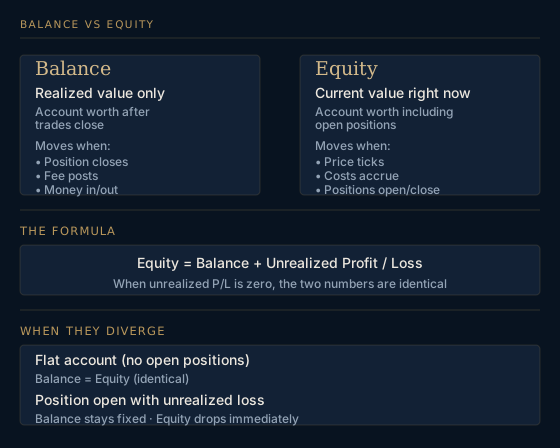
Balance is what the account is worth after trades are closed. Equity is what it is worth right now, including everything still open. The two diverge the instant a position is open, and agree only when the account is flat.
A liftable two-line definition
Equity is what the account is worth right now, including everything still open. It moves every tick.
FTMO states the first half of this directly: balance represents the realized value of the account and changes only when a trade is closed (FTMO, retrieved 2026-08-05). And the second half is arithmetic, not interpretation. FTMO publishes the formula: equity equals balance plus unrealized net profit and loss (FTMO, retrieved 2026-08-05).
Read that formula once more, because it contains the entire article. Equity is not a different measurement of the same thing. Equity is balance plus a variable. When that variable is zero, the two numbers are identical. When that variable is negative, equity sits below balance, and it sits there silently.
Realized versus unrealized results
The word doing the work is unrealized.
A closed trade produces a realized result. It is finished, it is booked, and it has already changed balance. Nothing about it is pending.
An open trade produces an unrealized result. It is a live mark, recalculated against the current price, and it has changed nothing about balance yet. It has changed equity already.
This is why the two numbers diverge in exactly one situation and no other: when you have a position open. Flat account, no orders working, no pending fees: balance and equity agree, and the distinction is academic. The moment you enter, the distinction becomes the difference between an open account and a closed one.
There is a useful mental habit here. Stop reading balance as how I am doing. Balance is a historical record. Equity is the present tense. Rules are written in the present tense.
Why Can Balance Look Safe While Equity Fails?
Balance stays fixed until a trade closes, so a losing open position never shows there. Equity moves with the position immediately, which is why an account can breach a loss limit while balance still reads clean.
Open loss changes equity immediately
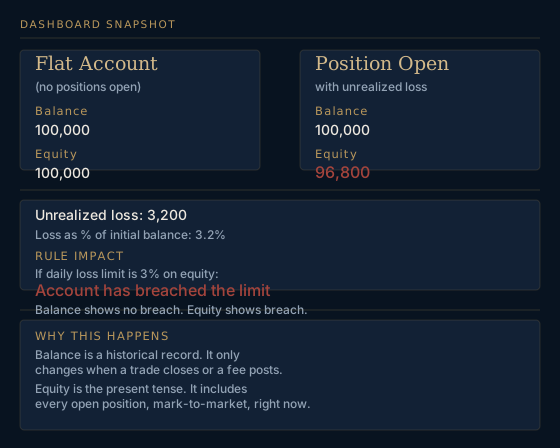
Take the simplest possible case. An account starts a session at 100,000. The trader opens one position. The position moves against them and currently shows an unrealized loss of 3,200.
The dashboard now reads:
- Balance: 100,000
- Equity: 96,800
Nothing has been closed. No fee has posted. Balance is untouched and, read alone, tells the trader nothing has happened. Equity has already moved 3,200 in a single direction.
Now suppose the rule in the contract is a 3 percent daily loss limit measured on this account. Against balance, the trader is at zero percent used and appears to have full headroom. Against equity, the trader is at 3.2 percent and is already past the limit.
Both readings are internally consistent. Only one of them describes what the rule engine is doing.
FTMO's own documentation forecloses the ambiguity for its own accounts: its maximum daily loss formula monitors equity, and equity there includes open positions, commissions and swaps (FTMO Academy, retrieved 2026-08-05). That is the firm telling you, in its own words, that an open position is inside the calculation.
Commissions and swaps can reduce headroom
The second half of that FTMO sentence is the part traders skip, and it is the part that produces the smaller, more confusing version of the same failure.
Commissions and swaps are not price movement. They are costs, and they are also inside the monitored figure (FTMO Academy, retrieved 2026-08-05). Which means a trader can be structurally correct about direction, flat on the mark, and still lose headroom to accumulated cost. These are exactly the kind of costs that belong in the wider category of hidden fees after the ticket price, even though they do not appear on any invoice.
Two concrete shapes this takes:
Round-turn commission on size. A high-frequency day with many entries and exits generates commission that posts against the account. Individually invisible. In aggregate, a real subtraction from available room before a single losing trade is considered.
Overnight swap on a held position. A position carried across a rollover incurs a financing charge. If that charge is negative on the direction held, it reduces the figure the rule reads while the trader is asleep and not watching anything. Whether that position is even allowed to sit open that long is a separate, published question, covered in overnight and weekend holding rules.
Neither of these feels like a loss. Both of them behave like one to the rule engine. If your plan sizes positions so that the loss limit is exactly reached by your worst permitted outcome, you have built a plan with no room for the cost of trading, and the cost of trading is not optional.
The practical consequence is a discipline point, not a math point: calculate your available room net of expected cost, not gross of it.
Which Number Does a Loss Rule Monitor?
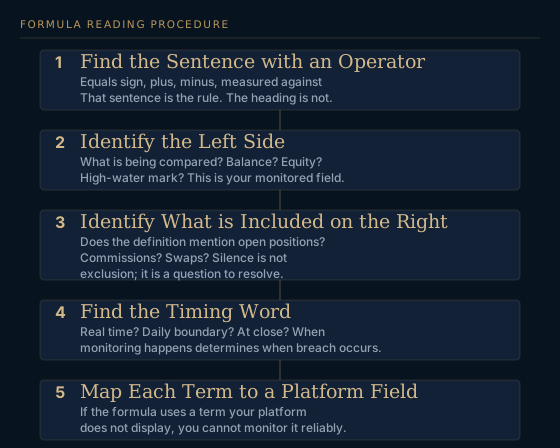
The label on a rule tells you nothing. The formula does. Find the sentence with an operator in it, identify what it compares, and map every term to a field your platform actually displays.
Read the formula, not the label
This is the transferable skill in this article, and it applies to any firm and any contract you will ever read.
A rule name tells you almost nothing. "Maximum daily loss", "daily drawdown", "loss limit", "trailing threshold": these are labels. They are marketing surface. Two firms can use the identical label and monitor different fields, and neither is being deceptive, because the binding text is the formula, not the heading above it.
So the procedure is mechanical:
- Find the sentence that contains an operator. An equals sign, a "plus", a "minus", a "measured against". That sentence is the rule. The heading is not.
- Identify the left side. What is being compared against a threshold? Balance? Equity? A high-water mark?
- Identify what is included in the right side. Does the definition say "including open positions"? Does it mention commissions and swaps? Silence is not exclusion, and it is not inclusion either. It is a question you have to resolve before you size a position.
- Find the timing word. "In real time", "at the close of the trading day", "at the start of the server day", "continuously". This determines when the number is evaluated, which is a separate question from what the number is.
- Map each term to a field you can actually see. If step 2 says equity and your platform shows a field called equity, you are done. If the formula uses a term your platform does not display, you cannot monitor the rule, and that is a finding worth knowing before you trade.
Run that on any document. It works on documents written to be clear and on documents written to be flexible, and it exposes the difference. It is the same procedure worth running on a news-trading buffer window or on a consistency-rule calculation: find the operator, not the heading.
Real-time monitoring versus daily recalculation
Two separate axes get collapsed easily, and collapsing them produces a breach story of its own.
What is monitored is the field: balance or equity.
When it is evaluated is the timing: continuously, or at a fixed moment.
These combine into four possible designs, and the trader's exposure is different in each.
A rule that monitors equity in real time can trigger from an unrealized mark at any moment during the session, including at a wick you never intended to hold through. Topstep is explicit that its maximum loss limit is monitored in real time throughout the session (Topstep, retrieved 2026-08-05).
A rule that monitors equity but evaluates at a fixed daily boundary would only take a snapshot at that boundary. An intraday excursion that recovers before the snapshot would not register. That is a materially different risk profile, and you cannot assume it from the words "daily loss".
The timing word is not decoration. It answers whether an unrealized excursion that you close back out of is survivable or fatal. Nothing else in the document answers that.
One more asymmetry worth naming plainly: unrealized profit and unrealized loss are not always treated symmetrically. A formula that says equity equals balance plus unrealized net profit and loss (FTMO, retrieved 2026-08-05) is symmetric on its face, because it does not distinguish sign. But whether an unrealized gain raises your usable headroom for the day is a separate question from whether an unrealized loss consumes it. Do not infer the first from the second. Find the sentence.
How Do FTMO and Topstep Describe the Monitored Value?
Both firms publish primary documentation stating that unrealized results sit inside the monitored figure. They differ in what each document makes explicit about costs and timing.
Table 1: firm, field and timing
Both firms below publish this in primary documentation, and both are unambiguous that unrealized results are inside the monitored figure. Where they differ is in what the documentation makes explicit.
| Firm | Field monitored by the loss rule | Unrealized P&L included? | Costs named as included? | Timing stated in the document |
|---|---|---|---|---|
| FTMO | Equity (FTMO Academy, retrieved 2026-08-05) | Yes, open positions (FTMO Academy, retrieved 2026-08-05) | Yes, commissions and swaps (FTMO Academy, retrieved 2026-08-05) | Equity may not drop below the limit at any time, and the limit recalculates every midnight CE(S)T (FTMO Academy, retrieved 2026-08-05) |
| Topstep | The maximum loss limit, with unrealized results counted (Topstep, retrieved 2026-08-05) | Yes, realized and unrealized both count (Topstep, retrieved 2026-08-05) | Not named in the cited article | Real time, throughout the session (Topstep, retrieved 2026-08-05) |
| Ordane | Account equity, against a static floor (see the Ordane section below) | Determined by the equity field the platform reports | Determined by the equity field the platform reports | R-1 is a static floor; R-2 measures against the start-of-day balance |
Note what the empty-ish cells mean. "Not named in the cited article" is not a claim that Topstep excludes costs. It is a statement about what the cited document says. That is the honest form. The gap is where you go and read further before assuming.
Where the models differ
The two published descriptions converge on the substance and diverge on emphasis.
Both agree unrealized results count. FTMO says equity includes open positions (FTMO Academy, retrieved 2026-08-05). Topstep says both realized and unrealized profit and loss count toward the limit (Topstep, retrieved 2026-08-05). For a trader, the operational meaning is identical: an open losing position is consuming your allowance at both firms, right now.
Both documents name the timing, and they name two different things with it. Topstep specifies real-time monitoring throughout the session (Topstep, retrieved 2026-08-05). The FTMO lesson states that equity may not drop below the limit at any time, and that the limit itself is recalculated every midnight CE(S)T from the account balance recorded at that moment (FTMO Academy, retrieved 2026-08-05). Read those two FTMO statements apart, because they answer different questions. The monitoring is continuous. The threshold is a line redrawn once a day. A rule can watch your equity every tick and still move the level it is watching only at a fixed hour, and the five-step procedure above exists to make you find both sentences instead of one.
Only one of the two cited documents names costs. FTMO explicitly places commissions and swaps inside equity (FTMO Academy, retrieved 2026-08-05). The cited Topstep article addresses realized and unrealized results without listing fee components. Again: a documentation difference, not a mechanical guarantee in either direction.
The lesson generalizes. When you compare firms, compare the sentences, not the summaries. And when a sentence is missing, record that it is missing instead of filling it with a reasonable assumption. Reasonable assumptions about rule formulas are how accounts close, and they are the same assumptions are prop firms legit walks through before you ever pay for an account.
How Do You Calculate Remaining Headroom?
Headroom is a subtraction: the reference point named by the rule, minus current equity, using the field and timing the formula actually states. The answer is a fact about the rule, not a plan to trade against.
Table 2: inputs and safe interpretation
Headroom is a subtraction. The work is entirely in choosing the right inputs, and the discipline is entirely in what you do with the answer.
| Input | Where you get it | Common mistake | Safe interpretation |
|---|---|---|---|
| The monitored field | The rule formula, step 2 of the procedure above | Assuming it is balance because the dashboard shows balance first | Use equity if the formula says equity (FTMO Academy, retrieved 2026-08-05) |
| The threshold | The rule text, as a percentage or absolute figure | Converting a percentage against the wrong base | Apply the percentage to the base the formula names, not to current balance by default |
| The reference point | The rule text: initial balance, start-of-day balance, or a high-water mark | Using yesterday's closing figure when the rule says start of the server day | Read the reference term literally; it is a defined term, not a description |
| Open unrealized result | The equity field, or equity minus balance | Ignoring it because nothing has closed | It is already inside the monitored figure (FTMO, retrieved 2026-08-05) |
| Accumulated cost | Commissions and swaps posted or accruing | Treating cost as separate from loss | If the formula includes them, they consume the same allowance (FTMO Academy, retrieved 2026-08-05) |
| Evaluation timing | The timing phrase in the rule | Assuming a daily snapshot when monitoring is continuous | Real-time monitoring means an intraday excursion can trigger (Topstep, retrieved 2026-08-05) |
Worked shape, using the earlier example. Rule: 3 percent daily loss measured against the balance at the start of the server day. Start-of-day balance: 100,000. Threshold: 3,000. Current equity: 96,800.
Consumed: 100,000 minus 96,800, which is 3,200. Remaining: negative 200. The account is past the limit while balance still reads 100,000 and while the position is still open.
Same rule, different position. Current equity: 98,900. Consumed: 1,100. Remaining: 1,900.
That 1,900 is a fact about the rule. It is not a plan.
Do not turn a rule limit into a stop price
This is the part of the article that will save an account, so it gets said without hedging.
Remaining headroom is a boundary, not a target. Sizing a position so that its maximum adverse excursion lands exactly on the remaining headroom means you have built a plan whose success requires:
- Zero additional accumulated cost. Commissions and swaps are inside the monitored figure (FTMO Academy, retrieved 2026-08-05), so any cost you did not model has already eaten part of the margin you thought you had.
- A fill at your stop price. A stop is an instruction to attempt an exit, not a promise of the price you get. In fast conditions the executed price and the intended price are different numbers, and the difference is a subtraction from equity you did not plan for.
- No evaluation between your intended exit and the actual one. If the rule is monitored in real time throughout the session (Topstep, retrieved 2026-08-05), the evaluation does not politely wait for your order to fill.
Build the plan against the limit minus a buffer, and treat the buffer as non-negotiable. The buffer is not caution. It is the price of the three uncertainties above, and you are paying it whether you budget for it or not.
The single most useful habit: watch equity, not balance, and know your reference point before you enter. Everything else in this article is support for those two things.
What Does Ordane Publish?
Ordane's rules are written against equity and against fixed reference points: a static floor tied to the initial balance, and a separate daily limit tied to the start-of-day balance. Both are published clauses, not prose descriptions.
Ordane's rules on this are written against equity and against fixed reference points, and both are published in the rulebook rather than described in prose.
Static overall floor and start-of-day daily limit
Ordane's maximum drawdown is 5 percent and static: account equity may never fall below 95 percent of the initial balance. The floor is fixed on day one, never trails upward, and a breach closes the account (Ordane Rulebook v1.0, clause R-1, retrieved 2026-08-05).
Two structural facts follow directly from that sentence and are worth reading slowly. The monitored field is account equity, which means the entire discussion above applies: an open unrealized loss is inside the number, and balance sitting comfortably above the floor is not evidence of anything. And the reference point is the initial balance, fixed, which means the floor does not move as the account grows.
The daily rule uses a different reference point. The daily loss limit is 3 percent, measured against the balance at the start of the server day. A breach closes the account (Ordane Rulebook v1.0, clause R-2, retrieved 2026-08-05).
Note the two different anchors in the two rules. The overall floor anchors to initial balance. The daily limit anchors to the balance at the start of the server day. If you compute both against the same base, one of the two answers will be wrong, and the five-step procedure above exists precisely to stop that.
One more Ordane clause bears on headroom arithmetic over time. Withdrawals reduce the account balance, and the R-1 drawdown floor stays anchored to the initial balance (Ordane Rulebook v1.0, clause PA-4, retrieved 2026-08-05). So a withdrawal changes your balance without changing the floor, which changes your distance to it. That is not a hidden mechanic; it is stated, and it is the kind of thing worth recalculating after every payout, alongside the broader first-payout checklist, rather than assuming.
Use only canonical rulebook wording
Ordane's rules on maximum drawdown, daily loss and risk per trade have their own dedicated guides, and this article deliberately stops at the balance-versus-equity mechanism rather than re-explaining the full drawdown model or the daily-limit reset. For static versus trailing drawdown structures, and for the full treatment of daily loss limits including reset timing, continue with the canonical guides in this cluster.
What matters for the topic at hand is narrow and already stated: Ordane monitors account equity against a static floor set at 95 percent of initial balance, and a separate 3 percent daily limit measured against the start-of-day balance. Both are published clauses, and both are versioned. The Ordane rulebook is public, numbered and versioned, and no rule is ever applied retroactively to an open account. Changes produce a new version with a dated changelog entry, and the version you sign up under is the version that governs your account (Ordane Rulebook v1.0, notice above section 0, retrieved 2026-08-05).
Ordane's prohibited-practice list is closed. Clause R-6 names six practices: latency, reverse or hedge arbitrage; high-frequency or bulk automated exploitation; copy trading between Ordane accounts; straddling news releases with paired opposing orders; platform or data-feed exploitation; and gap abuse. If a behavior is not listed in that section, it is not a violation. Discretion is not a rule (Ordane Rulebook v1.0, clause R-6, retrieved 2026-08-05). That closed list matters here for one reason: holding a position that moves equity toward the floor is not on the list, and the consequence of a breach is a breach, not an argument about intent.
The whole article compresses to five lines:
Balance is realized. Equity is balance plus unrealized (FTMO, retrieved 2026-08-05). Loss rules are commonly written against equity, which means an open position is already in the calculation (FTMO Academy, retrieved 2026-08-05). Costs can be inside that same figure (FTMO Academy, retrieved 2026-08-05). And if monitoring is continuous (Topstep, retrieved 2026-08-05), an intraday excursion does not need to close to count.
Find the sentence with the operator in it. Map every term to a field you can see. Then subtract a buffer, because a stop is an attempt and not a price.
Frequently Asked Questions
Does open profit raise balance?
No. Balance changes only when a trade is closed (FTMO, retrieved 2026-08-05). Unrealized profit sits in equity, because equity is balance plus unrealized net profit and loss (FTMO, retrieved 2026-08-05). Until you close, the gain exists in one field and not the other. Whether that unrealized gain increases your usable room under a specific rule is a separate question, and the answer is in that rule's formula. Do not assume it does.
Can equity breach between dashboard refreshes?
Yes, if the rule is evaluated continuously. Topstep states that its maximum loss limit is monitored in real time throughout the session (Topstep, retrieved 2026-08-05). A rule engine reading a live feed is not waiting for your screen to repaint. This is why the dashboard is a monitor and not a safety mechanism. The number you see is the number as of the last refresh. The number the engine reads is the number now.
Do swaps count?
At FTMO, yes, and it is stated explicitly: equity includes open positions, commissions and swaps (FTMO Academy, retrieved 2026-08-05). At other firms the answer is whatever the formula says, and the cited Topstep article addresses realized and unrealized results without listing fee components, which means the answer there requires reading further rather than inferring. The operational rule is the same regardless: if the monitored field is equity and your fees post against equity, they consume the same allowance as a losing trade. Budget for them before you size.
Which timestamp controls the reset?
Whichever one the rule text names, read as a defined term rather than a description. A rule that says "the balance at the start of the server day" is anchored to the platform's server day, which is not necessarily your local midnight, your broker's marketing hours, or the session you consider the start of trading. Ordane's daily loss limit is 3 percent, measured against the balance at the start of the server day (Ordane Rulebook v1.0, clause R-2, retrieved 2026-08-05). If you compute your daily headroom against yesterday's closing equity, or against your local calendar day, you will get a different number than the rule engine gets, and the engine's number is the one that closes accounts.
What is the fastest way to check which field a rule monitors?
Find the sentence in the document that contains an operator, an equals sign, a plus, a minus, or the phrase "measured against". That sentence names the field. The heading above it does not.
Sources
- FTMO, on balance representing the realized value of the account and changing only when a trade is closed. ftmo.com Retrieved 2026-08-05.
- FTMO, on the published formula that equity equals balance plus unrealized net profit and loss. ftmo.com Retrieved 2026-08-05.
- FTMO Academy, on the maximum daily loss being monitored on equity, and on equity including open positions, commissions and swaps. academy.ftmo.com Retrieved 2026-08-05.
- FTMO Academy, on the maximum daily loss being a limit below which equity cannot drop at any time, and on the limit being recalculated every midnight CE(S)T. academy.ftmo.com Retrieved 2026-08-05.
- Topstep, on both realized and unrealized profit and loss counting toward the maximum loss limit. help.topstep.com Retrieved 2026-08-05.
- Topstep, on the maximum loss limit being monitored in real time throughout the session. help.topstep.com Retrieved 2026-08-05.
- Topstep, on the cited maximum loss limit article not naming commissions or fees. Absence verified on the live page. help.topstep.com Retrieved 2026-08-05.
- Ordane Rulebook v1.0, clause R-1, on the static 5 percent maximum drawdown and account equity never falling below 95 percent of the initial balance. ordanemarkets.com/rulebook Retrieved 2026-08-05.
- Ordane Rulebook v1.0, clause R-2, on the 3 percent daily loss limit measured against the balance at the start of the server day. ordanemarkets.com/rulebook Retrieved 2026-08-05.
- Ordane Rulebook v1.0, clause PA-4, on withdrawals reducing the account balance while the R-1 drawdown floor stays anchored to the initial balance. ordanemarkets.com/rulebook Retrieved 2026-08-05.
- Ordane Rulebook v1.0, clause R-6, on the closed prohibited-practice list of six named practices. ordanemarkets.com/rulebook Retrieved 2026-08-05.
- Ordane Rulebook v1.0, notice above section 0, on the rulebook being public, numbered and versioned, and never applied retroactively to an open account. ordanemarkets.com/rulebook Retrieved 2026-08-05.