Home · The Ordane Journal · Before You Pay · How to Test a Prop Firm Free Trial
How to Test a Prop Firm Free Trial
A prop firm free trial is a time-limited, no-cost account that reproduces some subset of a firm's paid evaluation, letting a prospective buyer inspect the platform, the dashboard, and the rule calculations before purchase. It costs nothing but your time.
Ordane accounts operate on simulated capital. No live funds are traded and no deposits are accepted. Ordane sells one product, the Ordane Instant Account: direct access, no evaluation phase and no challenge, on simulated capital. That means Ordane does not run a free trial in the sense this article describes, and we have no trial funnel to defend. What follows is a method you can point at any firm, including the ones with far longer histories than ours, and the same method is the backbone of how to audit a prop firm before you pay.
Most traders waste a free trial. They log in, take a few trades, watch the equity curve go up, and decide the firm is fine. That is not a test. That is a confidence ritual with a login screen, and it is the same instinct that leaves people wondering later whether prop firms are legit at all.
The method has one rule: a trial is an acceptance test, not a rehearsal for glory. You are not proving you can trade. You are proving whether the firm's numbers, records, and software behave the way the written rules say they do.
What Is a Prop Firm Free Trial For?
FTMO describes its free trial as an abridged version of its challenge experience (FTMO Free Trial FAQ, retrieved 2026-08-05). Abridged is an honest word. It tells you in advance that what you are testing is not the thing you will buy, and it is a useful contrast to firms that sell an instant account instead of an evaluation, where there is no abridged version to compare against.
Your job during the trial is to find out exactly which parts were abridged, and whether the parts that remain behave correctly.
A Trial Tests Fit, Not Future Results
Three things a trial can tell you:
- Whether the dashboard's arithmetic matches the written rulebook.
- Whether the platform gives you order records you could use in a dispute.
- Whether your own process survives contact with this specific rule set.
Three things a trial cannot tell you:
- Whether the firm pays.
- Whether the firm will exist in twelve months.
- Whether a rule not written down will be applied to you later.
Confusing the first list for the second is how people end up angry at withdrawal time, chasing the same questions covered in prop firm withdrawal requirements. A clean trial pass tells you the software works. It says nothing about the treasury behind it.
Hold that boundary and everything below becomes straightforward. Break it and no amount of testing helps you.
Which Rules Should You Reproduce First?
The single highest-value use of a trial is to make the dashboard show you a number, then calculate that number yourself from the written rules, then compare.
If they disagree, you have found something worth knowing before you pay. If they agree, you have learned the firm's definitions, which is nearly as useful, because a disagreement about what a rule means is far harder to settle after the fact than a disagreement about arithmetic.
Loss Limit and Reset Clock
Start with the loss limits, because those are what close accounts.
For each loss limit in the rulebook, answer four questions in writing:
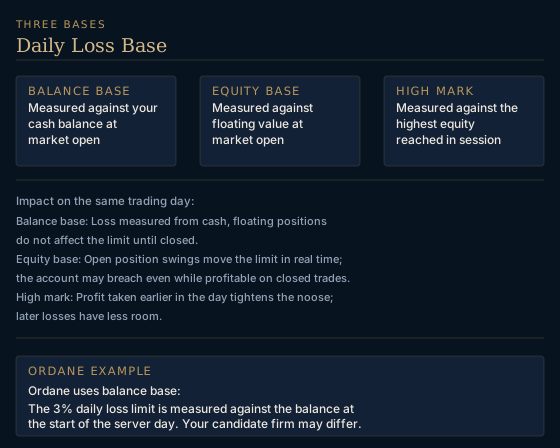
What is the base? Is the daily limit measured against the balance at the start of the day, the equity at the start of the day, or the highest equity reached during the day? These produce different numbers on the same trading day. Ordane's own rulebook is explicit on this point: the daily loss limit is 3 percent, measured against the balance at the start of the server day, and a breach closes the account (Ordane Rulebook v1.0, clause R-2). Whatever your candidate firm says, find the equivalent sentence and write down which of the three bases it names.
When does the day start? "Server day" is not the same as your local midnight. Find the exact server time and the exact time zone, then note what your local clock reads at that moment. That gap closes accounts for reasons that have nothing to do with the quality of the trade.
Does the floor move? A static drawdown floor is fixed on day one, unlike a trailing floor, which rises with your equity, which means profitable trading tightens the noose. Ordane uses the static version: maximum drawdown is 5 percent and static, account equity may never fall below 95 percent of the initial balance, the floor is fixed on day one, never trails upward, and a breach closes the account (Ordane Rulebook v1.0, clause R-1). Your candidate firm may differ, and that difference is the difference between two very different products.
Is the trigger equity or closed profit? Some firms breach you on floating drawdown, meaning an open position that dips below the line closes the account even if it would have recovered. Others measure only closed trades. Find out which, then deliberately test it during the trial with a small, controlled position.
Now run the test. Take one trade sized so that the resulting loss lands close to but under the daily limit as you calculated it. Screenshot the dashboard before and after. Compare its stated remaining allowance against yours. If the two agree, you understand the rule. If they do not, you have found either an error in your reading or an error in their dashboard, and both are worth resolving before purchase.
Profit Target and Qualifying-Day Logic
Then do the same for the upside, where the abridgement usually lives.
FTMO reduces the free trial profit target from ten percent to five percent (FTMO Free Trial FAQ, retrieved 2026-08-05). For its 2-Step free trial, FTMO also reduces the minimum trading day requirement from four days to two (FTMO Free Trial FAQ, retrieved 2026-08-05). Both of those are documented in the firm's own FAQ, which is the right way to do it, and both mean that hitting the trial target proves less than it feels like it proves.
So write down, from the paid rulebook rather than the trial dashboard:
- The paid profit target, as a percentage and as a currency amount on the account size you intend to buy.
- The minimum number of trading days, and the firm's definition of a trading day. Does a single closed trade count? Does a position opened and left overnight count for one day or two?
- Whether there is a consistency rule that caps how much of your profit may come from a single day. Ordane's is 20 percent: at the moment of a withdrawal request, no single trading day may account for more than 20 percent of the cycle's total profit. If a day exceeds 20 percent, the excess profit from that day is deferred to the next cycle, never confiscated, and the remainder of the cycle pays out normally (Ordane Rulebook v1.0, clause R-4). Find the equivalent clause in your candidate firm's rulebook, and find out whether their excess is deferred or forfeited, because those are not the same outcome.
- Whether there is a maximum duration, and what happens on the last day.
Then check whether the trial dashboard is showing you paid numbers or trial numbers. If it shows trial numbers, every progress bar you see during the trial is measuring against a target you will not face.
How Should You Test the Platform?
Rules are one half of the trial. Software is the other, and it is the half that traders under-test because it feels boring. You are looking for one thing: whether this platform produces records good enough to argue with.
Order, Log and Timestamp Checks
Run these checks, in this order:
Order types. Place a market order, a limit order, a stop order, and a stop-loss attached at entry. Confirm each one works and each one is visible in the order history afterward. This matters because some rulebooks require a stop-loss at entry as a condition, not a suggestion. Ordane's clause R-3 is written that way: maximum risk per trade is 1.5 percent of current balance and a stop-loss is mandatory at entry, and two maximum losses equal the daily limit, which is the design rather than an accident (Ordane Rulebook v1.0, clause R-3). If a firm requires something the platform makes awkward, you want to know now.
Modification and partials. Move a stop. Move a target. Close half a position. Then check whether the history records the modification, or whether it silently overwrites the original.
Timestamps. Note the server time next to your local time on every screenshot. Then check whether the exported history uses server time, UTC, or your local time. When a firm later tells you a trade breached a daily limit, the timestamp convention is the whole argument.
Exports. Find the export function and use it. Download the trade history as a file. Open it. Confirm it contains entry time, exit time, instrument, direction, volume, price, and profit. If the platform cannot produce that file, you have no independent record of anything, and everything you know about your own account is whatever the dashboard chooses to show you.
Reconciliation. Take the exported file and hand-total the profit column. Compare it to the dashboard's reported profit. Small rounding differences are normal. Large ones are not.
FTMO says its free trial includes access to most of its proprietary applications (FTMO Free Trial FAQ, retrieved 2026-08-05). Where a firm offers tooling like that, use it during the trial, but use it alongside your own exported file, not instead of it. Vendor analytics are a convenience. The raw export is evidence.
Test Normal Conditions Before Edge Cases
Test order matters here, and most traders get it backwards.
Spend the first portion of the trial in ordinary market hours with ordinary position sizes. You are establishing a baseline: normal spread, normal fill quality, normal dashboard behavior. Without a baseline you cannot tell whether something you see later is a platform problem or just Tuesday.
Only then move to edge cases:
- The market open and the market close.
- A high-impact economic release, if the rulebook's news trading rule permits trading through one. Ordane's rulebook restricts one specific thing here: clause R-6(d) prohibits straddling news releases with paired opposing orders. Because R-6 is a closed list, no other clause restricts trading during news or high-impact events (Ordane Rulebook v1.0, clause R-6(d)). Rulebook v1.0 defines each prohibited practice with examples in Appendix A, published 2026-08-01 (Ordane Rulebook v1.0, clause R-6 and section 6 Changelog, checked 2026-08-05). Your candidate firm may be far more restrictive, or may leave it to discretion, which is worse.
- An overnight hold, then a weekend hold, if permitted. At Ordane, overnight and weekend holding is allowed. It is not on the R-6 closed list, and what is not listed is not a violation (Ordane Rulebook v1.0, clause R-6).
- A deliberate near-miss on the daily limit, as described above.
One warning about edge-case testing. Do not manufacture large losses to see what breaks. A trial that ends in a breach teaches you almost nothing about the firm and quite a lot about your own impulse control. Test the boundary at a distance you can afford to be wrong about.
What Should the Trial Record Contain?
A trial with no written record is a trial you cannot use. Two weeks after it ends, you will remember a feeling and no numbers.
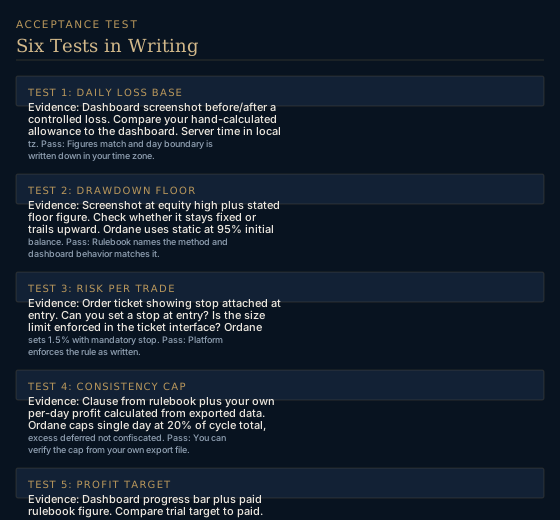
Run the trial against a fixed checklist and record each result. The following table is built from documented rule structures, so every row has a real referent rather than a placeholder.
Table 1: Test, Evidence and Pass Condition
| Test | Evidence to capture | Pass condition |
|---|---|---|
| Daily loss base and clock | Dashboard screenshot before and after a controlled loss, plus stated server time | Your hand-calculated remaining allowance matches the dashboard, and the server day boundary is written down in your local time |
| Drawdown floor behavior | Dashboard screenshot at a new equity high, plus the stated floor figure | The floor either stays fixed at the initial balance or visibly trails, and the rulebook says which; Ordane's is static at 95 percent of the initial balance (Ordane Rulebook v1.0, clause R-1) |
| Risk-per-trade and stop requirement | Order ticket showing stop attached at entry | Platform accepts the stop at entry, and the size limit in the rulebook is enforceable in the ticket; Ordane sets this at 1.5 percent with a mandatory stop (Ordane Rulebook v1.0, clause R-3) |
| Consistency or single-day cap | Written clause plus your own per-day profit split from the export | You can calculate, from your own file, whether any day exceeds the cap; Ordane's cap is 20 percent, with excess deferred rather than confiscated (Ordane Rulebook v1.0, clause R-4) |
| Profit target arithmetic | Dashboard progress bar plus the paid rulebook figure | The trial target and the paid target are both written down and compared; FTMO documents a reduction from 10 percent to 5 percent on trial (FTMO Free Trial FAQ, retrieved 2026-08-05) |
| Minimum trading days | Dashboard day counter plus the paid rulebook figure | The trial requirement and the paid requirement are both recorded; FTMO documents a 2-Step trial reduction from 4 days to 2 (FTMO Free Trial FAQ, retrieved 2026-08-05) |
| Export completeness | The downloaded history file itself | File contains entry time, exit time, instrument, direction, volume, price and profit for every trade |
| Export reconciliation | Your hand-total of the export against the dashboard total | Figures agree within rounding |
| Prohibited-practice list | The rulebook section, copied into your notes | The list is closed and enumerable, or it is open-ended and discretionary; Ordane's R-6 names six practices and states that anything not listed is not a violation (Ordane Rulebook v1.0, clause R-6) |
| Inactivity and duration limits | The rulebook clause plus any dashboard countdown | You know the exact number of idle days that closes the account; Ordane's is 30 consecutive days (Ordane Rulebook v1.0, clause R-5) |
Keep Native Exports and Screenshots
Two storage rules, both learned the hard way by people who did not follow them.
First, keep the native export file, not a screenshot of it. A CSV or XLSX you downloaded from the platform is a document with a timestamp. A photograph of a screen is a photograph.
Second, screenshot the rulebook page itself, including any version number and date shown on it. A firm that revises rules without a changelog is a firm whose rules you cannot cite six weeks later. This is why versioning is a specification and not a courtesy. Ordane publishes it as one: the Ordane rulebook is public, numbered and versioned, and no rule is ever applied retroactively to an open account. Changes produce a new version with a dated changelog entry, and the version you sign up under is the version that governs your account. The governing document is Ordane Rulebook v1.0, published 2026-07-23 (Ordane Rulebook v1.0, section 6 Changelog).
If your candidate firm's rulebook has no version, no date, and no changelog, save the page anyway. You have just made your own version.
How Do Trial Rules Differ from Paid Rules?
This is the section that pays for the whole exercise.
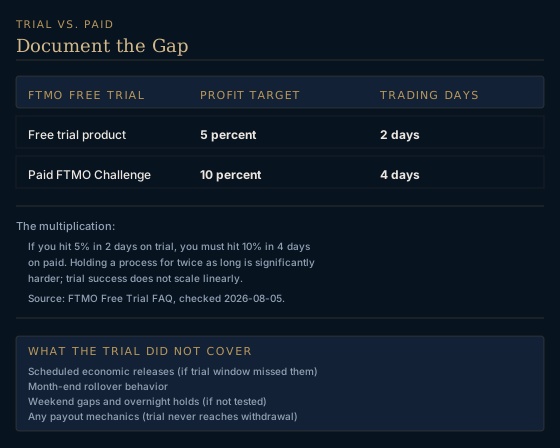
Build the table below yourself, with your candidate firm's real figures in the empty columns, before you buy. The FTMO columns are populated from that firm's own published FAQ, as a worked example of what a documented reduction looks like.
Table 2: Objective-by-Objective Comparison
| Objective | FTMO free trial, as published | FTMO paid equivalent, as published | Your candidate firm's trial | Your candidate firm's paid |
|---|---|---|---|---|
| Relationship of trial to paid product | Abridged version of the challenge experience (FTMO Free Trial FAQ, retrieved 2026-08-05) | The FTMO Challenge itself (FTMO Free Trial FAQ, retrieved 2026-08-05) | ||
| Profit target | 5 percent (FTMO Free Trial FAQ, retrieved 2026-08-05) | 10 percent (FTMO Free Trial FAQ, retrieved 2026-08-05) | ||
| Minimum trading days, 2-Step | 2 days (FTMO Free Trial FAQ, retrieved 2026-08-05) | 4 days (FTMO Free Trial FAQ, retrieved 2026-08-05) | ||
| Tool and application access | Most proprietary applications, including a shortened version of the Account Analysis (FTMO Free Trial FAQ, retrieved 2026-08-05) | Not stated on that FAQ page, checked 2026-08-05 | ||
| Does completion qualify you? | No, no eligibility to automatically secure an account (FTMO Free Trial FAQ, retrieved 2026-08-05) | Not applicable |
Filling that table forces you to read two documents instead of one, which is the point. The trial rules and the paid rules are separate texts and they frequently disagree.
Recheck Every Reduced Target or Duration
Once the table is filled, do the multiplication.
If the paid target is double the trial target, your trial result needs to double before it means anything. If the paid minimum trading days is double the trial's, your two-day performance needs to hold for four days, and holding a process for four days is meaningfully harder than holding it for two.
Then check the categories the trial may have left out entirely. A trial that runs for a limited window may never expose you to a scheduled economic release, a rollover, a month-end, or a weekend gap. A trial with a shortened duration cannot test an inactivity clause. A trial that does not reach withdrawal cannot test any part of the payout machinery, which is most of what actually matters, including how long a payout actually takes to arrive once approved.
Write down what the trial did not cover. That list is your remaining risk, and it does not shrink because the trial went well.
What Can a Trial Never Prove?
A trial cannot prove future payout behavior. FTMO says completing its free trial does not automatically qualify a trader for its subsequent account (FTMO Free Trial FAQ, retrieved 2026-08-05). That sentence is worth reading twice, because the firm is telling you the trial is not a credential.
Extend the logic. If a trial pass is not a qualification, it is certainly not a solvency statement. A trial exercises the front end: dashboard, platform, rule arithmetic. Payout depends on the back end: whether money exists, whether an approval clock is binding, whether a late payment carries a penalty, and the underlying question of whether prop firms actually pay at all.
Those are separate systems, and the trial touches none of them. Test them separately with the questions that actually reach them:
- Is there a written approval deadline, and what happens when it lapses? Ordane's clause G-0 states that every withdrawal request is approved, or denied in writing citing the exact rule breached by section number, within 24 clock hours. Past that deadline the request is treated as approved and the G-1 clock starts (Ordane Rulebook v1.0, clause G-0).
- Is there a penalty for late payment, or only an apology? The Ordane Guarantee is the mechanism here. Under clause G-1, a payout approved and not paid within 48 clock hours, not business hours, triggers automatic compensation: a 100 percent refund of the account fee, plus the payout owed in full (Ordane Rulebook v1.0, clause G-1).
- Are the exclusions to that guarantee enumerated and time-capped? The Ordane Guarantee has two objective exclusions: documented fraud or KYC review, and declared force majeure. Both are capped at 10 business days each. Past that deadline, G-1 applies regardless (Ordane Rulebook v1.0, clause G-2, checked 2026-08-05).
- Is there money you can look at? Ordane's payout reserve is published at a public TRON address on ordanemarkets.com, and clause PR-1 of Rulebook v1.0 is the commitment that puts it there: the address goes on-chain, with a dated payout ledger, before the first account is sold. The page carries an observed balance dated 2026-08-04, and the only thing it claims for that address is that the reserve is not a promise, it is an address (ordanemarkets.com, reserve section, and Ordane Rulebook v1.0, clause PR-1, checked 2026-08-05). Read it as exactly that. One address on one day is a snapshot, and a snapshot says nothing about total liabilities or about whether a payout owed to you next month arrives.
- Is there a dated payout ledger? Rulebook v1.0 commits Ordane to a dated payout ledger and to payout performance metrics published with dates on a fixed monthly schedule, starting with the first month in which a payout is requested. Clause PR-2 also states what holds until then: there is no payout history to report, and none is claimed (Ordane Rulebook v1.0, clause PR-2, checked 2026-08-05).
We are new, and we will not fake a history. That sentence is on our own homepage, and the rulebook behind it starts payout performance metrics with the first month in which a payout is requested (ordanemarkets.com, reserve section, and Ordane Rulebook v1.0, clause PR-2, checked 2026-08-05). What you can inspect today is the reserve address, the versioned rulebook, and the penalty clause that costs us money if we are late.
Whatever firm you are evaluating, apply the same standard. Ask for the clause, the number, and the link. A trial cannot substitute for any of the three.
The Ordane Instant Account Has No Evaluation Phase
For completeness on our own product, since the comparison is fair to make.
Ordane sells one product, the Ordane Instant Account: direct access, no evaluation phase and no challenge (Ordane Rulebook v1.0, section 1). It comes in four sizes: $10,000, $25,000, $50,000 and $100,000. The fee is one-time: $139 for the $10,000 account, $299 for $25,000, $549 for $50,000 and $999 for $100,000. There are no recurring fees, no hidden tiers and no coupon games, unlike the layered pricing and reset fees some firms add after the ticket price (Ordane Rulebook v1.0, section 1).
That structure means there is no trial-versus-paid gap to test, because there is no two-stage funnel. The rules you read before purchase are the rules that govern the account after purchase, and no rule is applied retroactively.
It also means you cannot rehearse before paying. That is a real trade-off, and we will not dress it up as a feature. What replaces the rehearsal is the specification: six numbered rules, a closed prohibited-practice list, a written approval clock, and a penalty on us for missing it.
A breach closes the account. That is the whole consequence: no partial confiscations, no surprise fees, no renegotiation (ordanemarkets.com, FAQ, checked 2026-08-05). That is worth knowing before you buy anything from anyone, ours included.
Questions traders ask about prop firm free trials
Does a trial pass qualify you?
No. FTMO states directly that free trials do not grant eligibility to automatically secure an account (FTMO Free Trial FAQ, retrieved 2026-08-05). Treat a trial pass as evidence that you understood the rules and the platform worked, and nothing more.
How many trials are enough?
One properly documented trial beats five casual ones. The measure is not repetitions, it is coverage: did you verify the loss-limit base and clock, the drawdown behavior, the target arithmetic, the export completeness, and the prohibited-practice list? If yes, you are done. If no, another trial only helps if you go in with the checklist.
Should you test slippage?
Test fills, yes. Manufacture volatility to test them, no. Place ordinary orders during ordinary hours to establish a baseline, then note fill quality during a scheduled release if the rulebook permits trading through one. Keep the exported timestamps and prices so the comparison is a document rather than an impression.
What if the trial terms differ from the paid terms?
Then the trial has told you exactly what you needed. A documented difference, published in the firm's own FAQ the way FTMO publishes its reduced target and reduced day count, is an honest firm being clear about scope (FTMO Free Trial FAQ, retrieved 2026-08-05). An undocumented difference you discover mid-trial is a different signal, and it belongs in your notes with a screenshot and a date.
Either way, the rule stands: the paid rulebook governs the paid account. Read that one before you pay, and let the trial tell you only what a trial can tell you.
Sources
- FTMO Free Trial FAQ, on the free trial being an abridged version of the FTMO Challenge experience. ftmo.com Retrieved 2026-08-05.
- FTMO Free Trial FAQ, on the profit target being reduced from 10 percent to 5 percent on the free trial. ftmo.com Retrieved 2026-08-05.
- FTMO Free Trial FAQ, on the minimum trading days requirement being reduced from 4 to 2 on the 2-Step free trial. ftmo.com Retrieved 2026-08-05.
- FTMO Free Trial FAQ, on free trials granting no eligibility to automatically secure an FTMO Account. ftmo.com Retrieved 2026-08-05.
- FTMO Free Trial FAQ, on the trial giving access to most of the firm's proprietary applications. ftmo.com Retrieved 2026-08-05.
- Ordane official site, FAQ, on a breach closing the account with no partial confiscations, no surprise fees and no renegotiation. ordanemarkets.com Retrieved 2026-08-05.
- Ordane official site, reserve section, and Ordane Rulebook v1.0 clause PR-1, on the payout reserve being published at a public TRON address with an observed balance dated 2026-08-04, and on the reserve being an address rather than a promise. ordanemarkets.com Retrieved 2026-08-05.
- Ordane Rulebook v1.0, clause PR-2, on payout performance metrics beginning with the first month in which a payout is requested, and on there being no payout history to report until then. ordanemarkets.com/rulebook Retrieved 2026-08-05.
- Ordane Rulebook v1.0, clause G-2, on both guarantee exclusions, documented fraud or KYC review and declared force majeure, being capped at a maximum of 10 business days each. ordanemarkets.com/rulebook Retrieved 2026-08-05.
- Ordane Rulebook v1.0, clause R-6 and section 6 Changelog, on Appendix A defining each prohibited practice with examples, published 2026-08-01. ordanemarkets.com/rulebook Retrieved 2026-08-05.
- Ordane official site, reserve section, on the firm being new and not faking a history. ordanemarkets.com Retrieved 2026-08-05.