Home · The Ordane Journal · Payouts · Prop Firm Payouts: Rules, Splits & Red Flags
Prop Firm Payouts: Rules, Splits & Red Flags
A prop firm payout is the structured process where a proprietary trading company compensates a trader for generating simulated profits according to a specific rulebook. Ordane accounts operate on simulated capital. No live funds are traded and no deposits are accepted.
Traders search for a reliable prop firm payout process because securing profits is the ultimate goal of any strategy. Understanding how simulated profits convert into real money requires reading the rulebook before paying the evaluation fee. A funded account is a common term in the industry, but terminology varies widely. Many traders enter the market expecting immediate returns, only to find that the withdrawal process requires careful adherence to specific guidelines. The path to a successful payout involves navigating complex rules, understanding the timeline, and avoiding hidden restrictions that can invalidate your efforts. By examining the terms upfront, traders can protect their capital and ensure they are operating within a verifiable and secure environment.
What Is a Prop Firm Payout?
A prop firm payout is the process where a proprietary trading company compensates a trader for generating simulated profits. The firm reviews the trading history for rule violations, calculates the agreed profit split, and transfers real money to the trader using the firm's own capital revenue.
The payout mechanism bridges the gap between simulated trading and real compensation. When you trade on a prop firm platform, your orders do not go to a live exchange. Instead, the firm evaluates your performance and pays you based on the simulated results. This structure means the firm must have sufficient capital reserves to honor withdrawal requests. Where that payout money actually comes from is worth checking before you pay an evaluation fee. Ordane sells one product, the Ordane Instant Account: direct access, no evaluation phase and no challenge, on simulated capital.
How simulated profits become real money
The process starts when a trader requests a withdrawal. The firm's risk team examines the ledger to ensure no prohibited practices occurred during the cycle. If the account passes the review, the firm issues a payment from its own corporate treasury. Payouts are paid in real money from company fee revenue. No client deposits are taken and no client capital is traded. Rulebook v1.3 clause PR-one commits Ordane to publish the payout reserve on-chain; the live rulebook and homepage publish the TRON address. This transparency ensures that the funds required for payouts are visible and verifiable by the public before any trading activity begins.
The timeline from funded account to first withdrawal
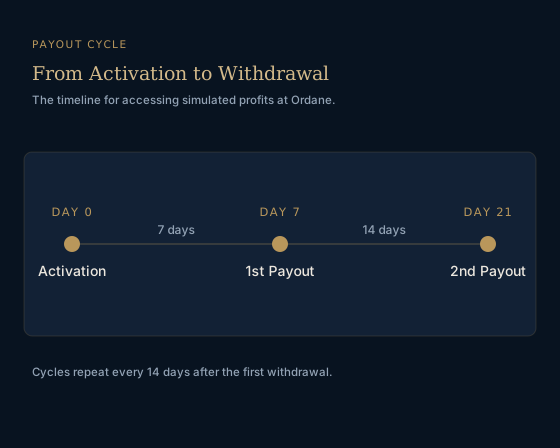
Every firm defines a specific waiting period before the first withdrawal. At Ordane, the first withdrawal is available seven calendar days after account activation, and the cycle thereafter is every fourteen days. Other firms might require thirty days or a minimum number of active trading days before unlocking the withdrawal button. Traders must read the rulebook, and cross-check it against the full first-payout checklist, to understand exactly when they become eligible to submit a request. The timeline is a critical factor in a trader's financial planning, as delayed access to profits can impact their ability to sustain their trading activities.
What Hidden Rules Can Block Your Payout?
Hidden rules block prop firm payouts when traders violate undocumented restrictions during their profitable cycles. The most common barriers include minimum winning days, consistency rules that cap daily profits, and sudden scaling plan adjustments that invalidate earlier trading setups just before a withdrawal request is submitted and processed.
Traders often discover these rules only after requesting a withdrawal, leading to frustration and denied payments. Reading the fine print is a mandatory step for anyone looking to secure their earnings. Firms that rely on discretionary rules can arbitrarily decide to withhold funds, making a closed list of rules a vital feature for trader protection. Knowing whether a firm can enforce a rule that was never written down is worth confirming before you rely on its promises.
Minimum winning days requirements
Many firms mandate a minimum number of profitable days to prevent traders from securing a payout with a single lucky trade. Topstep (prop firm) allows funded traders to request a payout of up to 50 percent of their account balance after accumulating 5 winning trading days (Topstep Payout Policy, retrieved 2026-09-24). At Ordane, the prohibited-practice list is closed. Clause R-six names six practices: latency, reverse or hedge arbitrage; high-frequency or bulk automated exploitation; copy trading between Ordane accounts; straddling news releases with paired opposing orders; platform or data-feed exploitation; and gap abuse. If a behavior is not listed in that section, it is not a violation. Discretion is not a rule. This means traders do not have to worry about unwritten expectations regarding their trading frequency or the distribution of their winning days.
Consistency rules and scaling plans
Consistency rules restrict how much of your total profit can come from a single day. Ordane's consistency rule is twenty percent: at the moment of a withdrawal request, no single trading day may account for more than twenty percent of the cycle's total profit. If a day exceeds twenty percent, the excess profit from that day is deferred to the next cycle. It is never confiscated, and the remainder of the cycle pays out normally. This approach protects the firm from extreme volatility while ensuring the trader does not lose their earned profits due to an exceptionally strong market movement.
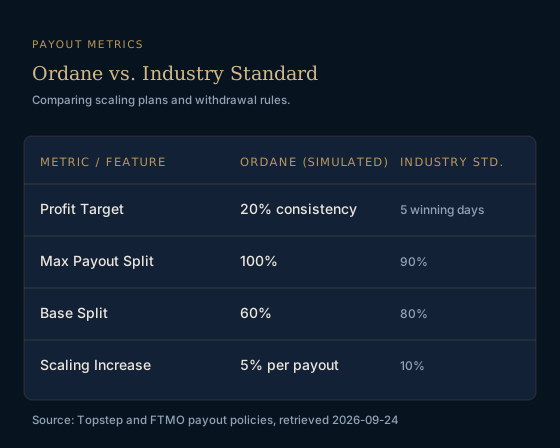
| Metric/Feature | Ordane (Simulated) | Industry Standard |
|---|---|---|
| Profit Target Limit | Twenty percent consistency rule | 5 winning days (Topstep Payout Policy, retrieved 2026-09-24) |
| Maximum Payout Split | One hundred percent | 90 percent (FTMO Evaluation Process and Scaling Plan, retrieved 2026-09-24) |
| Base Split | 80 percent | 80 percent (FTMO Evaluation Process and Scaling Plan, retrieved 2026-09-24) |
| Scaling Increase | 5 percent per withdrawal | 10 percent (FTMO Evaluation Process and Scaling Plan, retrieved 2026-09-24) |
Will the Firm Exist When It's Time to Pay?
Regulatory enforcement actions are shutting down prop firms without warning, leaving traders without their expected payouts. Before paying an evaluation fee, traders must verify if the firm operates legally, publishes its payout reserve on a verifiable ledger, and maintains clear contractual protections against arbitrary account closures and delayed payments.
The fear of a firm disappearing overnight is grounded in recent history, as several prominent companies have ceased operations abruptly. A trader must verify the structural integrity of the company to ensure their efforts will be rewarded. Relying solely on a firm's marketing materials is insufficient in an industry where longevity is not guaranteed.
Regulatory actions and the MyForexFunds case
The proprietary trading industry faces intense scrutiny from federal regulators. When regulators freeze a firm's assets, pending payouts are halted immediately. This makes the legal structure and transparency of the firm more important than the advertised profit split. Knowing what actually happens to your account and unpaid profit if a firm shuts down is the starting point for that verification. A firm that operates transparently and maintains a verifiable reserve provides a layer of security that protects traders from unexpected regulatory shutdowns.
How to vet a firm's longevity before paying
Traders must look for structural proof rather than marketing claims. A five-check audit of the firm covers exactly this ground. Ordane's payout reserve is published at a public TRON address on ordanemarkets.com and in Rulebook v1.3 clause PR-one. The page carries a dated observed balance and states that the reserve is not a promise, it is an address. Furthermore, the Ordane rulebook is public, numbered and versioned, and no rule is ever applied retroactively to an open account. Changes produce a new version with a dated changelog entry, and the version you sign up under is the version that governs your account. This contractual stability ensures that the firm cannot alter the rules to avoid paying out successful traders.
How Do Profit Splits and Evaluation Costs Work?
Profit splits dictate the percentage of simulated profits a trader keeps, while evaluation costs represent the upfront capital required to access the platform. Traders must calculate the total effective cost of a payout by combining the initial fee, activation charges, and the firm's specific withdrawal caps during the first months.
The split is the headline number, but the cost structure determines the actual value of a payout. High splits are irrelevant if the upfront costs are prohibitive or if strict caps limit the withdrawal amount. Evaluating the complete financial picture is necessary to determine the true profitability of a prop firm account.
How scaling plans increase your split to 90%
Firms often start traders on a lower split and increase it as the trader demonstrates consistency over time. FTMO (prop firm) offers a scaling plan where successful traders can achieve a payout split of up to 90 percent (FTMO Evaluation Process and Scaling Plan, retrieved 2026-09-24). Ordane's profit split starts at eighty percent and rises two point five percentage points with every completed withdrawal, reaching one hundred percent from the ninth withdrawal onward. Withdrawals number one and number two are each capped at three percent of initial balance. From withdrawal number three onward there is no cap. This scaling mechanism rewards long-term discipline while protecting the firm's capital reserve during the initial withdrawal phases.
The true cost of reaching a payout
The true cost includes every fee paid before receiving the first transfer, but traders must also calculate how profit splits evolve. Traders must factor in all initial and recurring costs, alongside the scaling benefits, to calculate their break-even point.
Declared inputs for this check: an 80 percent base split (FTMO Evaluation Process and Scaling Plan, retrieved 2026-09-24), a 10 percent scaling increase (FTMO Evaluation Process and Scaling Plan, retrieved 2026-09-24), and a 90 percent maximum split (FTMO Evaluation Process and Scaling Plan, retrieved 2026-09-24). Worked arithmetic: 80 + 10 = 90 maximum split.
At Ordane, the fee is one-time: fifty-nine dollars for the two thousand five hundred dollar account, one hundred thirty-nine dollars for the ten thousand dollar account, two hundred ninety-nine dollars for the twenty-five thousand dollar account, five hundred forty-nine dollars for the fifty thousand dollar account, nine hundred ninety-nine dollars for the one hundred thousand dollar account. There are no recurring fees, no hidden tiers and no charge to withdraw. The absence of recurring fees ensures that traders are not penalized for taking their time to reach a profitable state.
How Do You Request Your First Payout?
Requesting your first payout requires navigating the firm's dashboard, completing the identity verification process, and submitting the withdrawal form. The firm then reviews your trading history against the rulebook, approves the amount, and processes the transaction to your selected payment method within the contractual timeframes established in their terms.
The procedure is straightforward if your trading history aligns with the rulebook. Preparing your documents in advance speeds up the process and prevents unnecessary delays. Understanding the specific steps involved ensures a smooth transition from simulated profits to real compensation.
The identity verification process
Identity verification is the first mandatory step before any funds are released. KYC happens once, at the first withdrawal request, not at purchase. There is no re-verification loop at every payout. Once verified, you submit the request through the dashboard. Traders must provide government-issued identification and proof of address to comply with international regulations. This one-time process streamlines subsequent withdrawals, allowing traders to access their funds more efficiently in the future.
The approval timeline and late penalties
The firm then reviews the cycle. Every withdrawal request is approved, or denied in writing citing the exact rule breached by section number, within twelve clock hours. Past that deadline the request is treated as approved and the G-one clock starts. This mechanism is known as The Ordane Guarantee.
| Payout Phase | Maximum Timeline | Consequence for Delay |
|---|---|---|
| Approval Decision | Twelve clock hours | Treated as approved |
| Payment Transfer | Twenty-four clock hours | Full refund plus payout |
| Documented Exclusions | Ten business days | G-one applies after deadline |
A payout approved and not paid within twenty-four clock hours, not business hours, triggers automatic compensation: a one hundred percent refund of the account fee, plus the payout owed in full. Both G-two exclusions (documented fraud or KYC review, and declared force majeure) are capped at ten business days each. Past that deadline, G-one applies regardless. This ensures the payout process does not drag on indefinitely and holds the firm accountable for timely payments.
Prop Firm Payout FAQ
How long does a prop firm payout take?
Processing times vary significantly by firm. Under The Ordane Guarantee, approval happens within twelve clock hours, and payment follows within twenty-four clock hours. If the timeline is missed, the trader receives a full refund of the fee alongside the payout. This contractual obligation provides certainty that is often lacking in the broader industry.
What is the highest prop firm payout split?
Many firms cap the initial split but scale it later to reward long-term consistency. FTMO offers a scaling plan where successful traders can achieve a payout split of up to 90 percent (FTMO Evaluation Process and Scaling Plan, retrieved 2026-09-24). Ordane reaches one hundred percent from the ninth withdrawal onward, providing a clear path to maximum compensation.
Do prop firms actually pay out?
Legitimate firms process payouts according to their published rules, but regulatory actions show that not all firms operate legally. Checking the firm's verifiable payout reserve helps mitigate this risk and ensures the company has the capital to honor its commitments.
Can a prop firm deny my payout?
Yes. A firm can deny a payout if the trader breaches a rule during the cycle. At Ordane, a breach closes the account. That is the whole consequence: no partial confiscations, no surprise fees, no renegotiation. The rules are public and versioned, meaning traders know exactly what behaviors will result in a denial.
What happens to my drawdown after a payout?
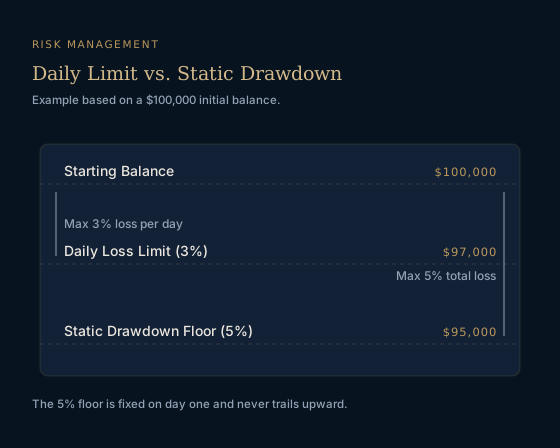
Rules differ widely by firm. Ordane's maximum drawdown is five percent and static: account equity may never fall below ninety-five percent of the initial balance. The floor is fixed on day one, never trails upward, and a breach closes the account. Furthermore, withdrawals reduce the account balance, and the R-one drawdown floor stays anchored to the initial balance.
Sources
- FTMO Evaluation Process and Scaling Plan ftmo.com Retrieved 2026-09-24T12:03:32-03:00.
- Topstep Payout Policy topstep.com Retrieved 2026-09-24T12:03:32-03:00.
- FTMO Evaluation Process and Scaling Plan ftmo.com Retrieved 2026-09-24.