Home · The Ordane Journal · Payouts · Prop Firm Payouts: Capital Gains or Regular Income
Prop Firm Payouts: Capital Gains or Regular Income
Traders search for a funded account every day, aiming to scale their trading operations. Prop firm payouts are generally classified as ordinary income for independent contractors, not capital gains, because traders provide performance data on simulated accounts rather than risking personal capital. Ordane accounts operate on simulated capital. No live funds are traded and no deposits are accepted.
The mechanics of these environments are often misunderstood, especially regarding taxation. When participants request a withdrawal, they frequently assume their profits will be treated favorably under tax codes designed for investors. This assumption leads to severe complications during tax season. This structural reality determines exactly how tax authorities classify the compensation you receive. Understanding the difference between investment returns and service compensation is critical for anyone operating in this industry.
Are prop firm payouts taxed as capital gains?
Proprietary trading firm payouts are generally treated as compensation for services rendered as an independent contractor, subjecting them to ordinary income tax and self-employment tax, rather than capital gains tax. Traders provide trading signals instead of investing their own funds, changing the tax classification entirely for these simulated trading environments.
The distinction hinges on the nature of the activity. Capital gains apply when you put your own money at risk to purchase an asset, hold that asset, and eventually sell it for a profit. Because participants in this industry do not supply the trading capital, they do not own the underlying assets being traded.
Authorities look at the economic substance of the relationship. When you receive a payout, you are being compensated for the data and the simulated performance you generated. This shifts the classification from passive investment income to active earned income.
The consequences of this classification are significant for tax planning:
- Payouts are taxed at your marginal ordinary income rate.
- You may be liable for self-employment taxes to cover specific social programs.
- Capital losses from your personal brokerage accounts generally cannot be used to offset this specific type of income.
- You may need to make quarterly estimated tax payments to avoid penalties.
This structural reality means that the favorable tax rates associated with long-term capital gains are entirely inaccessible for this type of compensation. Traders must prepare for a tax burden that closely mirrors the obligations of a freelance consultant. We strongly advise consulting a certified tax professional to understand exactly how these rules apply to your specific jurisdiction.
Why Are Prop Firm Payouts Classified as Regular Income?
The classification of this income is not an arbitrary decision by tax authorities. It is a direct result of how these trading environments are legally structured. To understand the tax treatment, you must understand the underlying mechanics of the accounts themselves.
You do not own the trading capital
The most critical factor in determining tax status is the ownership of the capital at risk. Traders at proprietary trading firms, such as FTMO (prop firm), do not own the capital they trade; they execute trades on simulated accounts, meaning they do not realize capital gains or losses on the underlying financial instruments (FTMO, retrieved 2026-09-23). You cannot claim a capital gain on an asset you never purchased with your own money.
In a traditional retail brokerage account, you deposit your own funds. If you buy a currency pair and it appreciates, the profit is tied directly to your initial capital risk. In the proprietary trading model, the firm provisions the simulated environment. The participant pays a fee for access and infrastructure, but the capital traded does not belong to them. Therefore, the resulting payouts are viewed as performance-based compensation rather than a return on investment.
Ordane sells one product, the Ordane Instant Account: direct access, no evaluation phase and no challenge, on simulated capital.
This distinction is absolute. Because you are trading simulated capital, your activity does not meet the statutory requirements for capital gains treatment. The authorities require a clear transfer of ownership and risk to classify income as a capital gain.
Trades are executed on simulated accounts
The environment itself reinforces this tax classification. The platforms provided are testing grounds designed to measure trading skill and consistency. You are interacting with live market data, but the orders do not necessarily route to a public exchange in your name.
This means there is no taxable event occurring at the level of the individual trade. When you close a profitable position in a simulated account, you have not realized a taxable gain. The taxable event only occurs when the firm approves a withdrawal request and transfers fiat currency or cryptocurrency to your personal wallet or bank account. This transfer is recorded as payment for services rendered.
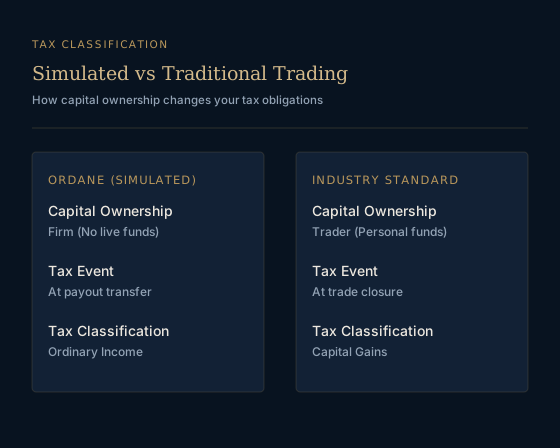
| Metric/Feature | Ordane (Simulated) | Industry Standard |
|---|---|---|
| Capital Ownership | Firm (No live funds) | Trader (Personal funds) |
| Tax Event | At payout transfer | At trade closure |
| Tax Classification | Ordinary Income | Capital Gains |
The timing and nature of the taxable event highlight why the income is treated as regular compensation. You are being paid a contractor fee based on a specific metric, which happens to be your simulated trading performance.
How Does the Self-Employment Tax Affect Independent Contractors?
Beyond ordinary income tax, participants in the United States face an additional burden. The classification as an independent contractor brings specific obligations that catch many unprepared.
Providing trading signals vs. investing
You are essentially a data provider. The firm pays you for the intellectual property of your trading decisions, which they may or may not use in their own live market operations.
This relationship is formalized in the agreements participants sign. You are not an employee, nor are you an investor. You are a third-party vendor providing a specific service. This status triggers the requirement to pay self-employment taxes, which cover obligations that are otherwise handled by an employer.
Operating as a signal provider has distinct characteristics:
- You are responsible for your own tax withholding.
- The firm will not issue employee tax forms; they will typically issue documentation for non-employee compensation.
- You are responsible for reporting the income on the appropriate business schedules of your tax return.
- You have the ability to deduct legitimate business expenses incurred in the process of generating this income.
Understanding this dynamic is crucial for financial planning. The gross amount of your payout is not what you will keep. A significant percentage must be reserved for these dual tax obligations.
Self-employment tax requirements
The requirement to pay self-employment tax fundamentally alters the profitability of participating in these programs. Because you are not an employee, the firm does not pay the employer portion of these taxes. You are responsible for both the employer and employee portions, which currently total a significant percentage of your net earnings.
This is where treating the activity as a legitimate business becomes necessary. Independent contractors have the right to deduct ordinary and necessary business expenses. These deductions can lower the net taxable income, thereby reducing both the ordinary income tax and the self-employment tax burdens.
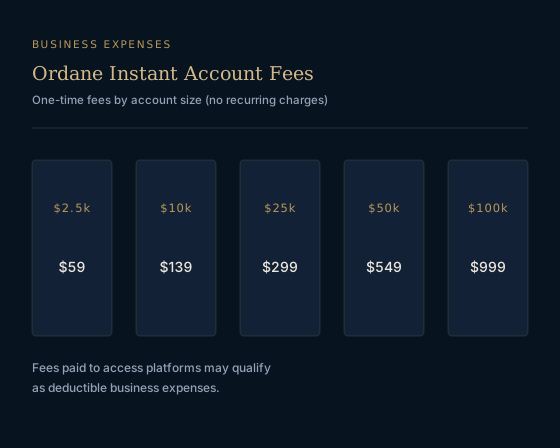
Traders often ask if the fees paid for access are deductible. While you must consult a tax professional, fees paid to access platforms are commonly treated as business expenses for independent contractors. We can look at the cost structure to understand what might be expensed. Ordane Instant Account comes in five sizes: $2,500, $10,000, $25,000, $50,000, and $100,000. The fee is one-time: $59 for the $2,500 account, $139 for the $10,000 account, $299 for the $25,000 account, $549 for the $50,000 account, $999 for the $100,000 account. There are no recurring fees, no hidden tiers and no charge to withdraw.
Declared inputs for this check: a $299 fee for the $25,000 account, a $139 fee for the $10,000 account, and a $0 withdrawal charge. Worked arithmetic: 299 + 139 = 438 total upfront cost.
Properly tracking these costs is essential. Internet service, specialized charting software, and the fees paid to the firms themselves may all qualify as deductions, softening the impact of the self-employment tax.
The importance of clear firm policies
The taxation of your payouts is complex enough without having to worry about whether the firm will actually pay you. The industry is full of opaque rules that allow firms to deny withdrawals. The transparency of the firm's operations directly impacts your ability to run your trading activity as a predictable business.
A reliable environment requires strict adherence to public rules:
- The governing document is Ordane Rulebook v1.0, published July 23, 2026.
- The Ordane rulebook is public, numbered and versioned, and no rule is ever applied retroactively to an open account. Changes produce a new version with a dated changelog entry, and the version you sign up under is the version that governs your account.
- Ordane's prohibited-practice list is closed. Clause R-6 names six practices: latency, reverse or hedge arbitrage; high-frequency or bulk automated exploitation; copy trading between Ordane accounts; straddling news releases with paired opposing orders; platform or data-feed exploitation; and gap abuse. If a behavior is not listed in that section, it is not a violation. Discretion is not a rule.
When you are treated as an independent contractor for tax purposes, you need a contract that protects your interests. A closed list of rules ensures that if you follow the documented procedures and generate simulated profits, your invoice will be paid.
Verification and payout guarantees
The fear of passing an evaluation and never getting paid is the most common concern in this industry. If you are building a business that requires paying self-employment taxes, you must have certainty that your revenue source is secure.
Ordane's payout reserve is published at a public TRON address on ordanemarkets.com and in Rulebook v1.0 clause PR-1. The page carries a dated observed balance and states that the reserve is not a promise, it is an address. This transparency provides the necessary proof that the capital exists to honor payout requests.
Every withdrawal request is approved, or denied in writing citing the exact rule breached by section number, within 12 clock hours. Past that deadline the request is treated as approved and the G-1 clock starts. A payout approved and not paid within 24 clock hours, not business hours, triggers automatic compensation: a 100 percent refund of the account fee, plus the payout owed in full.
Both G-2 exclusions (documented fraud or KYC review, and declared force majeure) are capped at 10 business days each. Past that deadline, G-1 applies regardless. This mechanical enforcement of payment deadlines allows traders to forecast their cash flow and manage their tax liabilities with confidence.
Managing drawdowns and consistency
To maintain the status of an independent contractor receiving payouts, you must first survive the risk management parameters of the account. Taxation only becomes a concern after you have successfully navigated the trading rules.
Ordane's maximum drawdown is 5 percent and static: account equity may never fall below 95 percent of the initial balance. The floor is fixed on day one, never trails upward, and a breach closes the account. The daily loss limit is 3 percent, measured against the balance at the start of the server day. A breach closes the account. Maximum risk per trade is 1.5 percent of current balance and a stop-loss is mandatory at entry. Two maximum losses equal the daily limit, which is the design rather than an accident.
These parameters require strict discipline. If you violate a rule, the contract ends. A breach closes the account. That is the whole consequence: no partial confiscations, no surprise fees, no renegotiation.
Furthermore, managing your payout size requires understanding consistency rules. Ordane's consistency rule is 20 percent: at the moment of a withdrawal request, no single trading day may account for more than 20 percent of the cycle's total profit. If a day exceeds 20 percent, the excess profit from that day is deferred to the next cycle. It is never confiscated, and the remainder of the cycle pays out normally.
Scaling your independent contractor business
As you generate more payouts and handle your tax obligations, you will naturally look to scale your operations. Understanding the payout structure is vital for projecting your after-tax income.
The first withdrawal is available 7 calendar days after account activation, and the cycle thereafter is every 14 days. Withdrawals #1 and #2 are each capped at 3 percent of initial balance. From withdrawal #3 onward there is no cap. Withdrawals reduce the account balance, and the R-1 drawdown floor stays anchored to the initial balance.
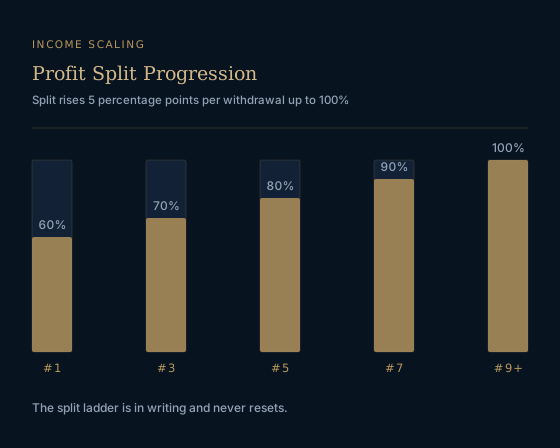
Ordane's profit split starts at 60 percent and rises 5 percentage points with every completed withdrawal, reaching 100 percent from the ninth withdrawal onward. The split ladder is in writing and never resets. This progressive structure means your gross revenue increases over time, assuming consistent performance, which in turn increases your estimated tax obligations.
FAQ: Prop firm taxes
Are prop firm payouts taxed as capital gains?
No. Because you do not own the underlying capital and are trading in a simulated environment, the payouts are not considered a return on investment. They are classified as compensation for providing a service.
How are prop firm payouts taxed?
They are generally taxed as ordinary income and are subject to self-employment taxes in jurisdictions like the United States. You are treated as an independent contractor providing trading data to the firm.
Is prop firm income capital gains?
It is not. Capital gains require the taxpayer to purchase an asset with their own funds, hold it, and sell it. Simulated trading accounts do not involve the purchase of real assets by the participant.
Prop firm taxes regular income?
Yes. The funds transferred to your bank account or crypto wallet upon a successful withdrawal request are treated as regular earned income. You must report this income on the appropriate tax forms for freelance or contractor work.
Do I need to pay self-employment taxes on prop firm payouts?
In the United States, participants generally must pay self-employment taxes. This covers Medicare and Social Security contributions that an employer would typically split with an employee. Because you are an independent contractor, you bear the full burden of these specific taxes.
This article is for information only and is not investment, financial, or tax advice.
Ordane accounts operate on simulated capital. No live funds are traded and no deposits are accepted. Payouts depend on simulated performance under Rulebook v1.0; no level of performance is typical or assured.
Sources
- FTMO FAQ - Do I trade with real money? ftmo.com Retrieved 2026-09-23.