Home · The Ordane Journal · Rules and Mechanics · Can a Prop Firm Enforce a Rule That Isn't Written Down?
Can a Prop Firm Enforce a Rule That Isn't Written Down?
A prop firm can enforce a rule that is not written in its terms only if those terms grant it discretion to. Under a closed rules list, where every prohibited practice is named and the list ends there, a practice that is not written is not a violation and cannot be enforced.
Ordane accounts operate on simulated capital. No live funds are traded and no deposits are accepted. Clause P-2 of the Ordane Rulebook v1.0 requires that declaration. The shape of the rulebook decides everything that follows. This article separates the two rulebook shapes, names the clause that makes a payout deniable after the fact, and shows the closed-list test you can run on any firm's terms before you pay.
The short answer: only if its rulebook lets it
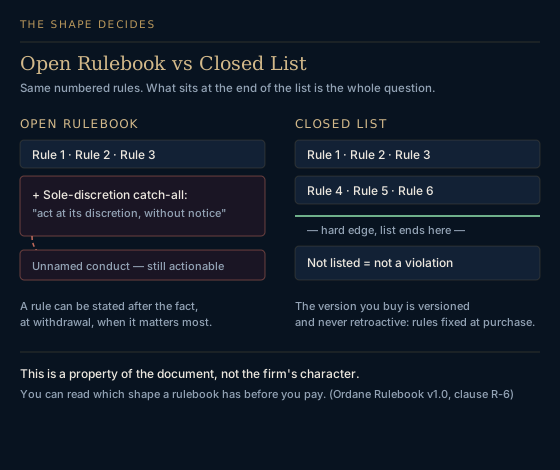
An open rulebook lists some rules, then keeps a clause that lets the firm act on more. A closed list names every prohibited practice and stops, so a practice that is not written is not a violation.
Ordane's clause R-6 is one such closed list: it names six prohibited practices and states that if a behavior is not listed, it is not a violation (Ordane Rulebook v1.0, clause R-6).
Open rulebook vs closed list, the distinction that decides disputes
Every dispute over an unwritten rule comes down to one question: does the rulebook have a closed edge, or an open one. An open rulebook enumerates some rules and then adds a clause that reaches past them, a catch-all that lets the firm act on conduct it never named. A closed list does the opposite. It names each prohibited practice, and the naming is the whole boundary, so what is not on the list is permitted by definition. The answer to whether a firm can enforce an unwritten rule is not a matter of the firm's character. It is a property of the document you agreed to, and you can read which shape it has before you pay.
Three tests decide almost every dispute. The table below applies them to each rulebook shape.
| Test that decides a dispute | Open rulebook with a catch-all | Closed list, versioned |
|---|---|---|
| Is the rule pre-published and numbered? | Not necessarily; a catch-all clause lets the firm act on conduct it never enumerated | Yes; every prohibited practice is named and the list ends there |
| Can the rules change after you buy? | Yes, if the terms reserve the right to amend at any time and apply it to open accounts | No; a versioned, never-retroactive rulebook fixes your rules at purchase |
| Is there documented recourse at payout? | Often none; with no pre-published rule there is no clause to cite back | Yes; you can point to the numbered clause and to the absence of the disputed rule |
The sole-discretion clause and how it voids a payout
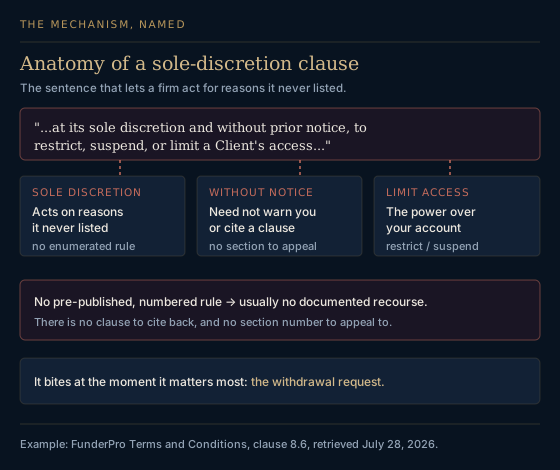
The mechanism traders fear has a name in the terms: the sole-discretion clause. It is the sentence that lets a firm act for reasons it never listed. FunderPro's live Terms and Conditions are a plain example. They reserve the right, at the company's sole discretion and without prior notice, to restrict, suspend, or limit a client's access to their account, products, or services (FunderPro Terms and Conditions, clause 8.6, retrieved 2026-07-28). Even a named rule can have a discretionary edge: clause 4.9, which governs excessive order placement, ends by giving the company sole discretion to define unreasonable behavior and its limits (FunderPro Terms and Conditions, clause 4.9, retrieved 2026-07-28).
Two clauses like that change what a rulebook is. A rule you can read in advance becomes a rule the firm can state after the fact, at the moment it matters most, which is withdrawal. The classic pattern is a firm with no published consistency rule that applies one at payout and points to a general clause buried in the terms. Because the rule was never pre-published and numbered, there is usually no documented recourse: no clause to cite back, no section number to appeal to.
Retroactive changes are the same problem on a timer. When a firm reserves the right to change the fee, terms, and rules of its challenges at any time, the account you bought under one set of rules can be governed by another (FunderPro Terms and Conditions, clause 5.4, retrieved 2026-07-28). The same document also contains the counterweight: clause 17.1 promises that material changes to the terms will be communicated in advance, with the option to accept them or terminate the agreement (FunderPro Terms and Conditions, clause 17.1, retrieved 2026-07-29). The open question a trader should ask is which clause governs a rule change applied to an open challenge account. In December 2025, Finance Magnates reported that the prop firm FundingTicks faced backlash for applying rule changes retroactively to existing accounts, including a lower profit split and new minimum trade-hold and profitable-day requirements (Finance Magnates, December 2025, retrieved 2026-07-28).
The stakes are not hypothetical. In August 2023 the U.S. Commodity Futures Trading Commission charged Traders Global Group, doing business as My Forex Funds, and Murtuza Kazmi with fraudulently taking over $300 million from customers hoping to become professional traders (CFTC Release 8771-23, August 2023, retrieved 2026-07-29). The case did not end as a clean regulator win: in May 2025 the court dismissed it with prejudice and sanctioned the CFTC, ordering the regulator to pay the defendants over 3 million USD in attorneys' fees and costs (Quinn Emanuel, retrieved 2026-07-29). The lesson for this article survives the dismissal: nobody in that fight was protected by the width of a rulebook. Part of why the terms matter so much here is the structure of the product itself. Trade-press analysis of the retail prop model describes the customer as typically trading a simulated or demo account against the firm's own risk engine, not live markets, with the firm acting as counterparty (The Industry Spread, retrieved 2026-07-28). When the firm that writes the rules is also the party on the other side of your account, the width of its discretion clause is not a detail. It is the whole question, and it sits underneath the broader one of whether prop firms can be trusted at all.
What a closed rules list actually guarantees
A closed list is a rulebook with a hard edge. The prohibited practices are enumerated and finite, and the enumeration is the boundary: a practice that is not on the list is permitted, not by the firm's goodwill but by the logic of a closed set. That is what makes it different from a promise. A firm can promise to be fair and still keep a clause that lets it act on anything. A closed list removes the clause, so there is nothing left to act on outside the named practices.
Pair the closed list with one more property and you have the full guarantee: versioning that is never retroactive. If every change produces a new, dated version, and the version you signed up under governs your account for its life, then the firm cannot add a rule to your account after you bought it. The rule set is fixed at purchase. Together, a closed list and non-retroactive versioning answer the two ways an unwritten rule reaches you: a rule that was never named, and a rule added after the fact. Neither is a character judgement of the firm. Both are structural properties of the document, and both are things you can verify by reading.
How Ordane writes its rules, in its own words
Concession first, because it is the honest starting point: Ordane is new and has no payout history. There is nothing to show yet, and no payout history will be manufactured (ordanemarkets.com, payout ledger section). Ordane is operated by Ordane Markets Ltd (in formation) (ordanemarkets.com, footer and FAQ). What can be verified today is not a record of behavior but the shape of the rulebook, published before the first account is sold.
Ordane sells one product, the Ordane Instant Account: direct access, no evaluation phase and no challenge, on simulated capital.
Ordane's prohibited-practice list is closed. Clause R-6 names six practices: latency, reverse or hedge arbitrage; high-frequency or bulk automated exploitation; copy trading between Ordane accounts; straddling news releases with paired opposing orders; platform or data-feed exploitation; and gap abuse. If a behavior is not listed in that section, it is not a violation. Discretion is not a rule. That text is clause R-6 of Ordane Rulebook v1.0. It is the opposite of a sole-discretion clause: instead of a sentence that reaches past the named rules, a sentence that says there is nothing past them.
The versioning clause closes the other gap. The Ordane rulebook is public, numbered and versioned, and no rule is ever applied retroactively to an open account. Changes produce a new version with a dated changelog entry, and the version you sign up under is the version that governs your account (Ordane Rulebook v1.0, the notice above section 0 and the section 6 changelog). The governing document today is Ordane Rulebook v1.0, published 2026-07-23 (Ordane Rulebook v1.0, section 6 changelog).
There is an honest limit to state plainly. Rulebook v1.0 says each prohibited practice is defined with examples in Appendix A, and Appendix A is published on ordanemarkets.com as of 2026-08-01 with definitions A-1 through A-6 (Ordane Rulebook v1.0, clause R-6 and Appendix A, checked against the live page 2026-08-01). So this article can tell you the list is closed, name the six practices, and point you to the worked examples at the source — it will not restate every A-clause here, because the binding text should stay in one place. The closed-list principle stands on its own. The worked example is one you can check without opening Appendix A: holding a position overnight or across the weekend. Neither appears among the six practices of clause R-6, so under a closed list it is permitted by definition (ordanemarkets.com specification sheet, and Ordane Rulebook v1.0, clause R-6). You do not have to trust that reasoning. You can read the list and confirm the absence yourself.
How to tell if a rule is enforceable before you pay
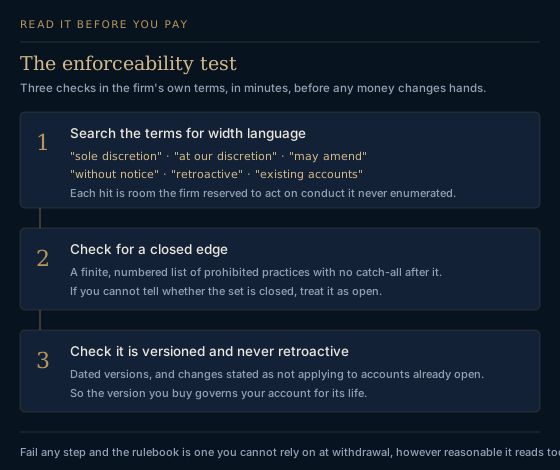
You can judge a rulebook's shape in a few minutes, from the firm's own terms, before any money changes hands.
Search the terms for the width language first. Open the document and use your browser's find function for the phrases below. Each hit is a place where the firm has reserved room to act on something it did not enumerate.
| Search the terms for | What a hit means |
|---|---|
| "sole discretion", "at our discretion" | The firm reserved room to act on conduct it did not enumerate |
| "may amend", "change ... at any time" | The rules can change after you buy |
| "without notice", "any reason" | The firm need not warn you or cite a listed rule |
| "retroactive", "existing accounts" | Check whether a change applies to accounts already open |
Then check for the closed edge. A closed list reads as a finite, numbered set of prohibited practices with no catch-all after it. An open one reads as a list followed by a clause that reaches past the list. If you cannot tell whether the set is closed, treat it as open, because an ambiguous boundary is one the firm can resolve at payout.
Last, check that the rulebook is versioned and dated, and that changes are stated as not applying to accounts already open. A rulebook that can change your account's rules after purchase is a rulebook you cannot rely on at withdrawal, no matter how reasonable it reads today. This enforceability test is one part of a wider pre-purchase document check, which covers the reserve, the payout clock, and the drawdown model as well.
Questions traders ask about unwritten prop firm rules
Can a prop firm enforce a rule that is not in the terms?
Only if the terms give it discretion to. A rulebook with a sole-discretion or catch-all clause lets a firm act on conduct it never enumerated, including at payout. Under a closed rules list, where the prohibited practices are named and the list ends there, a practice that is not written is not a violation and cannot be enforced.
Can a prop firm invent a rule after you buy?
It can if two things are true: the terms let it change the rules at any time, and those changes apply to accounts already open. FunderPro's terms reserve the right to change the fee, terms, and rules of its challenges at any time (FunderPro Terms and Conditions, clause 5.4, retrieved 2026-07-28). The protection against this is versioning that is never retroactive, where the version you bought governs your account for its life.
What is a closed rules list at a prop firm?
A closed list is a finite, enumerated set of prohibited practices with no catch-all clause after it. Because the list is the whole boundary, any practice not on it is permitted by definition. Ordane's clause R-6 names six prohibited practices and states that if a behavior is not listed, it is not a violation (Ordane Rulebook v1.0, clause R-6).
Can a prop firm ban a strategy that is not listed?
Under a closed rules list, no. If the prohibited practices are named and the list ends there, a strategy that is not on the list is permitted by definition, not by the firm's goodwill. Overnight and weekend holding is allowed at Ordane. It is not on the R-6 closed list, and what is not listed is not a violation (ordanemarkets.com specification sheet, and Ordane Rulebook v1.0, clause R-6). Under an open rulebook with a sole-discretion clause the answer flips, because the firm can act on a strategy it never enumerated.
What does a sole-discretion clause mean?
It is a term that lets a firm act for reasons it has not listed, at its own judgement and often without notice. FunderPro's live terms, for example, reserve the right at the company's sole discretion and without prior notice to restrict, suspend, or limit a client's access to their account (FunderPro Terms and Conditions, clause 8.6, retrieved 2026-07-28). The clause is the mechanism that makes an unwritten rule enforceable.
Do prop firm rules apply retroactively to your account?
That depends on the rulebook. Some firms reserve the right to change rules at any time and apply the change to existing accounts, which is what drew backlash to FundingTicks in December 2025 (Finance Magnates, December 2025, retrieved 2026-07-28). A rulebook that is versioned and never retroactive fixes your rules at the moment you buy, so a later change produces a new version and leaves your account under the one you agreed to.
Sources
- FunderPro Terms and Conditions, clause 8.6, on the right, at the company's sole discretion and without prior notice, to restrict, suspend, or limit a client's access to their account, products, or services. funderpro.com/terms-conditions Retrieved 2026-07-28.
- FunderPro Terms and Conditions, clause 4.9, on the company's sole discretion to define unreasonable behavior and its limits. funderpro.com/terms-conditions Retrieved 2026-07-28.
- FunderPro Terms and Conditions, clause 5.4, on the right to change the fee, terms, and rules of the challenges at any time. funderpro.com/terms-conditions Retrieved 2026-07-28.
- FunderPro Terms and Conditions, clause 17.1, on material changes being communicated in advance with the option to accept or terminate the agreement. funderpro.com/terms-conditions Retrieved 2026-07-29.
- U.S. Commodity Futures Trading Commission, Release 8771-23, on charging Traders Global Group, doing business as My Forex Funds, with fraudulently taking over $300 million from customers hoping to become professional traders. cftc.gov, Press Release 8771-23 Retrieved 2026-07-29.
- Quinn Emanuel, on the court dismissing the My Forex Funds case with prejudice and ordering the CFTC to pay the defendants over $3 million in attorneys' fees and costs. quinnemanuel.com Retrieved 2026-07-29.
- Finance Magnates, on prop firm FundingTicks facing backlash for applying rule changes retroactively to existing accounts, including a lower profit split and new trade-hold and profitable-day requirements. financemagnates.com Retrieved 2026-07-28.
- The Industry Spread, on the retail prop model in which the customer is typically trading a simulated or demo account against the firm's own risk engine, with the firm acting as counterparty. theindustryspread.com Retrieved 2026-07-28.
- Ordane Rulebook v1.0, clause P-2, on all accounts operating on simulated capital with no live funds and no deposits accepted. ordanemarkets.com/rulebook Retrieved 2026-07-25.
- Ordane Rulebook v1.0, clause R-6 and Appendix A, on the closed list of six prohibited practices and that a behavior not listed is not a violation, with each practice defined by examples in Appendix A (A-1 through A-6), published 2026-08-01. ordanemarkets.com/rulebook Retrieved 2026-08-01.
- Ordane Rulebook v1.0, notice above section 0 and section 6 Changelog, on the rulebook being public, numbered, versioned, never applied retroactively to an open account, and governed today by version 1.0 published 2026-07-23. ordanemarkets.com/rulebook Retrieved 2026-07-25.
- Ordane Markets, specification sheet, payout ledger and footer, on Ordane Instant Account as the single simulated-capital product, overnight and weekend holding being allowed, no payout history to show or manufacture, and the operating entity Ordane Markets Ltd (in formation). ordanemarkets.com Retrieved 2026-07-25.