Home · The Ordane Journal · Payouts · Prop Firm KYC: When Verification Stalls Your Payout
Prop Firm KYC: When Verification Stalls Your Payout
KYC, short for Know Your Customer, is the identity check a firm runs to confirm you are who you say you are before it moves money to you. It is not a red flag. It is a standard financial-services control, and a firm that skipped it entirely would be the more worrying option.
Ordane accounts operate on simulated capital. No live funds are traded and no deposits are accepted (Ordane Rulebook v1.0, clause P-2, and ordanemarkets.com payout-funding statement, retrieved 2026-07-29). That distinction matters later in this article, because it is the reason a prop firm's KYC step lands at a different moment than a broker's would.
KYC in one line, and the variable that actually decides your payout
What KYC and AML checks are, in plain terms
KYC is the identity check; AML is the reason for it. Anti-money-laundering rules require regulated firms to know who their customers are, so they build an identity programme to satisfy that requirement. FINRA states that a firm's AML programme must include a risk-based customer identification program designed to let the firm form a reasonable belief that it knows the true identity of its customers (FINRA, retrieved 2026-07-29). The UK Financial Conduct Authority states that regulated firms must apply risk-based customer due diligence measures to prevent their services being used for money laundering or terrorist financing, under the Money Laundering Regulations (FCA, retrieved 2026-07-29).
In practice, for a trader, that means submitting a government photo ID and usually a proof of address, once, and having a human or an automated system match it against the name on the account.
Why "when" matters far more than "whether"
Every serious firm will verify you at some point. The question is what that verification is standing between. If it happens before you can trade, the cost is a few days of waiting before you start. If it happens the moment you request your first withdrawal, the cost is a few days between passing and getting paid. If it happens on every single withdrawal request, the cost is a recurring, discretionary pause on your money, forever.
Same check. Three completely different exposures.
The three KYC timing models: at purchase, at first withdrawal, at every payout
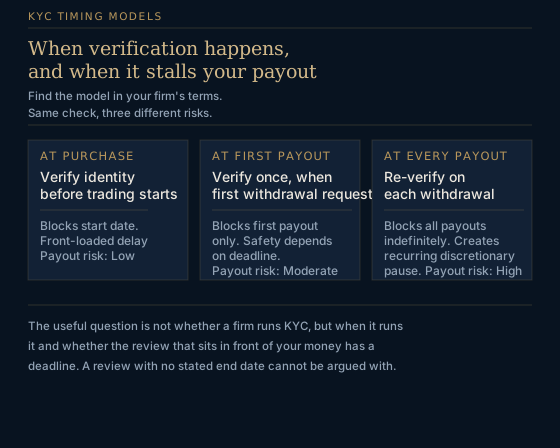
Any firm you are considering fits into one of three models. Find out which one before you pay.
| Model | When you verify | What it blocks | Payout-stall risk |
|---|---|---|---|
| At purchase | Before you can trade | Your start date | Low. Delay is front-loaded and visible. |
| At first withdrawal | Once, on the first payout request | Your first payout only | Moderate. Depends entirely on whether the review has a deadline. |
| At every payout | On each withdrawal request | Every payout, indefinitely | High. Creates a recurring, discretionary pause. |
At purchase: verified before you can trade
The firm verifies identity at signup. You lose a few days up front and then the topic never returns. The trade-off is friction before you have any reason to trust the firm, which is why many firms avoid it: identity checks at checkout suppress conversions.
At first withdrawal: verified once, when money is about to move
The check is deferred to the moment it actually matters, the first time value leaves the firm. In the FTMO Challenge: 1-Step, FTMO's identity verification becomes available only after all applicable Trading Objectives are met and the evaluation results are reviewed, not before trading begins (FTMO x OANDA, retrieved 2026-07-29).
This model is defensible and common. Its safety depends on one thing: whether the review that sits in front of your first payout is bounded by a deadline, or left open.
Ordane uses this model. KYC happens once, at the first withdrawal request, not at purchase, and there is no re-verification loop at every payout (Ordane Markets, homepage FAQ, retrieved 2026-07-29). Identity verification is one item on a longer first-payout checklist; the rest of that checklist covers the other requirements you clear before the first request goes through.
At every payout: re-verified on each request, the re-KYC loop
Here the firm reserves the right to re-run verification on each withdrawal request. Regulators do expect ongoing monitoring: the FCA states that businesses must continuously monitor all customers to make sure transactions are consistent with what the business knows about the customer and their risk profile (FCA, retrieved 2026-07-29). Monitoring transactions in the background is not the same thing as freezing a payout while you resubmit a passport photo you already submitted three months ago.
If a firm's terms allow verification to be re-opened at any withdrawal, with no stated ceiling on how long that takes, the firm has written itself a permanent, discretionary pause button on your money. It may never press it. It does not have to promise you anything about when it will let go.
Next step. Once the checklist is clear, match the model in Instant Account vs evaluation, then open the rulebook and accounts side by side.
Why "we still need to verify you" is the classic payout stall
The unbounded review: KYC with no deadline
The stall pattern has a specific shape. The firm does not deny the payout, because a denial has to be justified against a rule. It pauses the payout for review, and a review with no stated end date cannot be argued with. There is nothing to escalate. You are not owed anything yet, on paper, because the process has not concluded.
This is not hypothetical. In March 2024 The Funded Trader suspended all payouts citing a self-imposed internal audit of every payout, without specifying a timeline for clearing the backlog (Finance Magnates, retrieved 2026-07-29). The mechanism was a review, not a refusal. That is exactly what makes it hard for a trader to contest.
What a bounded KYC exclusion looks like instead
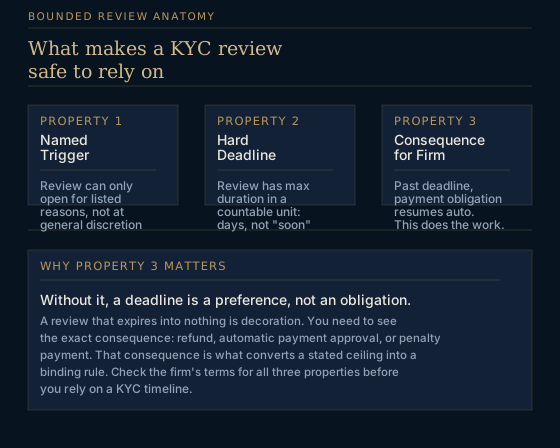
A bounded review has three properties, and you can check all three in a firm's own written terms:
- A named trigger. The review can only be opened for a specific, listed reason, not at general discretion.
- A hard deadline. The review has a maximum duration, stated in a unit you can count.
- A consequence for the firm. Past that deadline, the obligation to pay resumes automatically, regardless of the review's status.
Property three is the one that does the work. Without it, a deadline is a preference. The Ordane Guarantee is written this way: it has two objective exclusions, documented fraud or KYC review, and declared force majeure. Both carry a hard deadline, and beyond it the payment penalty applies regardless (Ordane Rulebook v1.0, clause G-2, retrieved 2026-07-29). Those exclusions sit inside a payout clock, so the review is a bounded interruption to that clock rather than a replacement for it. The full payout clock is the frame a KYC review has to fit inside.
What to check about a firm's KYC before you pay
Three questions, all answerable from a firm's published terms in ten minutes. If any answer is "not stated anywhere," you have your answer.
Is the KYC timing stated in writing at all?
Not in a support-chat reply. In a document you can point at later. If the timing is only ever explained conversationally, the timing can change conversationally.
Is the review deadline bounded, or open-ended?
Look for a number and a unit. "As soon as possible," "promptly," and "subject to review" are not deadlines. Then look for what happens when the deadline passes. A deadline that expires into nothing is decoration.
Is verification a one-time step or a loop on every payout?
Search the terms for language allowing re-verification at any withdrawal. This is the single clause most likely to convert a passed account into an unpaid one, and it is usually one sentence long. Related: whether a payout can be reversed or denied after it has already been approved, and the wider set of checks to run on a firm before you pay.
How Ordane handles KYC
Ordane sells one product, the Ordane Instant Account: direct access, no evaluation phase and no challenge, on simulated capital (Ordane Rulebook v1.0, section 1). Its KYC process follows the same discipline as the rest of the account: one step, bounded by a deadline, published rather than left to discretion.
Once, at the first withdrawal request
KYC happens once, at the first withdrawal request, not at purchase. There is no re-verification loop at every payout (Ordane Markets, homepage FAQ, retrieved 2026-07-29). You are not asked to verify identity to buy an account, and you are not asked to re-verify on the second, fifth, or ninth withdrawal.
Bounded by The Ordane Guarantee, not left open-ended
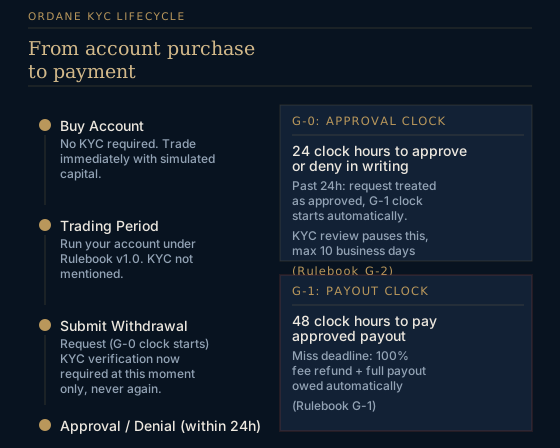
The KYC review is not a free-floating discretion. Every withdrawal request is approved, or denied in writing citing the exact rule breached by section number, within 24 clock hours, and past that deadline the request is treated as approved and the payment clock starts (Ordane Rulebook v1.0, clause G-0, retrieved 2026-07-29). A payout approved and not paid within 48 clock hours, not business hours, triggers automatic compensation: a 100 percent refund of the account fee, plus the payout owed in full (Ordane Rulebook v1.0, clause G-1, retrieved 2026-07-29).
KYC review is one of exactly two things that can pause that machinery, alongside declared force majeure, and both carry a hard deadline beyond which the penalty applies regardless (Ordane Rulebook v1.0, clause G-2, retrieved 2026-07-29). The review is an interruption with an expiry, not an alternative to the clock.
| Rulebook clause | What it binds | Deadline | Past the deadline |
|---|---|---|---|
| Ordane Rulebook v1.0, clause G-0 | Approval, or written denial citing the exact rule breached by section number, of every withdrawal request | 24 clock hours | The request is treated as approved and the payment clock starts |
| Ordane Rulebook v1.0, clause G-1 | Payment of an approved payout | 48 clock hours, not business hours | Automatic compensation: a 100 percent refund of the account fee, plus the payout owed in full |
| Ordane Rulebook v1.0, clause G-2 | The two objective exclusions: documented fraud or KYC review, and declared force majeure | A hard deadline, with the exact day count stated in the clause itself | The payment penalty applies regardless |
What is not published yet, stated plainly
Ordane is new, so here is the honest boundary of what you can verify today. The list of documents required at that first verification step is not published on the site yet, so this article does not invent one. This article states that the exclusion deadline exists and is hard, and points you to the rulebook clause itself for the exact day count. Check the clause before you rely on any figure.
There is also no payout history to point at yet, which is why the argument here is structural rather than anecdotal. If you want the general method for verifying that a firm actually pays before trusting it, that is the article to read alongside this one.
FAQ: prop firm KYC and your payout
Does a prop firm run KYC before or after you pass?
It depends on the firm, and it is worth checking before you pay. Some verify at purchase, before you can trade. Others defer verification until you have met the objectives and are requesting a payout. In the FTMO Challenge: 1-Step, for instance, identity verification becomes available only after all applicable Trading Objectives are met and the evaluation results are reviewed (FTMO x OANDA, retrieved 2026-07-29). Ordane verifies once, at the first withdrawal request, not at purchase (Ordane Markets, homepage FAQ, retrieved 2026-07-29).
Can a prop firm refuse a payout over KYC?
A firm can pause a payout pending an identity review, and if that review has no stated deadline, the pause can last indefinitely. That is why the useful question is not whether KYC can stop a payout, but whether the firm has written a maximum duration for the review and a consequence for exceeding it. At Ordane, KYC review is one of two objective exclusions to The Ordane Guarantee, each carrying a hard deadline, beyond which the payment penalty applies regardless (Ordane Rulebook v1.0, clause G-2, retrieved 2026-07-29).
Do prop firms re-verify you at every withdrawal?
Some reserve the right to. Ongoing transaction monitoring is a genuine regulatory expectation; the FCA requires businesses to continuously monitor all customers so transactions stay consistent with the customer's known risk profile (FCA, retrieved 2026-07-29). Background monitoring is not the same as pausing each payout for a fresh document upload. At Ordane there is no re-verification loop at every payout (Ordane Markets, homepage FAQ, retrieved 2026-07-29).
Does KYC mean the trading is with real money?
No. KYC is an identity and anti-money-laundering control, and it applies because money is being paid out to you, not because client capital is being traded. FINRA states the point of the customer identification programme is to let the firm form a reasonable belief that it knows the true identity of its customers (FINRA, retrieved 2026-07-29). Ordane accounts operate on simulated capital. No live funds are traded and no deposits are accepted (Ordane Rulebook v1.0, clause P-2, and ordanemarkets.com payout-funding statement, retrieved 2026-07-29). The identity check exists because real money leaves the firm at payout, not because real money is in the account.
Sources
- FINRA, Anti-Money Laundering (AML), on a risk-based customer identification program (CIP) that lets a firm form a reasonable belief that it knows the true identity of its customers. finra.org Retrieved 2026-07-29.
- UK Financial Conduct Authority, on applying risk-based customer due diligence under the Money Laundering Regulations, and on continuously monitoring all customers so transactions stay consistent with the customer's business and risk profile. fca.org.uk Retrieved 2026-07-29.
- FTMO x OANDA, on identity verification in the FTMO Challenge: 1-Step becoming available only after all applicable Trading Objectives are met and the evaluation results are reviewed. ftmo.oanda.com Retrieved 2026-07-29.
- Finance Magnates, on The Funded Trader citing a self-imposed internal audit of all payouts to suspend them in March 2024, without specifying a timeline. financemagnates.com Retrieved 2026-07-29.
- Ordane Markets, homepage FAQ, on KYC running once at the first withdrawal request, not at purchase, with no re-verification loop at every payout. ordanemarkets.com Retrieved 2026-07-29.
- Ordane Rulebook v1.0, clause G-0, on every withdrawal request being approved, or denied in writing citing the exact rule breached by section number, within 24 clock hours. ordanemarkets.com/rulebook Retrieved 2026-07-29.
- Ordane Rulebook v1.0, clause G-1, on a payout approved and not paid within 48 clock hours triggering automatic compensation of a 100 percent fee refund plus the payout in full. ordanemarkets.com/rulebook Retrieved 2026-07-29.
- Ordane Rulebook v1.0, clause G-2, on the two objective exclusions to The Ordane Guarantee, documented fraud or KYC review and declared force majeure, each carrying a hard deadline beyond which the guarantee applies regardless. ordanemarkets.com/rulebook Retrieved 2026-07-29.
- Ordane Rulebook v1.0, clause P-2, on all accounts operating on simulated capital with no live funds traded and no deposits accepted. ordanemarkets.com/rulebook Retrieved 2026-07-29.