Home · The Ordane Journal · Payouts · Alpha Capital Payout Rules Explained
Alpha Capital Payout Rules Explained
Payout rules define the schedule, profit split, and eligibility conditions for withdrawing simulated profits from a proprietary trading firm. Ordane accounts operate on simulated capital. No live funds are traded and no deposits are accepted. (Ordane Rulebook v1.0, clause P-2, retrieved 2026-09-05)
Traders often evaluate proprietary trading firms by looking at the rules for withdrawals. The focus is always on the payout schedule, the profit split, and the regulatory environment of the firm. Payouts depend on simulated performance under Rulebook v1.0; no level of performance is typical or assured. Ordane sells one product, the Ordane Instant Account: direct access, no evaluation phase and no challenge, on simulated capital. (Ordane Rulebook v1.0, section 1, retrieved 2026-09-05) The industry sells many variations, so comparing them requires looking at the exact clauses.
Does Alpha Capital Group actually pay out?
Alpha Capital Group processes simulated payouts for traders who follow its published rules, though evaluating the firm requires checking the exact withdrawal terms. Traders evaluating proprietary firms ask if the company actually processes withdrawals for traders who follow the rules. To understand if a firm pays, traders look at the operational history and the specific clauses that govern the withdrawal request. A firm's ability to pay is tied to its business model and the rules it enforces on the trading activity. In the proprietary trading sector, payouts are contingent on strict adherence to risk management parameters.
Here is a checklist of what traders typically verify regarding payout reliability:
- The clarity of the withdrawal timeline.
- The absence of retroactive rule changes.
- The specific conditions required to submit a request.
- The method of payment processing.
Ordane addresses the fear of non-payment with a public reserve. Ordane's payout reserve is published at a public TRON address on ordanemarkets.com and in Rulebook v1.0 clause PR-1. (Ordane Rulebook v1.0, clause PR-1, retrieved 2026-09-05) The page carries a dated observed balance and states that the reserve is not a promise, it is an address. Payouts are paid from company fee revenue. No client deposits are taken and no client capital is traded. Rulebook v1.0 clause PR-1 commits Ordane to publish the payout reserve on-chain; the live rulebook and homepage publish the TRON address.
To further ensure payment, The Ordane Guarantee provides a strict timeline. Every withdrawal request is approved, or denied in writing citing the exact rule breached by section number, within 24 clock hours. (Ordane Rulebook v1.0, clause G-0, retrieved 2026-09-05) Past that deadline the request is treated as approved and the G-1 clock starts. A payout approved and not paid within 48 clock hours, not business hours, triggers automatic compensation: a 100 percent refund of the account fee, plus the payout owed in full. (Ordane Rulebook v1.0, clause G-1, retrieved 2026-09-05)
When evaluating different providers, the actual mechanism of payment is critical. Some firms use third-party payment processors, while others handle transactions internally through cryptocurrency networks. The reliability of these networks often dictates the speed of the transaction. A trader must review the terms of service to understand exactly which payment rails are supported and what fees might apply during the transfer.
Another factor is the documentation required to process the first withdrawal. Most firms require identity verification before any funds are released. KYC happens once, at the first withdrawal request, not at purchase. (ordanemarkets.com, FAQ, retrieved 2026-09-05) There is no re-verification loop at every payout.
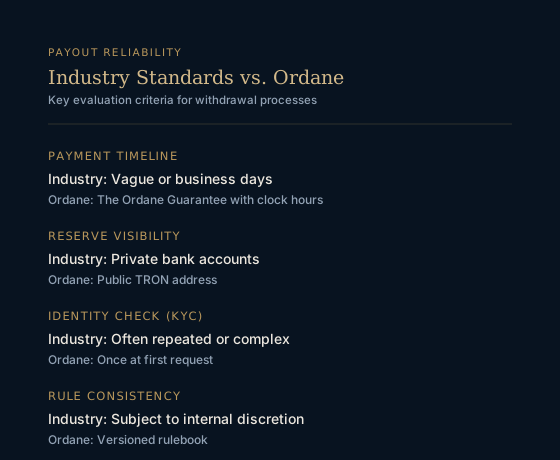
| Evaluation Criteria | Industry Approach | Ordane Approach |
|---|---|---|
| Payment Timeline | Often vague or subject to business days | The Ordane Guarantee with clock hours |
| Reserve Visibility | Private bank accounts | Public TRON address |
| Identity Check | Often repeated or complex | Once at first request |
| Rule Consistency | Subject to internal discretion | Versioned rulebook |
What hidden rules can delay your first payout?
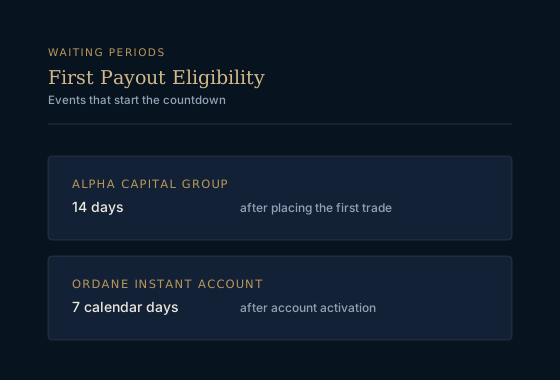
A mandatory 14-day waiting period is the primary rule that delays a first payout at Alpha Capital Group. Traders want to know what conditions apply before they can request their first withdrawal. For example, Alpha Capital Group dictates that traders can request their first payout 14 days after placing their first trade on the funded account. (Alpha Capital Group Rules, retrieved 2026-09-05) This timeframe is a strict requirement for payment eligibility.
Understanding the waiting period is essential for managing expectations. The 14-day rule means that even if a trader generates profits early in the cycle, the funds remain locked until the designated time has passed. This structure is common in the industry to ensure that trading activity is consistent over a measurable period.
- The cycle begins on the date of the first executed order.
- Days without trading do not accelerate the cycle.
- The request button becomes active only after the full period elapses.
At Ordane, the timeline is defined by the rulebook. The first withdrawal is available 7 calendar days after account activation, and the cycle thereafter is every 14 days. (Ordane Rulebook v1.0, clause PA-1, retrieved 2026-09-05) This schedule is fixed. Furthermore, Ordane's maximum drawdown is 5 percent and static: account equity may never fall below 95 percent of the initial balance. (Ordane Rulebook v1.0, clause R-1, retrieved 2026-09-05) The floor is fixed on day one, never trails upward, and a breach closes the account.
Traders must also be aware of trading style restrictions that might affect payout eligibility. Ordane's prohibited-practice list is closed. Clause R-6 names six practices: latency, reverse or hedge arbitrage; high-frequency or bulk automated exploitation; copy trading between Ordane accounts; straddling news releases with paired opposing orders; platform or data-feed exploitation; and gap abuse. (Ordane Rulebook v1.0, clause R-6, retrieved 2026-09-05) If a behavior is not listed in that section, it is not a violation. Discretion is not a rule.
Some firms promise that profit is certain, which no regulator allows. Ordane makes no such claims. The focus is entirely on clear, verifiable conditions. Ordane's consistency rule is 20 percent: at the moment of a withdrawal request, no single trading day may account for more than 20 percent of the cycle's total profit. (Ordane Rulebook v1.0, clause R-4, retrieved 2026-09-05) If a day exceeds 20 percent, the excess profit from that day is deferred to the next cycle. It is never confiscated, and the remainder of the cycle pays out normally.
The daily limits also play a role in maintaining the account until the payout date. The daily loss limit is 3 percent, measured against the balance at the start of the server day. (Ordane Rulebook v1.0, clause R-2, retrieved 2026-09-05) A breach closes the account. Maximum risk per trade is 1.5 percent of current balance and a stop-loss is mandatory at entry. (Ordane Rulebook v1.0, clause R-3, retrieved 2026-09-05) Two maximum losses equal the daily limit, which is the design rather than an accident.
To calculate the exact timing, traders must look at the calendar.
| Event | Action Required | Timeline Consequence |
|---|---|---|
| First Trade | Execution of order | Starts the countdown for Alpha Capital Group |
| Account Activation | Receiving credentials | Starts the 7-day clock for Ordane |
| Subsequent Requests | Submitting the form | Typically on a 14-day cycle |
Consistency rules are designed to prevent luck from dictating the payout. By capping the percentage of profit that can be attributed to a single day, firms ensure that the trader is executing a repeatable strategy. This is a risk management tool that protects the firm from extreme market volatility and sudden outsized gains that do not reflect consistent trading skill.
Traders must monitor their daily performance closely. If a major economic announcement causes a significant market move, and the trader captures a large portion of that move, they must calculate the ratio of that day's profit against the total cycle profit. If the ratio exceeds the limit, the trader knows exactly what will happen at the end of the cycle. At Ordane, the excess is deferred, never erased.
What is a prop firm payout reserve?
A prop firm payout reserve is a verifiable pool of capital maintained to mathematically prove a firm can meet withdrawal requests. Regulatory stability is a primary concern for traders committing time to a platform. A firm must have a sustainable model to survive over the long term. The UK Financial Conduct Authority (FCA) restricts retail leverage on major currency pairs to 30:1. (PS19/18: Restricting contract for difference (CFD) products sold to retail clients, retrieved 2026-09-05) This regulation shapes how firms manage market exposure.
Firms operating in jurisdictions with strict oversight must adapt their risk models to comply with leverage caps and client money rules. The restriction on retail leverage forces a different approach to margin requirements. When evaluating a firm, traders must consider how regulatory changes might impact the firm's ability to operate and process withdrawals.
- Leverage limits reduce the notional size a trader can control.
- Lower leverage requires more initial margin for the same position.
- Regulatory compliance adds operational overhead to the business.
Ordane is new. Its live homepage says it will not fake a history; the rulebook says payout performance metrics begin with the first month in which a payout is requested. (ordanemarkets.com, reserve section, retrieved 2026-09-05) Rulebook v1.0 commits Ordane to a dated payout ledger from payout number one, and to payout performance metrics published with dates on a fixed monthly schedule. (Ordane Rulebook v1.0, clause PR-2, retrieved 2026-09-05) As of 2026-07-25 the ledger is empty, because no payout has happened yet.
The structural design of the platform also affects longevity. Ordane runs on a trading platform it designed and built with its own engineering team, and licenses no third-party terminal: not MatchTrader, not MetaTrader, not any external vendor. The distinction is structural, not cosmetic. A firm that licenses its terminal can be closed by a decision it does not control, and in 2024 that is exactly what happened: MetaQuotes withdrew MT4 and MT5 access from prop firms, True Forex Funds announced permanent closure on 13 May after its licences were terminated, and SurgeTrader ceased all operations on 24 May, one week after losing its Match-Trader licence. Ordane owns the terminal its traders use, so no vendor can revoke it, reprice it, or decide it will no longer serve this industry.
Transparency in operations is another indicator of longevity. The Ordane rulebook is public, numbered and versioned, and no rule is ever applied retroactively to an open account. (Ordane Rulebook v1.0, section 6, retrieved 2026-09-05) Changes produce a new version with a dated changelog entry, and the version you sign up under is the version that governs your account. The governing document is Ordane Rulebook v1.0, published 2026-07-23.
Traders also worry about accounts being closed for inactivity. Accounts with no trading activity for 30 consecutive days are closed. (Ordane Rulebook v1.0, clause R-5, retrieved 2026-09-05) The 30 consecutive days in clause R-5 are calendar days, not business days. Under clause R-5, trading activity means at least one filled order. Pending orders and platform logins do not count.
| Firm Aspect | Vendor Dependency | Ordane Structure |
|---|---|---|
| Trading Terminal | Licensed from third party | Built and owned internally |
| Risk Exposure | Subject to vendor revocation | Controlled by internal engineering |
| Rule Application | Often retroactive | Strictly versioned |
The regulatory environment heavily scrutinizes the use of live funds. Firms offering a funded account often face complex legal hurdles. By operating strictly on simulated environments, companies can offer evaluation and trading experiences without crossing into regulated brokerage activities. This distinction is vital for operational continuity. If a firm misrepresents its structure, it risks regulatory action that could freeze operations and halt all payouts indefinitely.
Therefore, clear documentation is paramount. Firms must state explicitly how they operate and where the payout funds originate. A company that relies entirely on new customer fees to pay successful traders operates a fragile model. A company that maintains a verifiable reserve provides a mathematical proof of its capacity to honor its obligations.
The industry has seen numerous firms launch with aggressive marketing only to disappear within months. This cycle of rapid expansion and sudden collapse is often driven by an overreliance on new registrations to fund payouts for existing users. When the influx of new traders slows, the firm cannot meet its obligations, leading to delayed withdrawals and eventual closure. This is the primary reason traders must demand verifiable proof of capital reserves. A public address containing the necessary funds provides a mathematical guarantee that the firm can honor its commitments, regardless of the daily volume of new sign-ups.
The choice of trading platform is intrinsically linked to the firm's independence. By building and maintaining proprietary technology, a firm insulates itself from the shifting policies of external software vendors. The historical reliance on a single, dominant platform left the entire sector vulnerable to unilateral decisions. A proprietary terminal requires significant upfront investment in engineering and infrastructure, signaling a commitment to a durable business model rather than a short-term venture. This structural independence is a critical factor for traders assessing the long-term viability of their chosen platform.
How much of the profit do you keep?
Funded traders keep an 80% default profit split at Alpha Capital Group, calculated from eligible simulated profits at the moment of request. The final detail traders verify is the actual split of the generated profits. Alpha Capital Group offers a default profit split of 80% to funded traders. (Alpha Capital Group FAQ, retrieved 2026-09-05) This percentage defines the trader's share of the total eligible profit generated during the cycle, calculated at the moment of the request.
Understanding the split structure is crucial for projecting potential earnings. A default split provides a baseline, but traders must verify if the firm offers a path to increase that percentage over time. Scaling plans and split escalators are common mechanisms used to reward long-term profitability and consistency.
Ordane declares the inputs for this check as a $139 account fee, a $0 recurring fee, and a 60 percent first-withdrawal split. Ordane's worked arithmetic is: $139 + $0 = $139 total upfront cost.
| Metric | Input Value | Resulting Amount |
|---|---|---|
| Account Fee | $139 | Initial cost |
| Recurring Fee | $0 | Additional cost |
| Expected Spread | Raw | Execution baseline |
| Total Upfront Cost | $139 | Final commitment |
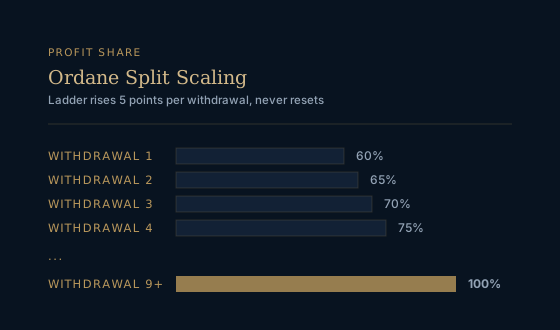
At Ordane, the structure is designed to scale with the trader's success. Ordane's profit split starts at 60 percent and rises 5 percentage points with every completed withdrawal, reaching 100 percent from the ninth withdrawal onward. (Ordane Rulebook v1.0, clause PA-2, retrieved 2026-09-05) The split ladder is in writing and never resets. This provides a clear mathematical progression for the trader's share of the simulated profits.
The withdrawal amounts are subject to specific rules in the early stages. Withdrawals #1 and #2 are each capped at 3 percent of initial balance. (Ordane Rulebook v1.0, clause PA-3, retrieved 2026-09-05) From withdrawal #3 onward there is no cap. Withdrawals reduce the account balance, and the R-1 drawdown floor stays anchored to the initial balance. (Ordane Rulebook v1.0, clause PA-4, retrieved 2026-09-05) This mechanic ensures that capital preservation remains the priority even after a successful cycle.
The cost of entry is also a factor in the overall calculation. Ordane Instant Account comes in five sizes: $2,500, $10,000, $25,000, $50,000 and $100,000. (Ordane Rulebook v1.0, section 1, retrieved 2026-09-05) The fee is one-time: $59 for the $2,500 account, $139 for the $10,000 account, $299 for $25,000, $549 for $50,000 and $999 for $100,000. There are no recurring fees, no hidden tiers and no coupon games. Ordane charges no commission, no spread and no swap. The account fee is the only cost the trader pays. The reason is structural, not promotional: accounts run on simulated capital, so no order is routed to an exchange and nothing is financed overnight, which means neither line has an underlying bill behind it.
Ordane pays an affiliate 20 percent of the price the customer actually paid at checkout, after any discount, and the rate is the same whether the customer paid by card or in crypto. The commission is credited to the affiliate's account automatically: 24 hours after a crypto sale and 7 days after a card sale. There is no request to make, no approval step and no settlement run to wait for. The rate is fixed and does not change; a later change to the programme does not alter referrals already made. Every sale counts, with no exclusion by product or account size.
Traders also consider the instruments available, as different assets have different characteristics. Ordane lists four asset classes: FX pairs (majors and minors), metals, indices and crypto. No exotics. Leverage on FX majors and minors is 1:50; leverage for metals, indices, and crypto has not been set yet. Accounts are simulated: no swap.
Regarding specific trading strategies, Expert Advisors are fully permitted at Ordane: a trader may run an EA executing the trader's own strategy on an Ordane account. Furthermore, overnight and weekend holding is allowed at Ordane. It is not on the R-6 closed list, and what is not listed is not a violation. (Ordane Rulebook v1.0, clause R-6, retrieved 2026-09-05)
The R-6 prohibition on copy trading between Ordane accounts applies only between different people. Copy trading is permitted exclusively between Ordane accounts that belong to the same person, meaning the same account holder and ultimate beneficial owner. Copy trading between person A and person B is always prohibited. (Ordane Rulebook v1.0, Appendix A, entry A-3, retrieved 2026-09-05) Ordane's Appendix A, entry A-1, names a normal hedge of a single Ordane position with a stop-loss under R-3, with no cross-feed exploit, as an example that does NOT close the account. Ordane's prohibited-practice list is closed: clause R-6 names six practices, and the only hedge-related one is latency, reverse or hedge arbitrage (R-6(a)). If a behavior is not listed, it is not a violation, so ordinary hedging inside one account is not a violation at Ordane.
Ordane's rulebook does restrict one thing around news: clause R-6(d) prohibits straddling news releases with paired opposing orders. (Ordane Rulebook v1.0, clause R-6(d), retrieved 2026-09-05) Because R-6 is a closed list, no other clause restricts trading during news or high-impact events.
To summarize the operational context, traders must read the rulebook. A breach closes the account. That is the whole consequence: no partial confiscations, no surprise fees, no renegotiation. The Ordane Guarantee has two objective exclusions: documented fraud or KYC review, and declared force majeure. Both carry a hard deadline, and beyond it G-1 applies regardless. (Ordane Rulebook v1.0, clause G-2, retrieved 2026-09-05) Both G-2 exclusions (documented fraud or KYC review, and declared force majeure) are capped at 10 business days each. Past that deadline, G-1 applies regardless.
The mechanics of simulated capital mean that the firm is evaluating the data generated by the trader, rather than the actual financial outcome of a routed order. This data is the product. When a trader requests a payout, they are essentially requesting compensation for the quality of the data they have provided through their simulated trading activity. This is why strict adherence to the rules is non-negotiable. The data is only valuable if it is generated under controlled, consistent conditions.
Firms use this data for various internal purposes, including risk modeling and algorithm development. Therefore, behaviors that exploit the simulated environment, such as latency arbitrage or gap abuse, corrupt the data. This explains why such practices are strictly prohibited and result in immediate account closure. A trader who understands this relationship can better navigate the rulebook. The rules are not arbitrary obstacles; they are the parameters that define the value of the trading data.
By focusing on a single, clear product, firms can streamline their operations and offer a more transparent service. Ordane sells one product, the Ordane Instant Account: direct access, no evaluation phase and no challenge, on simulated capital. This removes the complexity of multiple challenge phases, trailing drawdowns, and subjective evaluation criteria. The trader knows exactly what is expected from the first executed order.
The clarity of the fee structure also contributes to a transparent environment. When a firm lists multiple add-ons, customization options, and recurring fees, the true cost of the account becomes obscured. A one-time fee provides absolute certainty regarding the financial commitment required. The trader can calculate their exact risk before signing up. The absence of commissions, spread markups, and overnight swaps further simplifies the calculation. The trader only needs to focus on managing their risk and executing their strategy within the boundaries of the R-1 and R-2 limits.
Frequently Asked Questions
What is the default profit split at Alpha Capital Group?
Alpha Capital Group offers a default profit split of 80% to funded traders. (Alpha Capital Group FAQ, retrieved 2026-09-05)
When can a trader request their first payout at Alpha Capital Group?
Traders at Alpha Capital Group can request their first payout 14 days after placing their first trade on the funded account. (Alpha Capital Group Rules, retrieved 2026-09-05)
How does the FCA regulate retail leverage?
The UK Financial Conduct Authority (FCA) restricts retail leverage on major currency pairs to 30:1. (PS19/18: Restricting contract for difference (CFD) products sold to retail clients, retrieved 2026-09-05)
What is the minimum withdrawal timeline at Ordane?
At Ordane, the first withdrawal is available 7 calendar days after account activation, and the cycle thereafter is every 14 days. (Ordane Rulebook v1.0, clause PA-1, retrieved 2026-09-05)
What happens if Ordane delays a payout?
If Ordane approves a payout but does not pay within 48 clock hours, it triggers automatic compensation: a 100 percent refund of the account fee, plus the payout owed in full. (Ordane Rulebook v1.0, clause G-1, retrieved 2026-09-05)
Sources
- Alpha Capital Group FAQ alphacapitalgroup.uk Retrieved 2026-09-05T02:21:09-03:00.
- Alpha Capital Group Rules alphacapitalgroup.uk Retrieved 2026-09-05T02:21:09-03:00.
- PS19/18: Restricting contract for difference (CFD) products sold to retail clients fca.org.uk Retrieved 2026-09-05T02:21:09-03:00.