Home · The Ordane Journal · Payouts · Prop Firm Payout Methods & Hidden Withdrawal Rules
Prop Firm Payout Methods & Hidden Withdrawal Rules

A proprietary trading firm payout is the final settlement of simulated trading profits, transferred directly from the firm's corporate revenue to the trader using digital assets or traditional bank wires.
Ordane accounts operate on simulated capital. No live funds are traded and no deposits are accepted.
Traders evaluating different firms must examine the payment rails available, the origin of the capital, and the contractual rules that govern the withdrawal request. The process of receiving a payment involves legal classifications, specific transfer networks, and strict compliance procedures that dictate when and how the money arrives.
How Do Prop Firms Process Payouts?
Where the payout money actually comes from
A common concern among traders is the source of the capital used to settle these payments. Since the accounts are simulated, the payments do not originate from live market execution profits.
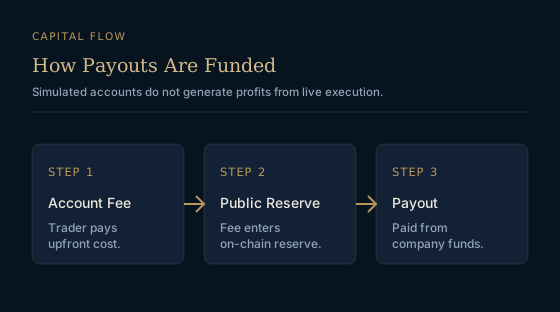
Payouts are paid in real money from company fee revenue. No client deposits are taken and no client capital is traded. Rulebook v1.0 clause PR-1 commits Ordane to publish the payout reserve on-chain; the live rulebook and homepage publish the TRON address.
When the payment originates from corporate revenue rather than market execution, the firm's financial health determines its ability to meet payout obligations. This structural reality makes verifiable reserves a critical metric for evaluating a firm. A transparent reserve demonstrates that the firm maintains sufficient capital to honor approved invoices, mitigating the counterparty risk inherent in these agreements. A deeper look at where prop firm payout money actually comes from shows why this revenue model, and not the trading itself, is what determines whether a firm can pay.
Ordane's payout reserve is published at a public TRON address on ordanemarkets.com and in Rulebook v1.0 clause PR-1. The page carries a dated observed balance and states that the reserve is not a promise, it is an address. The industry standard varies, but transparency regarding the reserve capital provides a verifiable metric. When a firm publishes its reserve, traders can observe the available capital independently. This approach replaces marketing claims with auditable data on a public ledger. That same transparency principle applies to the payout clock itself: see how long prop firms actually take to pay for the two separate deadlines, approval and transfer, that most firms blur into one promise.
What Are the Standard Prop Firm Withdrawal Methods?
The methods used to transfer capital have evolved to address the specific challenges of global payments. Firms must balance transaction speed, network costs, and accessibility for traders located in various countries. The selection of payment rails impacts how quickly the trader receives the funds after the invoice is approved.
Cryptocurrency and stablecoins
The demand for rapid cross-border settlement has changed the primary payment channels in the industry. Proprietary trading firms increasingly rely on cryptocurrency and stablecoins for global payouts to avoid the delays and high correspondent banking fees associated with international wire transfers (financemagnates.com, retrieved 2026-09-23).
Stablecoins pegged to the United States Dollar provide a mechanism for transferring value without the volatility associated with other digital assets. The use of blockchain networks allows for continuous settlement outside of traditional banking hours.
The adoption of digital assets for settlement requires traders to manage their own digital wallets. Receiving funds in stablecoins places the responsibility of securing the private keys and navigating the conversion to local fiat currency on the individual. Despite this added responsibility, the speed and low cost of blockchain settlement make it the dominant choice for international payouts. Transactions on networks like TRON or Ethereum settle in minutes, providing immediate finality once the firm initiates the transfer. This efficiency reduces the administrative burden on the firm and provides the trader with predictable delivery times.
Traditional bank wire transfers
Despite the shift toward digital assets, traditional bank wire transfers remain a standard option for many firms. The international wire system, primarily operating through the SWIFT network, provides a familiar channel for receiving large payments directly into a bank account.
The primary limitation of the wire transfer method is the involvement of correspondent banks. A single transaction may pass through multiple intermediary institutions before reaching the final destination. Each institution adds processing time and may deduct a fee from the principal amount.
Traders selecting the wire transfer option must provide accurate SWIFT codes, routing numbers, and receiving bank details. Any error in the provided information can result in the payment being rejected by an intermediary institution, leading to weeks of delay while the funds are returned and reissued. The processing time for international wires typically ranges from two to five business days. The exact duration depends on the jurisdictions involved, the specific banks processing the transaction, and the time of day the firm initiates the transfer.
Intermediaries and Deel
To streamline the management of agreements and payments, many firms integrate third-party intermediaries. Platforms designed for global payroll handle the compliance, tax documentation, and currency conversion aspects of the transaction.
FTMO (prop firm) provides simulated traders with payout options that include traditional bank wire transfers, Skrill, and multiple cryptocurrencies (ftmo.com, retrieved 2026-09-23).
These platforms often provide integrated currency exchange services, allowing traders to receive funds in their local currency without relying on the exchange rates offered by their primary bank. The use of specialized payroll platforms ensures that all regulatory reporting and tax documentation requirements are met prior to the disbursement of funds. Intermediaries provide the trader with multiple withdrawal options from a single platform. The firm funds the intermediary account, and the trader selects their preferred method to withdraw the balance to their local account. This structure shifts the complexity of cross-border transfers from the proprietary trading firm to a specialized payment processor.
What Hidden Rules Can Block Your First Payout?
Approval of a withdrawal request depends on strict adherence to the governing contract. Firms enforce risk management parameters and compliance procedures before authorizing any payment. A breach of these parameters can result in the denial of the request and the closure of the account.
Consistency rules and minimum trading days
Many firms impose consistency rules to filter out anomalous trading behavior. These rules dictate that the profit generated must be distributed across multiple trading days rather than concentrated in a single event.
Ordane's consistency rule is 20 percent: at the moment of a withdrawal request, no single trading day may account for more than 20 percent of the cycle's total profit. If a day exceeds 20 percent, the excess profit from that day is deferred to the next cycle. It is never confiscated, and the remainder of the cycle pays out normally. For the general mechanics behind this kind of clause across the industry, see what the consistency rule actually is and how it is calculated firm by firm.
The purpose of these rules is to identify traders who can demonstrate repeatable data generation rather than isolated volatile events. Evaluating simulated performance requires a sufficient sample size of data points. By enforcing consistency parameters, firms ensure that the agreement is fulfilled according to the specified risk models. The application of consistency rules varies across the industry. Some firms confiscate profits that exceed the threshold, while others defer the excess. Understanding the exact mechanism is critical for planning a withdrawal.
In addition to consistency, many firms require a minimum number of trading days before a withdrawal request is eligible for processing. This requirement forces the trader to maintain the account for a specific duration.
Ordane sells one product, the Ordane Instant Account: direct access, no evaluation phase and no challenge, on simulated capital. The difference this direct-access model makes to the eventual payout is detailed in instant account vs evaluation.
KYC verification delays
Know Your Customer procedures are mandatory for processing financial transactions. Firms must verify the identity and residence of the trader to comply with international regulations.
KYC happens once, at the first withdrawal request, not at purchase. There is no re-verification loop at every payout. A full walkthrough of when this check runs, and how it can stall a payout, is covered in prop firm KYC verification explained.
Delays in the verification process are a common reason for postponed payments. If the submitted documents are unclear or require manual review, the approval of the withdrawal request is paused until the compliance check is complete.
Both G-2 exclusions (documented fraud or KYC review, and declared force majeure) are capped at 10 business days each. Past that deadline, G-1 applies regardless.
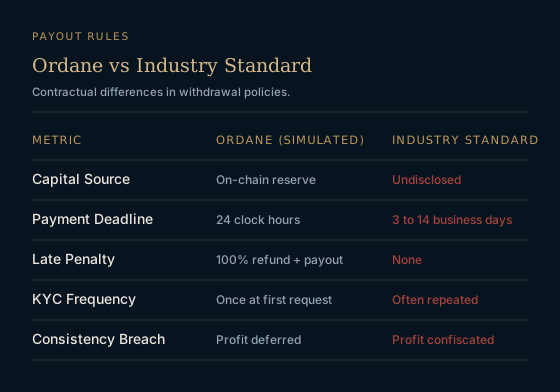
The Ordane Guarantee provides a specific framework for handling delays. Every withdrawal request is approved, or denied in writing citing the exact rule breached by section number, within 12 clock hours. Past that deadline the request is treated as approved and the G-1 clock starts. A payout approved and not paid within 24 clock hours, not business hours, triggers automatic compensation: a 100 percent refund of the account fee, plus the payout owed in full. Approval itself is not always the end of the story either; see can a prop firm take back your payout for the narrow conditions under which an approved payout can still be reversed.
| Metric/Feature | Ordane (Simulated) | Industry Standard |
|---|---|---|
| Capital Source | Published on-chain reserve | Undisclosed |
| Payment Deadline | 24 clock hours | 3 to 14 business days |
| Late Penalty | 100 percent fee refund plus payout | None |
| KYC Frequency | Once at first request | Often repeated |
| Consistency Breach | Excess profit deferred | Excess profit confiscated |
What Are the Typical Payout Fees and Transfer Costs?
The final amount received by the trader depends on the fees deducted during the transfer process. These costs are determined by the payment method selected and the policies of the processing institutions.
Declared inputs for this check: a $59 fee for the $2,500 account, a $0 charge to withdraw, and a $0 recurring fee. Worked arithmetic: $59 + $0 = $59 total upfront cost.
The fee is one-time: $59 for the $2,500 account, $139 for the $10,000 account, $299 for the $25,000 account, $549 for the $50,000 account, $999 for the $100,000 account. There are no recurring fees, no hidden tiers and no charge to withdraw.
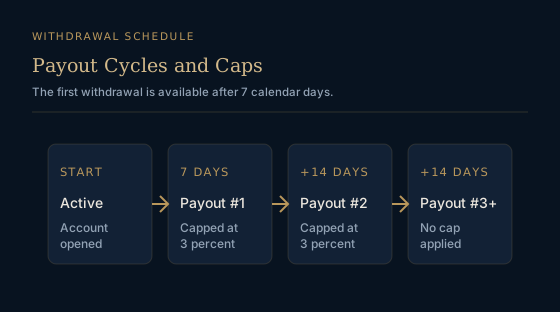
The first withdrawal is available 7 calendar days after account activation, and the cycle thereafter is every 14 days. Withdrawals #1 and #2 are each capped at 3 percent of initial balance. From withdrawal #3 onward there is no cap. Withdrawals reduce the account balance, and the R-1 drawdown floor stays anchored to the initial balance. The full first-payout checklist, including what happens before that 7-day clock even starts, is in prop firm withdrawal requirements. Traders comparing cycles across firms can also check how often you can withdraw from a prop firm.
For cryptocurrency transfers, network fees apply. The blockchain network requires a fee to process and validate the transaction. The entity responsible for covering this fee varies by firm. Some firms absorb the network cost, while others deduct it from the total payout amount.
Wire transfers involve fees from the originating bank, correspondent banks, and the receiving bank. These deductions can significantly reduce the final amount, especially for smaller withdrawals. Intermediary platforms may also charge a percentage or a flat fee for currency conversion or withdrawal to a local bank account. Traders must account for these transfer costs when calculating the expected return from a withdrawal request.
Frequently Asked Questions
Traders evaluating the industry consistently raise specific questions regarding the mechanics of payments. The following answers clarify the standard procedures and networks used for settlements.
What are the standard prop firm payout methods?
The standard methods include cryptocurrency transfers, traditional bank wires, and third-party global payroll platforms. Digital assets, specifically stablecoins, have become the preferred method due to settlement speed and lower international transfer costs.
How do prop firms pay out?
Firms review the simulated trading data against the contract rules, approve the invoice, and initiate the transfer through the selected payment rail.
Are there prop firms that pay in crypto?
Yes. The majority of the industry has adopted cryptocurrency networks for global settlement. Stablecoins are utilized to provide rapid cross-border payments without the friction and delays of the correspondent banking system.
What are the main prop firm withdrawal methods?
The primary methods are stablecoin transfers on networks like TRON or Ethereum, direct bank wires via SWIFT, and intermediary platforms that offer localized withdrawal options such as Skrill or direct local bank transfers.
Do prop firms use Deel?
Many firms use Deel (payroll platform) or similar global payroll intermediaries to manage agreements, collect tax documentation, and process payments across multiple jurisdictions. These platforms simplify the compliance burden for the firm and provide the trader with various local withdrawal methods.
Traders who want to check these payout terms directly, rather than take a summary on faith, can read the Ordane Rulebook or view the Ordane Instant Account.
Sources
- The Evolution of Payouts in Prop Trading financemagnates.com Retrieved 2026-09-23.
- FTMO FAQ on Payouts ftmo.com Retrieved 2026-09-23.