Home · The Ordane Journal · Payouts · Can You Trade While a Payout Is Pending?
Can You Trade While a Payout Is Pending?
A pending payout window is the interval between submitting a payout request and completing the review, balance, and payment actions defined by the firm’s published policy. Whether you may keep trading inside that window is set by that same policy, not by industry custom, and it varies from full access to a required flat account.
Ordane accounts operate on simulated capital. No live funds are traded and no deposits are accepted. (Ordane Rulebook v1.0, clauses P-2 and PR-1, retrieved 2026-08-24)
Can you trade while a prop firm payout is pending?
Sometimes, but never assume it. A firm may allow immediate trading, require a flat account before submission, pause one account type, disable copying, or exclude the request day from the next cycle. The published policy controls the account state.
The sector lacks a common conduct framework, and disputes regularly concern payout denials, simulated execution, drawdowns, and prohibited strategies. (FinanceFeeds, retrieved 2026-08-24)
Belgium’s FSMA says each firm determines the conditions under which participants may use its platform and which simulated transactions it copies. (Belgian Financial Services and Markets Authority, retrieved 2026-08-24)
Read the payout policy rather than relying on a promotional page. Start with the first-withdrawal eligibility checklist, then separate approval time from transfer time using the two clocks behind a payout. The Financial Commission’s voluntary Prop Firm Code of Conduct says payout conditions, timelines, and methods should be clearly stated and published. (The Financial Commission, retrieved 2026-08-24)
If the policy does not answer a question, record it as “not documented.” A support response may clarify practice, but it is weaker evidence than a published clause the trader can preserve and cite.
What can change when you submit a payout request?
Permission to trade does not prove that copying remains connected. An immediate transfer does not prove the request day counts toward the next cycle. A requirement to be flat at submission does not prove the account remains paused afterward.
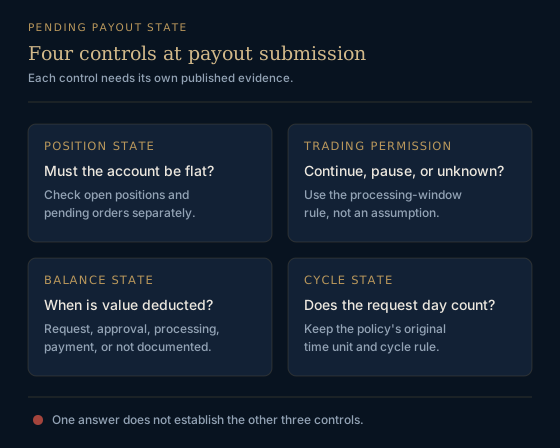
Record the state before requesting:
| Control | Evidence to capture | Permitted conclusion |
|---|---|---|
| Positions and orders | Open-position and pending-order policy | Whether the account must be flat at submission |
| Trading permission | Processing-window rule | Continue, pause, or not documented |
| Balance deduction | Named deduction event | When the displayed balance should change |
| Next-cycle treatment | Cycle rule and original time unit | Whether the request day contributes to the next cycle |
Blank space is not permission. If one control cannot be completed from published material, that uncertainty belongs in the decision. Before choosing an amount, calculate what a payout does to the remaining drawdown buffer.
What must be closed before a request?
FTMO states that all open positions and pending orders must be closed before a Reward claim can be requested. (FTMO, retrieved 2026-08-06)
That rule applies before submission; it does not establish whether positions may reopen during review. “You must be flat to request” and “you cannot trade while processing” are different clauses.
Check both positions and orders. Closing every active position does not remove a limit or stop order still waiting on the platform.
FTMO says a Reward claim becomes available in Account MetriX on the fourteenth day, or any later day, after the first trade on that specific account. (FTMO, retrieved 2026-08-06)
Eligibility dates are separate from processing restrictions. Compare the firm’s rule with the broader guide to payout frequency and recurring withdrawal cycles.
How can you price the trades closed for a request?
Record both the visible request value and the value of positions that must be closed.
remaining trade value = probability of target × remaining gain − probability of stop × remaining loss
delay cost = expected opportunities forgone during the delay + any documented cycle effect
Use probabilities and values from the trader’s own journal. The verified sources do not provide a defensible cash value for a hypothetical trade.
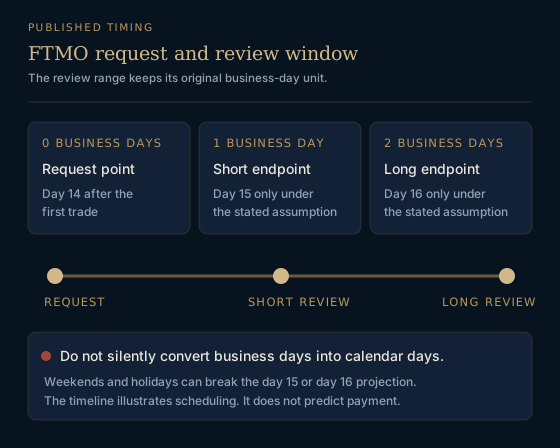
Declared inputs for this check: day 14 as FTMO’s first request point, a 1-business-day review floor, and a 2-business-day review ceiling. Worked arithmetic: 14 + 2 = 16. (FTMO, retrieved 2026-08-06)
| Scenario step | Numeric input | Result | What the result proves |
|---|---|---|---|
| First request point | 14 days after the first trade | Day 14 | The request is unavailable before the published point |
| Short review endpoint | 14 + 1 | Day 15 under the no-interruption assumption | A business-day unit must remain attached to the result |
| Long review endpoint | 14 + 2 | Day 16 under the no-interruption assumption | The arithmetic is usable only with its calendar assumption declared |
| Published review range | 1 to 2 business days | Not convertible without a calendar | Weekends and holidays can break a calendar-day projection |
FTMO states that it reviews the account and notifies the trader within 1 to 2 business days after submission. (FTMO, retrieved 2026-08-06)
The calculation is a scheduling illustration, not a prediction of the payment date.
What can stop working while a payout processes?
Trading permission and automation status can diverge. A platform may permit manual trading while disabling the connection that mirrors orders across accounts.
Topstep states that its copy-trading connection is automatically disabled while a payout processes. Once the deduction is complete and the balance updates, the trader must manually enable the connection again. (Topstep, retrieved 2026-08-06)
That creates two separate checks:
- Does the firm disconnect copying automatically?
- Is reconnection automatic or manual?
After processing, verify the source account, destination account, allocation settings, and connection status before placing another order. If several accounts are connected, preserve the firm’s multiple-account and copy-trading limits. For firms without published instructions, ask whether copying or other automation is interrupted, and distinguish a support response from a public rule.
Topstep also states that the trading day on which a payout is requested does not count toward the winning days required for the next payout cycle. (Topstep, retrieved 2026-08-06)
Keep the policy’s original unit. “Trading day,” “calendar day,” “winning day,” and “business day” describe different counters and should not be converted into one another without evidence.
When does the requested amount leave the balance?
The deduction timestamp determines which balance the trader sees while the request is pending.
Topstep says funds are transferred immediately for the account type covered by its immediate-transfer section, allowing trading to start again right away. (Topstep, retrieved 2026-08-06)
For the account type Topstep labels “Live,” the firm says trading should remain paused until the payout is fully processed and the funds have been deducted. (Topstep, retrieved 2026-08-06)
These are different account states, not contradictory firm-wide rules.
If a policy does not identify the deduction event, record it as not documented. Do not infer the rule from when a dashboard happens to refresh.
How does the pending window work at Ordane?
Ordane sells one product, the Ordane Instant Account: direct access, no evaluation phase and no challenge, on simulated capital. (Ordane Rulebook v1.0, section 1, retrieved 2026-08-24)
What deadlines does The Ordane Guarantee set?
Every withdrawal request must be approved or denied in writing, with the exact breached rule cited by section number, within 24 clock hours. After that deadline, the request is treated as approved and the G-1 clock starts. (Ordane Rulebook v1.0, clause G-0, retrieved 2026-08-24)
An approved payout not paid within 48 clock hours triggers automatic compensation consisting of a 100 percent refund of the account fee plus the payout still owed in full. (Ordane Rulebook v1.0, clause G-1, retrieved 2026-08-24)
The first deadline governs the decision. The second governs payment after approval. Both use clock hours rather than business days. If approval has already been issued, the next question is whether a firm can reverse or claw back that decision.
What do PA-1 and PA-4 establish?
The first withdrawal is available 7 calendar days after account activation, and the cycle thereafter is every 14 days. (Ordane Rulebook v1.0, clause PA-1, retrieved 2026-08-24)
Withdrawals reduce the account balance, while the R-1 drawdown floor remains anchored to the initial balance. (Ordane Rulebook v1.0, clause PA-4, retrieved 2026-08-24)
PA-1 establishes eligibility timing. PA-4 establishes the balance effect and preserves the original drawdown reference. Neither clause identifies the processing event at which the displayed balance changes.
Which Ordane rule is tested at submission?
Ordane's consistency rule is 20 percent: at the moment of a withdrawal request, no single trading day may account for more than 20 percent of the cycle's total profit. If a day exceeds 20 percent, the excess profit from that day is deferred to the next cycle. It is never confiscated, and the remainder of the cycle pays out normally. (Ordane Rulebook v1.0, clause R-4, retrieved 2026-08-24)
The calculation and deferral mechanism are explained separately in the consistency-rule guide.
The governing document is Ordane Rulebook v1.0, published 2026-07-23. (Ordane Rulebook v1.0, section 6, retrieved 2026-08-24)
Rulebook v1.0 documents the deadlines, balance effect, eligibility cycle, and consistency timestamp. It does not document whether the account is paused or otherwise restricted during the processing window. That gap is neither permission nor prohibition. It is an undocumented state. (Ordane Rulebook v1.0, retrieved 2026-08-24)
How do the documented policies compare?
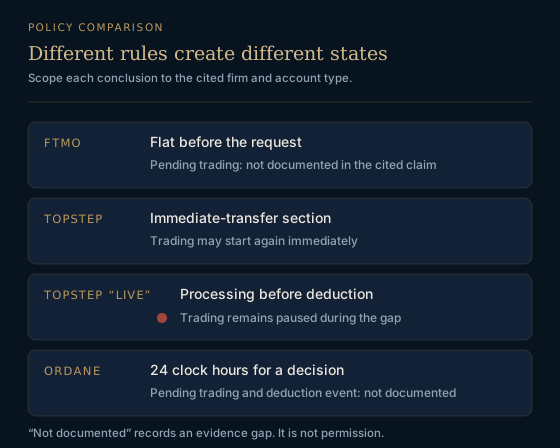
| Firm | Policy scope | Must you be flat to request? | Can you trade while pending? | Balance event | Decision window |
|---|---|---|---|---|---|
| FTMO | Account covered by the cited Reward FAQ | Yes. Open positions and pending orders must be closed. (FTMO, retrieved 2026-08-06) | Not documented in the cited claim | Not documented in the cited claim | Review and notification within 1 to 2 business days. (FTMO, retrieved 2026-08-06) |
| Topstep | Account type covered by the immediate-transfer section | Not documented in the cited claim | Yes. Trading may start again immediately after requesting. (Topstep, retrieved 2026-08-06) | Funds are transferred immediately when the request is made. (Topstep, retrieved 2026-08-06) | Not documented in the cited claim |
| Topstep | Account type labelled “Live” by Topstep | Not documented in the cited claim | No. Trading should pause until processing finishes. (Topstep, retrieved 2026-08-06) | Deduction occurs after full processing. (Topstep, retrieved 2026-08-06) | Not documented in the cited claim |
| Ordane | Ordane Instant Account | Not documented | Not documented | Withdrawals reduce the balance, but the processing event is not identified. (Ordane Rulebook v1.0, clause PA-4, retrieved 2026-08-24) | 24 clock hours for approval or written denial. (Ordane Rulebook v1.0, clause G-0, retrieved 2026-08-24) |
Removing the account-type column would turn scoped Topstep rules into a false firm-wide generalisation. “Not documented” is a finding, not a guess.
Which checks should you run before submitting?
Capture the account balance and equity, open positions, pending orders, cycle totals, automation status, submission timestamp, and timezone immediately before requesting; the snapshot preserves that instant without replacing the firm's own records.
If identity review can affect processing, also preserve the published KYC timing and payout-delay limits.
Frequently asked questions
Can you trade while a payout is pending?
Only when the applicable policy permits it. Topstep documents immediate trading for one account type and a processing pause for another, while Ordane does not document its pending-window trading state. (Topstep, retrieved 2026-08-06) (Ordane Rulebook v1.0, retrieved 2026-08-24)
Must every position be closed before requesting a payout?
Not as a universal rule. FTMO requires all open positions and pending orders to be closed before a Reward claim can be requested. (FTMO, retrieved 2026-08-06)
Does copy trading remain connected during processing?
It depends on the firm. Topstep says its copy-trading connection is automatically disabled while a payout processes and must be manually enabled again after deduction and balance update. (Topstep, retrieved 2026-08-06)
Does the request day count toward the next payout cycle?
Not under the cited Topstep rule. Topstep says the request day does not count toward the winning days required for the next payout cycle. (Topstep, retrieved 2026-08-06)
What does Ordane document about the pending window?
Ordane documents a 24-clock-hour decision deadline, a subsequent 48-clock-hour payment deadline, withdrawal eligibility, balance reduction, and the R-4 submission test. It does not document whether trading pauses during processing. (Ordane Rulebook v1.0, clauses G-0, G-1, PA-1, PA-4, and R-4, retrieved 2026-08-24)
Next step
Before choosing an account, inspect the numbered Ordane clauses and payout clocks. Treat any missing processing rule as undocumented until it appears in the published rulebook.
Sources
- Financial Commission Launches Prop Firm Certification As Industry Seeks Rules On Payouts And Trader Abuse financefeeds.com Retrieved 2026-08-24.
- The FSMA warns consumers against shadow investment game fsma.be Retrieved 2026-08-24.
- Prop Firm Code Of Conduct financialcommission.org Retrieved 2026-08-24.
- How do I withdraw my reward? | FTMO.com ftmo.com Retrieved 2026-08-06.
- Topstep Payout Policy | Topstep Help Center help.topstep.com Retrieved 2026-08-06.