Home · The Ordane Journal · Rules and mechanics · Do Prop Firms Manipulate Your Trades?
Do Prop Firms Manipulate Your Trades?
Ordane accounts operate on simulated capital. No live funds are traded and no deposits are accepted. (Ordane Rulebook v1.0, clause P-2, and ordanemarkets.com payout-funding statement, retrieved 2026-08-05)
Ordane sells one product, the Ordane Instant Account: direct access, no evaluation phase and no challenge, on simulated capital. (Ordane Rulebook v1.0, section 1, retrieved 2026-08-05)
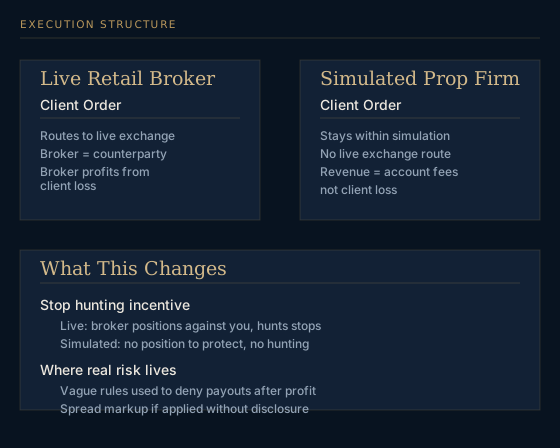
On a simulated account, no order is routed to a live exchange. The classic accusation that your counterparty hunts your stop for profit does not apply the way most traders picture it. What can still hurt you is the quality of simulated fills, a hidden spread markup, and a vague rule used as a pretext when a payout comes due, the same pretext covered in prop firm hidden rules that void a payout.
The rest of this article separates the real worry from the misconception and gives four checks before you pay, alongside the broader checklist for auditing a prop firm.
Do prop firms manipulate your trades?
A prop firm running a simulated environment is not your counterparty collecting your loss as revenue; it has no position to protect, and its revenue is account fees. What it controls is the simulation: fill price, slippage, and spread. Those are real, checkable levers, but engineering and pricing questions, not a conspiracy against your stop.
Why simulated changes the question
A live dealing-desk broker profits from your loss because it is your counterparty. On a simulated account the firm is not warehousing your risk; it could harm you without touching a fill by writing a rule loose enough to deny a withdrawal later, the same mechanism the consistency rule is often blamed for.
So ask not whether the platform is rigged, but where the spread comes from, whether a markup is added, and whether an execution complaint answers to a written rule.
What can a prop firm actually do to your fills?
A prop firm can affect your fills through slippage, spread markup, requotes, an unrealistic-fill rule, or an undefined discretionary rule.
| Mechanism | What it actually is | How to read it |
|---|---|---|
| Slippage on fast markets | Ordinary market behaviour, reproduced by the simulation | Normal. Expect it around releases and at session opens |
| Spread markup | A pricing decision by the firm, added on top of the liquidity provider's spread | A fee question. It is legitimate only if disclosed |
| Requote or rejected order | Execution quality of the platform under load | Normal in small doses, a quality signal in large ones |
| Unrealistic-fill rule | A written clause banning strategies that exploit favourable simulated fills | Neither manipulation nor a red flag; it is the firm admitting the simulation is imperfect |
| Undefined, discretionary rule | A clause broad enough to cover any behaviour after the fact | The actual red flag. This is where payouts die |
Slippage and requotes are what traders complain about loudest, yet they are the least dangerous. The undefined clause is what almost nobody checks, and it can cost a full withdrawal, which is also where a static drawdown rule can be misread when the real cause is a vague conduct clause.
What do competitors' rulebooks reveal about simulated fills?
Competitors' rulebooks reveal that the simulated environment sets the fills, because each firm bans strategies designed to exploit them.
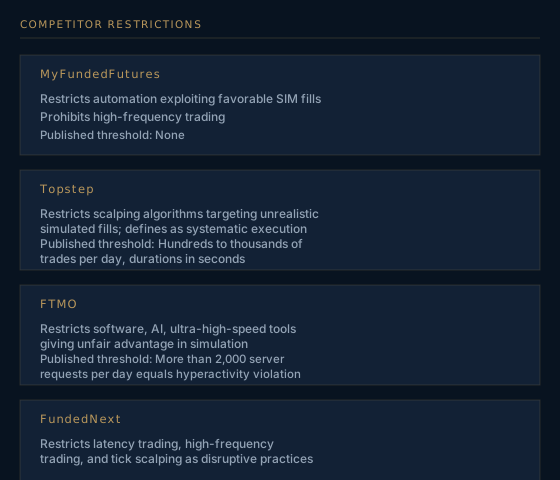
MyFundedFutures allows automated strategies only if they do not aim to exploit the favorable fills offered in the Simulated Environment (MyFundedFutures Help Center, "Fair Play and Prohibited Trading Practices," retrieved 2026-08-05). The firm admits its simulated fills can be more favourable than a live venue, and protects itself from systems built around that gap.
Topstep says it more bluntly. Its prohibited-strategies policy bans scalping algorithms designed to exploit unrealistic SIM fills (Topstep Help Center, "Prohibited Trading Strategies at Topstep," retrieved 2026-08-05). Topstep also frames prohibited behaviors as intentional and systematic, usually hundreds or thousands of trades per day with average durations in seconds, not minutes (Topstep Help Center, "Prohibited Trading Strategies at Topstep," retrieved 2026-08-05).
FTMO's (prop firm) Forbidden Trading Practices prohibit software, artificial intelligence, ultra-high-speed tools or mass data entry that might manipulate, abuse or give the trader an unfair advantage (FTMO.com, "Forbidden Trading Practices," retrieved 2026-08-05). FTMO also publishes a useful number: it treats an account as hyperactive, and a forbidden practice, when automated robots or expert advisors cause more than 2,000 server requests per day on individual simulated trades or pending orders being opened, modified, or closed (FTMO.com, "Forbidden Trading Practices," retrieved 2026-08-05). The scope counts order traffic, not every click.
FundedNext (prop firm) covers the same ground in three restrictions: it strictly prohibits latency trading, restricts high-frequency trading on its platform, and limits tick scalping because of its capacity for market manipulation and disruptive trading practices (FundedNext Help Center, "What are the Restricted/Prohibited Trading Strategies?," retrieved 2026-08-05). MyFundedFutures states plainly in the same Fair Play document that high-frequency trading is not allowed on its plans (MyFundedFutures Help Center, "Fair Play and Prohibited Trading Practices," retrieved 2026-08-05).
| Firm | What its own documentation restricts | Named threshold published |
|---|---|---|
| MyFundedFutures | Automation that exploits favourable simulated fills; high-frequency trading not allowed | No |
| Topstep | Scalping algorithms designed to exploit unrealistic SIM fills | Yes: hundreds or thousands of trades per day, durations in seconds |
| FTMO | Software, AI, ultra-high-speed tools or mass data entry giving unfair advantage | Yes: more than 2,000 server requests per day on simulated trades or pending orders |
| FundedNext | Latency trading prohibited; high-frequency trading restricted; tick scalping limited | No |
Four firms, four separate rulebooks, the same admission: the simulation sets the fills. That is first-party evidence. It flips the question from "are they cheating me on fills" to "do they tell me where the spread comes from, and is their rule list specific enough that I can read it before I pay."
Two firms publish a number; two do not. A published threshold is the difference between a rule you can obey and one you can only hope you did not break.
How do you check execution before you pay?
You can check execution in four steps: identify the spread source, confirm the named platform, verify the rule list is closed, and test fills at small size.
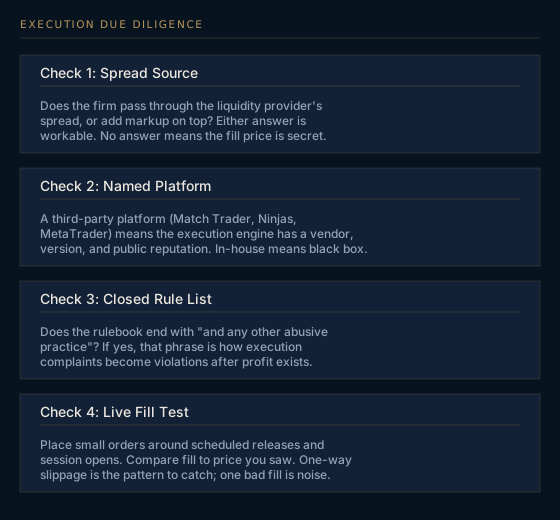
1. Find where the spread comes from. The firm should state whether it passes a spread through, adds a markup on top, or charges no spread at all. Any of the three is an answer. No answer is the problem: the number you trade against is set by a decision you cannot see. Ordane's answer is the third one.
2. Look for a named trading platform. A named third-party platform means the execution engine has a vendor, a version and a public reputation. An unnamed in-house terminal means the fill logic is entirely internal and entirely unaccountable.
3. Confirm the prohibited-practice list is closed. An open list ends with a phrase like "and any other practice we deem abusive." That phrase is the mechanism by which an ordinary execution complaint becomes a violation after you have already made the money. A closed list means the behaviours are enumerated and the enumeration is the whole of it.
4. Test fills at small size first. Before you scale, place a handful of orders around a scheduled release, worth pairing with the prop firm news-trading buffer window, and at a session open, and compare the fill to the price you saw. You are looking for a pattern of slippage that only ever runs against you, not perfection.
The wider pre-purchase check, covering payout terms, drawdown mechanics and company substance, is a separate exercise. An execution check is one part of auditing a prop firm before you pay, not a substitute; once fills clear, confirm the withdrawal requirements for a first payout too.
How does Ordane handle execution?
Ordane handles execution on Match Trader, a named third-party platform, so check number two resolves to a vendor rather than a black box, the same distinction that separates an instant account from a challenge model. (Confirmed by the owner, 2026-07-28)
Instruments: FX majors and minors, metals, indices, and crypto. No exotics. Ordane charges no spread, no commission and no swap: the account fee is the only cost. A simulated account has no execution cost to recover, so there is nothing to pass on and nothing to mark up. Leverage on FX majors and minors is 1:50; leverage for metals, indices, and crypto has not been set yet. (Confirmed by the owner, 2026-07-28)
An honest limit belongs here. Ordane charges no commission and no spread, so there is no second line to the bill. If commission matters to your cost model, and for a high-turnover strategy it will, that is a question to ask directly rather than assume, the same way it is worth asking how profit split scales with each payout.
On the rule side: Ordane's prohibited-practice list is closed. Clause R-6 names six practices: latency, reverse or hedge arbitrage; high-frequency or bulk automated exploitation; copy trading between Ordane accounts; straddling news releases with paired opposing orders; platform or data-feed exploitation; and gap abuse. If a behavior is not listed in that section, it is not a violation. Discretion is not a rule. (Ordane Rulebook v1.0, clause R-6, retrieved 2026-08-05)
That stops an execution complaint from being recast as abuse after the fact. If your strategy is not one of those six, no clause exists to convert it; overnight and weekend holding, for instance, is not on that closed list either. A behaviour that is not listed is not a violation, which is a different guarantee from a promise that nobody will ever accuse you of anything.
Rulebook v1.0 also defines each prohibited practice with examples in Appendix A, which was published on 2026-08-01 and is part of Rulebook v1.0. (Ordane Rulebook v1.0, clause R-6 and section 6 Changelog, checked against the live page 2026-08-04)
The governing document is Ordane Rulebook v1.0, published 2026-07-23. (Ordane Rulebook v1.0, section 6 Changelog, retrieved 2026-08-05) It is public, numbered and versioned; no rule is applied retroactively, and the version you sign up under governs your account. (Ordane Rulebook v1.0, notice above section 0, and section 6 Changelog, retrieved 2026-08-05)
What are the most common questions about prop firm execution?
Traders most often ask five questions: whether firms manipulate trades, stop hunt, give bad fills, mark up spreads, or rewrite rules after a profit.
Do prop firms manipulate your trades?
Not in the way the phrase suggests. On a simulated account there is no live order to route and no position for the firm to protect. The levers that do exist are the simulation's fill quality and whether a markup is added to the spread. Both are checkable before you pay. A vague rule used to deny a payout is the more common harm.
Do prop firms stop hunt?
Stop hunting in the retail sense requires a counterparty that profits from your loss. A simulated account has no such counterparty; the firm's revenue is the account fee. Slippage and gaps through your stop are ordinary market behaviour reproduced by the simulation, and they will happen at releases and session opens regardless of who your provider is.
Why do I get bad fills on a prop firm account?
Usually one of three reasons: genuine volatility at the moment you sent the order, a wider spread than you expected because a markup is applied, or a platform under load producing requotes. Compare fills at small size across different conditions before assuming intent. A pattern that only ever runs against you is worth acting on; a single bad fill is not.
Where does the prop firm spread come from?
From the liquidity provider, sometimes with a markup added by the firm on top. Ordane charges no spread at all, and no commission and no swap either. The structural reason is worth following: a simulated account sends no order to an exchange and borrows nothing overnight, so neither line has an underlying bill behind it. A firm that charges them anyway is not passing a cost along. Any firm that will not state which of the two models it uses has told you something.
Can a firm call my strategy an execution abuse after I profit?
Only if its rule list is open-ended. A closed list, like the six practices named in clause R-6, means a behaviour that is not enumerated is not a violation. An open list ending in "or any other practice we deem abusive" leaves that determination to be made after the money exists, which is precisely the wrong time.
This article is for information only and is not investment, financial, or tax advice. Ordane accounts operate on simulated capital. No live funds are traded and no deposits are accepted. Payouts depend on simulated performance under Rulebook v1.0; no level of performance is typical or assured.
Sources
- Fair Play and Prohibited Trading Practices | My Funded Futures Help Center help.myfundedfutures.com Retrieved 2026-08-05.
- Prohibited Trading Strategies at Topstep | Topstep Help Center help.topstep.com Retrieved 2026-08-05.
- Forbidden Trading Practices | FTMO.com ftmo.com Retrieved 2026-08-05.
- What are the Restricted/Prohibited Trading Strategies? | FundedNext Help Center help.fundednext.com Retrieved 2026-08-05.
- Ordane Rulebook v1.0, clause P-2 | ordanemarkets.com ordanemarkets.com Retrieved 2026-08-05.
- Confirmed by the owner, 2026-07-28 (registry/canonical-facts.json) ordanemarkets.com Retrieved 2026-09-01.