Home · The Ordane Journal · Rules and mechanics · Ordane vs FTMO: Instant vs Challenge
Ordane vs FTMO: Instant vs Challenge
Ordane accounts operate on simulated capital. No live funds are traded and no deposits are accepted. Payouts depend on simulated performance under Rulebook v1.0; no level of performance is typical or assured.
Ordane sells one product, the Ordane Instant Account: direct access, no evaluation phase and no challenge, on simulated capital.
This page is a document comparison, not a recommendation to buy any account. Read each firm's rulebook on the day you pay.
What does Ordane vs FTMO actually compare?
A one-sentence definition
Ordane sells a one-time Instant Account with no evaluation phase, while FTMO sells a Challenge (1-Step or 2-Step) that must clear profit and loss objectives before an FTMO Account and Rewards.
The useful question is not which brand is "best." It is which fee structure, drawdown definition, and payout gate match the way you already trade, after you read both firm's own documents on the day you buy.
Simulated capital on both sides
Neither product is a bank deposit. Both sell access to a rule-bound simulation and, if you clear the written payout path, a share of the simulated result paid from the firm's own funds. That shared fact does not make the products interchangeable. Access timing, refund mechanics, and how the loss floor moves still differ. Treat marketing pages as invitations to open the rule documents, not as the documents themselves.
Side by side at a glance
Figures below were read from each firm's own pages on 2026-08-15. Challenge fees and promotions change; confirm the live checkout before you pay.
| Attribute | Ordane Instant Account | FTMO Challenge / FTMO Account |
|---|---|---|
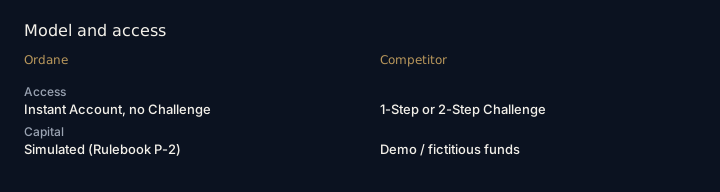
| Capital type | Simulated (Rulebook P-2) | Demo / fictitious funds (FTMO site note) |
| Access model | Instant: no evaluation, no challenge (§1) | 1-Step or 2-Step Challenge, then FTMO Account |
| Sizes (examples) | $2,500 · $10,000 · $25,000 · $50,000 · $100,000 | $10,000 · $25,000 · $50,000 · $100,000 · $200,000 |
| Entry fee shape | One-time USD; no recurring fees | One-time EUR Challenge fee (other currencies at checkout) |
| $50,000 example fee | $549 one-time (Rulebook §1) | 2-Step €345 on homepage Standard ladder; 1-Step €319 non-refundable (promo) |
| Fee refund | No Challenge refund (there is no Challenge) | 2-Step: fee repayout-eligible with first Reward; 1-Step: not repayout-eligible (FAQ) |
| Profit target to start | None | 2-Step: 10% then 5%; 1-Step: 10% (comparison) |
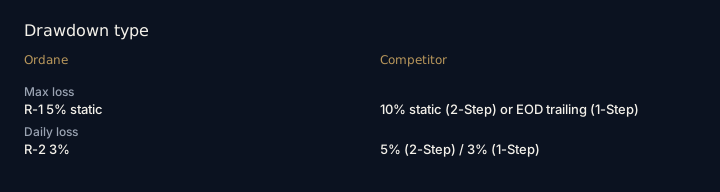
| Max daily loss | R-2: 3% of day-start balance | 2-Step: 5%; 1-Step: 3% |
| Max loss | R-1: 5% static on initial balance | 10%; 2-Step static; 1-Step end-of-day trailing |
| Min trading days | None for "pass" (Instant) | 2-Step: 4 days; 1-Step: none listed on comparison table |
| Reward / split headline | Ladder from 60% with early caps (PA-2 + PA-3) | Up to 90% (2-Step) / 90% (1-Step) on comparison table |
| Rulebook style | Public, versioned, never retroactive | FTMO Terms + Trading Objectives on FTMO.com |
How the FTMO path works
2-Step Challenge
The classic path is two phases. Phase 1 asks for a 10% profit target; Phase 2 asks for 5%. Max daily loss is 5% and max loss is 10% on a static basis, with at least four trading days (comparison table, retrieved 2026-08-15). Time to hit the targets is unlimited on that page. The Challenge fee for 2-Step is one-time and, if you pass and take a first Reward on the FTMO Account, FTMO states the fee is repayout-eligible with that first Reward withdrawal (FAQ).
Account sizes on How It Works include $10,000 through $200,000 simulated balances (how it works). The comparison page also states 2-Step "Starts from €89" as the entry of that ladder (comparison table).
1-Step Challenge
The 1-Step route collapses evaluation into a single 10% profit target, with 3% max daily loss and a 10% max loss on an end-of-day trailing basis, plus a Best Day Rule capped at 50% of Positive Days Profit (comparison table; 1-Step promo). Rewards are stated at 90%. The 1-Step fee is one-time and not repayout-eligible after a pass (FAQ). On the promo ladder, the $50,000 size lists €319 (promo, retrieved 2026-08-15).
What "pass" still leaves you with
Passing does not delete risk rules. You still trade under FTMO Account objectives, identity checks, and the firm terms. Instant does not mean "no rules" at Ordane either. Instant only removes the evaluation profit target before you can request a payout cycle under Ordane PA clauses. If you want a longer walkthrough of Instant versus evaluation as models, without naming FTMO as the page job, use Instant Account vs evaluation.
How the Ordane Instant Account works
Ordane sells one product: the Ordane Instant Account. Direct access, no evaluation phase and no challenge (Rulebook §1). You pay a one-time fee, receive the account size you bought, and trade under the six numbered rules from day one. There is no 10% Challenge target to clear before the payout calendar in PA-1 can start.
At $50,000 simulated size the fee is $549 one-time. The full ladder also lists $2,500/$59, $10,000/$139, $25,000/$299, and $100,000/$999 (Rulebook §1, retrieved 2026-08-15). There are no recurring Challenge subscriptions on that table.
Drawdown is explicit: R-1 is a 5% static floor on initial balance. Daily loss is R-2 at 3% of the balance at the start of the server day. Risk per trade is R-3 with a mandatory stop. Consistency (R-4) can defer excess day profit; it does not confiscate it or close the account under the published wording. Inactivity is R-5. The prohibited list is closed (R-6) with Appendix A definitions.
Payouts: first withdrawal after 7 calendar days, then every 14 days (PA-1). The trader share starts at 60% and steps up with completed withdrawals (PA-2), and withdrawals #1 and #2 are each capped at 3% of initial balance (PA-3). G-0 / G-1 put approval and payment on clock hours with written denial rules. Ordane is new; PR-2 states there is no payout history to report until activity begins. That is a real concession, not a slogan.
Worked fee check at $50,000
Hold the nominal size fixed and ignore marketing labels.
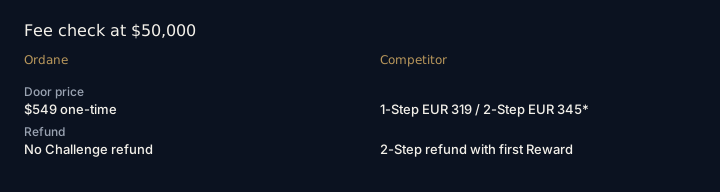
- Ordane Instant $50,000: $549 once. No Challenge refund, because there is no Challenge. You are under R-1/R-2 from day one (Rulebook §1).
- FTMO 1-Step $50,000: €319 one-time, non-refundable on FTMO FAQ, then you must still hit the 10% target under 3%/10% loss rules before an FTMO Account (promo; FAQ).
- FTMO 2-Step $50,000: homepage Standard ladder showed €345 on 2026-08-15 for that size tier; if you pass and take a first Reward, FTMO states the Challenge fee is repayout-eligible with that withdrawal (ftmo.com/en/; FAQ). Until then you have paid cash and still sit behind two profit targets.
- Failed attempts: a breached Challenge is another fee unless a promotion says otherwise. Ordane Instant breach also ends that account; the difference is you never paid for a separate evaluation stage.
Currency conversion matters. Ordane prices in USD on the rulebook table. FTMO Challenge fees are stated in EUR and may be paid in other currencies at checkout rates. A fair compare converts on the day you buy, then adds the probability you never reach the refund event on 2-Step.
If you need the broader fee stack (resets, data, chargebacks elsewhere in the sector), use prop firm hidden fees.
What does the document checklist restate?
| Check | Ordane Instant | FTMO Challenge path |
|---|---|---|
| Evaluation required? | No (Rulebook §1) | Yes (1-Step or 2-Step) (comparison table) |
| $50,000 door fee (2026-08-15 read) | $549 one-time | 1-Step €319; 2-Step €345 on homepage ladder |
| Fee refund after pass? | Not a Challenge fee | 2-Step yes with first Reward; 1-Step no (FAQ) |
| Max loss type | 5% static (R-1) | 10% static (2-Step) or EOD trailing (1-Step) |
| Public payout history claimed here? | No (PR-2) | FTMO markets Reward history on its site; verify live |
Where FTMO is the clearer fit (concession)
FTMO is the better mechanical fit when you want:
- A lower cash outlay to start on many Challenge sizes (2-Step "starts from €89", 1-Step "starts from €79" on the comparison page), accepting that you must clear evaluation objectives first.
- A refund path on 2-Step if you pass and receive a first Reward, which Ordane Instant fee does not mimic.
- Larger top size at $200,000 on FTMO published Challenge sizes, which Ordane Instant ladder does not offer today.
- A long public track record as a brand (FTMO markets years of operation and large Reward totals on its site). Ordane does not claim a payout history yet (PR-2).
- A mature app suite and free trial loop that FTMO advertises beside the Challenge. Ordane Instant is a thinner product surface by design.
Those are real advantages for a trader who treats evaluation as a filter they can pass and who prefers EUR Challenge pricing with FTMO tool suite. This page will not pretend otherwise.
Where Ordane differs on purpose
Ordane is built for traders who already know they want Instant access on simulated capital with a static 5% floor, a closed prohibited list, and a versioned rulebook that does not move under an open account. You are not buying a Challenge discount. You are buying day-one rules and a published payout clock (PA/G clauses).
Tradeoffs you must accept in writing:
- Higher door price at the same $50,000 label than many Challenge entry fees.
- Starting split at 60% with caps on the first two withdrawals (PA-2 + PA-3), not a marketing "up to 90%" headline alone.
- No multi-year payout ledger yet.
- No $200,000 Instant size on the published ladder.
Read static vs trailing drawdown before you treat "5%" and "10%" as the same distance to failure. FTMO 1-Step max loss is end-of-day trailing; Ordane R-1 is static. Same percentage words do not produce the same account life.
The sector risk of firm disappearance is not theoretical: Finance Magnates Intelligence estimated that between 80 and 100 proprietary trading firms may have disappeared from the market in 2024. (Finance Magnates, retrieved 2026-08-15). Also map loss floors with prop firm profit split explained.
Pre-pay checklist (both firms)
- Save the dated rulebook / Trading Objectives PDF or screenshot before checkout.
- Write the exact drawdown type: static, trailing, end-of-day trailing, equity vs balance.
- Write the fee: one-time vs monthly, refund conditions, activation, data add-ons.
- Write the first payout clock and any consistency / Best Day rule.
- Convert EUR fees to your payment currency on the day you buy.
- Run the full document pass in how to audit a prop firm.
Then open Ordane live accounts and rulebook beside FTMO live Challenge checkout. Do not buy from this article cache of numbers alone.
Worked check: door fee vs first reward gap
Declared inputs for this check only: Ordane Instant fee 549; FTMO 2-Step Challenge fee 345; simulated account size 50000; Ordane R-1 floor percent 5.
Worked arithmetic: 50000 × 0.05 = 2500. That is the Ordane static loss dollars on this size. Fee gap: 549 − 345 = 204. So at these declared inputs the Instant door costs 204 more dollars, while the Instant path also starts under a 2500 dollar static floor from day one, with no Challenge phase in between.
Questions traders ask about Ordane vs FTMO
Is Ordane an FTMO alternative with no Challenge?
Ordane Instant Account has no evaluation phase and no challenge (Rulebook §1). That is a model difference, not a promise that Ordane is "easier." Drawdown, daily loss, consistency, and the closed prohibited list still close accounts when breached.
Does FTMO use simulated accounts?
Yes. FTMO states client accounts are demo accounts with fictitious funds in a simulated environment (comparison table, retrieved 2026-08-15). Rewards are paid under FTMO's own Reward process after you meet their written conditions.
Which is cheaper at $50,000?
On 2026-08-15 readings, FTMO Challenge fees at that size were lower in EUR cash outlay than Ordane $549 Instant fee, especially before you count failed attempts. Ordane price is one-time and skips the profit target gate. Convert currencies on the day you buy and include the chance you never reach a 2-Step refund.
Does a higher reward percentage settle the choice?
No. A 90% headline on FTMO comparison table still sits behind evaluation rules, identity checks, and account objectives. Ordane ladder starts lower and publishes early withdrawal caps. Compare net path to first payout, not the marketing maximum alone.
Should a new trader buy Instant first?
Only if the trader already understands Instant rules and accepts the higher door price. Many new traders are better served by a lower Challenge entry while they learn evaluation mechanics, then revisit Instant after they can name drawdown type and payout clocks without a sales page. The audit article above is the safer next click either way.
What should I read next?
Start with Instant Account vs evaluation for the model map, then return here for the named-firm fee and loss-floor rows. The instant path is Ordane on this page. Ordane Markets Ltd (in formation) sells simulated accounts only. Nothing here is investment advice. This article is for information only and is not investment, financial, or tax advice.
Sources
- Ordane Rulebook ordanemarkets.com Retrieved 2026-08-15.
- Finance Magnates — prop firm market report financemagnates.com Retrieved 2026-08-15.
- FTMO Comparison Table ftmo.com Retrieved 2026-08-15.
- FTMO FAQ: Why is there a fee? ftmo.com Retrieved 2026-08-15.
- FTMO 1-Step Challenge promo promo.ftmo.com Retrieved 2026-08-15.
- FTMO homepage pricing table (ftmoPricingTable) ftmo.com Retrieved 2026-08-15.
- FTMO How It Works ftmo.com Retrieved 2026-08-15.