Home · The Ordane Journal · Rules and mechanics · Prop Firm Calculators: What Each One Computes
Prop Firm Calculators: What Each One Computes
A prop firm calculator takes a handful of inputs and returns exactly one number: a dollar limit, a lot size, or a payout figure. It computes one clause of a rulebook and is blind to the rest.
Ordane accounts operate on simulated capital. No live funds are traded and no deposits are accepted.
That gap is not a bug in the calculator. It is the calculator doing its one job correctly and nothing else. A lot-size tool computes position size against a risk percentage. It has no idea what your daily limit is, no idea whether you already used half of it this morning, and no idea whether the firm's consistency rule is about to eat the payout you're sizing this trade to reach. Ordane sells one product, the Ordane Instant Account: direct access, no evaluation phase and no challenge, on simulated capital.
The CFTC warns that forex and leveraged trading involve substantial risk of loss. (CFTC, retrieved 2026-08-15)
This article sorts six calculator types by the clause each models, names what each calculator cannot see, and computes five binding numbers on one account in Table 2.
What Is a Prop Firm Calculator Actually Modelling?
The 45-word answer
A prop firm calculator takes a small number of inputs, usually account size, a percentage, and sometimes an entry and stop price, and returns one number: a dollar limit, a lot size, or a payout amount. It computes exactly one clause of the rulebook. It does not check the others.
One clause per calculator
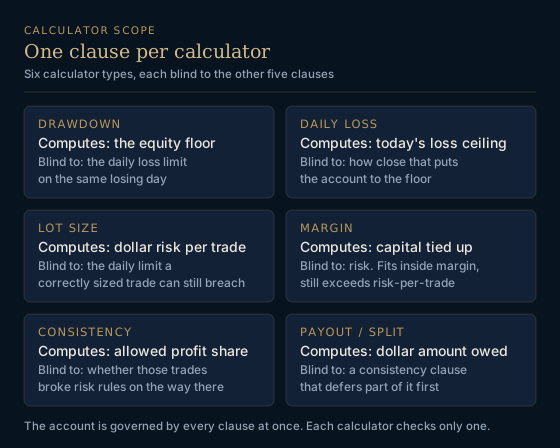
Every prop firm publishes several binding limits at once: a drawdown floor, a daily loss ceiling, a per-trade risk cap, and often a consistency rule that only activates at withdrawal. Each calculator on the market corresponds to one of those clauses, built to answer one question fast. The problem traders run into is not that the calculators are wrong. It is that a green result from a lot-size calculator says nothing about whether that same trade would put the account over the daily limit if it lost, or whether the profit from a big winning day will get partially deferred under a consistency clause the trader forgot existed until the withdrawal request. The account is governed by every clause simultaneously. The calculator was never asked to check more than one.
Table 1: Six Calculator Types, the Clause Each Models, the Clause Each Ignores
| Calculator type | Clause it computes | Clause it is blind to |
|---|---|---|
| Drawdown calculator | The floor: how far equity can fall from a reference balance before the account closes | Whether that day's loss also breaches a separate daily limit |
| Daily loss calculator | The per-day loss ceiling, usually a fixed dollar or percentage figure | Whether the floor for the whole account is now closer after that day |
| Lot size / position size calculator | Dollar risk on a single trade given entry, stop, and account size | The daily limit and the floor; a correctly sized trade can still be the one that breaches either |
| Margin calculator | How much of your capital a position ties up given leverage | Risk. A trade can fit easily inside available margin and still exceed the risk-per-trade clause |
| Consistency calculator | Whether one trading day's profit exceeds the allowed share of a payout cycle's total profit | Whether the underlying trades that produced that profit violated risk or daily limits on the way there |
| Payout / profit split calculator | The dollar amount after the firm's split percentage and any withdrawal cap | Whether a consistency clause defers part of that profit before the split is even applied |
Read the right column before you trust the left one, as the table shows with Topstep's Maximum Loss Limit (Topstep Help Center, retrieved 2026-08-11).
What a prop firm drawdown calculator must separate: static vs trailing
A prop firm drawdown calculator is only useful if it names whether the floor is static or trailing. Static is a fixed dollar line under the initial balance. Trailing moves with peak equity until it locks. Ordane publishes a static 5 percent floor: equity may never fall below 95 percent of the initial balance (Ordane Rulebook, retrieved 2026-08-11). Topstep publishes a Maximum Loss Limit that is measured against the account's own documentation, not against Ordane's static wording (Topstep Help Center, retrieved 2026-08-11). Without naming the mechanic, the printed number is not comparable across firms.
Prop firm lot size calculator vs prop firm margin calculator
A prop firm lot size calculator sizes a position under a risk-per-trade cap. A prop firm margin calculator sizes notional under leverage and margin. Those are different questions. Ordane caps risk per trade at 1.5 percent of current balance with a mandatory stop-loss (Ordane Rulebook, retrieved 2026-08-11). That number feeds a lot size calculator. It does not, by itself, tell you the margin a broker platform will reserve. Mixing the two is how a lot size still breaches the daily loss limit after two maximum-risk losses.
Prop firm daily loss calculator and the reset you cannot see
A daily loss calculator answers one question: how much more can this account lose today before something happens. What "something happens" means differs by firm, and the calculator will not tell you that on its own.
Topstep publishes fixed dollar figures for its Daily Loss Limit by account size: $1,000 on a $50K account, $2,000 on a $100K account, and $3,000 on a $150K account. (Topstep Help Center, retrieved 2026-08-11) Hitting that limit is not treated as a rule violation at Topstep. Open positions are flattened, pending orders are cancelled, and trading resumes at 5 PM CT the next session; the firm states explicitly that this is a forced break, not a breach. (Topstep Help Center, retrieved 2026-08-11)
Prop firm consistency calculator and prop firm payout calculator
A profit-share ladder is arithmetic
A payout calculator's job is the easiest of the six to verify by hand: multiply the profit by the split percentage, then check the result against any withdrawal cap. Ordane's split starts at 60 percent and rises 5 percentage points with every completed withdrawal, reaching 100 percent from the ninth withdrawal onward. (Ordane Rulebook, retrieved 2026-08-11) Withdrawals #1 and #2 are each capped at 3 percent of initial balance; from withdrawal #3 onward there is no cap. (Ordane Rulebook, retrieved 2026-08-11) A payout calculator for this account needs three inputs: cycle profit, which withdrawal number this is, and initial balance, because the cap only applies to the first two.
A consistency ceiling is a constraint on your best day
Consistency calculators exist because a payout is not simply "profit times split." Ordane's consistency rule sets a 20 percent ceiling: at the moment of a withdrawal request, no single trading day may account for more than 20 percent of the cycle's total profit. (Ordane Rulebook, retrieved 2026-08-11) A day that exceeds that share does not lose the excess. It is deferred to the next cycle, and the rest of the cycle's profit still pays out normally. (Ordane Rulebook, retrieved 2026-08-11) The order of operations matters: the consistency check runs against the profit total before the split percentage is applied, so a payout calculator that applies the split first and checks consistency after will hand back a number no rulebook actually produces.
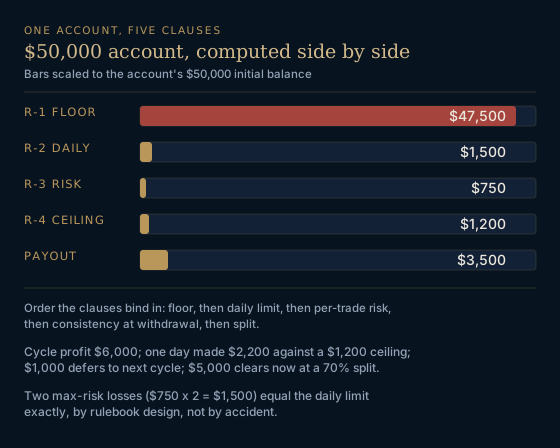
Table 2: One Account, Five Clauses, Computed Side by Side With Declared Inputs
Declared inputs: a $50,000 Ordane Instant Account, third withdrawal, cycle profit of $6,000, with one trading day inside that cycle contributing $2,200 of that profit.
| Clause | Rule | Computation | Result |
|---|---|---|---|
| R-1, drawdown floor | 5 percent static, floor never trails (Ordane Rulebook v1.0, clause R-1) | $50,000 x 0.95 | Account closes if equity falls below $47,500 |
| R-2, daily loss limit | 3 percent of start-of-day balance (Ordane Rulebook v1.0, clause R-2) | $50,000 x 0.03 | Account closes if a single day loses more than $1,500 |
| R-3, risk per trade | 1.5 percent of current balance, stop-loss mandatory (Ordane Rulebook v1.0, clause R-3) | $50,000 x 0.015 | Maximum $750 risk on any one trade; two max losses = $1,500, which equals the daily limit above |
| R-4, consistency ceiling | 20 percent of cycle profit per day (Ordane Rulebook v1.0, clause R-4) | $6,000 x 0.20 = $1,200 ceiling; the day in question made $2,200 | $1,000 of that day's profit is deferred to the next cycle; $5,000 of the cycle's $6,000 clears now |
| PA-2/PA-3, payout after split | 3rd withdrawal, no cap from #3 onward (Ordane Rulebook v1.0, clause PA-3); split ladder (Ordane Rulebook v1.0, clause PA-2) | $5,000 cleared profit x 70 percent split (60 + 5 + 5 for two completed withdrawals) | $3,500 payable, no withdrawal cap applies |
Every figure in that table traces back to a rule, in the order the rulebook actually applies them: floor, then daily limit, then per-trade risk, then consistency, then split. Run it against your own account size and the arithmetic changes; the order does not.
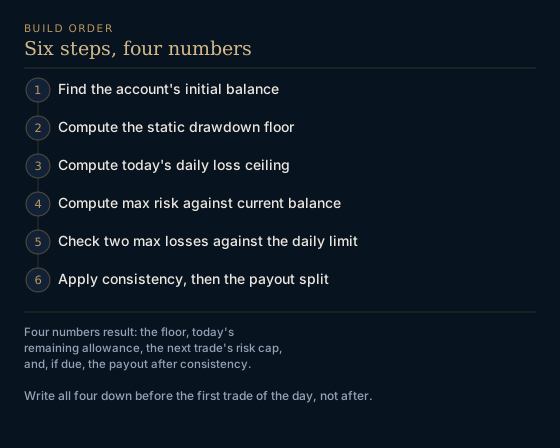
Build the four numbers yourself in six steps
- Find the account's initial balance on the statement you are about to buy.
- Compute the static drawdown floor: initial balance × (1 − floor percent).
- Compute today's daily loss ceiling against the start-of-day balance.
- Compute maximum risk per trade against current balance.
- Check that two maximum-risk losses do not exceed the daily ceiling.
- Apply the consistency check to cycle profit before the payout split.
Declared inputs for Ordane Instant Account arithmetic in Table 2: initial balance $50,000; R-1 floor 5 percent; R-2 daily limit 3 percent; R-3 risk per trade 1.5 percent; R-4 consistency 20 percent of cycle profit (Ordane Rulebook, retrieved 2026-08-11).
What Does Ordane's Rulebook Make Computable Before You Trade?
Static floor, daily limit, risk per trade
Ordane sells one product, the Ordane Instant Account: direct access, no evaluation phase and no challenge, on simulated capital. Those percentages are fixed against a stated base, so Table 2 can be run before you pay. The drawdown floor is 5 percent of initial balance, static. (Ordane Rulebook, retrieved 2026-08-11) The daily loss limit is 3 percent of the balance at the start of the server day. (Ordane Rulebook, retrieved 2026-08-11) Risk per trade is capped at 1.5 percent of current balance with a mandatory stop-loss. (Ordane Rulebook, retrieved 2026-08-11)
Why two maximum losses equal the daily limit
The 1.5 percent per-trade cap and the 3 percent daily limit are not two independent numbers that happen to be close. Two trades each risking the maximum 1.5 percent equal exactly the 3 percent daily limit, and the rulebook states this is the design rather than an accident. (Ordane Rulebook, retrieved 2026-08-11) A lot-size calculator built around the per-trade rule alone will size each individual trade correctly and still let a trader take two maximum-risk losses in a row and land exactly on the daily limit's edge with a third trade still open. Knowing the relationship between the two clauses is what a calculator cannot supply on its own: it has to be read once, in the rulebook, and carried into every calculation after.
Frequently Asked Questions
Is a free calculator accurate?
A free calculator can be arithmetically correct and still return a useless number if it is fed the wrong reference point, for example current balance where the rule requires initial balance, or start-of-day balance where the rule requires a trailing high-water mark. (Topstep Help Center, retrieved 2026-08-11) Verify which base number the calculator assumes before trusting its output; the arithmetic is rarely the failure point.
Does the calculator include costs?
Most position-size and margin calculators compute against price movement and leverage alone. They do not typically deduct spread, commission, or overnight financing from the risk figure, which means a trade sized to risk exactly 1.5 percent on price movement can, once costs are added, risk slightly more than that in practice. (Ordane Rulebook, retrieved 2026-08-11)
Which number should I check first?
The floor, always. A drawdown breach on a static-floor account closes it permanently regardless of what the daily loss or consistency calculators say, because the floor is the one clause with no recovery path once breached. (Ordane Rulebook, retrieved 2026-08-11) Check the floor, then the daily limit, then per-trade risk, then consistency at withdrawal time. Those four checks are the order the clauses bind in, and Table 2 follows the same order.
Why do two firms publish different consequences for the same kind of limit?
Topstep treats a Daily Loss Limit breach as a forced break, flattening positions and resuming trading the next session. (Topstep Help Center, retrieved 2026-08-11) Ordane closes the account outright on the same kind of breach. (Ordane Rulebook, retrieved 2026-08-11) The dollar or percentage figure a calculator returns looks the same either way, so the consequence has to be read separately from the number.
What is the point of computing all five clauses on one account?
Table 2 shows the interaction: two max per-trade losses equal the daily limit, and consistency applies before the split (Ordane Rulebook, retrieved 2026-08-11). A single calculator run in isolation cannot surface that relationship.
See also daily loss vs max drawdown, what a consistency rule is, profit split, static vs trailing drawdown, what happens when you breach.
Sources
- What is the Maximum Loss Limit? | Topstep Help Center help.topstep.com Retrieved 2026-08-11.
- Daily Loss Limit in the Trading Combine and Express Funded Account | Topstep Help Center help.topstep.com Retrieved 2026-08-11.
- What are the account specifications? | FTMO.com ftmo.com Retrieved 2026-08-11.
- Ordane Rulebook v1.0 ordanemarkets.com Retrieved 2026-08-11.
- CFTC Forex Fraud Advisory cftc.gov Retrieved 2026-08-15.