Home · The Ordane Journal · Rules and mechanics · Prop Firm Scaling Plan Explained: How Your Account Size Grows
Prop Firm Scaling Plan Explained: How Your Account Size Grows
Ordane accounts operate on simulated capital. No live funds are traded and no deposits are accepted.
Ordane sells one product, the Ordane Instant Account: direct access, no evaluation phase and no challenge, on simulated capital.
Ordane accounts operate on simulated capital. No live funds are traded and no deposits are accepted. This article explains one growth mechanic and refuses its neighbour: how a prop firm raises the account size you manage, and what has to happen to move up a level. It does not teach the profit split, the percentage of profit you keep. That is a different lever with its own page.
What a scaling plan actually is
A prop firm scaling plan is a published rule set that increases your account size, contract limit, or profit split when you hit measurable milestones the firm defines in advance. It is not a reward; it is a conditional upgrade written into the rulebook before you pay.
What does a prop firm scaling plan actually change?
It changes the account size or profit share only when the firm's published scaling conditions are met.
How do you verify a scaling step before you pay?
Read the scaling clause on the same document family as the loss limits, with a retrieval date.
ESMA's product-intervention notice states that CFDs are complex instruments and come with a high risk of losing money rapidly due to leverage (ESMA, retrieved 2026-08-10). That leverage risk is the independent frame behind any prop CFD-style ticket.
The 45-word answer, quotable as written
A prop firm scaling plan increases the account size a trader manages once they clear set performance milestones, so the capital grows through results rather than through buying a larger account. The plan raises the balance, or the position limits you are allowed to trade, not the price you paid.
Ordane Instant Account comes in five sizes: $2,500, $10,000, $25,000, $50,000 and $100,000. The size is chosen at purchase.. To understand how this differs from other models, see our article on Instant Account vs Evaluation: How the Two Prop Firm Models Differ.
Account size, not profit share
A scaling plan and a profit split are two different levers, and confusing them is the most common reason traders misread an offer. A scaling plan grows the capital you manage. A profit split sets the percentage of profit you keep. This page owns the first lever only. For how the percentage you keep scales, see Prop Firm Profit Split Explained: The Math and When It Scales.
How to read any firm's plan
Four questions strip a marketing page down to what it actually offers. For For how different rules change outcomes, read the linked Journal pieces on drawdown and payout timing.
Capital scaling versus contract scaling
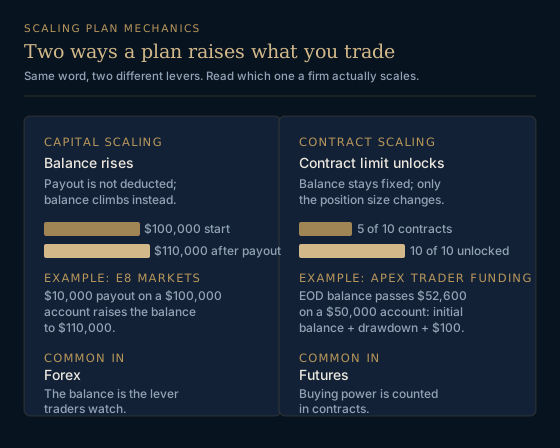
Firms build scaling two ways. Learn both and you can read any firm's plan, whatever it names them.
Capital scaling: the balance rises
Capital scaling raises the total balance you trade. Hit the milestone and the number you manage goes up, so position sizes rise with it. A payout-linked variant is common: instead of deducting a withdrawal from the balance, the firm leaves it in, so the traded capital climbs with every payout. The practical effect for a trader is compounding: because taking money out does not shrink the balance, the capital you trade grows every time you get paid, and the next position is sized against the larger number rather than the original one. This mechanism can also impact your drawdown, as explained in What a Payout Does to Your Drawdown.
Contract scaling: buying power unlocks in tiers
Contract scaling leaves the stated balance alone and raises the contracts you may hold after milestones. Futures prop desks often use this shape. Verify the next contract tier and any trailing threshold on the firm help page before you treat a step as earned. Read the unit a firm scales and you know what actually changes when you level up.
What triggers a level up
Sales pages blur the milestone. The levers behind most plans are concrete: a net-growth threshold on the account, a minimum number of payouts taken, a clean rules record, and profitability sustained across a rolling multi-month window.
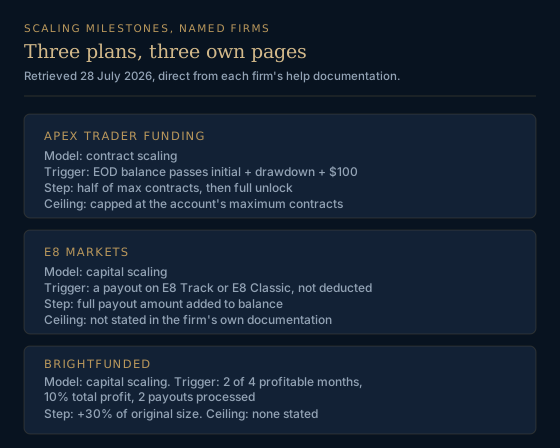
BrightFunded increases account balances by 30% of the original account size at each qualifying step, measured over a four-month window counted from the first executed trade, per BrightFunded's own help documentation (retrieved 28 July 2026). To qualify for a BrightFunded scale-up, a trader must be profitable in at least two of the four months with at least 10% total profit, and must process at least two payouts, per BrightFunded's help documentation (retrieved 28 July 2026).
Now the honest counter-fact: some plans have a ceiling and some do not, and a plan is worth only what its milestones realistically allow. So ask the one question that matters before you buy: what exactly moves me up, and by how much.
Where named firms set the scaling milestones
BrightFunded cells below come from that firm's help documentation (retrieved 28 July 2026). Other firm rows were removed when live fetches returned HTTP 403. As of 28 July 2026. This table is volatile and valid until 26 October 2026.
Ordane Instant Account comes in five sizes: $2,500, $10,000, $25,000, $50,000 and $100,000.
Why Ordane sells fixed sizes
Ordane sells one product, the Ordane Instant Account: direct access, no evaluation phase and no challenge (Ordane Rulebook v1.0 Ordane Instant Account comes in five sizes: $2,500, $10,000, $25,000, $50,000 and $100,000 (Ordane Rulebook v1.0 You choose the size at purchase. The published product line is five fixed sizes chosen at purchase.
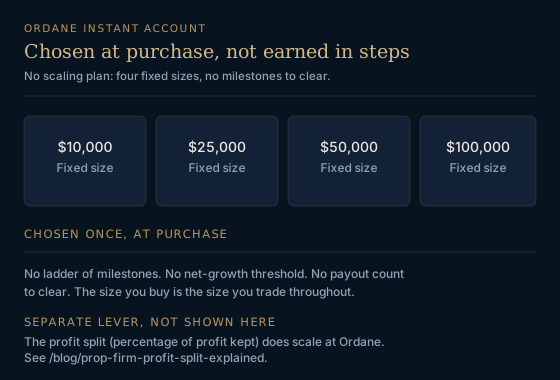
A scaling plan lets a trader start small and grow the account through performance without paying more for a bigger size, and the fixed-size model does not offer that. What it offers instead is a size known the day you buy and a rulebook that does not move under you. In practice that means the capital you manage in the first session is the capital you manage in the hundredth: there is no threshold to clear, no month-count to satisfy, and no step you can miss and have to run again. You trade the same rules against the same size throughout, which is a different bargain from chasing a moving milestone, and whether it suits you depends on whether you would rather earn a larger account over time or simply choose it up front. The Ordane rulebook is public, numbered and versioned, and no rule is ever applied retroactively to an open account. Changes produce a new version with a dated changelog entry, and the version you sign up under is the version that governs your account (Ordane Rulebook v1.0). The governing document is Ordane Rulebook v1.0, published 23 July 2026. For more on the importance of clear, unchanging rules, read Can a Prop Firm Enforce a Rule That Isn't Written Down?.
One lever does scale at Ordane: the profit split. Ordane's profit split starts at 60 percent and rises 5 percentage points with every completed withdrawal, reaching 100 percent from the ninth withdrawal onward. That is a separate mechanic with its own page, Prop Firm Profit Split Explained: The Math and When It Scales.
Worked scaling arithmetic
Declared inputs for this check only: base size 100000; scale step 0.25; cycles cleared 2.
| Input | Value | Arithmetic |
|---|---|---|
| Step dollars | 25000 | 100000 x 0.25 = 25000 |
| After 2 cycles | 150000 | 100000 + 25000 + 25000 = 150000 |
Arithmetically: 100000 x 0.25 = 25000 and 100000 + 25000 + 25000 = 150000 under these declared inputs.
An independent US regulator frames leveraged speculation the same way: like all futures products, speculating in these markets should be considered a high-risk transaction (CFTC, retrieved 2026-08-10).
How Ordane stays on fixed sizes
Ordane Instant Account comes in five sizes: $2,500, $10,000, $25,000, $50,000 and $100,000.
Ordane sells one product, the Ordane Instant Account: direct access, no evaluation phase and no challenge, on simulated capital.
Ordane's profit split starts at 60 percent and rises 5 percentage points with every completed withdrawal, reaching 100 percent from the ninth withdrawal onward.
Withdrawals #1 and #2 are each capped at 3 percent of initial balance. From withdrawal #3 onward there is no cap.
The fixed-size model means the capital you manage in the first session is the capital you manage in the hundredth. There is no threshold to clear, no month-count to satisfy, and no step you can miss and have to run again. You trade the same rules against the same size throughout. Whether that suits you depends on whether you would rather earn a larger account over time or simply choose it up front.
| Check | Scaling plan | Ordane fixed size |
|---|---|---|
| Size at purchase | Often smaller entry, larger later | Chosen size on day one |
| Trigger to grow | Net growth, payouts, multi-month window | None; size does not auto-raise |
| What can reverse a step | Rules breach or dry window on some desks | Not applicable; size stays as bought |
| Split path | Separate from size on most desks | Ordane's profit split starts at 60 percent and rises 5 percentage poin... |
Declared inputs for this check only: start size 100000; step growth 0.25; two steps. Arithmetic: 100000 x 0.25 = 25000; 100000 + 25000 = 125000 after one step; 125000 + 25000 = 150000 after two steps under these declared inputs. Ordane sells the five fixed sizes above instead of a milestone ladder.
BrightFunded remains the worked third-party example in this article because its help page was fetchable. Firm rows that returned HTTP 403 were removed rather than left as unverifiable numbers.
Frequently Asked Questions
How does a prop firm scaling plan work?
A scaling plan raises the capital you manage once you clear performance milestones, such as a net-growth threshold, a minimum number of payouts, and sustained profitability over several months. Some firms raise the balance, others unlock larger position limits. The trigger and the step size differ by firm, so read each firm's own page.
What triggers an account size increase?
Common triggers are a net-growth threshold on the account, a minimum number of payouts taken, a clean rules record, and profitability held across a rolling multi-month window. BrightFunded, for example, requires profit in at least two of four months, at least 10% total profit, and at least two payouts, per BrightFunded's help documentation (retrieved 28 July 2026).
What is the difference between capital and contract scaling?
Capital scaling raises the balance you trade, which is common in forex. Contract scaling leaves the balance alone and unlocks larger position limits as it grows, which is common in futures.
Does taking a payout grow the balance?
Usually a payout is deducted, so it does not. Read the firm's own page to know which rule applies.
Can a firm take a scaling level away once you earn it?
Yes, when the plan says so. Some firms keep the higher size only while you stay inside the rules and meet a trailing profitability window; a breach or a dry month can drop you back. If the help page is silent on revocation, treat that silence as unresolved risk and ask support for the written clause before you pay.
Sources
- Scaling Levels (PA) Explained - Apex Trader Funding apextraderfunding.com Retrieved 2026-07-28.
- How do I scale my account balance on the E8 Trader account? - E8 Markets Help Center help.e8markets.com Retrieved 2026-07-28.
- How to Scale Up my Funded Star Account Infinitely - BrightFunded Help Center help.brightfunded.com Retrieved 2026-07-28.
- Ordane Rulebook v1.0 ordanemarkets.com Retrieved 2026-07-28.
- Notice of product intervention decisions on CFDs and binary options | ESMA esma.europa.eu Retrieved 2026-08-10.
- Customer Advisory: Understand the Risks of Virtual Currency Trading | CFTC cftc.gov Retrieved 2026-08-10.