Home · The Ordane Journal · Before You Pay · Are Prop Firms Legit or a Scam?
Are Prop Firms Legit or a Scam?
A proprietary trading firm is a business that grants traders access to simulated capital for a fee, paying out a percentage of the profits generated under strict risk parameters. Ordane accounts operate on simulated capital. No live funds are traded and no deposits are accepted.
While legitimate prop firms exist and offer clear rules with real payouts funded by evaluation fees, the retail space contains unregulated scams. Identifying the difference requires knowing how to vet a prop firm by checking regulatory status and understanding simulated market mechanics. Traders must demand public rulebooks, verifiable reserves, and transparent payment structures before paying any upfront fee.
Ordane sells one product, the Ordane Instant Account: direct access, no evaluation phase and no challenge, on simulated capital. This structure separates objective performance from the deceptive marketing that plagues the industry.
Are Prop Firms Legitimate Businesses?
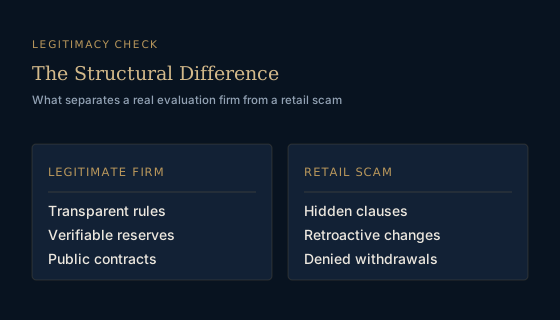
Proprietary trading firms are legitimate businesses when they operate with transparent rules and verifiable payout mechanisms, but the retail evaluation sector includes fraudulent operators. A legitimate firm publishes its exact policies before purchase, while scams rely on hidden clauses and retroactive rule changes to deny withdrawals, often leaving traders wondering what happens if the firm goes out of business.
Do legitimate prop firms actually pay out?
Traders worry about passing a rigorous test only to find the firm refuses to pay. Legitimate operations do pay out, but the mechanics dictate the reliability. The industry advertises the split percentage. Ordane publishes the reserve. Ordane's payout reserve is published at a public TRON address on ordanemarkets.com and in Rulebook v1.0 clause PR-1. The page carries a dated observed balance and states that the reserve is not a promise, it is an address. Payouts are paid in real money from company fee revenue. No client deposits are taken and no client capital is traded. Rulebook v1.0 clause PR-1 commits Ordane to publish the payout reserve on-chain; the live rulebook and homepage publish the TRON address. Hiding financial backing increases the probability of denied withdrawals and delays in the payout process.
What unwritten rules void your profits?
Worried the rules change after you pay? They are versioned; the version you buy governs your account for life. The governing document is Ordane Rulebook v1.0, published 2026-07-23. The Ordane rulebook is public, numbered and versioned, and no rule is ever applied retroactively to an open account. Changes produce a new version with a dated changelog entry, and the version you sign up under is the version that governs your account.
Ordane's prohibited-practice list is closed. Clause R-6 names six practices: latency, reverse or hedge arbitrage; high-frequency or bulk automated exploitation; copy trading between Ordane accounts; straddling news releases with paired opposing orders; platform or data-feed exploitation; and gap abuse. If a behavior is not listed in that section, it is not a violation. Discretion is not a rule. Competitors often enforce a hidden consistency rule at withdrawal, confiscating earned profits under the guise of risk management. This raises the question of whether a firm can enforce a rule that is not in the terms.
Ordane's consistency rule is 20 percent: at the moment of a withdrawal request, no single trading day may account for more than 20 percent of the cycle's total profit. If a day exceeds 20 percent, the excess profit from that day is deferred to the next cycle. It is never confiscated, and the remainder of the cycle pays out normally.
Will the prop firm still exist tomorrow?
We are new. We have no payout history to show, and we will not manufacture one. What you can verify today is the reserve address. Firm collapse remains a real risk, as regulators actively investigate deceptive operations and fake reviews.
Traders must demand enforceable contracts. Every withdrawal request is approved, or denied in writing citing the exact rule breached by section number, within 24 clock hours. Past that deadline the request is treated as approved and the G-1 clock starts. A payout approved and not paid within 48 clock hours, not business hours, triggers automatic compensation: a 100 percent refund of the account fee, plus the payout owed in full. These mechanisms constitute The Ordane Guarantee. Both G-2 exclusions (documented fraud or KYC review, and declared force majeure) are capped at 10 business days each. Past that deadline, G-1 applies regardless. The Ordane Guarantee enforces accountability through financial penalty.
How Does the Business Model Affect Your True Costs?
Retail prop firms operate primarily on an evaluation fee model, granting access to a simulated trading environment. The revenue generated from upfront fees sustains the business and provides the capital required to pay the traders who successfully navigate the strict parameters.
Upfront evaluation fees vs. subscriptions
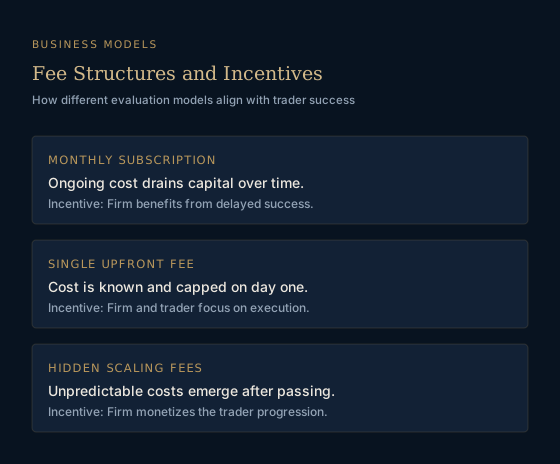
Traditional models require recurring monthly subscriptions until a trader passes an evaluation, creating a financial incentive for the firm to prolong the testing phase. The modern approach utilizes a single upfront fee, which is a key difference between an evaluation challenge and an instant account.
| Fee Structure | Financial Impact | Incentive Alignment |
|---|---|---|
| Monthly Subscription | Ongoing cost drains capital over time. | Firm benefits from delayed trader success. |
| Single Upfront Fee | Cost is known and capped on day one. | Firm and trader focus on immediate execution. |
| Hidden Scaling Fees | Unpredictable costs emerge after passing. | Firm monetizes the trader's progression. |
Ordane Instant Account comes in five sizes: $2,500, $10,000, $25,000, $50,000 and $100,000. The fee is one-time: $59 for the $2,500 account, $139 for the $10,000 account, $299 for $25,000, $549 for $50,000 and $999 for $100,000. There are no recurring fees, no hidden tiers or activation costs and no coupon games. Ordane charges no commission, no spread and no swap. The account fee is the only cost the trader pays. The reason is structural, not promotional: accounts run on simulated capital, so no order is routed to an exchange and nothing is financed overnight, which means neither line has an underlying bill behind it.
Simulated trading and the retail model
Understanding the simulated nature of the accounts is critical. Retail prop firms generally operate by charging an upfront evaluation fee for access to a simulated trading environment. Understanding how simulated capital differs from a broker demo is essential, as profits made on simulated accounts are paid out from the fees collected from failing traders rather than actual market execution (Bloomberg, retrieved 2026-09-05).
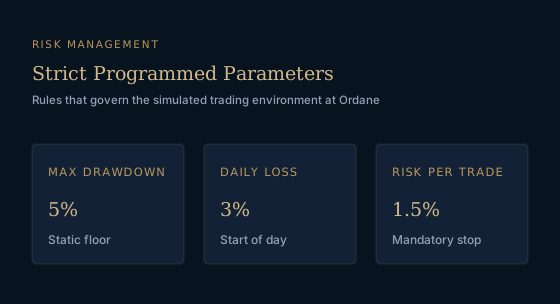
Because capital is simulated, firms manage risk strictly through programmed parameters. Ordane's maximum drawdown is 5 percent and static: account equity may never fall below 95 percent of the initial balance. The floor is fixed on day one, never trails upward, and a breach closes the account. The daily loss limit is 3 percent, measured against the balance at the start of the server day. A breach closes the account. Maximum risk per trade is 1.5 percent of current balance and a stop-loss is mandatory at entry. Two maximum losses equal the daily limit, which is the design rather than an accident. A breach closes the account. That is the whole consequence: no partial confiscations, no surprise fees, no renegotiation.
What Are the Regulatory Warnings and Real Win Rates?
Financial authorities actively warn against unregulated retail proprietary trading models. Regulators emphasize that simulated accounts lack the critical protections afforded to traditional brokerage accounts, and the statistical probability of losing the initial evaluation fee remains extraordinarily high across the entire industry.
FCA warnings on unauthorised firms
Regulatory bodies monitor the retail evaluation space closely. Traders must recognize that they operate outside standard investor compensation funds.
ESMA statistics on retail CFD loss rates
Trading difficulty is a mathematical reality. The European Securities and Markets Authority (ESMA) states that between 74 percent and 89 percent of retail accounts lose money when trading Contracts for Difference (CFDs), reflecting the baseline statistical difficulty of trading that applies to prop firm evaluations (ESMA, retrieved 2026-09-05). This failure rate explains industry economics.
To illustrate the financial mechanics, we provide a concrete calculation.
Declared inputs for this check: a $59 fee for the $2,500 account, a $139 fee for the $10,000 account, and a $198 combined cost for both accounts. Worked arithmetic: $59 plus $139 equals $198.
| Account Type | Fee Parameter | Combined Cost Metric |
|---|---|---|
| $2,500 Account | $59 upfront fee | Baseline cost |
| $10,000 Account | $139 upfront fee | Mid-tier cost |
| Combined Purchase | N/A | $198 total cost |
This transparency ensures traders understand exactly what they are paying before they commit capital to a simulated environment.
Frequently Asked Questions
Readers frequently ask how to separate legitimate trading operations from deceptive ones in this industry. The correct answers depend entirely on understanding the core difference between real market execution and simulated environments, alongside evaluating the precise legal standing of the entity collecting the evaluation fees.
Can you lose your own money with a prop firm?
Maximum financial loss is restricted strictly to the fee paid at checkout. Because accounts operate entirely in a simulated environment, negative balances do not transfer to the trader. If a trader breaches the maximum drawdown parameter, the account simply closes without additional debt.
Are prop firms regulated by financial authorities?
Most retail evaluation firms operate outside direct financial regulator jurisdiction because they do not handle client funds for real market trading. They sell evaluation services. However, consumer protection laws apply, and regulators intervene if a firm engages in fraudulent solicitation or deceptive marketing.
Is a prop firm account just a demo account?
Mechanically, the trading environment is identical to a standard demonstration account provided by retail brokerages. The distinction lies in the contractual agreement. The firm agrees to pay a percentage of profits generated within that simulated environment, provided the trader adheres strictly to documented risk parameters.
What happens if a prop firm shuts down?
If a firm ceases operations, active accounts terminate and pending payouts are frequently lost. This structural vulnerability highlights the necessity of verifiable reserves. A firm lacking transparent financial backing presents a higher risk of sudden closure compared to one publishing its payout capacity openly.
How do prop firms make their money?
The primary revenue stream for the retail evaluation model is the collection of upfront fees. Because the statistical probability of consistent trading success is low, the volume of fees collected from unsuccessful evaluations exceeds the volume of profits withdrawn by successful participants.
Sources
- Bloomberg: Retail Prop Trading Faces Regulatory Reckoning After MFF Collapse
Retrieved Sep 5, 2026 - ESMA: ESMA adopts final product intervention measures on retail CFDs
Retrieved Sep 5, 2026