Home · The Ordane Journal · Before You Pay · Can You Trust Prop Firm Reviews?
Can You Trust Prop Firm Reviews?
Ordane accounts operate on simulated capital. No live funds are traded and no deposits are accepted. Payouts depend on simulated performance under Rulebook v1.0; no level of performance is typical or assured.
Ordane sells one product, the Ordane Instant Account: direct access, no evaluation phase and no challenge, on simulated capital.
A trustworthy prop firm review is one you can verify independently: it names a date, a clause, an account stage, or a payment interval that you can check against the firm's own published rules.
In one sentence: A prop firm review is trustworthy only when it gives you a liftable detail you can check against a source the reviewer does not control.
Clause P-2 of the Ordane Rulebook v1.0 requires that declaration, and the no-deposit statement is published on ordanemarkets.com. That is the company writing this article, and by the end of it you should be able to hold Ordane to the same standard as everyone else, including in the place where Ordane currently has nothing to show you, the same place are prop firms legit asks you to check before you pay anyone.
What makes a prop firm review trustworthy?
ESMA's product-intervention notice states that CFDs are complex instruments and come with a high risk of losing money rapidly due to leverage. That leverage risk is the independent frame behind any prop CFD-style ticket.
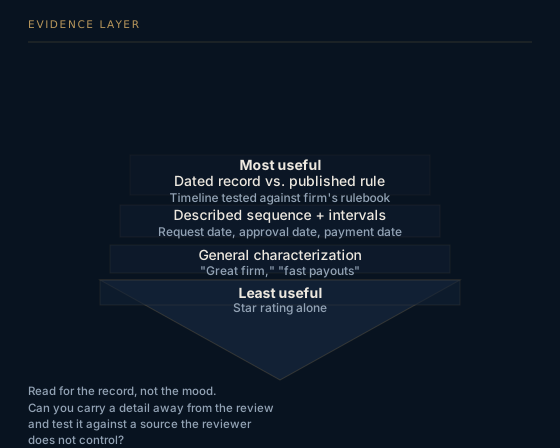
A prop firm review is trustworthy when it contains a detail you can lift out of the review and check against a source the reviewer does not control, such as a date, a rule number, or a payment interval.
Trust in a review does not come from enthusiasm, length, or the reviewer's apparent sincerity. It comes from whether the review contains something that survives being lifted out of the review and tested somewhere else.
A liftable evidence standard
Apply one test to every review you read: can I take a piece of this review, carry it away from the review page, and confirm it against a source the reviewer does not control?
Specific records beat star ratings
Ranked from most to least useful, the things a review can contain are:
Read for the record, not the mood.
Which review patterns deserve scrutiny?
The patterns that deserve scrutiny are single-purpose accounts, repeated marketing language, timing clusters, and reviews that praise payouts without naming dates, stages, or clauses.
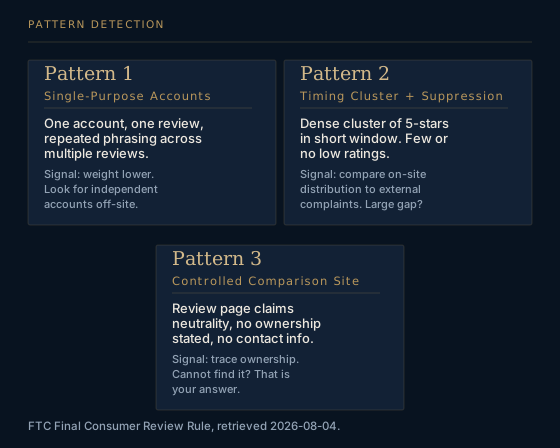
A pattern across many reviews can justify caution. A pattern can never justify accusing one named person of writing a fake review, and this article does not ask you to do that.
Single-purpose accounts and repeated language
Neither pattern is proof. Both are reasons to weight the page lower and go looking for evidence somewhere the firm does not control the publishing.
Timing clusters and missing detail
Missing detail is the most reliable of the soft signals, because it is difficult to fake convincingly and easy to detect. Faking a rating takes a second. Faking a plausible, internally consistent account of a full withdrawal cycle under a specific rulebook takes actual knowledge of the rulebook.
How do affiliate relationships change the evidence?
Affiliate relationships change the evidence by adding a commission motive, so a clear disclosure and a checkable detail matter more than the recommendation itself.
Most prop firm content you find through a search engine is written by someone who gets paid when you buy. That is not a scandal by itself. It is the default commercial structure of the sector, and pretending otherwise wastes your attention.
Disclosure must be clear
Look for the disclosure before you read the review. A clear disclosure is a plain statement, near the recommendation and before the reader has to decide anything, saying the writer earns a commission if you sign up. It names the relationship in ordinary words.
The absence of any disclosure on a page that ranks a firm first, links to it repeatedly, and uses a tracking parameter in the link is its own signal. The tracking parameter is often the most honest thing on the page.
A disclosed incentive still does not prove the claim
Here is the part people get backwards. Disclosure does not repair an unverifiable claim, and disclosure does not invalidate a verifiable one.
A reviewer who discloses a commission and then tells you a firm is "one of the most trustworthy in the industry" has told you nothing at all, and the disclosure has not improved that. The claim was empty before the disclosure and it remains empty after.
What do FTC rules say about fake reviews?
FTC rules say that fake reviews, review suppression, and company-controlled sites misrepresented as independent are prohibited practices.
United States consumer protection rules give you a useful vocabulary here, because a regulator has already written down which practices are prohibited. That vocabulary works as a reading tool even where the rules themselves do not apply.
Table 1: prohibited practice and reader signal
| Prohibited practice (per the FTC rule) | What it looks like on a review page | What you should do |
|---|---|---|
| Fake reviews and testimonials attributed to people without genuine experience (16 CFR 465.2) | Reviews with no checkable detail, repeated phrasing, single-purpose accounts | Weight the page lower; seek evidence off the firm's own properties |
| Misrepresenting a review section as representative when negative reviews were suppressed (16 CFR 465.7) | A rating distribution with almost no low scores; complaints appearing elsewhere but not here | Search for the firm's complaints outside its own site and compare |
| Misrepresenting a company-controlled site or entity as providing independent reviews (16 CFR 465.6) | A "review site" whose ownership, contact details and funding are unstated | Trace ownership before treating the site as third-party |
The three rows are not interchangeable. The first is about individual reviews, the second about the distribution you are shown, the third about who is publishing.
How do you audit one payout review?
You audit one payout review by checking whether it names a date, an amount, an account stage, a clause number, and a payment interval you can compare against the firm's published rules.
Take the single review that matters most to you, the one that made you consider paying, and audit it line by line. This takes a few minutes and replaces a star rating with a finding.
Table 2: claim, proof and unresolved gap
Work through a testimonial with this structure. The right-hand column is the one that decides whether the review moved you.
| Claim in the review | What would prove it | Common unresolved gap |
|---|---|---|
| They paid me | A date, an amount, and an interval between request and receipt | Amount and dates absent; only the outcome asserted |
| Payout was fast | The interval, compared against the firm's published approval and payment windows | No published window cited, so "fast" has no baseline |
| Rules are fair | A named clause number the reviewer operated under | No clause named; fairness asserted as a feeling |
| I got a large payout | The account size and stage, since caps and splits usually vary by both, the way prop firm profit split explained breaks down | Size and withdrawal number omitted, so the figure is uninterpretable |
| Support was responsive | A response interval and what was actually resolved | No interval, no outcome, only tone |
Notice how many of the gaps are omissions rather than contradictions. That is the usual situation. Reviews rarely say false things you can catch. They say true things too thin to use.
Verify dates, account stage and payment record
Three checks do most of the work.
Do not ask a reviewer for private documents, and do not post anyone's statements. You do not need them. Everything above is checkable from public documents and stated intervals.
What does Ordane claim today?
Ordane claims today that it has no payout history yet, that its rules are public and versioned, and that it will not manufacture testimonials or history.
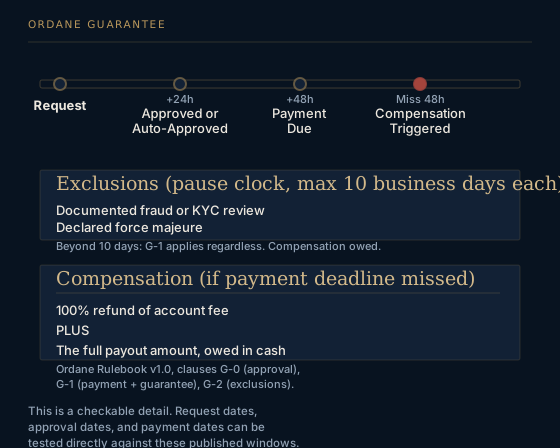
Now the same standard, applied here.
New company, no payout history
Every withdrawal request is approved, or denied in writing citing the exact rule breached by section number, within 24 clock hours. Past that deadline the request is treated as approved and the G-1 clock starts. A payout approved and not paid within 48 clock hours, not business hours, triggers automatic compensation: a 100 percent refund of the account fee, plus the payout owed in full. On ordanemarkets.com that mechanism is labelled the 48-hour payout guarantee, pointing at Rulebook section 4, clauses G-0 to G-2. The guarantee has two objective exclusions: documented fraud or KYC review, and declared force majeure. Both carry a hard deadline, and beyond it G-1 applies regardless.
Ordane's prohibited-practice list is closed. Clause R-6 names six practices: latency, reverse or hedge arbitrage; high-frequency or bulk automated exploitation; copy trading between Ordane accounts; straddling news releases with paired opposing orders; platform or data-feed exploitation; and gap abuse. If a behavior is not listed in that section, it is not a violation. Discretion is not a rule. Those are checkable statements: you can open the rulebook, count the clauses, read the numbers, and hold them against your account later. They are not a payout history, and this article will not present them as one.
Do not manufacture testimonials or history
Hold the same audit against Ordane after enough time has passed. If the ledger is still empty and the marketing has grown warmer, that is your finding.
What else should you check before trusting a review?
Before trusting a review, check whether it names a specific date, clause, or payment interval you can verify, whether the reviewer discloses an affiliate relationship, and whether the page suppresses negative feedback.
Should you trust Ordane's own reviews today?
No, not on testimonials. Ordane is new and has no customer payouts yet, so there is no dated payout record to lift. What you can check today is that Ordane accounts operate on simulated capital and that the no-deposit statement is published on ordanemarkets.com. You can also check that Ordane Rulebook v1.0 is public, numbered and versioned, and that no rule is ever applied retroactively to an open account. Apply the same liftable-detail standard to Ordane that you apply to any other firm.
Frequently asked questions
Should you trust Ordane's own reviews today?
No, not on testimonials. Ordane is new and has no customer payouts yet, so there is no dated payout record to lift. What you can check today is that Ordane accounts operate on simulated capital and that the no-deposit statement is published on ordanemarkets.com. You can also check that Ordane Rulebook v1.0 is public, numbered and versioned, and that no rule is ever applied retroactively to an open account. Apply the same liftable-detail standard to Ordane that you apply to any other firm.
What does this rule change on a simulated account?
It changes what the specification allows on simulated capital, not a live brokerage balance.
Where is the cost of the permission written?
In a separate clause from the permission itself: leverage, flatten clock, commission, or weekend close language on the firm's own page.
How do you reproduce the arithmetic in this article?
Use the declared inputs in the worked check and recompute the same multiplication or division; the numbers are listed in the table.
Does Ordane treat unlisted behaviour as a violation?
No. Ordane's prohibited-practice list is closed; what is not listed is not a violation. This article is for information only and is not investment, financial, or tax advice.
Sources
- Notice of product intervention decisions on CFDs and binary options, ESMA Retrieved 2026-08-10.
- 16 CFR 465.2, Rule on the Use of Consumer Reviews and Testimonials (current CFR text, Cornell LII) Retrieved 2026-08-05.
- 16 CFR 465.6 Company-controlled review websites or entities (current CFR text, Cornell LII) Retrieved 2026-08-05.
- 16 CFR 465.7 Review suppression (current CFR text, Cornell LII) Retrieved 2026-08-05.
- FTC Consumer Reviews Rule Q&A Retrieved 2026-08-04.
- FTC Final Consumer Review Rule Retrieved 2026-08-04.
- Ordane Rulebook v1.0 Retrieved 2026-08-09.
- ordanemarkets.com, guarantee section Retrieved 2026-08-05.