Home · The Ordane Journal · Before You Pay · Top 10 Prop Trading Firms: Verified Rules
Top 10 Prop Trading Firms: Verified Rules
# Top 10 Prop Trading Firms: Verified Rules
A proprietary trading firm evaluation is an assessment process where traders pay an upfront fee to prove their skills on a simulated platform to access a simulated account. Ordane accounts operate on simulated capital. No live funds are traded and no deposits are accepted. (Ordane Rulebook v1.0, clause P-2, retrieved 2026-09-06)
**In one sentence:** A proprietary trading firm provides traders with a simulated trading environment where they can earn a share of simulated profits by passing an evaluation and following strict risk rules.
The retail proprietary trading sector has experienced accelerated growth, positioning itself as a dominant alternative within the broader retail trading landscape. As the industry expands, the marketing noise increases. Traders frequently encounter promises of vast wealth, but the reality is built on strict risk management and contractual rules. To navigate this environment safely, a trader must evaluate firms based on their published documents rather than their promotional material.
The core mechanic relies on providing a trading environment that mirrors real market conditions without exposing the firm to actual market risk during the assessment phase. Traders execute strategies on simulated data feeds. If the parameters are met, they proceed to the next stage. However, many fail because they misunderstand the specific constraints of the environment.
Ordane lists four asset classes: FX pairs (majors and minors), metals, indices and crypto. No exotics. Ordane's settled leverage is 1:50 on FX majors and minors. Leverage for metals, indices and crypto has not been set yet.
Do Prop Trading Firms Actually Pay Out?
The primary concern for any participant is whether the company honors its withdrawal requests. You can pass the most difficult assessment, follow every parameter, and still face a denied payout if the company lacks a transparent settlement process. To answer this, you must look at the mechanical structure of the firm and the explicit language in its rulebook.
Typical Profit Splits
Profit splits are highly advertised, but they only matter if the payout is executed. FTMO (prop firm) provides a baseline profit split of 80/20, which traders can increase to 90/10 upon fulfilling the conditions of their Scaling Plan.
At Ordane, the structure is codified. The Ordane Guarantee defines the exact timeline for approval and payment. Every withdrawal request is approved, or denied in writing citing the exact rule breached by section number, within 24 clock hours. Past that deadline the request is treated as approved and the G-1 clock starts. A payout approved and not paid within 48 clock hours, not business hours, triggers automatic compensation: a 100 percent refund of the account fee, plus the payout owed in full. Both G-2 exclusions (documented fraud or KYC review, and declared force majeure) are capped at 10 business days each. Past that deadline, G-1 applies regardless.
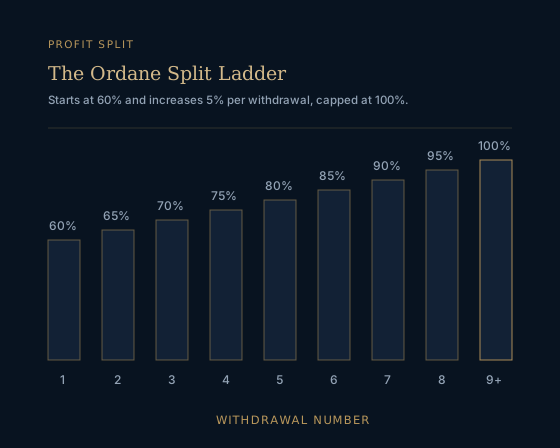
Ordane's profit split starts at 60 percent and rises 5 percentage points with every completed withdrawal, reaching 100 percent from the ninth withdrawal onward. The split ladder is in writing and never resets. The first withdrawal is available 7 calendar days after account activation, and the cycle thereafter is every 14 days. Withdrawals #1 and #2 are each capped at 3 percent of initial balance. From withdrawal #3 onward there is no cap. KYC happens once, at the first withdrawal request, not at purchase. There is no re-verification loop at every payout.
Where the Payout Money Comes From
Firms must source capital to cover successful withdrawals. Payouts are paid in real money from company fee revenue. No client deposits are taken and no client capital is traded. Rulebook v1.0 clause PR-1 commits Ordane to publish the payout reserve on-chain; the live rulebook and homepage publish the TRON address. Ordane's payout reserve is published at a public TRON address on ordanemarkets.com and in Rulebook v1.0 clause PR-1. The page carries a dated observed balance and states that the reserve is not a promise, it is an address.
A verifiable reserve allows participants to inspect the exact balance available for payouts at any moment, shifting the relationship from trust to cryptographic proof.
Ordane is new. Its live homepage says it will not fake a history; the rulebook says payout performance metrics begin with the first month in which a payout is requested. Rulebook v1.0 clause PR-2 commits Ordane to a dated payout ledger from payout number one, and to payout performance metrics published with dates on a fixed monthly schedule. As of July 25, 2026 the ledger is empty, because no payout has happened yet. Rulebook v1.0 clause PR-3 commits Ordane to independent third-party attestation of payout records, entering effect per the public roadmap milestone.
Which Hidden Rules Cause Evaluation Failures?
Subjective rules often lead to account closures right before a payout. A transparent firm uses a closed list of rules. Ordane's prohibited-practice list is closed. Clause R-6 names six practices: latency, reverse or hedge arbitrage; high-frequency or bulk automated exploitation; copy trading between Ordane accounts; straddling news releases with paired opposing orders; platform or data-feed exploitation; and gap abuse. If a behavior is not listed in that section, it is not a violation. Discretion is not a rule.
A breach closes the account. That is the whole consequence: no partial confiscations, no surprise fees, no renegotiation.
Drawdown Calculations
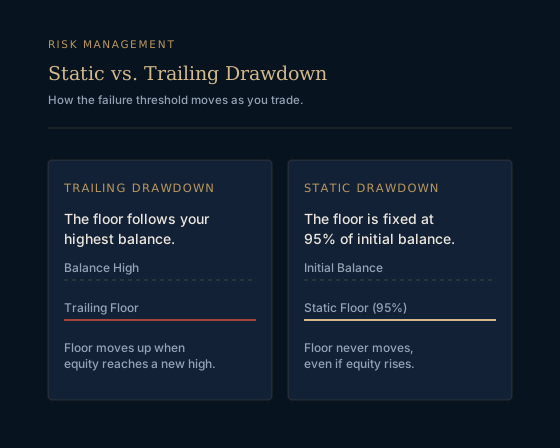
Drawdown mechanics are the most critical factor in account survival. A trailing drawdown follows your highest balance, meaning you can lose your account even if you remain profitable. A static drawdown offers more stability. Ordane's maximum drawdown is 5 percent and static: account equity may never fall below 95 percent of the initial balance. The floor is fixed on day one, never trails upward, and a breach closes the account. Withdrawals reduce the account balance, and the R-1 drawdown floor stays anchored to the initial balance.
The daily loss limit is 3 percent, measured against the balance at the start of the server day. A breach closes the account. Maximum risk per trade is 1.5 percent of current balance and a stop-loss is mandatory at entry. Two maximum losses equal the daily limit, which is the design rather than an accident.
Consistency and News Rules
Many firms mandate arbitrary consistency targets. Ordane's consistency rule is 20 percent: at the moment of a withdrawal request, no single trading day may account for more than 20 percent of the cycle's total profit. If a day exceeds 20 percent, the excess profit from that day is deferred to the next cycle. It is never confiscated, and the remainder of the cycle pays out normally.
Ordane's rulebook does restrict one thing around news: clause R-6(d) prohibits straddling news releases with paired opposing orders. Because R-6 is a closed list, no other clause restricts trading during news or high-impact events. Overnight and weekend holding is allowed at Ordane. It is not on the R-6 closed list, and what is not listed is not a violation.
Accounts with no trading activity for 30 consecutive days are closed. The 30 consecutive days in clause R-5 are calendar days, not business days. Under clause R-5, trading activity means at least one filled order. Pending orders and platform logins do not count.
Expert Advisors are fully permitted at Ordane: a trader may run an EA executing the trader's own strategy on an Ordane account. Appendix A of Rulebook v1.0 is published (changelog entry dated August 1, 2026) and defines each R-6 practice with examples. A-2 states that R-6(b) does not ban all automation, only bulk or high-frequency exploitation: a single expert advisor or script placing discretionary or rules-based trades at human-scale frequency, with a stop-loss on every position under R-3, is the example that does NOT close the account. The R-6 prohibition on copy trading between Ordane accounts applies only between different people. Copy trading is permitted exclusively between Ordane accounts that belong to the same person, meaning the same account holder and ultimate beneficial owner. Copy trading between person A and person B is always prohibited.
Will the Prop Firm Still Exist When You Pass?
Regulatory pressure and platform stability dictate whether a firm survives.
Furthermore, platform independence is crucial. In 2024, True Forex Funds (prop firm) announced permanent closure on May 13 after its licences were terminated, and SurgeTrader (prop firm) ceased all operations on May 24, one week after losing its Match-Trader licence. Ordane runs on a trading platform it designed and built with its own engineering team, and licenses no third-party terminal: not MatchTrader, not MetaTrader, not any external vendor. The distinction is structural, not cosmetic. A firm that licenses its terminal can be closed by a decision it does not control. Ordane owns the terminal its traders use, so no vendor can revoke it, reprice it, or decide it will no longer serve this industry.
The governing document is Ordane Rulebook v1.0, published July 23, 2026. The Ordane rulebook is public, numbered and versioned, and no rule is ever applied retroactively to an open account. Changes produce a new version with a dated changelog entry, and the version you sign up under is the version that governs your account. Rulebook v1.0 clause PR-3 commits Ordane to independent third-party attestation of payout records, entering effect per the public roadmap milestone.
How Much Does an Evaluation Really Cost?
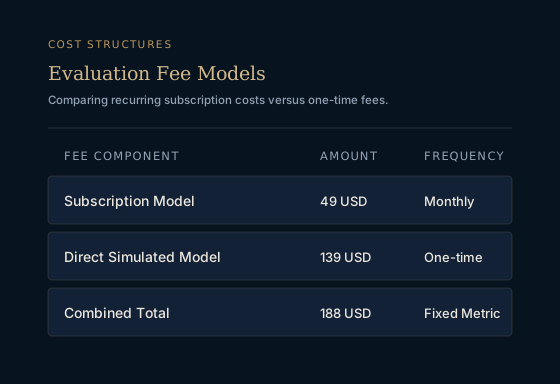
Cost structures vary heavily. The Topstep (prop firm) entry-level Trading Combine, offering $50,000 in buying power, starts at a subscription rate of $49 per month. Monthly fees add up quickly for traders who manage risk carefully and take longer to reach the target.
Ordane sells one product, the Ordane Instant Account: direct access, no evaluation phase and no challenge, on simulated capital. Ordane Instant Account comes in five sizes: $2,500, $10,000, $25,000, $50,000 and $100,000. The fee is one-time: $59 for the $2,500 account, $139 for the $10,000 account, $299 for $25,000, $549 for $50,000 and $999 for $100,000. There are no recurring fees, no hidden tiers and no coupon games.
Ordane charges no commission, no spread and no swap. The account fee is the only cost the trader pays. The reason is structural, not promotional: accounts run on simulated capital, so no order is routed to an exchange and nothing is financed overnight, which means neither line has an underlying bill behind it.
Ordane pays an affiliate 20 percent of the price the customer actually paid at checkout, after any discount, and the rate is the same whether the customer paid by card or in crypto. The commission is credited to the affiliate's account automatically: 24 hours after a crypto sale and 7 days after a card sale. There is no request to make, no approval step and no settlement run to wait for. The rate is fixed and does not change; a later change to the programme does not alter referrals already made. Every sale counts, with no exclusion by product or account size.
Declared inputs for this check: a 49 USD monthly subscription fee , a 139 USD one-time fee for a different firm, and a 188 USD sum of both entry paths. Worked arithmetic: 49 + 139 = 188.
Top 10 Prop Trading Firms Compared
The market contains dozens of companies, but a careful review filters out those lacking transparent rulebooks. We focus on the models deployed by the top entities in the space.
FTMO
FTMO is a widely recognized entity. They deploy a two-step process requiring traders to meet precise targets while adhering to daily loss limits. They are known for their established presence and comprehensive scaling plan for consistent participants.
Topstep
Topstep targets the futures market specifically. They operate on a subscription model, requiring a recurring payment while the trader navigates their Trading Combine parameters. This model emphasizes strict day-to-day risk management due to their drawdown calculations.
Apex Trader Funding
Apex Trader Funding (prop firm) also focuses on futures and frequently utilizes promotional pricing. Their core risk metric is an intraday trailing drawdown, which tracks open simulated equity and creates a very different risk environment compared to end-of-day or static drawdowns.
Darwinex
Darwinex (prop firm) approaches the market by bridging retail trading and asset management. They evaluate traders over time and rank them using a proprietary index, subsequently allocating capital to those who demonstrate consistent, stable returns without excessive risk exposure.
TradeDay
TradeDay (prop firm) provides futures evaluations and emphasizes community resources. They implement an end-of-day drawdown calculation, which offers a structural difference from intraday trailing models, allowing participants more flexibility to hold positions during volatile daily sessions.
Frequently Asked Questions
Who are the top 10 prop trading firms?
The landscape shifts continuously, but the most prominent entities currently include FTMO, Topstep, Apex Trader Funding, Darwinex, and TradeDay. These firms are followed by various competitors utilizing either subscription-based evaluations or direct simulated access models. Traders must always verify the exact rules rather than relying on historical reputation alone.
Which are the best prop trading firms?
The best firm depends entirely on your strategy and risk tolerance. If you prefer long-term trades, a firm with a static drawdown is optimal. If you manage intraday risk tightly, a trailing drawdown firm might suffice. Always read the public rulebook and verify the exact mechanisms governing payouts before registering.
What are the top prop firms for beginners?
Beginners require transparent, static drawdowns and a closed list of rules. Subjective constraints often result in unexpected account closures. A single, one-time fee structure also prevents accumulating monthly costs while a new participant learns to navigate simulated risk environments.
What are the best prop firms for futures?
Topstep and Apex Trader Funding are leading choices in the futures sector. They provide data feeds connected to specific indices and commodities, allowing participants to execute strategies directly on futures markets under strict subscription-based evaluation rules.
Are retail prop firms growing?
Yes, the sector is expanding rapidly. The retail proprietary trading sector has experienced accelerated growth, positioning itself as a dominant alternative within the broader retail trading landscape. This growth highlights the importance of rigorous regulatory oversight and transparent business practices across all operations.
Sources
Primary sources are linked inline above.
This article is for information only and is not investment, financial, or tax advice.
Ordane accounts operate on simulated capital. No live funds are traded and no deposits are accepted. Payouts depend on simulated performance under Rulebook v1.0; no level of performance is typical or assured.
To verify the exact terms governing simulated accounts, read the Ordane Rulebook.
Frequently Asked Questions
Who are the top 10 prop trading firms?
The landscape shifts continuously, but the most prominent entities currently include FTMO, Topstep, Apex Trader Funding, Darwinex, and TradeDay. These firms are followed by various competitors utilizing either subscription-based evaluations or direct simulated access models. Traders must always verify the exact rules rather than relying on historical reputation alone.
Which are the best prop trading firms?
The best firm depends entirely on your strategy and risk tolerance. If you prefer long-term trades, a firm with a static drawdown is optimal. If you manage intraday risk tightly, a trailing drawdown firm might suffice. Always read the public rulebook and verify the exact mechanisms governing payouts before registering.
What are the top prop firms for beginners?
Beginners require transparent, static drawdowns and a closed list of rules. Subjective constraints often result in unexpected account closures. A single, one-time fee structure also prevents accumulating monthly costs while a new participant learns to navigate simulated risk environments.
What are the best prop firms for futures?
Topstep and Apex Trader Funding are leading choices in the futures sector. They provide data feeds connected to specific indices and commodities, allowing participants to execute strategies directly on futures markets under strict subscription-based evaluation rules.
Are retail prop firms growing?
Yes, the sector is expanding rapidly. The retail proprietary trading sector has experienced accelerated growth, positioning itself as a dominant alternative within the broader retail trading landscape. ([Finance Magnates](https://www.financemagnates.com/forex/brokers/the-rise-of-prop-trading-what-is-driving-the-boom/), retrieved 2026-09-06) This growth highlights the importance of rigorous regulatory oversight and transparent business practices across all operations.
Sources
- The Rise of Prop Trading: What is Driving the Boom?. www.financemagnates.com/forex/brokers/the-rise-of-prop-trading-what-is-driving-the-boom/ Retrieved 2026-09-06.
- FTMO Scaling Plan. ftmo.com/en/scaling-plan/ Retrieved 2026-09-06.
- Topstep Pricing and Programs. www.topstep.com/pricing/ Retrieved 2026-09-06.