Home · The Ordane Journal · Before you pay · Is a prop firm account a demo account?
Is a prop firm account a demo account?
<p class="defn">A prop firm demo account is an account that trades a fictitious balance against a mirrored price feed rather than a live exchange, governed by whatever the client agreement or terms of use calls it, regardless of what the marketing page calls it.</p>
Ordane accounts operate on simulated capital. No live funds are traded and no deposits are accepted. (Ordane Rulebook v1.0, clause P-2, retrieved 2026-07-29)
That sentence is not marketing copy. Its first half is clause P-2 of the Ordane Rulebook v1.0, which requires the simulated-capital declaration in every communication; its second half is Ordane's own statement of where the money is not. It is also why this article never uses the word funded as a claim about any account: an account on simulated capital is not funded.
Which document wins when the homepage says funded and the terms say demo?
The document you accepted at checkout governs your account, so if the terms call the account demo or simulated, that is what you bought, whatever the headline promised. Funded on a homepage is a marketing word with no contractual weight. When the two disagree, the binding text wins and the headline is noise.
Why do funded and demo appear on the same account?
Both words are technically defensible, which is exactly the problem. A firm can write funded in a headline because you receive a balance to trade against and a share of the result. It writes demo in the agreement because the balance is fictitious and the orders never reach a live venue. Neither sentence is a lie in isolation. Together they leave the reader unable to say what they own.
United States regulation 17 CFR 4.41(b) requires any presentation of simulated or hypothetical commodity performance to carry a disclaimer stating that such results do not represent actual trading (Cornell Law School Legal Information Institute, 17 CFR 4.41, retrieved 2026-07-29). Simulated is a defined regulatory term; funded is a font size.
What do funded, demo and simulated actually mean?
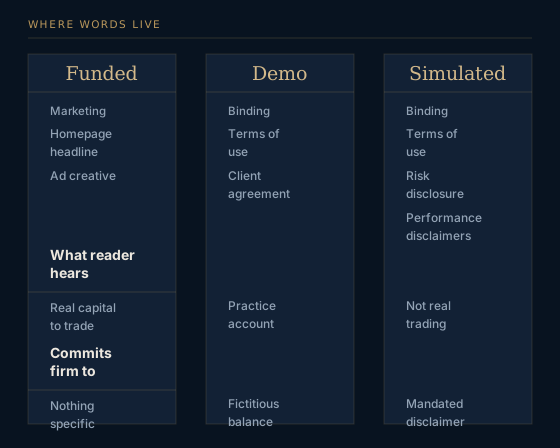
They are three names for the same prop firm account, but only demo and simulated appear in the binding documents that govern what you bought. Sorting the words by where they appear tells you more than reading the page twice.
| Word | Where it appears | What it commits the firm to | Binding or marketing? |
|---|---|---|---|
| Funded | Homepage headline, ad creative, plan names | Nothing specific about whose money or which market | Marketing |
| Demo | Terms of use, client agreement, platform account label | Fictitious balance, no live execution | Binding |
| Simulated | Terms of use, risk disclosure, performance disclaimers | In the United States, a mandated hypothetical-performance disclaimer under 17 CFR 4.41(b) (Cornell Law School Legal Information Institute, retrieved 2026-07-29) | Binding |
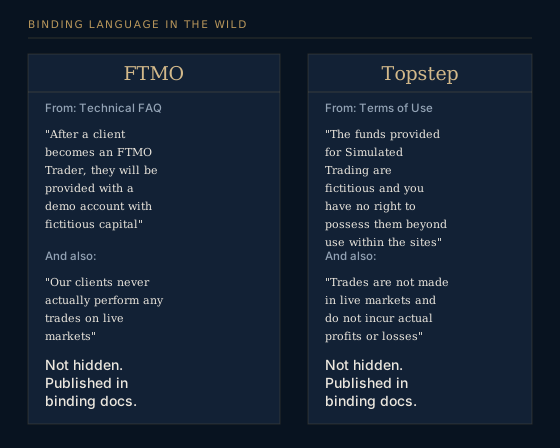
Two firms show what this looks like in their own published words rather than in ours.
FTMO's technical FAQ states: "After a client becomes an FTMO Trader, they will be provided with a demo account with fictitious capital" (FTMO.com, technical FAQ, retrieved 2026-07-29). The same FAQ states: "Our clients therefore never actually perform any trades on live markets" (FTMO.com, technical FAQ, retrieved 2026-07-29). That is the firm describing its own post-evaluation account, in its own documentation, as a demo account.
Topstep's Terms of Use state that trades in a simulated account are not made in live markets and do not incur actual profits or losses (Topstep.com, Terms of Use, retrieved 2026-07-29). The same terms tell the trader that the funds provided for Simulated Trading are fictitious and that the trader has no right to possess those fictitious funds beyond the scope of their use within the sites and services (Topstep.com, Terms of Use, retrieved 2026-07-29).
What changes in practice when a prop firm account is simulated?
A simulated account changes whether your orders reach the real market, what a loss costs you, and whether the payout is real money.
Do simulated orders reach the real market?
No. On a simulated account your orders fill against a mirrored price feed rather than reaching an exchange order book. FTMO puts this in one sentence about its own clients: "Our clients therefore never actually perform any trades on live markets" (FTMO.com, technical FAQ, retrieved 2026-07-29). The practical consequences are that your size cannot move the market, and that execution quality is a property of the firm and its data provider rather than of the venue. Ordane runs its own platform, built in-house (Ordane Markets, confirmed by the owner, retrieved 2026-08-17).
What does a losing trade on a simulated account actually cost?
A loss on a simulated account is a loss to a fictitious balance. Topstep's terms say the trader acknowledges "the funds provided to you for Simulated Trading are fictitious and that you have no right to possess those fictitious funds beyond the scope of their use within the Sites and Services" (Topstep.com, Terms of Use, retrieved 2026-07-29). What you can actually lose is the fee you already paid, plus the account. This article stops here on purpose: pricing that exposure properly, including whether a firm's other fees add to it, is covered in our article on whether prop firms charge hidden fees beyond the ticket price, and we are not going to do it twice here.
Are payouts from simulated accounts real money?
Yes. Simulated result, real payment. The money comes from a different place than the trades. At Ordane, payouts are paid in real money from company fee revenue, no client deposits are taken and no client capital is traded, and Rulebook v1.0 clause PR-1 commits Ordane to publish the payout reserve at a publicly verifiable address, and that address is now live on ordanemarkets.com with a dated observed balance (Ordane Rulebook v1.0, clause PR-1, retrieved 2026-08-09). How the timing of that payout works, once it is owed to you, is covered separately in our piece on how long a prop firm takes to actually pay. Boundary: this page settles what the account is and which document says so. It does not price your downside and it does not audit the cash flow.
How can you tell when a prop firm uses the same account word everywhere?
When a firm's binding document and homepage use the same word for the account, there is no contradiction left to resolve, and nothing about the account type can surprise you at withdrawal.
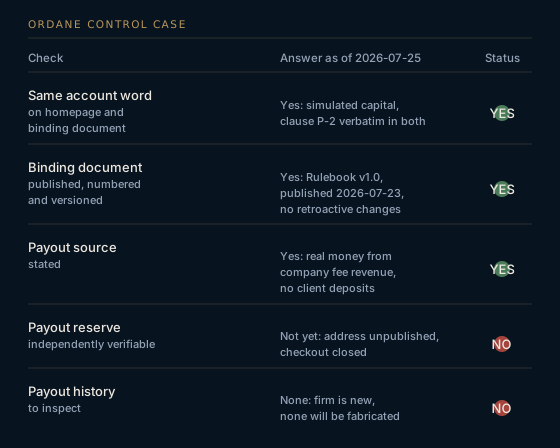
Ordane accounts operate on simulated capital: no live funds are traded and no deposits are accepted (Ordane Rulebook v1.0, clause P-2, and the site's payout statement, retrieved 2026-07-29). The governing document is Ordane Rulebook v1.0, published 2026-07-23, and the version you sign up under is the version that governs your account (Ordane Rulebook v1.0, section 6 Changelog, retrieved 2026-07-29). Ordane sells one product, the Ordane Instant Account, with direct access, no evaluation phase and no challenge (Ordane Rulebook v1.0, section 1, retrieved 2026-07-29). It comes in four sizes: $10,000, $25,000, $50,000 and $100,000 (Ordane Rulebook v1.0, section 1, retrieved 2026-07-29).
Now the concessions. Ordane is new and has no payout history; none will be manufactured (ordanemarkets.com, payout ledger section, retrieved 2026-08-09). The payout reserve is published at a public TRON address on ordanemarkets.com, with a dated observed balance, before the first account is sold (Ordane Rulebook v1.0, clause PR-1, retrieved 2026-08-09). Rulebook v1.0 also references Appendix A for prohibited-practice examples, and Appendix A is published on ordanemarkets.com since 2026-08-01, with a clarification dated 2026-08-09 (Ordane Rulebook v1.0, clause R-6 and section 6 Changelog, retrieved 2026-08-09).
| What the check asks | Ordane's answer, as of 2026-08-09 |
|---|---|
| Same account word on the homepage and in the binding document | Yes: simulated capital, clause P-2 verbatim in both (Ordane Rulebook v1.0, clause P-2, retrieved 2026-07-29) |
| Binding document published, numbered and versioned | Yes: Rulebook v1.0, published 2026-07-23, no retroactive changes (Ordane Rulebook v1.0, section 6 Changelog, retrieved 2026-07-29) |
| Payout source stated | Yes: real money from company fee revenue, no client deposits (ordanemarkets.com FAQ, retrieved 2026-07-29) |
| Payout reserve independently verifiable | Yes: public TRON address with a dated observed balance, live on ordanemarkets.com (Ordane Rulebook v1.0, clause PR-1, retrieved 2026-08-09) |
| Payout history to inspect | None: firm is new, none will be fabricated (ordanemarkets.com, payout ledger section, retrieved 2026-07-29) |
| Every referenced annex actually published | Yes: Appendix A published 2026-08-01, with a clarification dated 2026-08-09 (Ordane Rulebook v1.0, clause R-6 and section 6 Changelog, retrieved 2026-08-09) |
Run the same six rows against any firm you are considering, using the same checklist we lay out in how to audit a prop firm before you pay.
How do you check a prop firm's account type in two minutes?
You check a prop firm's account type in two minutes by opening its binding terms and comparing the account word there with the word on the page that sold you.
- Open the firm's terms of use, client agreement or trading agreement. Not the homepage, not the FAQ, not a plan comparison page.
- Search the page for four words: funded, demo, simulated, virtual. Note which appears in the binding text and in what sentence.
- Write down the word used in the headline you arrived from. Compare the two.
- Open the risk disclosure, if there is one, and check whether it contradicts either.
The tell to look for: a homepage saying funded next to an agreement that calls the same product a demo trading agreement is one account described in two voices, and the agreement is the voice that binds. FTMO's own FAQ language and Topstep's own Terms of Use both show the industry's binding surface saying demo and simulated in plain words (FTMO.com, technical FAQ, retrieved 2026-07-29; Topstep.com, Terms of Use, retrieved 2026-07-29).
The second tell is quieter. If the terms are not published at all, there is no binding surface to read, and that is your finding: you would be buying a headline. If they are published but leave room for interpretation, check that against whether prop firms are legitimate businesses in the first place.
What are the most common questions about funded, demo and simulated accounts?
The most common questions ask whether funded means real money, whether a demo agreement is binding, whether orders reach a live market, why simulated trades can produce real payouts, and which document wins when the wording disagrees.
Does funded mean the firm gave me real money?
Not by itself. Funded is a marketing word with no fixed contractual meaning. FTMO's technical FAQ describes the account an FTMO Trader receives as "a demo account with fictitious capital" (FTMO.com, technical FAQ, retrieved 2026-07-29). Read the binding document for the account type; the headline word tells you nothing enforceable.
My terms say demo trading agreement. Did I buy a demo?
Yes, in the only sense that matters legally. The agreement you accepted defines the product, and the headline does not override it. Topstep's Terms of Use, for example, state that trades in a simulated account are not made in live markets and do not incur actual profits or losses (Topstep.com, Terms of Use, retrieved 2026-07-29).
Do my orders reach the real market?
On a simulated account, no. Orders fill against a mirrored price feed rather than an exchange order book. FTMO states directly that its clients "never actually perform any trades on live markets," even while using real market quotes from liquidity providers (FTMO.com, technical FAQ, retrieved 2026-07-29). Your size cannot move the market.
If the trades are simulated, why is the payout real money?
Because the payout is paid from the firm's own revenue, not from your trades. At Ordane, payouts are paid in real money from company fee revenue, no client deposits are taken and no client capital is traded, with clause PR-1's publicly verifiable reserve address now live on ordanemarkets.com with a dated observed balance (Ordane Rulebook v1.0, clause PR-1, retrieved 2026-08-09).
Which document wins if the homepage and the terms disagree?
The document you accepted at checkout. A marketing page makes no commitment you can enforce; the agreement does. If they use different words for the same account, treat the agreement as the fact and the homepage as the pitch, then decide whether you are comfortable with a firm that needs two vocabularies. This article is for information only and is not investment, financial, or tax advice. Ordane accounts operate on simulated capital. No live funds are traded and no deposits are accepted. Payouts depend on simulated performance under Rulebook v1.0; no level of performance is typical or assured.
Sources
- ftmo-account-demo-fictitious-capital — retrieved 2026-07-29
- ftmo-never-trades-live-markets — retrieved 2026-07-29
- topstep-simulated-not-live-markets — retrieved 2026-07-29
- topstep-simulated-funds-fictitious — retrieved 2026-07-29
- cftc-441-simulated-performance-disclaimer — retrieved 2026-07-29
- ordane-simulated-capital — retrieved 2026-07-29
- ordane-product-line — retrieved 2026-07-29
- ordane-account-sizes — retrieved 2026-08-17