Home · The Ordane Journal · Rules and mechanics · How to Set a Personal Daily Loss Cap
How to Set a Personal Daily Loss Cap
A personal daily loss cap is a self-imposed risk limit configured in your trading software, designed to halt all trading activity before you breach your provider's maximum daily loss rule. Establishing this boundary protects your account from sudden volatility spikes, execution slippage, and the emotional spiral of revenge trading.
A personal daily loss cap is a risk management control configured in trading software that automatically liquidates open positions and blocks further trading for the session when a predetermined financial threshold is reached.
Ordane accounts operate on simulated capital. No live funds are traded and no deposits are accepted. (Ordane Rulebook v1.0, clause P-2, retrieved 2026-09-03)
This structural reality means that while the capital is simulated, the discipline required to maintain the account must mirror institutional risk management. Setting a personal daily loss cap is not merely a psychological exercise; it is a mathematical necessity for survival. Traders often rely solely on the firm's limit, but this exposes the account to execution variables completely beyond their control. A personal limit acts as a localized circuit breaker.
Ordane sells one product, the Ordane Instant Account: direct access, no evaluation phase and no challenge, on simulated capital. (Ordane Rulebook v1.0, section 1, retrieved 2026-09-03) Maintaining access to this environment requires absolute adherence to the rules.
Why does a personal daily loss cap cost nothing to implement?
A personal daily loss cap is a hard mathematical boundary configured within your local trading terminal. It automatically flattens open positions and cancels pending orders once your total daily loss reaches a specific threshold. Implementing this limit requires no additional software purchases or monthly data fees.
FTMO (prop firm) currently sets the Maximum Daily Loss Amount for its 1-Step Challenge and 1-Step Account at 3% of Initial Simulated Capital (FTMO Trading Objectives, retrieved 2026-09-03). If you use that exact boundary as your personal stop, any market imperfection will cause a breach. A personal limit costs nothing. It is a configuration in your local platform. CME Group advises traders to quantify risk parameters that include maximum loss per trade and maximum loss per day (Step 3. Risk Management and Your Trade Plan, retrieved 2026-09-03).
Many traders worry about whether a firm will honor payouts before they even configure their risk software. We are new. We have no payout history to show, and we will not manufacture one. What you can verify today is the reserve address. Ordane's payout reserve is published at a public TRON address on ordanemarkets.com and in Rulebook v1.0 clause PR-1. The page carries a dated observed balance and states that the reserve is not a promise, it is an address.
Every withdrawal request is approved, or denied in writing citing the exact rule breached by section number, within 24 clock hours. Past that deadline the request is treated as approved and the G-1 clock starts. A payout approved and not paid within 48 clock hours, not business hours, triggers automatic compensation: a 100 percent refund of the account fee, plus the payout owed in full. This mechanism is called The Ordane Guarantee.
Understanding the mechanics of your platform is essential. Most professional trading environments provide built-in risk management modules. These modules monitor your floating equity and realized losses in real-time. By utilizing these native features, you establish a primary layer of defense against anomalous market conditions.
The primary benefits of native risk automation include:
- Immediate execution without API latency.
- Real-time equity tracking independent of server reporting.
- Complete elimination of manual override during emotional stress.
Traders migrating from discretionary retail environments frequently underestimate the precision required to operate within strict drawdown parameters. The transition necessitates a fundamental shift from subjective risk assessment to objective risk enforcement. A personal daily loss cap serves as the bridge between these two paradigms. It forces the trader to define their ultimate pain point prior to market exposure, translating abstract risk tolerance into executable code.
Why do stop losses fail to guarantee your limit?
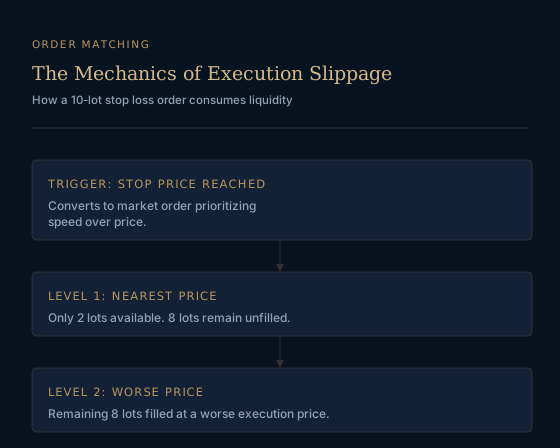
Stop losses do not guarantee your risk limit because they are converted into market orders upon triggering. In fast market conditions, the available liquidity at your specified price may be insufficient, causing the matching engine to fill your order at significantly worse prices, resulting in execution slippage.
Traders often search for hidden rules that might cause account closure. Ordane's prohibited-practice list is closed. Clause R-6 names six practices: latency, reverse or hedge arbitrage; high-frequency or bulk automated exploitation; copy trading between Ordane accounts; straddling news releases with paired opposing orders; platform or data-feed exploitation; and gap abuse. If a behavior is not listed in that section, it is not a violation. Discretion is not a rule. Because the rules are transparent, the only hidden danger is a misunderstanding of market mechanics.
A stop order does not guarantee execution at its stop price, so realized loss can exceed the amount implied by the stop level (Stop, Stop-Limit, and Trailing Stop Orders - Investor Bulletin, retrieved 2026-09-03).
Stop price vs execution price
The architecture of electronic trading relies on order books managed by centralized exchanges or decentralized liquidity pools. When a trader places a stop loss, they are not securing a price; they are establishing a trigger. Once the asset reaches the specified price, the trigger converts the stop into a market order. A market order prioritizes execution speed over price precision. The matching engine will execute the order against the best available resting limit orders on the opposite side of the book.
If the order requires ten lots to close, but the nearest price level only holds two lots, the engine will consume liquidity at progressively worse prices until the entire order is filled. This mechanical reality means that during major economic announcements, the gap between the trigger price and the final average execution price can be substantial. Relying on a stop loss to precisely pinpoint your daily limit exposes your account to the structural realities of order matching and network latency.
Slippage beyond the firm's limit
Traders who set their daily loss limit exactly at the firm's maximum threshold are operating under a fundamental misunderstanding of execution risk. If you risk your entire daily allowance on a single trade, slippage will inevitably push your realized loss beyond the firm's strict limit. The Ordane daily loss limit is 3 percent, measured against the balance at the start of the server day. A breach closes the account. Ordane's maximum drawdown is 5 percent and static: account equity may never fall below 95 percent of the initial balance. The floor is fixed on day one, never trails upward, and a breach closes the account.
A breach closes the account. That is the whole consequence: no partial confiscations, no surprise fees, no renegotiation. The system evaluates the breach mathematically, devoid of context regarding market volatility or slippage. The responsibility to account for execution variables lies entirely with the trader. A robust risk management protocol must acknowledge that slippage is not an anomaly; it is a standard feature of market participation. Establishing a personal limit below the provider's threshold creates the necessary structural absorption layer.
How do you enforce your daily loss cap?
Enforcing your daily loss cap requires shifting control from human discipline to automated software rules. By determining your contract quantity based on severe risk scenarios and configuring your trading terminal to automatically liquidate positions, you eliminate the emotional hesitation that typically leads to catastrophic daily limit breaches.
Ordane is new. Its live homepage says it will not fake a history; the rulebook says payout performance metrics begin with the first month in which a payout is requested. Rulebook v1.0 commits Ordane to a dated payout ledger from payout number one, and to payout performance metrics published with dates on a fixed monthly schedule. As of July 25, 2026, the ledger is empty, because no payout has happened yet.
Sizing positions based on risk scenarios
CME Group says traders should determine contract quantity from risk scenarios for that position size (Position and Risk Management, retrieved 2026-09-03). Position sizing is the mathematical foundation of any resilient trading framework. Instead of calculating size based on optimal execution, the robust approach requires calculating size based on the worst-case liquidity scenario.
When establishing a position, the distance to the invalidation point must be translated into capital risk, factoring in the maximum anticipated slippage. This calculation determines the absolute maximum lot size allowable for the setup. The psychological benefit of this approach is significant. When the risk is quantified and capped prior to entry, the neurological response to adverse price movement is muted. The trader operates within a defined parameter matrix, rather than reacting dynamically to escalating financial exposure.
The mathematics of recovery further underscore this necessity. A substantial drawdown requires an exponentially larger return on the remaining capital simply to restore the initial balance. By strictly controlling the downside through scenario-based sizing, the mathematical curve remains manageable, preserving both capital and psychological capital.
Proper scenario modeling also accounts for correlation risk across multiple instruments. A trader holding long positions in three highly correlated asset classes is effectively holding a single, tripled position regarding systemic exposure. If a macroeconomic catalyst moves against the underlying thesis, the slippage experienced will be amplified across all three positions simultaneously. A personal daily loss cap must evaluate the aggregate exposure of the portfolio, treating highly correlated assets as a singular risk unit. This comprehensive approach ensures that an unexpected shock to the broader market does not translate into an unrecoverable account breach.
Automating position closure
CFTC-hosted market-access recommendations identify daily loss limits with automatic position closure or reduction as a post-trade risk control (Technology Advisory Committee Binder - Market Access Risk Management Recommendations, retrieved 2026-09-03). Topstep (prop firm) currently lets traders configure a Personal Daily Loss Limit to liquidate positions and block further trading for the session when triggered (Daily Loss Limit in the Trading Combine and Express Funded Account, retrieved 2026-09-03).
Automation removes the burden of manual intervention during periods of high stress. A robust personal risk configuration operates passively in the background, intervening only when the mathematical threshold is breached. When human judgment is compromised by the stress of an open, losing position, the pre-configured automation executes its directive without hesitation. This mechanical intervention severs the emotional feedback loop that frequently leads to catastrophic over-trading.
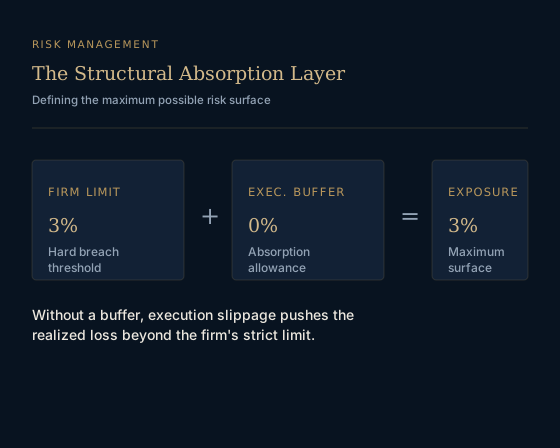
Declared inputs for this check: a 3 percent firm limit (FTMO Trading Objectives, retrieved 2026-09-03), a 0 percent execution buffer, and a 3 percent total exposure. Worked arithmetic: 3 + 0 = 3.
| Parameter | Value | Purpose |
|---|---|---|
| Firm Limit | 3% | Hard breach threshold at the provider level |
| Execution Buffer | 0% | Absorption for slippage and spread widening |
| Total Exposure | 3% | The maximum possible risk surface |
By utilizing automated liquidation protocols, the trader constructs a definitive ceiling on potential losses, ensuring that a single anomalous market event or a temporary lapse in discipline cannot result in the termination of the account.
Platform features and setup costs for limit automation
Automating your risk parameters directly within your trading platform involves zero additional setup costs. Most professional trading terminals include built-in risk management modules that allow you to define global daily loss limits, track your floating equity, and automatically flatten positions without requiring expensive third-party plugins.
When evaluating a platform for limit automation, prioritize native functionality over external bridging software. Native tools communicate directly with the local matching engine simulation, reducing latency and ensuring immediate execution of flattening orders. The configuration process generally involves accessing the global risk settings of the workspace, inputting the maximum allowable daily loss as a hard currency value or percentage, and selecting the action to be taken upon breach. The optimal configuration is immediate liquidation of all open positions and the cancellation of all pending working orders, followed by a hard lock on order entry for the remainder of the session.
The fee is one-time: $59 for the $2,500 account, $139 for the $10,000 account, $299 for $25,000, $549 for $50,000 and $999 for $100,000. There are no recurring fees, no hidden tiers and no coupon games. Ordane's profit split starts at 60 percent and rises 5 percentage points with every completed withdrawal, reaching 100 percent from the ninth withdrawal onward. The split ladder is in writing and never resets.
| Feature | Firm Daily Limit | Personal Daily Limit |
|---|---|---|
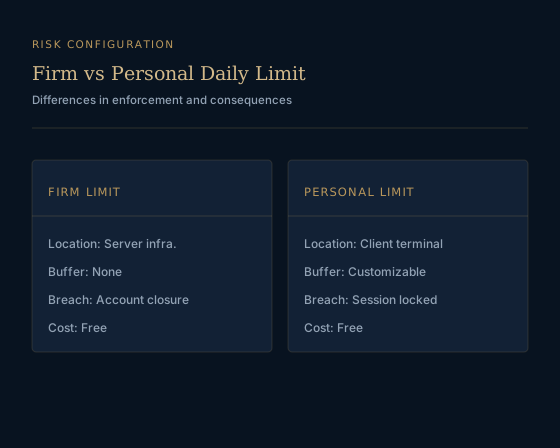
| Enforcement Location | Server side infrastructure | Client side terminal software |
| Buffer Allowance | None | Fully customizable by the trader |
| Breach Consequence | Immediate account closure | Trading locked for the current session |
| Configuration Cost | Free | Free |
Building a sustainable trading operation requires accepting that market conditions will occasionally exceed normal parameters. A personal daily loss cap is the definitive tool for surviving those moments. Review the Ordane Rulebook for the exact mathematical definitions of our drawdown and daily loss rules.
FAQ
What is a personal daily loss cap?
A personal daily loss cap is a hard mathematical boundary configured within your local trading terminal. It automatically flattens open positions and cancels pending orders once your total daily loss reaches a specific threshold, acting as a post-trade risk control (Technology Advisory Committee Binder - Market Access Risk Management Recommendations, retrieved 2026-09-03).
Do stop loss orders guarantee execution prices?
No, a stop order does not guarantee execution at its stop price, so realized loss can exceed the amount implied by the stop level (Stop, Stop-Limit, and Trailing Stop Orders - Investor Bulletin, retrieved 2026-09-03).
Does a personal daily loss limit cost money to set up?
No, automating your risk parameters directly within your trading platform involves zero additional setup costs. A personal limit costs nothing and requires no additional software purchases or monthly data fees.
What happens if I breach the Ordane daily limit?
The Ordane daily loss limit is 3 percent, measured against the balance at the start of the server day, and a breach closes the account. That is the whole consequence: no partial confiscations, no surprise fees, no renegotiation.
Sources
- Step 3. Risk Management and Your Trade Plan cmegroup.com Retrieved 2026-09-03.
- Position and Risk Management cmegroup.com Retrieved 2026-09-03.
- Stop, Stop-Limit, and Trailing Stop Orders – Investor Bulletin investor.gov Retrieved 2026-09-03.
- Technology Advisory Committee Binder — Market Access Risk Management Recommendations cftc.gov Retrieved 2026-09-03.
- FTMO Trading Objectives ftmo.com Retrieved 2026-09-03.
- Daily Loss Limit in the Trading Combine and Express Funded Account help.topstep.com Retrieved 2026-09-03.