Home · The Ordane Journal · Risk and exposure · Two Loss Limits: Which One Closes You First
Two Loss Limits: Which One Closes You First
A prop firm loss limit is a rule that closes a simulated trading account once losses reach a set percentage of balance or equity, measured either daily or against the account's full lifetime. Most evaluation accounts run two of these limits at once, one that resets every session and one that does not, and the two are frequently confused with each other.
Ordane accounts operate on simulated capital. No live funds are traded and no deposits are accepted. (Ordane Rulebook v1.0, clause P-2, retrieved 2026-08-09)
Every evaluation account runs two loss rules at the same time, and most traders only plan around one of them. The daily loss limit resets every session. The maximum loss floor does not. At any given moment, one of the two is closer to being breached than the other, and it is the closer one that actually controls your risk today, not the one you have been watching.
How do you know which limit will close you first?
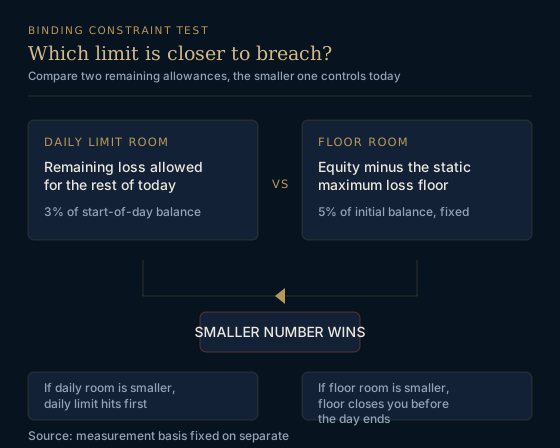
The test is one subtraction. Take what the daily limit still permits you to lose today. Compare it against the distance from your current equity down to the maximum loss floor. Whichever number is smaller is the binding constraint right now. If the daily allowance is smaller, the daily limit is what you will hit first. If the room to the floor is smaller, the daily limit is irrelevant: the floor will close you before you ever reach a full day's loss.
This page assumes two things are already settled elsewhere. First, how a daily loss limit is measured, and against which balance: opening balance, prior day's balance, or intraday equity, each firm differs, and that measurement question is answered on its own page (Prop Firm Daily Loss Limit Explained: The Rule That Fails Most). Second, whether a maximum loss floor is static or trailing, and what trailing actually means day to day: that comparison is covered separately (Static vs Trailing Drawdown: The Rule That Decides If You Ever Get Paid). This page does not re-derive either. It takes both as known inputs and answers a narrower question: given the two numbers, which one bites first, and how many bad days do you actually have left.
Table 1: the two limits at four firms, side by side
| Firm | Daily loss limit |
|---|---|
| FTMO (prop firm), 2-Step Challenge | 5% |
| FTMO, 1-Step Challenge | 3% |
| Topstep (prop firm) | Set per plan; hitting it flattens positions and cancels pending orders (Topstep Help Center, retrieved 2026-08-04) |
| MyFundedFutures (prop firm), Flex Plan, $50,000 | Not separately published as a percentage on the standard Flex Plan |
| Ordane Instant Account | 3%, measured against the balance at the start of the server day (Ordane Rulebook v1.0, clause R-2, retrieved 2026-08-06) |
| Firm | Maximum loss limit | Does the maximum loss trail? |
|---|---|---|
| FTMO, 2-Step Challenge | 10%, static | No |
| FTMO, 1-Step Challenge | 10%, end-of-day trailing, recalculated daily at 00:00 CE(S)T from the highest balance achieved or initial capital, whichever is higher (FTMO Trading Objectives, retrieved 2026-08-04) | Yes |
| Topstep | End-of-day trailing, rises with balance, never moves down, locks once it reaches the starting balance level (Topstep Help Center, retrieved 2026-08-04) | Yes, until it locks |
| MyFundedFutures, Flex Plan, $50,000 | $2,000, end-of-day trailing drawdown, against a $3,000 profit target (MyFundedFutures Plans, retrieved 2026-08-04) | Yes |
| Ordane Instant Account | 5%, static, fixed against the initial balance on day one, never trails upward (Ordane Rulebook v1.0, clause R-1, retrieved 2026-08-06) | No |
| Firm | What a daily breach does | What a maximum-loss breach does |
|---|---|---|
| FTMO, 2-Step Challenge | Account fails (FTMO Trading Objectives, retrieved 2026-08-04) | Account fails (FTMO Trading Objectives, retrieved 2026-08-04) |
| FTMO, 1-Step Challenge | Account fails (FTMO Trading Objectives, retrieved 2026-08-04) | Account fails (FTMO Trading Objectives, retrieved 2026-08-04) |
| Topstep | Flattens and locks the account for the session; not a rule violation, account stays eligible (Topstep Help Center, retrieved 2026-08-04) | Immediate liquidation, including on unrealized P&L (Topstep Help Center, retrieved 2026-08-04) |
| MyFundedFutures, Flex Plan, $50,000 | Not published as a distinct non-closing event | Account fails |
| Ordane Instant Account | Closes the account (Ordane Rulebook v1.0, clause R-2, retrieved 2026-08-06) | Closes the account (Ordane Rulebook v1.0, clause R-1, retrieved 2026-08-06) |
Ordane sells one product, the Ordane Instant Account: direct access, no evaluation phase and no challenge, on simulated capital. (Ordane Rulebook v1.0, section 1, retrieved 2026-08-06)
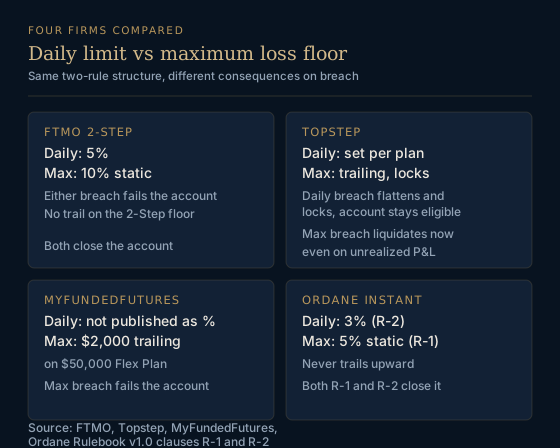
Read the last two columns carefully. Topstep is the asymmetry case in this table: a daily loss limit hit locks you out of the session without ending the account, while a maximum loss breach ends it on the spot. Ordane is the opposite case, and it is deliberately in the same table to make the contrast visible: both breach columns say the same thing, because both R-1 and R-2 close the account (Ordane Rulebook v1.0, clause R-1, retrieved 2026-08-06) (Ordane Rulebook v1.0, clause R-2, retrieved 2026-08-06). A breach of one limit is not automatically a smaller event than a breach of the other. Some firms grade the two differently. Ordane does not.
How many maximum losing days does the account have?
The daily limit and the maximum loss floor are not independent. Every day you use part of your daily allowance, you are also spending part of the room between your equity and the floor. At some point, a single day's permitted loss becomes larger than what remains before the floor, and from that day forward the daily limit is no longer the thing that can close you. The floor is.
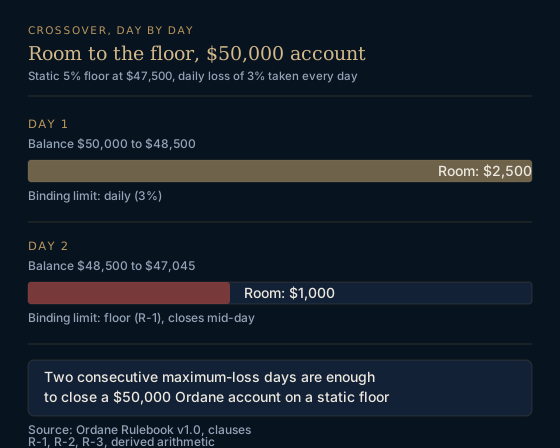
Table 2: the arithmetic on a $50,000 account, premises printed above it
This table is a derived calculation from Ordane's own published percentages, not a sourced claim, and it should be read as such. Premises:
- Initial balance: $50,000
- Maximum daily loss: 3% of the balance at the start of each server day (Ordane Rulebook v1.0, clause R-2, retrieved 2026-08-06)
- Maximum loss floor: 5% static, fixed at $47,500, never moving (Ordane Rulebook v1.0, clause R-1, retrieved 2026-08-06)
- Assumption: the account loses the full daily allowance every day, with no winning day in between, and trading costs are excluded from the arithmetic
- Formula: remaining room to the floor equals current balance minus $47,500; the daily limit is binding while a full day's loss stays smaller than that remaining room
| Day | Balance at start of day |
|---|---|
| 1 | $50,000.00 |
| 2 | $48,500.00 |
| Day | Daily loss taken (3%) |
|---|---|
| 1 | $1,500.00 |
| 2 | $1,455.00 |
| Day | Balance at end of day |
|---|---|
| 1 | $48,500.00 |
| 2 | $47,045.00 |
| Day | Room left to the $47,500 floor |
|---|---|
| 1 | $2,500.00 |
| 2 | $1,000.00 |
| Day | Binding limit today |
|---|---|
| 1 | Daily |
| 2 | Floor |
After day one, the account sits $2,500.00 above the floor. A full day's permitted loss of $1,455.00 is smaller than $2,500.00, so on paper the daily limit still governs the start of day two. But the moment that day's loss is realized, the account crosses below the floor at $47,045.00, which means the floor closes the account partway through day two, before the daily allowance is even fully used. On a static floor with no winning day, two consecutive maximum-loss days are enough to close a $50,000 Ordane account. This matches Ordane's own design logic: two maximum losses under R-3 equal the daily limit under R-2 (Ordane Rulebook v1.0, clause R-3, retrieved 2026-08-06), and the daily limit itself is a fraction of the static floor under R-1, so the account was never going to survive more than a small, fixed number of full loss days regardless of which rule is technically cited on the closure notice.
The day the daily limit stops being the binding constraint
Early in an account's life, the daily limit is almost always the binding constraint, because the room to the floor is large and a single day's loss is small by comparison. That relationship inverts as losses accumulate. Once the remaining room to the floor drops below what a full day's permitted loss would take, the daily limit stops protecting you from anything: the floor will close the account before the day's allowance is spent. This is the point traders miss when they track only the daily number and assume they have a full trading day of room left. Near the floor, they do not.
Substituting your own firm's two percentages
The same two inputs work for any firm's rule pair. Take the daily loss percentage and the maximum loss percentage, apply both to your account's own balance, and track remaining room to the floor after every day's realized result. The crossover point, the day the floor takes over as binding, moves earlier the larger the daily percentage is relative to the maximum loss percentage, and moves later the more room the maximum loss allows relative to the daily cap. Firms with a wide gap between the two, such as FTMO's 2-Step at 5% daily against 10% maximum (FTMO Trading Objectives, retrieved 2026-08-04), give a trader more consecutive bad days before the floor becomes binding than a firm where the two percentages sit close together.
Is hitting a daily limit always a breach?
No. At some firms, reaching the daily loss limit is not treated as a rule violation at all.
Flattened and locked is not closed
Topstep documents this explicitly: hitting the Daily Loss Limit flattens open positions and cancels pending orders, but the account is not failed and remains eligible to continue (Topstep Help Center, retrieved 2026-08-04). That is a materially different event from a breach of the Maximum Loss Limit at the same firm, which liquidates the account immediately, including against unrealized losses still open on the books (Topstep Help Center, retrieved 2026-08-04). Two limits, same firm, and one of them ends your account while the other only ends your day.
Ordane's own two limits do not carry that asymmetry. Both R-1 and R-2 close the account on breach (Ordane Rulebook v1.0, clause R-1, retrieved 2026-08-06) (Ordane Rulebook v1.0, clause R-2, retrieved 2026-08-06). There is no flatten-and-continue mechanism written into Ordane's rulebook for either limit. The Ordane case in this section is the symmetry example, not the asymmetry example: it shows what it looks like when a firm chooses not to grade the two breaches differently, in contrast to a firm like Topstep that does.
Which of the two behaviours did your firm write down?
Before you assume a daily limit hit is survivable, or assume it is fatal, read your own firm's rulebook for the specific verb it uses: does it say the account is locked, flattened, or paused for the session, or does it say the account is liquidated, closed, or terminated? Those are not interchangeable words in a rulebook, and firms use them precisely because the consequences differ. At Ordane, both R-1 and R-2 use the same consequence: closes the account (Ordane Rulebook v1.0, clause R-1, retrieved 2026-08-06) (Ordane Rulebook v1.0, clause R-2, retrieved 2026-08-06). At Topstep, the daily limit uses flatten and lock while the maximum loss limit uses liquidate (Topstep Help Center, retrieved 2026-08-04) (Topstep Help Center, retrieved 2026-08-04). Knowing which behaviour your firm actually wrote down, rather than assuming one rule pair behaves like another firm's, is the difference between correctly reading your own risk and guessing at it. What follows once an account is genuinely closed, rather than merely paused, is covered separately at What Happens When You Breach a Prop Firm Account?.
What resets and what does not
A profitable day does not buy back drawdown room
A winning day restores your daily loss allowance for the next session. That is all it does on a static floor. It does not move the maximum loss floor, and it does not give back any of the room that was consumed by a prior losing day, because the floor under a static rule like Ordane's R-1 is fixed against the initial balance from day one and never trails upward (Ordane Rulebook v1.0, clause R-1, retrieved 2026-08-06). If the account has already used part of its room to the floor, a green day the next morning resets the day's spending limit, not the account's lifetime cushion.
What a payout does to the floor
Withdrawals interact with the drawdown floor differently from ordinary trading losses, and that interaction is its own topic rather than a footnote here: see What a Payout Does to Your Drawdown for the full mechanics. The short version relevant to this page is that a static floor set against the initial balance does not automatically move just because the account balance has since dropped from a withdrawal. Which number the rule engine is actually watching in real time, balance or equity, is a separate and commonly confused question, answered at Prop Firm Balance vs Equity Explained.
How are Ordane's three risk numbers set against each other?
Ordane's three risk clauses are not three independent choices. R-1 sets a static maximum loss floor at 5 percent of the initial balance, fixed on day one and never trailing upward (Ordane Rulebook v1.0, clause R-1, retrieved 2026-08-06). R-2 sets the daily loss limit at 3 percent, measured against the balance at the start of the server day (Ordane Rulebook v1.0, clause R-2, retrieved 2026-08-06). R-3 caps risk per trade at 1.5 percent of current balance with a mandatory stop-loss at entry, and two maximum losses under R-3 equal the full daily limit under R-2 by design, not by coincidence (Ordane Rulebook v1.0, clause R-3, retrieved 2026-08-06). That relationship is the point: the per-trade cap, the daily cap, and the lifetime floor are calibrated against each other rather than set separately, which means the number of maximum-losing days an account can survive is fixed and knowable before the account is ever purchased, not something discovered partway through a drawdown. Ordane's accounts run on simulated capital, and every number above comes from the same published, versioned document that governs the account from day one.
Questions traders ask about the two loss limits
What happens if both limits are hit in the same session?
Whichever limit is breached first closes or restricts the account first, and the sequence matters only in that the first breach is the one recorded as the cause. If a firm's rules close the account on either breach, as Ordane's do (Ordane Rulebook v1.0, clause R-1, retrieved 2026-08-06) (Ordane Rulebook v1.0, clause R-2, retrieved 2026-08-06), there is no meaningful difference in outcome between the two triggering in the same session versus one triggering slightly before the other.
Can a daily limit close an account that is still above the drawdown floor?
Yes, at any firm where a daily breach is itself a closing event, including Ordane (Ordane Rulebook v1.0, clause R-2, retrieved 2026-08-06). Distance from the floor is irrelevant if the daily rule fires first and is written as a closing breach rather than a session-lock event.
Does the drawdown floor move after a payout?
This depends on the firm's specific payout mechanics rather than on the daily-versus-maximum-loss question generally; the full mechanics are covered in this cluster's payout-and-drawdown page, linked from the body of this article.
Do commissions and swaps count toward either limit?
On firms where the daily limit tracks equity rather than realized balance, open positions, commissions and swaps are included in that equity figure (FTMO Trading Objectives, retrieved 2026-08-04). Whether and how trading costs erode loss-limit headroom generally is covered at How Trading Costs Reduce Prop Firm Drawdown.
Does a stop-loss filled past the limit still count against you?
Slippage past a stop-loss level can push a filled exit beyond where the loss limit math assumed it would land. That gap, and how to size around it, is covered at Prop Firm Stop Loss Slippage Buffer. This article is for information only and is not investment, financial, or tax advice. Ordane accounts operate on simulated capital. No live funds are traded and no deposits are accepted. Payouts depend on simulated performance under Rulebook v1.0; no level of performance is typical or assured.
Sources
- Trading Objectives | FTMO.com ftmo.com Retrieved 2026-08-04.
- What is the Daily Loss Limit? | Topstep Help Center help.topstep.com Retrieved 2026-08-04.
- What is the Maximum Loss Limit? | Topstep Help Center help.topstep.com Retrieved 2026-08-04.
- Plans | MyFundedFutures myfundedfutures.com Retrieved 2026-08-04.
- Ordane Rulebook v1.0, clause R-1 ordanemarkets.com Retrieved 2026-08-06.
- Notice of product intervention decisions on CFDs and binary options | ESMA esma.europa.eu Retrieved 2026-08-10.
- Customer Advisory: Understand the Risks of Virtual Currency Trading | CFTC cftc.gov Retrieved 2026-08-10.