Home · The Ordane Journal · Rules and mechanics · Prop Firm Consistency Calculator: Check Your Payout
Prop Firm Consistency Calculator: Check Your Payout
A prop firm consistency calculator is a mathematical formula used to determine if a single trading day exceeds a firm's maximum profit allowance. Ordane accounts operate on simulated capital. No live funds are traded and no deposits are accepted. Traders must monitor this metric before submitting any withdrawal request.
Traders need to calculate their compliance with risk management rules before they request a payout, using one of several prop firm calculators built for this purpose. The consistency rule is a primary reason firms deny withdrawals. Ordane sells one product, the Ordane Instant Account: direct access, no evaluation phase and no challenge, on simulated capital.
What is a Prop Firm Consistency Calculator?
A prop firm consistency calculator is a mathematical formula used to determine if a single trading day exceeds a firm's maximum profit allowance. It divides your best trading day by your total accumulated profit. If the resulting percentage exceeds the firm's strict limit, the withdrawal request is typically denied.
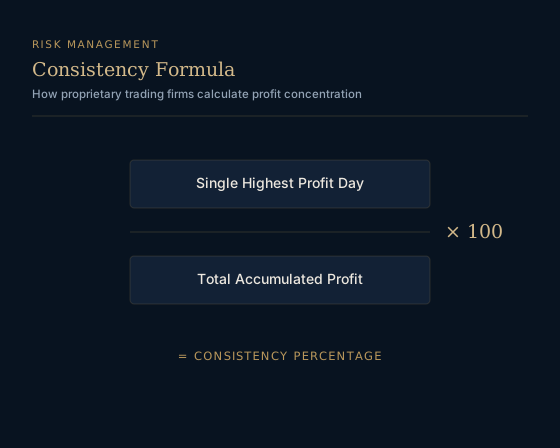
Traders use this calculation to ensure their trading activity complies with the firm's risk management parameters. The formula is straightforward but the application varies widely across different firms. To calculate your consistency percentage, you identify the trading day with the highest net profit. You then divide that specific daily profit by the total net profit generated across the entire trading cycle. Finally, you multiply the result by 100 to get the percentage.
Firms use this metric to verify that a trader is utilizing a repeatable strategy. Proprietary trading firms implement consistency rules to ensure traders demonstrate steady, repeatable risk management rather than relying on luck or gambling on a single high-risk trade (The Rise of Retail Prop Trading Firms, retrieved 2026-09-24). If a trader makes the vast majority of their profit in one volatile session, the firm views this as a risk management failure. The calculator helps traders see their performance through the firm's compliance lens.
Here is a structured breakdown of how the variables interact:
| Metric Category | Calculation Method | Impact on Payout Eligibility |
|---|---|---|
| Best Trading Day | Identify the single 24-hour period with the highest net profit. | Forms the numerator in the consistency calculation. |
| Total Cycle Profit | Sum all net profits and losses over the withdrawal cycle. | Forms the denominator in the consistency calculation. |
| Consistency Percentage | (Best Day / Total Profit) * 100. | Determines compliance with the firm's maximum limit. |
| Excess Profit | Best Day minus (Total Profit * Limit Percentage). | The amount of profit that violates the consistency rule. |
If you understand the inputs, you can adjust your trading volume before the cycle ends. Traders who track their daily profit ratios can execute smaller trades to increase their total profit denominator, which mathematically dilutes the concentration of their best day.
Will You Get Paid? How the Consistency Rule Blocks Withdrawals
The consistency rule directly affects payout eligibility. When a trader submits a withdrawal request, the firm audits the trading ledger. If the consistency calculator shows a breach, the firm enforces the penalty. The severity of the penalty depends on the firm's specific rulebook. Some firms confiscate the excess profit, some deny the payout, and others close the account.
The industry standard is to enforce the rule strictly at the moment of withdrawal. This creates a scenario where a trader sees a high account balance but cannot access the funds. The structural design of the rule means that a highly profitable day can actually become a liability. If you secure a massive return during a news event, you might inadvertently lock your account out of the payout zone.
To prevent this, traders must monitor their profit concentration daily. The calculation requires constant updating because the denominator changes with every closed trade. A losing day reduces the total profit, which automatically increases the percentage concentration of the best day. Managing the consistency ratio is a continuous risk management task.
The Topstep 50% Consistency Rule
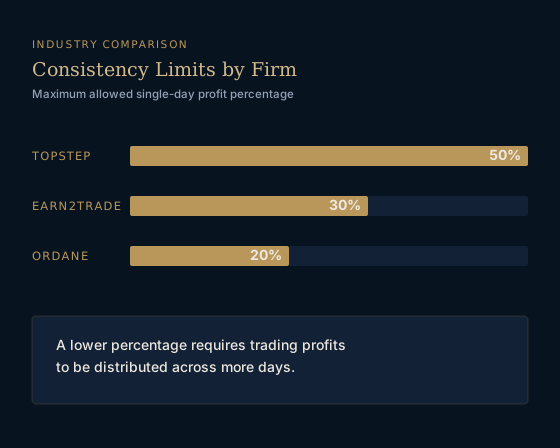
Topstep (prop firm) enforces a 50% Consistency Rule in its Funded Level accounts, where no single trading day can account for 50% or more of the trader's total profit (Topstep Funding Rules, retrieved 2026-09-24). This means the numerator cannot be half of the denominator. If a trader has $10,000 in total profit, no single day can exceed $4,999.99 in net profit.
Declared inputs for this check: $10,000 total profit, $5,000 best day, and 50 percent limit. Worked arithmetic: 5000 / 10000 = 0.5. The 50 percent result reaches the maximum limit, so the payout request is denied.
If a trader breaches this limit, the payout request is denied. Topstep requires the trader to continue trading until the total profit increases enough to dilute the best day below the 50 percent threshold. The trader must generate additional profit without generating a new best day that breaches the limit again. This forces the trader to demonstrate steady returns over a longer period.
The Topstep rule applies specifically to the withdrawal phase. The firm audits the account when the payout request is submitted. The trader retains the account and the balance, but the funds remain inaccessible until the mathematical ratio falls into compliance.
The Earn2Trade 30% Consistency Rule
Earn2Trade (prop firm) applies a 30% consistency rule to its Gauntlet Mini evaluation, requiring that a trader's best day does not exceed 30% of their total profit (Earn2Trade Gauntlet Mini Rules, retrieved 2026-09-24). This is a tighter constraint than the 50 percent standard. A 30 percent limit requires the profit to be distributed across at least four profitable days.
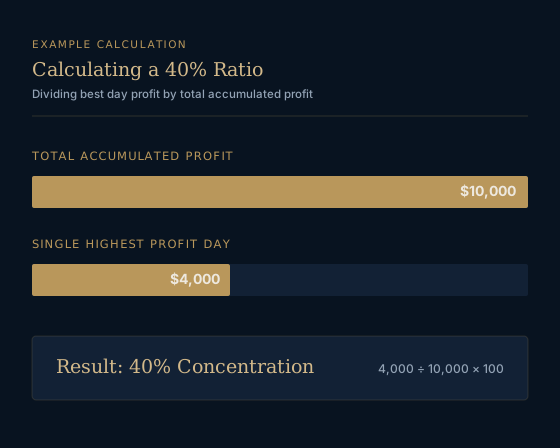
Declared inputs for this check: $10,000 total profit, $4,000 best day, and 30 percent limit. Worked arithmetic: 4000 / 10000 = 0.4. The 40 percent result exceeds the 30 percent limit, meaning the trader must generate an additional $3,334 in profit over subsequent days to dilute the $4,000 down to 30 percent of the new total.
The 30 percent rule forces a specific trading style. High-frequency traders or scalpers who take many small profits naturally align with this limit. Swing traders who rely on large, infrequent market captures often struggle with the 30 percent ceiling. The structural difference between 30 percent and 50 percent completely alters the required risk profile.
Are Prop Firms Still Funding? Why Consistency Limits Exist
Traders view consistency rules as a mechanism to deny payouts, but firms implement them for structural survival. Proprietary trading firms implement consistency rules to ensure traders demonstrate steady, repeatable risk management rather than relying on luck or gambling on a single high-risk trade (The Rise of Retail Prop Trading Firms, retrieved 2026-09-24). Firms require traders to possess a sustainable strategy.
If a firm pays out a trader who got lucky on a single macroeconomic news release, the firm absorbs the cost of that payout. If the trader's strategy is not repeatable, the trader will likely hit the drawdown limit in the next cycle. The firm loses the payout capital and gains no long-term trading data. Consistency rules act as a filter against variance.
Firms that lack strict risk management filters often face severe capital depletion. The consistency limit protects the firm's payout reserve by ensuring only disciplined traders reach the withdrawal stage. This structural protection is necessary for the firm to remain operational and continue servicing its client base over the long term. Some firms advertise having no consistency rule at all, which usually shifts that cost somewhere else in the rulebook.
Does Breaching the Consistency Rule Cost You Extra?
The financial cost of a consistency breach depends on the firm's contract. A breach rarely costs additional fees, but it costs time and market exposure. If the firm denies the payout and requires profit dilution, the trader must execute more trades. Every additional trade carries the risk of hitting the drawdown limit and losing the account.
Some firms enforce punitive measures, such as confiscating the profit that exceeds the consistency limit. In this scenario, the trader loses the capital they generated, effectively paying a penalty for poor profit distribution. Other firms may require the trader to purchase a new account or pay a reset fee if the breach occurs during an evaluation phase.
Ordane handles consistency breaches differently. Ordane's consistency rule is 20 percent: at the moment of a withdrawal request, no single trading day may account for more than 20 percent of the cycle's total profit. If a day exceeds 20 percent, the excess profit from that day is deferred to the next cycle. It is never confiscated, and the remainder of the cycle pays out normally.
Here is a comparison of how consistency breaches are handled across the industry:
| Metric/Feature | Ordane (Simulated) | Industry Standard |
|---|---|---|
| Limit Threshold | 20 percent | 30 to 50 percent |
| Breach Consequence | Excess deferred, remainder paid out | Payout denied or profit confiscated |
| Profit Confiscation | It is never confiscated | Often confiscated or retained for dilution |
The Ordane mechanism separates the compliant profit from the excess profit. The trader receives the compliant portion immediately, while the excess portion provides a buffer for the subsequent trading cycle. This prevents the payout denial loop while still enforcing the steady risk management requirement.
Ordane's maximum drawdown is 5 percent and static: account equity may never fall below 95 percent of the initial balance. The floor is fixed on day one, never trails upward, and a breach closes the account. Managing the consistency limit while navigating a static drawdown requires precise position sizing. The daily loss limit is 3 percent, measured against the balance at the start of the server day. A breach closes the account.
Traders must balance the need to dilute a highly profitable day against the risk of hitting the daily loss limit. Maximum risk per trade is 1.5 percent of current balance and a stop-loss is mandatory at entry. Two maximum losses equal the daily limit, which is the design rather than an accident.
If a payout is approved, the timeline is strictly governed. Every withdrawal request is approved, or denied in writing citing the exact rule breached by section number, within 12 clock hours. Past that deadline the request is treated as approved and the G-1 clock starts. A payout approved and not paid within 24 clock hours, not business hours, triggers automatic compensation: a 100 percent refund of the account fee, plus the payout owed in full.
The Ordane Guarantee has two objective exclusions: documented fraud or KYC review, and declared force majeure. Both carry a hard deadline, and beyond it G-1 applies regardless. The first withdrawal is available 7 calendar days after account activation, and the cycle thereafter is every 14 days. Ordane's profit split starts at 60 percent and rises 5 percentage points with every completed withdrawal, reaching 100 percent from the ninth withdrawal onward. Withdrawals #1 and #2 are each capped at 3 percent of initial balance. From withdrawal #3 onward there is no cap. Withdrawals reduce the account balance, and the R-1 drawdown floor stays anchored to the initial balance.
Together, the profit split ladder and the payout guarantee clock determine what a compliant trader actually receives, and when.
Prop Firm Consistency Calculator FAQ
How do I use a prop firm consistency calculator?
You use the calculator by determining your total accumulated profit and identifying your highest single profit day within the cycle. You then divide the highest day by the total profit and multiply by one hundred. If the resulting percentage is lower than your firm's maximum threshold, your account is compliant. If the result is higher, you must continue trading to dilute the percentage before submitting a withdrawal request.
What is the consistency rule on Topstep?
Topstep enforces a 50% Consistency Rule in its accounts, where no single trading day can account for 50% or more of the trader's total profit. This requires traders to ensure that their best performing session does not represent half or more of their total gains when they submit a payout request.
What is the Earn2Trade consistency rule?
Earn2Trade applies a 30% consistency rule to its evaluation, requiring that a trader's best day does not exceed 30% of their total profit. This strict 30% threshold forces traders to maintain highly disciplined, steady risk management throughout the entire evaluation cycle.
Does the consistency rule apply after the evaluation phase?
The consistency rule applies differently depending on the specific firm's contractual terms. Some firms enforce the rule strictly during the evaluation phase to filter out lucky traders, while removing it once the trader passes. Other firms maintain the rule permanently on active accounts to ensure ongoing risk management compliance before every withdrawal request. You must consult your specific rulebook to verify when the rule is active.
Can I still get a payout if I breach the consistency rule?
Yes, you can still get a payout if you breach the consistency rule, but you will experience a delay. You will be required to continue executing trades on subsequent days to increase your total profit denominator. Once your total profit grows large enough to push your single best day below the percentage limit, your account returns to compliance and you can successfully submit your payout request. For a detailed explanation of the consistency rule mechanics, always refer back to the exact mathematical formula provided by your firm.
Sources
- Topstep Funding Rules topstep.com Retrieved 2026-09-24T11:29:31-03:00.
- Earn2Trade Gauntlet Mini Rules earn2trade.com Retrieved 2026-09-24T11:29:31-03:00.
- The Rise of Retail Prop Trading Firms financemagnates.com Retrieved 2026-09-24T11:29:31-03:00.