Home · The Ordane Journal · Rules and mechanics · How Do Prop Firms Work? The Basic Mechanics
How Do Prop Firms Work? The Basic Mechanics
What Is a Proprietary Trading Firm?
A proprietary trading firm provides professional traders with simulated capital to execute market strategies, rather than requiring individuals to risk their own personal savings. The firm manages the overall downside risk on its own books and, in return, retains a predetermined percentage of the profits generated by successful trading activity.
Ordane accounts operate on simulated capital. No live funds are traded and no deposits are accepted.
The core question every trader asks is whether the firm will actually pay out when a profit is made. The industry is built on evaluations and challenges, but the foundation must be a verifiable capacity to distribute earnings. Traders seek these companies because they want to trade significant size without risking their personal savings. A proprietary firm provides the infrastructure, the data feeds, and the simulated environment. In exchange, the firm expects strict adherence to risk management parameters. The fundamental mechanic remains the transfer of risk from the individual to the corporate entity. The second major concern is whether the firm will still exist in twelve months, a fear mitigated only by complete financial transparency.
What Is the Evaluation Phase?
The evaluation phase is a test designed to measure a trader's ability to protect capital while generating consistent returns.
A trader pays an upfront fee to take the test. The fear of hidden rules failing an account at the last minute is common. Ordane sells one product, the Ordane Instant Account: direct access, no evaluation phase and no challenge, on simulated capital. Ordane's rulebook is public, numbered and versioned, and no rule is ever applied retroactively to an open account. Changes produce a new version with a dated changelog entry, and the version you sign up under is the version that governs your account.
Ordane Instant Account comes in five sizes: $2,500, $10,000, $25,000, $50,000, and $100,000. The fee is one-time: $59 for the $2,500 account, $139 for the $10,000 account, $299 for the $25,000 account, $549 for the $50,000 account, $999 for the $100,000 account. There are no hidden fees, no hidden tiers and no charge to withdraw.
What Are the Trading Rules and Risk Parameters?
Strict parameters govern risk in a proprietary setting. Without these limits, a firm cannot sustain operations.
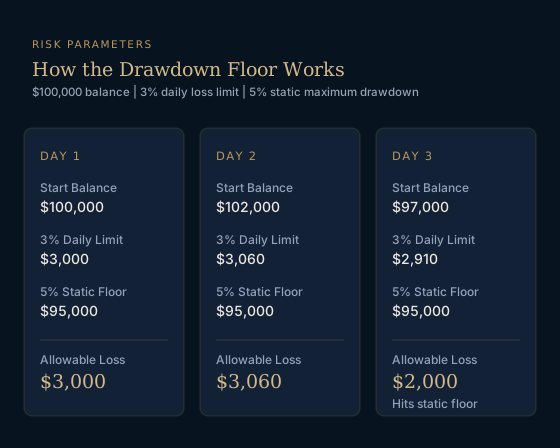
Ordane's maximum drawdown is 5 percent and static: account equity may never fall below 95 percent of the initial balance. The floor is fixed on day one, never trails upward, and a breach closes the account. The daily loss limit is 3 percent, measured against the balance at the start of the server day. A breach closes the account.
Here is a mathematical scenario showing how the 3 percent daily loss limit and 5 percent static maximum drawdown apply to a $100,000 account balance:
| Trading Day | Starting Balance | Daily Loss Limit (3%) | Hard Drawdown Floor (95% of Initial) | Allowable Loss for the Day |
|---|---|---|---|---|
| Day 1 | $100,000 | $3,000 | $95,000 | $3,000 |
| Day 2 | $102,000 | $3,060 | $95,000 | $3,060 |
| Day 3 | $97,000 | $2,910 | $95,000 | $2,000 |
Maximum risk per trade is 1.5 percent of current balance and a stop loss is mandatory at entry. Two maximum losses equal the daily limit, which is the design rather than an accident. Ordane's consistency rule is 20 percent: at the moment of a withdrawal request, no single trading day may account for more than 20 percent of the cycle's total profit. If a day exceeds 20 percent, the excess profit from that day is deferred to the next cycle. It is never confiscated, and the remainder of the cycle pays out normally. Accounts with no trading activity for 30 consecutive days are closed.
Ordane's prohibited practice list is closed. Clause R-6 names six practices: latency, reverse or hedge arbitrage; high frequency or bulk automated exploitation; copy trading between Ordane accounts; straddling news releases with paired opposing orders; platform or data feed exploitation; and gap abuse. If a behavior is not listed in that section, it is not a violation. Discretion is not a rule.
Are Prop Firms Regulated?
Regulatory oversight depends on the jurisdiction and the specific services the firm provides to the public. Regulators monitor the proprietary trading space, requiring firms that provide financial services in their jurisdiction to hold appropriate financial licenses (ASIC Financial Services, retrieved 2026-09-26).
Because most prop firms offer simulated environments rather than acting as brokers holding client deposits, they often operate outside traditional brokerage licensing. Traders worry about firms disappearing overnight with fees and unpaid profits. The defense against this risk is transparency and verifiable reserves.
How Does the Profit Split Work?
The profit split determines how much money the trader takes home after a successful trading cycle.
At Ordane, payouts are paid in real money from company fee revenue. No client deposits are taken and no client capital is traded. Rulebook v1.0 clause PR-1 commits Ordane to publish the payout reserve on-chain; the live rulebook and homepage publish the TRON address. Every withdrawal request is approved, or denied in writing citing the exact rule breached by section number, within 12 clock hours. Past that deadline the request is treated as approved and the G-1 clock starts. A payout approved and not paid within 24 clock hours, not business hours, triggers automatic compensation: a 100 percent refund of the account fee, plus the payout owed in full. This mechanism is called The Ordane Guarantee.
The Ordane Guarantee has two objective exclusions: documented fraud or KYC review, and declared force majeure. Both carry a hard deadline, and beyond it G-1 applies regardless. Both G-2 exclusions (documented fraud or KYC review, and declared force majeure) are capped at 10 business days each. Past that deadline, G-1 applies regardless. KYC happens once, at the first withdrawal request, not at purchase. There is no reverification loop at every payout.
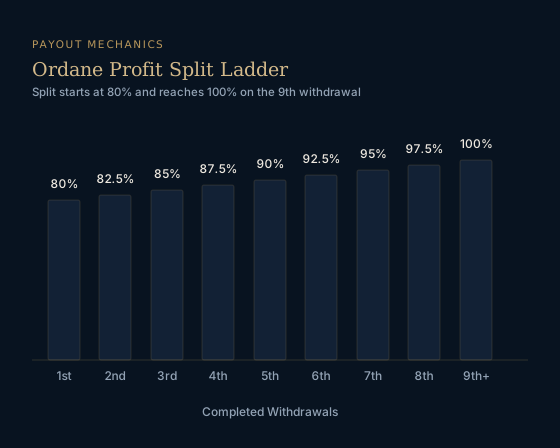
Ordane's profit split starts at 80 percent and rises 2.5 percentage points with every completed withdrawal, reaching 100 percent from the ninth withdrawal onward. The split ladder is in writing and never resets.
| Feature | Ordane (Simulated) | Industry Standard |
|---|---|---|
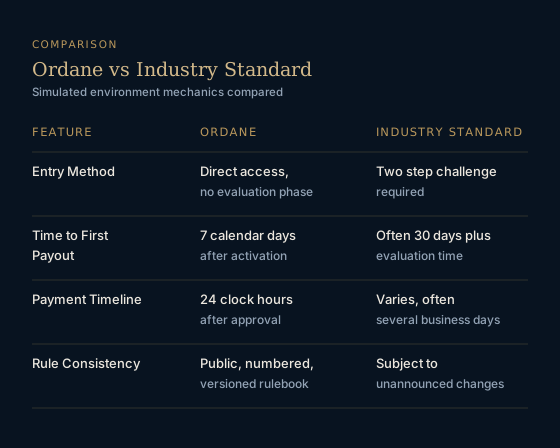
| Entry Method | Direct access, no evaluation phase | Two-step challenge required |
| Time to First Payout | 7 calendar days after activation | Often 30 days plus evaluation time |
| Payment Timeline | 24 clock hours after approval | Varies, often several business days |
| Rule Consistency | Public, numbered, versioned rulebook | Subject to unannounced changes |
FAQ: How Do Prop Firms Work?
This section answers the most common questions traders have about operating within a proprietary trading structure.
How do prop firms work?
A proprietary trading firm gives a trader access to its capital instead of the trader's own money, and the trader keeps an agreed share of the profits generated under the firm's risk rules.
Do I risk my own money?
The only money you risk is the initial fee paid to access the account. You do not deposit trading capital.
What is an evaluation challenge?
An evaluation is a testing phase some firms require before granting access to their capital. Ordane does not use one: the Instant Account gives direct access with no evaluation phase.
Are prop firms regulated?
Regulators monitor the proprietary trading space, requiring firms that provide financial services in their jurisdiction to hold appropriate financial licenses (ASIC Financial Services, retrieved 2026-09-26).
What is the typical profit split?
Profit splits vary by firm and are set out in each firm's own published terms. At Ordane, the split starts at 80 percent and rises with every completed withdrawal, reaching 100 percent from the ninth withdrawal onward.
Sources
- ASIC Financial Services asic.gov.au Retrieved 2026-09-26T00:46:02-03:00.