Home · The Ordane Journal · Before you pay · What Is a Prop Firm? Definition and How It Works
What Is a Prop Firm? Definition and How It Works
What Is a Prop Firm? The Definition in One Paragraph
A prop firm, short for proprietary trading firm, is a business that trades its own capital in the market on its own account, rather than money belonging to outside clients, carrying the risk of those positions and keeping or absorbing the result itself.
That is the original, regulatory sense of the term: a firm buying and selling financial instruments as principal, for its own account, not on behalf of customers (SEC Exchange Act Release No. 34-98202, retrieved 2026-08-28). Ordane accounts operate on simulated capital. No live funds are traded and no deposits are accepted. (Ordane Rulebook v1.0, clause P-2, retrieved 2026-08-28)
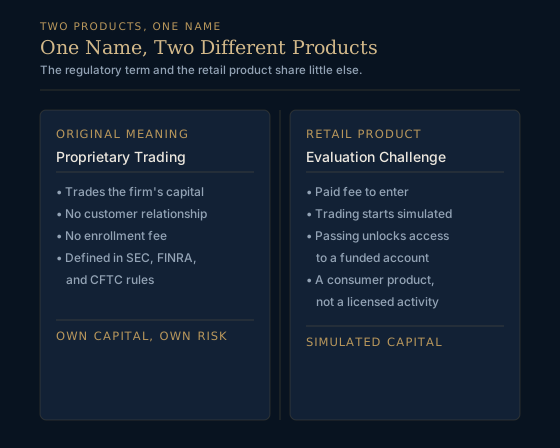
The name has since been borrowed by a second, unrelated product: a paid evaluation, often called a challenge, that starts a participant on simulated capital and only afterward, if the evaluation is passed, gives access to a funded account. The two things share a name and little else. Understanding the difference tells you exactly what you are buying before you pay a fee.
What Did "Prop Firm" Originally Mean?
Trading as Principal for the Firm's Own Account, Not for Customers
In U.S. banking regulation, proprietary trading is defined precisely: a firm acting as principal for its own trading account when it buys or sells financial instruments (12 CFR § 248.3, retrieved 2026-08-28). The same rule narrows what counts as a trading account by purpose, not just by label: an account used mainly for short-term resale, for benefiting from short-term price movements, or for short-term arbitrage profit (12 CFR § 248.3, retrieved 2026-08-28). European law reaches the same idea from a different angle. Under MiFID II, dealing on own account means trading against proprietary capital that results in transactions in financial instruments (MiFID II, Article 4(1)(6), retrieved 2026-08-28). Strip the legal language away and the common thread is simple: it is the firm's money, the firm's risk, and the firm's profit or loss, with no client on the other side of the relationship.
Bank Proprietary Trading Desks
FINRA's own rulebook starts its definition of a proprietary trading firm the same way: the member trades exclusively its own capital (FINRA Regulatory Notice 23-16, retrieved 2026-08-28). On the futures side, the Commodity Futures Trading Commission draws the same line administratively rather than descriptively: the owner or holder of a proprietary account is not treated as a customer under the segregation rules of the Commodity Exchange Act (17 CFR § 1.3, retrieved 2026-08-28). That distinction, house money versus customer money, is the entire regulatory reason the category exists. A desk trading a bank's own balance sheet answers to different rules than a desk executing orders for clients, because nobody else's money is at risk.
Floor Traders and Modern Algorithmic Firms Trading Their Own Capital
The concept predates electronic markets by decades. The Commodity Exchange Act defines a floor trader as a person who, in or around a contract market's pit or ring, buys or sells solely for that person's own account (7 U.S. Code § 1a(23), retrieved 2026-08-28). The CFTC's own glossary describes the same historical role in plainer terms: someone with exchange trading privileges who executed his own trades while physically present in the pit (CFTC Futures Glossary, retrieved 2026-08-28). The rule carving these firms out of standard exchange-membership requirements is not new either. It dates to 1965, when it was numbered Rule 15b8-1 before later becoming Rule 15b9-1 (SEC Exchange Act Release No. 34-98202, retrieved 2026-08-28). What has changed is the method, not the definition. The SEC now describes proprietary trading broker-dealers as firms running significant computer-based or algorithmic trading for their own account across exchange and off-exchange venues, often at very high speed (SEC Exchange Act Release No. 34-98202, retrieved 2026-08-28). Same principal, same own-account structure, a faster execution layer.
Why Is the Prop Firm You See Advertised a Different Product?
A Paid Challenge, Not a Trading Desk Job
The prop firm most readers encounter in an ad or a search result is not a hiring desk at all. Italy's securities regulator, CONSOB, has published a description of exactly this retail model, calling it an operating scheme known variously as shadow investment game, funding trading, or financed trading accounts, in which participants are induced to enter online trading challenges that in most cases require paid enrolment (CONSOB, retrieved 2026-08-28). That is a consumer product with an entry fee, not a job offer, and not the same activity the definitions above describe. A separate piece in this series works through how to verify a prop firm company's legal entity and regulatory status before paying that fee, since the retail model sits outside the licensing regime that governs the original one.
Why the Account Starts Simulated
CONSOB's description continues past the fee itself. In this retail model, trading starts simulated, and passing the evaluation is presented as the moment a participant may switch to supposedly real trading, with capital apparently made available by companies calling themselves proprietary firms (CONSOB, retrieved 2026-08-28). The word "apparently" is the regulator's, not ours, and it matters: whether that post-evaluation capital behaves like a broker's demo account or like something else entirely is a distinction worth reading in detail before assuming either one. A dedicated article in this cluster works through exactly how that simulated capital compares with an ordinary broker demo account.
Do You Pay to Start? What the Fee Actually Buys
In the retail evaluation model, yes: the fee is paid up front, before any trading happens, in exchange for enrollment in the challenge itself (CONSOB, retrieved 2026-08-28). What the fee buys is access to an attempt, not a guaranteed outcome and not employment. A participant who fails the evaluation has still paid the fee. A participant who passes moves to the second stage CONSOB describes, trading on capital the firm says it makes available (CONSOB, retrieved 2026-08-28). That sequence, pay first, attempt second, is the opposite of the original meaning of the term, where the firm's own capital and the firm's own risk were the entire point. Because the fee is the first real commitment a reader makes, a companion article in this series lays out how to audit a specific prop firm before paying, and another totals up the full financial exposure of the evaluation model beyond the initial fee.
Is This the Same Thing as a Bank's Prop Trading Desk?
No, and the regulatory language above and the CONSOB description above are describing two different activities that happen to share a name. Laid side by side:
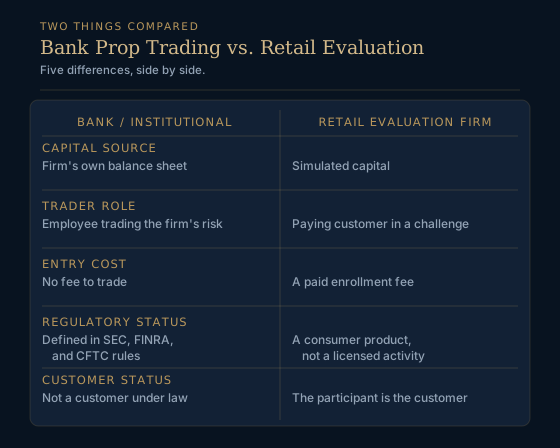
| Dimension | Bank or institutional proprietary trading | Retail evaluation-style "prop firm" |
|---|---|---|
| Whose capital is traded | The firm's own balance sheet (FINRA Regulatory Notice 23-16, retrieved 2026-08-28) | Simulated capital during and typically after the evaluation (CONSOB, retrieved 2026-08-28) |
| Relationship to the trader | The trader is the firm, or an employee of it, trading house risk | The trader is a paying customer entering a challenge (CONSOB, retrieved 2026-08-28) |
| Entry cost | No fee to trade; the firm is deploying its own money | A paid enrollment fee before any trading starts (CONSOB, retrieved 2026-08-28) |
| Regulatory category | Defined and named in banking and securities law, SEC, FINRA, CFTC (12 CFR § 248.3, retrieved 2026-08-28) | Described by a securities regulator as a consumer product, not a licensed trading activity (CONSOB, retrieved 2026-08-28) |
| Customer status | Not a customer relationship under law (17 CFR § 1.3, retrieved 2026-08-28) | The participant is the customer |
Whether a specific retail firm making these claims is legitimate is a separate question from the definition itself, and it deserves its own answer rather than a paragraph here: a dedicated article in this cluster checks the model, the regulators, and the proof against that exact question.
How Big Is Proprietary Trading, and Does It Always Make Money?
Scale of Firms Trading Their Own Capital Off-Exchange
The original activity operates at real scale. Proprietary trading firms that were exchange members but not FINRA members executed roughly $405 billion of off-exchange listed equities volume (SEC Exchange Act Release No. 34-98202, retrieved 2026-08-28). That figure is a snapshot of one month, not a permanent ceiling, and it moves with market conditions. It is cited here to show the order of magnitude at which firms trading only their own money already operate, separate from any retail product using the same name.
Why Even Large Bank Prop Desks Can Lose Money
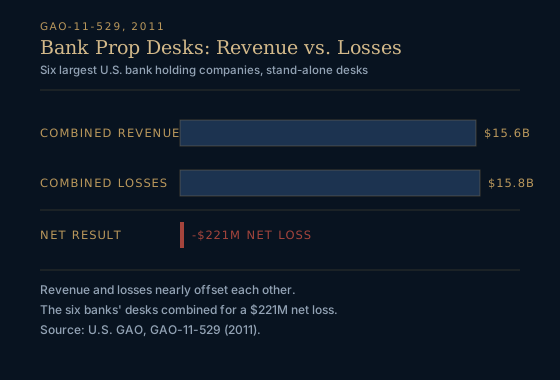
Trading a firm's own capital does not mean the firm always wins. The U.S. Government Accountability Office reviewed the stand-alone proprietary trading desks of the six largest U.S. bank holding companies over a multi-year window.
| Metric, six largest U.S. bank holding companies | Amount |
|---|---|
| Combined revenue, stand-alone proprietary desks | $15.6 billion |
| Combined losses, same desks, same period | $15.8 billion |
| Net result | A combined loss of about $221 million (GAO-11-529, retrieved 2026-08-28) |
Declared inputs for this check: the $15.6 billion in combined revenue and the $15.8 billion in combined losses GAO measured for the same six banks' stand-alone proprietary desks over the period reviewed. Worked arithmetic: 15.6 + 0.2 = 15.8, the gap GAO reports more precisely as the $221 million net loss for those same desks over the same period (GAO-11-529, retrieved 2026-08-28).
The lesson is not that proprietary trading is unprofitable. It is that trading a firm's own capital carries the firm's own risk with no customer fee cushioning the outcome, which is precisely the exposure the retail evaluation model tries to route around by collecting a fee regardless of how the challenge ends.
Frequently Asked Questions
What is a prop firm, in one sentence?
In its original and still legally accurate sense, a prop firm is a business that trades its own capital as principal, for its own account, not on behalf of customers (SEC Exchange Act Release No. 34-98202, retrieved 2026-08-28).
Does "prop firm" legally mean the same thing everywhere?
The core idea, the firm's own capital and its own risk, holds across jurisdictions, but the legal label differs: U.S. rules speak of proprietary trading and a trading account defined by short-term purpose (12 CFR § 248.3, retrieved 2026-08-28), while EU law under MiFID II uses the separate term dealing on own account (MiFID II, Article 4(1)(6), retrieved 2026-08-28). Retail evaluation products borrowing the name are not defined in either framework.
Is the capital in a retail prop firm account real money you can lose?
CONSOB's description of the retail model states that trading starts simulated, with any post-evaluation capital only apparently made available by the firm (CONSOB, retrieved 2026-08-28). Whether that arrangement functions like an ordinary demo account is worth checking directly with the firm in question rather than assumed.
Do you pay before you start trading with a prop firm?
In the retail evaluation model, yes: the regulator describes paid enrollment as the entry point to the challenge itself, before any trading outcome is known (CONSOB, retrieved 2026-08-28).
How is a modern proprietary trading firm different from a retail evaluation firm?
A modern institutional prop firm runs computer-based, algorithmic trading of its own capital across exchange and off-exchange venues (SEC Exchange Act Release No. 34-98202, retrieved 2026-08-28). A retail evaluation firm sells a paid challenge that starts on simulated capital (CONSOB, retrieved 2026-08-28). They share a name and nothing structural beneath it.
Ordane answers that same question about itself in the open: a versioned rulebook, a public payout reserve, and one instant account built on simulated capital from day one. See why Ordane built it this way.
Sources
- Exemption for Certain Exchange Members, Securities Exchange Act Release No. 34-98202 (Aug. 23, 2023) sec.gov Retrieved 2026-08-28.
- 12 CFR § 248.3 - Prohibition on proprietary trading (Legal Information Institute) law.cornell.edu Retrieved 2026-08-28.
- Directive 2014/65/EU on markets in financial instruments (MiFID II), Article 4(1)(6) eur-lex.europa.eu Retrieved 2026-08-28.
- Regulatory Notice 23-16: FINRA Adopts TAF Exemption for Proprietary Trading Firms finra.org Retrieved 2026-08-28.
- 7 U.S. Code § 1a - Definitions, paragraph (23) Floor trader law.cornell.edu Retrieved 2026-08-28.
- Futures Glossary | CFTC cftc.gov Retrieved 2026-08-28.
- 17 CFR § 1.3 - Definitions (Legal Information Institute) law.cornell.edu Retrieved 2026-08-28.
- GAO-11-529, Proprietary Trading: Regulators Will Need More Comprehensive Information to Fully Monitor Compliance with New Restrictions When Implemented gao.gov Retrieved 2026-08-28.
- CONSOB press release, Beware of online trading "video games" (8 July 2024) consob.it Retrieved 2026-08-28.